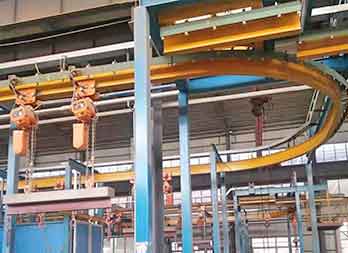
Monorail Bridge Cranes for Sale– Complete Buyer’s Guide & Tips
Discover monorail bridge cranes, top-running and underhung types, capacities, and expert tips to select the right crane for your workshop or warehouse.
Overview of Monorail Bridge Cranes
Monorail bridge cranes are overhead cranes that move along a single girder or track, providing precise and controlled material handling. They are widely used in workshops, assembly lines, warehouses, and maintenance areas where space is limited.
Single girder monorail overhead crane 1 ton to 20 ton, top running type-
Monorail bridge cranes come in different mounting types:
- Top-running monorail bridge cranes – The crane travels on rails mounted on the top of runway beams. Suitable for heavy loads and higher lifting capacities.
- Underhung monorail bridge cranes – The crane hangs from rails attached to the ceiling or overhead structure. Ideal for light- to medium-duty loads and limited floor space.
Typical components include:
- Single girder supporting the trolley and hoist
- Hoisting mechanism for lifting and lowering loads
- Trolley system (manual or motorized)
- End trucks for movement along the runway
Their simple structure makes installation easier and reduces overall costs compared to double girder cranes.
Key Benefits for Industrial Material Handling
Monorail bridge cranes provide smooth, reliable, and efficient lifting along a fixed path, which helps improve workflow and reduce manual labor.
Benefits include:
- Efficient handling of medium-weight loads (0.5–20 tons)
- Flexible integration into workshops, warehouses, or production lines
- Less floor space needed compared to forklifts or gantry cranes
- Lower installation and maintenance costs
- Stable operation that minimizes material damage
Who Should Consider a Monorail Bridge Crane
Monorail cranes are ideal where full-sized double girder cranes are unnecessary or space is constrained. They are especially useful in:
- Workshops or warehouses with limited floor space
- Light- to medium-duty lifting tasks
- Production or assembly lines requiring repetitive, straight-line movement
- Maintenance areas needing quick access to equipment or parts
In short, if your operation requires reliable lifting along a single path, with options for top-running or underhung installation, a monorail bridge crane is a practical and cost-effective choice.
What is a Monorail Bridge Crane?
Single Girder Design and Trolley System
A monorail bridge crane uses a single girder to support a hoist and trolley, which moves along the girder to lift and transport materials. The design is simple but highly effective, allowing smooth and precise movement along a straight path.
Key points:
- The trolley can be manual, motorized, or electric, depending on load requirements.
- The hoist is mounted on the trolley to lift loads vertically.
- The single girder can be mounted as top-running (on runway beams) or underhung (suspended from the ceiling or structure).
- This setup reduces weight, simplifies installation, and lowers maintenance costs compared to more complex cranes.
Comparison with Double Girder Overhead Cranes
While both monorail and double girder cranes handle overhead lifting, there are practical differences:
- Structure: Monorail cranes have one girder; double girder cranes have two, making them heavier and more rigid.
- Capacity: Monorail cranes usually handle light to medium loads (up to 20 tons), whereas double girder cranes handle heavier loads.
- Installation & Cost: Monorail cranes are easier to install and cost less, making them ideal for smaller workshops or limited spaces.
- Space Usage: Monorail cranes require less vertical and floor space, especially underhung versions.
In short, monorail cranes are a simpler, lighter, and more economical option when heavy-duty lifting is not needed.
Typical Applications and Industries
Monorail bridge cranes are widely used in industries where controlled, straight-line lifting is required:
- Workshops and manufacturing plants: Moving parts, assemblies, and machinery components along production lines.
- Warehouses and logistics centers: Transporting pallets, crates, or medium-weight goods.
- Maintenance and repair areas: Lifting equipment, engines, or machine parts safely and efficiently.
- Specialized industries: Automotive, plastics, metal fabrication, and small steel processing facilities.
Monorail cranes are especially useful where space is limited, frequent lifting is required, and operations need a cost-effective, reliable solution.
Technical Specifications
Lifting Capacity (1–20 Tons)
Monorail bridge cranes are designed to handle light- to medium-duty loads, typically ranging from 1 to 20 tons. Choosing the correct capacity is crucial to ensure safe and efficient operation. Overestimating may increase costs unnecessarily, while underestimating can lead to equipment strain and safety risks.
Key points:
- Select capacity based on the heaviest expected load plus a safety margin (usually 10–20%).
- Consider whether loads will be single items or bundles, as this affects hoist selection.
- Verify that the chosen crane can handle frequent lifts if your operation is high-usage.
Span and Lift Height Considerations
The span and lift height determine how far and how high a monorail crane can operate. Proper planning ensures smooth workflow and avoids operational bottlenecks.
- Span: Distance between runway rails; common spans range from 5 to 20 meters in smaller workshops.
- Lift Height: Maximum vertical distance the hoist can raise a load; must accommodate the tallest item plus clearance.
- Factor in building height, overhead obstacles, and runway structure when planning installation.
- Top-running cranes may allow slightly higher capacities and spans, while underhung cranes are limited by ceiling height.
Duty Classification and Service Factors
Duty classification indicates how frequently and intensively the crane will be used. Understanding this helps choose the right components to prevent premature wear.
- Light Duty (Class A–B): Occasional lifting, low operational frequency.
- Medium Duty (Class C–D): Regular lifting with moderate frequency.
- Heavy Duty (Class E–F): Frequent lifts, heavier loads, often in industrial production lines.
- Ensure the crane’s service factor matches operating conditions, load types, and cycles per hour.
Trolley Types (Manual, Motorized, Electric)
The trolley carries the hoist along the girder. Selecting the correct type affects efficiency, cost, and workflow.
- Manual Trolley: Simple and low-cost; suitable for light loads and occasional use.
- Motorized Trolley: Moves automatically along the girder; ideal for medium-duty operations and repetitive lifting.
- Electric Trolley: Offers precise control, higher speed, and better efficiency for frequent operations or heavier loads.
- Consider workspace layout, load weight, and operator convenience when choosing trolley type.
Applications & Use Cases
Monorail bridge cranes are designed to make material handling simpler and more efficient in environments where loads need to move along a fixed path. Their versatility, combined with compact design options, allows them to fit into a variety of industrial setups without occupying too much floor space.
Typical applications include:
- Automotive assembly lines: Moving engines, parts, and sub-assemblies along production lines with precise placement.
- Warehouses and logistics centers: Transporting pallets, crates, or medium-weight goods quickly and safely across storage areas.
- Light- to medium-duty workshops: Lifting machinery components, metal parts, or tools in fabrication and maintenance areas.
- Case study examples with measurable benefits: For instance, a 5-ton underhung monorail crane in a metal workshop reduced manual lifting by 70%, improved workflow speed, and minimized workplace injuries.
These use cases show that monorail cranes can improve efficiency and safety in operations that involve repetitive lifting along a single, linear path. They are particularly effective where traditional mobile cranes or forklifts would be cumbersome or inefficient. By choosing the right configuration—top-running or underhung—businesses can tailor the crane to their workspace and lifting requirements.
Pre-Purchase Considerations
Before investing in a monorail bridge crane, it’s important to carefully evaluate your workshop or facility’s specific needs. A well-planned purchase ensures safety, efficiency, and long-term reliability while avoiding unnecessary costs.
Key considerations include:
- Load requirements and frequency of use: Determine the heaviest load you’ll lift and how often the crane will operate. This ensures you select the correct capacity and duty classification to prevent overloading or excessive wear.
- Available space and runway conditions: Measure the available span, lift height, and ceiling clearance. Consider the type of mounting—top-running or underhung—to ensure smooth operation without interfering with other equipment.
- Environmental factors (indoor/outdoor, temperature, humidity): Cranes in outdoor or harsh environments may require protective coatings, weatherproof hoists, or special lubrication. Indoor cranes may have more flexibility but still need adequate ventilation and space.
- Safety compliance (CE, ISO, OSHA): Ensure the crane meets relevant safety standards. Compliance with international regulations protects workers and guarantees that your investment meets legal and insurance requirements.
Taking the time to evaluate these factors upfront helps you choose the right monorail crane for your operation. Proper planning minimizes installation issues, reduces downtime, and ensures smooth, safe lifting for years to come.
Installation & Maintenance Tips
Proper installation and maintenance are crucial for monorail bridge cranes to operate safely and reliably over the long term. Skipping these steps can lead to downtime, equipment damage, or safety hazards.
Key points to consider:
- Runway preparation and structural considerations: Ensure runway beams are level, securely anchored, and capable of supporting the crane’s weight and maximum load. Check that the building structure can handle top-running or underhung configurations.
- Routine inspection and maintenance schedules: Regularly inspect hoists, trolleys, end trucks, and girder components. Lubricate moving parts, check for wear, and replace damaged components before they cause failure.
- Common pitfalls and how to avoid them: Avoid overloading the crane, neglecting safety inspections, or operating at excessive speeds. Train operators properly and maintain a clear lifting path to prevent accidents and material damage.
Following these installation and maintenance practices will extend the life of your crane, improve safety, and reduce unplanned downtime.
Cost-Saving & Efficiency Strategies
Selecting the right crane design and setup can significantly impact operational efficiency and overall costs. Thoughtful choices upfront save money and improve workflow.
Strategies to consider:
- Monorail vs. other crane types: Monorail cranes are typically lighter and simpler than double girder or gantry cranes, making them more cost-effective for light- to medium-duty applications. Choose the crane type that matches your actual load and usage requirements to avoid overspending.
- Modular designs for easier expansion: Modular cranes can be adapted or extended as your operation grows. This flexibility reduces the need for full replacements and allows for future workflow adjustments.
- Optimizing trolley and hoist selection: Choose the right trolley type (manual, motorized, electric) and hoist capacity based on load weight, frequency, and operating speed. Proper matching increases efficiency, reduces wear, and improves safety.
Implementing these strategies ensures you get the most value from your monorail bridge crane while maintaining smooth, efficient operations.
Future-Proofing Your Crane Investment
Investing in a monorail bridge crane is not just about meeting today’s needs—it’s also about preparing for future changes in your operation. Choosing flexible and upgradable options can save money and prevent disruptions down the line.
Consider these approaches:
- Upgrade options (smart controls, remote operation, IoT monitoring): Modern crane systems can include features such as programmable hoist movements, remote control operation, and IoT sensors for real-time monitoring. These upgrades improve efficiency, reduce human error, and allow proactive maintenance.
- Adapting cranes for changing workflows or heavier loads: Modular crane designs and adjustable runways make it possible to extend spans, increase lifting height, or accommodate heavier loads as your facility grows. Planning for expansion upfront avoids costly modifications later.
By future-proofing your crane investment, you ensure that your equipment continues to meet operational demands safely and efficiently for many years.
Conclusion
Choosing the right monorail bridge crane requires careful consideration of capacity, space, mounting type, and operational needs. A well-selected crane enhances workflow efficiency, improves safety, and reduces long-term costs.
Key takeaways:
- Assess load requirements, frequency, and workspace constraints before purchase
- Select the appropriate mounting type—top-running or underhung—for your facility
- Prioritize proper installation, regular maintenance, and safety compliance
- Consider modular and upgradeable options to future-proof your investment
For tailored solutions, request a quote or consultation with crane specialists. They can help determine the best monorail bridge crane configuration for your facility, ensuring reliable performance and maximum efficiency.