Multi-Crane Solutions for Turbine Halls: 50–300 Ton Buyer Guide
Multi-Crane Solutions in Turbine Halls: Buyer Guide for 50–300 Ton Cranes
Most Important Takeaway
Investing in the right multi-crane solution for turbine halls is not just about capacity — it’s about coordinated crane systems, site integration, and long-term operational efficiency. For 50–300 ton cranes, buyers must evaluate tandem operation capability, structural readiness, and total cost of ownership to ensure safe, efficient, and reliable heavy lifting in power generation environments.
- Multi-crane setups are essential for turbine halls handling heavy rotating machinery, generators, and heat exchangers.
- Tandem crane operation and collision avoidance systems increase safety and productivity for 50–300 ton loads.
- Early site and structural assessment ensures crane runways and building support meet heavy lifting demands.
- European-design vs. conventional cranes: consider precision, efficiency, and lifecycle cost for high-value turbine hall applications.
- Safety standards (CMAA, FEM, ISO, ASME) and operator ergonomics are critical for high-capacity crane operations.
- Supplier evaluation should focus on experience, certifications, customization capabilities, and after-sales service.
- Long-term maintenance planning and spare parts strategy reduce downtime and operational costs.
Introduction
Overhead cranes in turbine halls are far more than simple lifting devices—they're the backbone of heavy equipment handling in power plants and industrial facilities. When moving components weighing 50–300 tons, such as generator rotors or large heat exchangers, precision and safety are critical. This guide helps buyers, engineers, and facility managers plan and implement multi-crane solutions in turbine halls, covering everything from technical specifications to site preparation and operational planning.
The goal is simple: provide practical guidance so you can select the right cranes, reduce operational risks, and optimize long-term performance.
Before diving into technical details, it's helpful to understand what this guide covers and why it's relevant:
- Focuses on turbine hall applications in power generation and heavy industry.
- Covers 50–300 ton overhead cranes and multi-crane operations.
- Offers practical advice on structural readiness, crane selection, and system integration.
Understanding who benefits from this guide can help you focus on the sections most relevant to your role:
- Facility managers overseeing turbine hall operations.
- Procurement teams responsible for heavy lifting equipment.
- Engineers planning installation, maintenance, or upgrades for crane systems.
Handling massive equipment in a turbine hall comes with unique difficulties. These are the challenges you need to plan for:
- Limited headroom and tight spaces restricting crane movement.
- High-capacity lifts requiring precise positioning and control.
- Coordinating multiple cranes working together safely in the same space.
Understanding Multi-Crane Needs
Planning a multi-crane system goes beyond simply specifying a crane capacity. You need to understand the types of equipment you'll be moving, how heavy it is, and whether multiple cranes must operate together. This ensures both safety and efficiency in your turbine hall operations.
Different types of equipment require different crane strategies. Here's what multi-crane systems usually handle:
- Generator rotor installation and replacement: These rotors can weigh hundreds of tons and require tandem lifts for safe handling.
- Heat exchangers and turbine casings: Bulky, sensitive components that demand precise alignment during installation.
- Heavy valves and piping assemblies: Often moved multiple times during construction or maintenance.
- Auxiliary equipment: Pumps, transformers, and control modules that need heavy-lift capacity for placement.
Choosing the right crane capacity is critical. Here's what buyers need to consider:
- Most turbine hall cranes range from 50 to 300 tons.
- Include a safety margin of 10–25% above the maximum component weight to accommodate unexpected variances.
- Some facilities require overlapping capacities between cranes to handle tandem or sequential lifts safely.
It's not just about lifting heavy objects—how cranes operate matters just as much. Consider these points:
- Redundancy: Having more than one crane ensures operations continue if one is under maintenance.
- Simultaneous lifts: Large components may require two cranes lifting together. Coordination and synchronization are essential.
- Precision placement: Components like turbine rotors and heat exchangers need millimeter-level accuracy. Smooth controls, proper travel paths, and speed settings all influence placement quality.
Planning ahead saves time, money, and reduces risk. Keep these in mind when selecting cranes:
- Confirm maximum component weight and dimensions before specifying crane capacity.
- Determine if tandem operation is necessary or if single-crane lifts suffice.
- Consider future maintenance needs: cranes should handle replacements or upgrades without requiring new equipment.
- Evaluate the crane control system: smooth, precise movement reduces the risk of damage to expensive equipment.
Crane Configurations for Turbine Halls
Selecting the right crane configuration is crucial for turbine hall operations. The choice directly affects efficiency, safety, and the ability to handle heavy components like generator rotors, heat exchangers, and large valves. Each hall has unique constraints—such as ceiling height, span, obstructions, and floor load limits—that determine the optimal setup.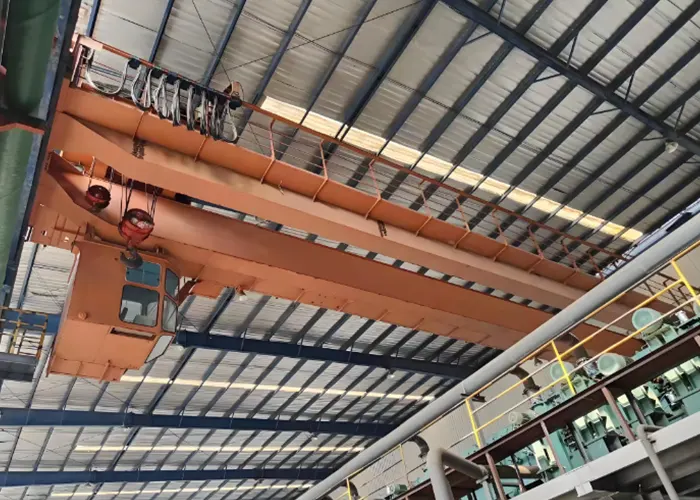
A key decision is whether to rely on a single crane or implement multiple cranes. Single-crane setups are often sufficient for smaller turbine halls or when the load remains within a single crane's capacity. They are simpler to maintain and operate but offer limited flexibility for heavy or oversized components.
Multi-crane setups are necessary when dealing with components exceeding a single crane's capacity or when simultaneous lifts are required. Multi-crane configurations allow redundancy—so operations can continue if one crane is under maintenance—and enable complex lifts, but they require careful planning to prevent collisions and ensure smooth coordination.
Overhead bridge cranes are the most common choice in turbine halls because of their span coverage, lifting capacity, and precision control. They come in two main types:
- Single-girder cranes: Best suited for lighter loads or halls with low headroom. They are cost-effective, easier to install, and simpler to maintain.
- Double-girder cranes: Ideal for heavier loads, longer spans, and taller lift heights. They provide better stability and load distribution, making them the preferred choice for heavy turbine components in the 50–300 ton range.
While overhead cranes handle most heavy lifting, other types of cranes can complement them for specialized tasks. Gantry cranes are useful in areas without permanent overhead support or where mobility is required. They can be moved to different positions within the hall as needed. Jib cranes excel at localized lifting tasks, such as installing auxiliary equipment or performing maintenance in areas beyond the main crane's reach.
Some components in turbine halls are too heavy or long for a single crane. Tandem lifting systems, where two cranes lift the same load simultaneously, ensure safety and precision. These operations require synchronized movement, advanced controls, and safety interlocks. Similarly, multi-trolley arrangements—where multiple trolleys operate on the same bridge—allow large components to be lifted evenly, reducing stress on individual trolleys and improving control over the load.
When deciding on crane configurations, keep these practical points in mind:
- Check the hall's span, headroom, and floor capacity before finalizing a crane type.
- Determine whether tandem operation or multi-trolley systems are necessary for the heaviest lifts.
- Ensure the layout allows safe simultaneous operation of multiple cranes if needed.
- Factor in maintenance access and long-term serviceability when selecting the configuration.
Technical Specifications for Buyers
Selecting the right cranes for a turbine hall isn't just about capacity—it's about ensuring the crane meets all operational, safety, and site requirements. A mismatch in specifications can lead to downtime, costly modifications, or even safety incidents. Buyers should carefully evaluate rated loads, spans, speeds, and controls before making a decision.
The first step is understanding the weight of the heaviest components the crane will handle. Rated load capacity should always include a safety margin of 10–25% above the maximum expected load. This accounts for load fluctuations, unexpected weight variances, and dynamic forces during lifting.
- Confirm the maximum weight of generators, rotors, heat exchangers, and other components.
- Factor in the safety margin when comparing crane options.
- Ensure the crane's structural components, hoist, and trolley are all rated for this enhanced load.
The crane must physically fit within the turbine hall and reach all required points. Span, lifting height, and runway design are critical. Even a perfectly rated crane can fail operationally if the runway or headroom is insufficient.
- Measure the full width (span) between runway rails to ensure crane bridges cover the operational area.
- Determine lifting height requirements, considering ceiling clearance and component placement needs.
- Evaluate runway strength and alignment: beams must support crane weight plus lifted load without deflection.
Cranes in turbine halls may be used frequently or intermittently. Understanding the duty class and operational profile is essential to selecting the right design.
- Duty class indicates the crane's ability to handle repetitive loads over time.
- Determine operational frequency: continuous use versus occasional lifts.
- Review hoist and travel speeds: faster speeds reduce cycle time but may require more precise control systems.
A crane's electrical design must match the turbine hall's available power. Additionally, control systems affect both precision and safety.
- Check voltage, phase, and frequency compatibility with local power supply.
- Select a control system that suits the operation: pendant controls, radio remote, or fully automated PLC integration.
- Consider dual control modes for complex lifts or tandem operations.
Finally, verify that cranes will move freely without obstruction. Even minor interference can prevent lifts, cause collisions, or damage components.
- Check clearance along the runway, under beams, and around columns or equipment.
- Ensure headroom allows full lift height without obstruction.
- Plan for temporary interference from scaffolding, auxiliary equipment, or maintenance platforms.
- Document all component dimensions and maximum weights before specifying the crane.
- Always consult structural engineers to verify runway and building support.
- Match the crane's control system to your operational needs—precision is critical for turbine hall lifts.
- Include sufficient safety margins for both load capacity and structural design.
Multi-Crane Coordination
When multiple cranes operate in the same turbine hall, coordination becomes just as important as the crane specifications themselves. Improper synchronization can cause collisions, uneven load distribution, or even serious accidents. Multi-crane systems allow for heavy or oversized components to be lifted safely, but only if the cranes are properly integrated and controlled.
Some turbine hall components are too heavy or long to be lifted by a single crane. In these cases, tandem operation—where two cranes lift a load together—is necessary.
- Tandem lifts require precise synchronization of hoists and trolley movements to ensure the load is evenly distributed.
- Load-sharing calculations must consider the weight of the component and dynamic forces during movement.
- Operators should be trained in tandem lifting procedures, or the system should include automated coordination for critical lifts.
With multiple cranes operating in close proximity, safety is a top concern. Modern cranes often include collision avoidance systems and safety interlocks.
- Sensors and software can prevent cranes from moving into each other's path.
- Interlocks can stop a crane automatically if a potential collision is detected.
- Regular inspection and testing of these systems is essential to maintain safe operation.
For high-precision lifts, multi-crane systems often need to integrate with a plant's existing automation. Connecting cranes to DCS, PLC, or other facility control systems enhances coordination and operational efficiency.
- Integration allows for centralized control of multiple cranes, reducing human error.
- Automated sequences can control tandem lifts, speed adjustments, and load positioning.
- Facility integration supports data collection for maintenance planning and operational reporting.
- Verify that cranes can operate in tandem if required by load weights or component dimensions.
- Check that collision avoidance systems and interlocks meet your safety standards.
- Plan for integration with existing automation and control systems to improve efficiency.
- Include operator training or automation features to ensure precise, safe multi-crane coordination.
Safety Standards & Compliance
Safety is the foundation of any turbine hall crane operation. When handling components weighing 50–300 tons, even small mistakes can lead to equipment damage, costly downtime, or injuries. Understanding and following proper standards, designing fail-safe systems, and planning lifts carefully are essential for reliable operation.
Overhead cranes must meet recognized industry standards to ensure they are safe, reliable, and suitable for heavy-duty use. Compliance with these standards also helps buyers demonstrate due diligence in procurement.
- CMAA (Crane Manufacturers Association of America): Covers design, load ratings, and maintenance practices for overhead cranes.
- FEM (European Federation of Materials Handling): Provides guidelines for lifting equipment, duty cycles, and safety factors.
- ISO Standards: Include requirements for hoist design, electrical safety, and operator interfaces.
- ASME Standards: Focus on mechanical integrity, emergency stops, and safety devices.
Even the best crane can fail if safety features and human factors are ignored. A well-designed crane includes emergency systems and considers the operator's needs.
- Emergency stop buttons must be easily accessible and responsive under all operating conditions.
- Fail-safe mechanisms, such as overload protection and brake systems, prevent accidents in case of power failure or mechanical fault.
- Ergonomically designed controls reduce operator fatigue, improve precision, and lower the risk of mistakes during critical lifts.
Before any lift, a detailed risk assessment should be conducted. This ensures all potential hazards are identified and mitigated, particularly in turbine halls with multiple cranes and tight spaces.
- Assess the weight, size, and center of gravity of each load.
- Plan lift paths to avoid collisions with structures, other cranes, and personnel.
- Determine appropriate lifting speed, hook height, and crane spacing for safe operation.
- Document lift plans and communicate them clearly to all operators involved.
- Always verify that the crane design meets CMAA, FEM, ISO, or ASME standards for your region.
- Confirm that emergency stops and fail-safe systems are installed and functional.
- Conduct detailed lift planning and risk assessments before commissioning multi-crane operations.
- Include operator training and clear procedural documentation as part of safety compliance.
Site & Structural Considerations
Before installing a crane in a turbine hall, it's crucial to assess the site and structural conditions. Even the best cranes will underperform—or become unsafe—if the runway, building structure, or foundation cannot support heavy loads. Careful planning at this stage saves time, prevents costly modifications, and ensures long-term safety.
The runway beams carry not only the crane itself but also the full weight of the lifted load. Designing them correctly is critical for safe operations.
- Runway beams must be sized to handle the combined weight of the crane and maximum load, plus a safety margin.
- Load distribution should ensure that concentrated forces do not exceed the floor or support structure's capacity.
- Inspect existing floors and foundations to verify that they can support crane loads without deflection, settlement, or cracking.
Many turbine halls were not originally designed for 50–300 ton cranes. Civil or structural upgrades may be required to safely accommodate heavy lifting.
- Reinforce existing beams, columns, or foundations if load calculations exceed original design limits.
- Upgrade runway rails and anchor points to support dynamic forces during crane operation.
- Consider overhead clearances and hall modifications to allow safe crane travel and load positioning.
Environmental factors can affect crane performance and safety. Seismic activity, temperature extremes, and humidity must be considered during design and installation.
- In seismic zones, cranes and runways should be designed to withstand earthquake forces, including lateral movement and dynamic loads.
- Temperature and humidity affect steel expansion, lubrication, and electrical systems; plan for these conditions in crane design.
- Dust, moisture, or corrosive atmospheres may require protective coatings, sealed electrical components, or specialized hoist systems.
- Conduct a full structural assessment before specifying crane types or capacities.
- Include civil or structural upgrades in the initial project budget if required.
- Plan for environmental factors—especially seismic, temperature, and humidity—to avoid unexpected downtime or damage.
- Coordinate with structural engineers and crane suppliers to ensure all modifications meet operational and safety requirements.
Supplier Evaluation & Selection Criteria
Choosing the right crane supplier is just as important as selecting the cranes themselves. A crane may meet all technical specifications on paper, but without a supplier who understands turbine hall operations and heavy-lift requirements, your project can face delays, cost overruns, or maintenance issues. Buyers should evaluate suppliers based on experience, certifications, custom capabilities, and after-sales support.
Not all crane manufacturers are equipped to handle heavy-duty turbine hall projects. Certifications and proven experience are critical indicators of reliability.
- Ensure the manufacturer has relevant quality certifications, such as ISO 9001 for quality management or CE marking for compliance with European standards.
- Look for experience with 50–300 ton cranes in turbine halls, including similar spans, load profiles, and multi-crane setups.
- Check references or case studies to confirm successful past projects with comparable requirements.
Turbine halls often require specialized crane configurations. A supplier must have the engineering capability to customize designs and integrate multiple cranes safely.
- Confirm the supplier can provide tandem lifting solutions, multi-trolley systems, and synchronization controls.
- Evaluate their ability to handle complex layouts, including limited headroom, long spans, or obstructions.
- Ask about design flexibility for future upgrades or additional cranes, ensuring the system can evolve as operational needs change.
Even the best cranes need maintenance. Reliable after-sales support minimizes downtime and keeps operations running smoothly.
- Check that spare parts are readily available and that delivery times meet operational needs.
- Confirm the supplier offers warranty coverage that includes both mechanical and electrical components.
- Evaluate the quality of technical support, including on-site service, remote troubleshooting, and training programs for operators and maintenance staff.
- Prioritize suppliers with proven experience in turbine hall cranes of 50–300 tons.
- Ensure the manufacturer can provide custom engineering and multi-crane coordination solutions.
- Verify the availability of spare parts, warranty terms, and after-sales service before committing.
- Consider long-term collaboration; a responsive supplier can prevent operational delays and reduce total cost of ownership.
Cost & Total Cost of Ownership
When planning a turbine hall crane project, it's easy to focus on the initial purchase price. But the reality is that the total cost of ownership (TCO) over the life of the crane often far exceeds the upfront equipment cost. Buyers should consider not only the crane hardware but also design, installation, operating costs, and long-term maintenance.
The first step in budgeting is understanding what contributes to the initial investment. A detailed cost breakdown helps prevent surprises later.
- Crane hardware: Includes bridge girders, hoists, trolleys, motors, controls, and structural components.
- Engineering and design: Custom layouts, multi-crane synchronization, and site-specific modifications.
- Installation and commissioning: Labor, rigging, testing, and adjustments required to make the system operational.
After installation, cranes continue to incur costs for energy, maintenance, and potential downtime. Planning for these costs upfront can significantly reduce operational surprises.
- Energy consumption: High-capacity cranes require substantial power. Optimized designs can reduce energy use and operating costs.
- Maintenance: Preventive maintenance, inspections, and part replacements are ongoing expenses that impact downtime.
- Downtime: Operational interruptions during maintenance or unexpected failures can be costly, especially in turbine hall environments where equipment installation schedules are critical.
Evaluating the crane's total cost over its expected service life is essential for high-value turbine hall applications. Focusing only on initial purchase price can be misleading.
- Consider durability and reliability of crane components to reduce replacement frequency.
- Factor in energy efficiency, ease of maintenance, and parts availability when comparing suppliers.
- Include potential future upgrades or expansions, ensuring the system remains cost-effective over decades.
- Break down costs into initial, operating, and lifecycle components before finalizing budgets.
- Ask suppliers for energy consumption data and maintenance schedules to estimate operating costs.
- Factor in potential downtime and replacement parts when calculating total cost of ownership.
- Choosing a slightly higher initial investment for a more durable, efficient crane can reduce overall lifecycle costs significantly.
Commissioning & Delivery
Commissioning and delivery are the final steps before a turbine hall crane becomes fully operational. Even with the best design and installation, improper commissioning can lead to safety issues, reduced performance, or costly delays. Proper planning ensures that the crane operates as intended from day one.
Before the crane arrives, the turbine hall and supporting structures must be ready. Preparing the site in advance reduces installation time and prevents unexpected issues.
- Verify that runway beams, columns, and foundations meet load requirements.
- Ensure adequate clearances, headroom, and travel paths for the crane and loads.
- Check electrical supply, grounding, and power connections for compatibility with crane systems.
- Confirm that lifting equipment, scaffolding, and access platforms are in place for installation teams.
Before shipment, it's important to confirm that the crane meets specifications and is ready for operation. Factory tests provide this assurance.
- FAT involves testing the crane's mechanical, electrical, and control systems in the factory environment.
- Proof load tests simulate maximum expected loads to verify structural integrity, hoist performance, and safety systems.
- Test reports and certificates should be provided and reviewed before shipment.
Once the crane arrives, careful installation and testing are critical. A structured approach ensures the system is safe, reliable, and fully documented for future reference.
- Assemble crane components according to manufacturer specifications, ensuring proper alignment of runways and bridge girders.
- Conduct on-site load tests, including lifting maximum expected weights and performing operational cycles.
- Verify all control systems, safety devices, and interlocks are fully functional.
- Complete installation documentation, including as-built drawings, test reports, and operator manuals, for handover to the facility team.
- Prepare the site thoroughly before crane delivery to prevent delays.
- Insist on FAT and proof load tests for all cranes, especially heavy 50–300 ton models.
- Ensure on-site testing includes all safety systems and operational cycles.
- Keep full documentation for future maintenance, inspections, and compliance audits.
Maintenance & Service Planning
Proper maintenance is essential to keep turbine hall cranes operating safely and efficiently over their lifespan. Heavy-duty cranes handling 50–300 ton loads require regular attention, not just for mechanical reliability, but also to prevent costly downtime and ensure operational safety. Planning maintenance from the start can save significant time and expense over the crane's lifecycle.
Regular inspections and planned maintenance help prevent unexpected failures. Predictive maintenance can also anticipate issues before they become critical, using data and monitoring tools.
- Establish a preventive maintenance schedule covering hoists, motors, brakes, controls, and structural components.
- Use predictive maintenance tools such as vibration analysis, thermal imaging, and motor current monitoring to detect early signs of wear.
- Document all maintenance activities to track component life and plan future service.
Downtime can be costly in turbine halls. Ensuring that spare parts are available and that emergency service is accessible is crucial.
- Keep a list of critical spare parts including hoist components, motors, and electrical control devices.
- Confirm that suppliers or local service partners can provide rapid delivery of parts and technical support.
- Include an emergency service plan to respond quickly in case of unplanned breakdowns.
Modern cranes can leverage technology to reduce maintenance costs and improve reliability. Remote monitoring and condition-based maintenance allow operators to detect issues without interrupting operations.
- Implement sensors to monitor load, motor health, and mechanical stress in real time.
- Use data to schedule maintenance based on actual equipment condition, rather than fixed intervals.
- Remote monitoring can alert operators to potential problems, helping avoid downtime and costly repairs.
- Develop a comprehensive maintenance plan before crane installation.
- Stock critical spare parts and establish relationships with reliable service providers.
- Consider condition-based monitoring systems for high-value, heavy-duty cranes.
- Document all inspections and maintenance for compliance and lifecycle planning.
Case Studies
Real-world examples help illustrate how multi-crane solutions perform in turbine halls and highlight considerations that may not be obvious during planning. These case studies show how proper crane selection, coordination, and planning ensure safe and efficient operations.
In a mid-sized turbine hall, two 100-ton overhead bridge cranes were used to lift and install a generator weighing 180 tons. The hall had limited headroom and a span of 28 meters.
- The cranes were configured for tandem operation, lifting the generator together to distribute the load evenly.
- Precise synchronization and load monitoring ensured that the generator remained level during the lift.
- Installation required careful runway alignment and minor structural reinforcement to handle combined crane loads.
- Tandem operation is critical for heavy but elongated components.
- Proper synchronization and safety monitoring prevent tilting and stress on crane structures.
- Minor structural upgrades can avoid major delays or hazards.
A power plant required a turbine rotor replacement using two 250-ton cranes. The rotor weighed approximately 480 tons and had a long, cylindrical profile.
- Cranes were equipped with advanced multi-crane control systems to ensure simultaneous movement.
- Collision avoidance sensors and emergency stop interlocks were tested prior to lifting.
- Lift planning included a detailed risk assessment, confirming clearances and precise alignment with the turbine housing.
- High-capacity tandem lifts require robust control systems and thorough risk assessments.
- Collision avoidance and fail-safe mechanisms are essential for safety.
- Detailed planning and coordination prevent operational delays and equipment damage.
- Always evaluate load distribution and consider tandem lifts for large or heavy components.
- Invest in advanced synchronization and safety systems for multi-crane operations.
- Plan structural upgrades and site preparation in advance to avoid last-minute modifications.
- Conduct risk assessments and lift simulations to identify potential hazards before actual operations.
Conclusion
Selecting the right multi-crane solution for a turbine hall is more than just choosing the heaviest crane. It’s a strategic decision that balances load capacity, operational safety, site and structural readiness, and long-term efficiency.
By carefully evaluating crane specifications, planning for site preparation and structural support, assessing supplier experience and certifications, and implementing maintenance and safety programs, buyers can ensure that heavy lifting operations run smoothly and reliably.
Well-planned multi-crane systems not only reduce the risk of accidents and equipment damage but also optimize workflow, minimize downtime, and lower total cost of ownership over the crane’s lifecycle. Investing the time and effort upfront translates into safe, efficient, and cost-effective turbine hall operations for decades.
Key Takeaways:
- Multi-crane planning ensures safe handling of 50–300 ton components.
- Proper site and structural assessments prevent costly modifications or failures.
- Supplier selection and certifications are critical for successful project delivery.
- Preventive maintenance, risk assessment, and operational planning reduce downtime and extend equipment life.
- Detailed lift planning and modern control systems enhance safety, precision, and efficiency.
Frequently Asked Questions – Questions Solved in This Guide
Turbine halls typically require cranes ranging from 50 to 300 tons, depending on the equipment being handled. Single or multi-crane setups are selected based on load weight, size, and operational requirements. Overhead bridge cranes (single or double girder) are most common, while gantry or jib cranes may supplement specific tasks. Multi-trolley arrangements and tandem lifts are often needed for oversized or heavy components.
Multi-crane systems allow heavy or elongated loads to be lifted safely, distributing weight across cranes and reducing stress on each unit. Properly coordinated cranes improve precision placement, reduce downtime, and provide redundancy if one crane is out of service. Advanced control systems and collision avoidance mechanisms further enhance operational safety.
Buyers should verify the crane's rated load capacity with safety margin, span, lifting height, duty class, operational frequency, hoist and travel speeds, and control systems (pendant, radio remote, or PLC). Power supply compatibility, headroom, clearance, and structural requirements should also be confirmed to prevent operational issues.
Structural assessment is essential. Runway beams, foundations, and floors must be capable of supporting the crane and maximum lifted loads. Civil upgrades may be required for heavy lifts, and environmental factors like temperature, humidity, and seismic conditions must be considered. A proper evaluation prevents structural failures and operational delays.
High-capacity turbine hall cranes should comply with international standards such as CMAA, FEM, ISO, and ASME. These standards cover mechanical design, electrical systems, safety devices, and operational guidelines. Compliance ensures safe, reliable, and maintainable crane operations.
The total cost of ownership (TCO) includes initial equipment costs (crane hardware, design, installation) and ongoing operating costs like energy consumption, preventive maintenance, spare parts, and downtime. Lifecycle analysis helps buyers make informed decisions, weighing upfront costs against long-term efficiency and durability.
Successful turbine hall crane projects follow a structured approach:
- Site preparation: Ensure runway alignment, clearance, and electrical connections are ready.
- Factory acceptance tests (FAT) and proof load tests: Verify mechanical, electrical, and safety systems before shipment.
- On-site commissioning: Perform full load tests, inspect controls and interlocks, and document all procedures.
- Maintenance planning: Implement preventive and predictive schedules, stock critical spare parts, and consider condition-based monitoring for long-term reliability.