5–40 Ton Overhead Cranes for Steel Structure Fabrication in Doha
Most Important Takeaway
Steel structure fabrication plants require long-span, high-stability overhead crane systems—typically in the 5–30 ton range (up to 40 tons)—that can support high-frequency lifting across multiple workstations without disrupting production flow or structural safety.
Choosing the wrong crane type or capacity directly increases downtime, structural risk, and long-term operating costs.
- Steel structure fabrication involves frequent heavy lifting of large, irregular steel components
- Crane span, stability, and duty class matter more than lifting speed alone
- Most plants operate with multiple cranes running simultaneously
- 5–30 ton overhead cranes are standard; 40 ton cranes are used at heavy assembly stations
- Double girder bridge cranes dominate heavy-duty operations
- Large-span single girder EOT cranes reduce building load and capital cost
- Outdoor gantry cranes are essential for steel yards and prefabrication areas
- Proper crane selection improves workflow efficiency, safety compliance, and future scalability
Overhead Crane Use in Steel Structure Fabrication Plants
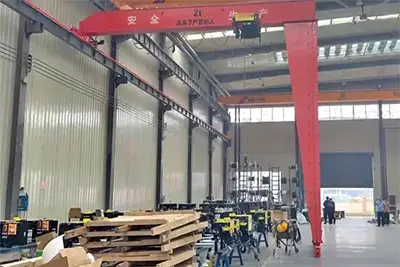
Steel structure fabrication in Qatar depends heavily on overhead cranes for moving materials and assemblies safely and efficiently across the workshop.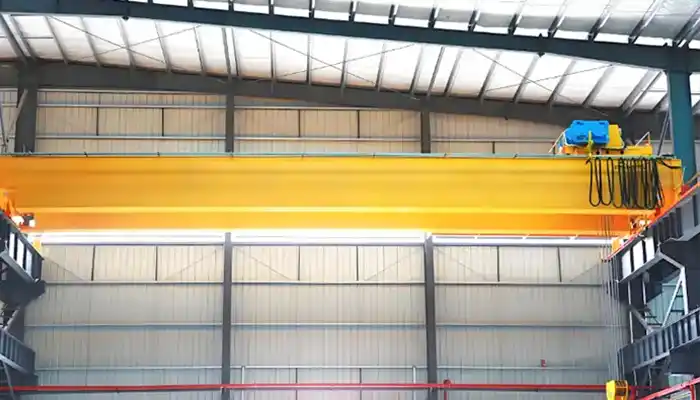
5 ton to 40 ton overhead crane for heavy lifting
Steel structure fabrication is not a stop-and-go process. Once production starts, steel moves continuously across the workshop.
Raw materials come in, parts are cut and welded, assemblies are built up, adjusted, and moved again. At almost every stage, a crane is involved.
In steel fabrication workshops, overhead cranes are commonly used to lift and position:
- Structural steel for buildings and industrial facilities
- Large welded frames and assemblies
- H-beams, box girders, columns, and truss structures
These are not compact or evenly balanced loads. Many parts are long, partially welded, or flexible, which changes how the crane must behave during lifting and travel.
Compared with general manufacturing, steel structure fabrication places heavier demands on crane systems. The main challenges come from the way the work is organized, not just from load weight.
Typical lifting conditions include:
- Repeated lifting between cutting, welding, fitting, and assembly areas
- Long travel distances across wide, multi-span workshops
- Loads that are long and offset, increasing the risk of swing
- Multiple cranes working at the same time in different bays
Because of this, operators often slow down crane movement to keep loads steady. Smooth travel and controlled braking matter more than lifting speed.
From a buyer's point of view, the most common issues are:
- Load sway when lifting long H-beams or trusses
- Coordination problems when several cranes share one workshop
- Structural stress on cranes used across wide spans
- Wear caused by high daily operating hours
This is why, in steel fabrication plants, selecting an overhead crane is a production planning decision, not a simple equipment purchase.
Steel structure fabrication in Qatar is concentrated in industrial zones designed for heavy manufacturing and logistics access.
The main areas include:
- Al Daayen, where medium to large fabrication workshops are common
- Al Wakrah, supporting infrastructure and construction projects
- Doha, supplying steel structures for commercial and urban development
Plants in these locations often operate on tight project schedules. Crane downtime quickly turns into delayed deliveries.
Most steel fabrication companies in these regions share similar operating conditions. They typically run:
- Large indoor workshops with several lifting zones
- Parallel crane runways serving different production lines
- Outdoor yards for material storage and pre-assembly
Because cranes are used every day, often for long shifts, local buyers usually focus on practical reliability rather than complex functions.
Key priorities for overhead cranes in these areas include:
- Stable operation over long spans
- Strong structural design for daily heavy use
- Easy access for inspection and maintenance
- Components suited for local service and repair
For steel fabricators in Al Daayen, Al Wakrah, and Doha, a good crane is one that runs steadily, handles long loads without drama, and keeps production moving without constant attention.
Company Scale and Workshop Configuration in Steel Structure Fabrication
Understanding how steel fabrication plants operate helps crane buyers select systems that reliably support daily production demands.
Most steel structure fabrication companies operating in Al Daayen, Al Wakrah, and Doha fall into the medium to large enterprise category. These are not small workshops doing occasional lifting. They run organized production lines where cranes are part of daily operations.
A typical fabrication plant usually has:
- Annual output focused on building steel structures, industrial frames, and welded assemblies
- In-house fabrication rather than outsourcing key processes
- Several departments working in parallel under the same roof
From a crane buyer's perspective, this matters because the crane is expected to work every day, often for long shifts, not just handle occasional lifts.
Most plants have full production capability, including:
- CNC or manual cutting of steel plates and sections
- Manual and automated welding stations
- Assembly and pre-fit areas for trial installation
- Surface treatment zones such as shot blasting and painting
Each stage requires moving steel components between stations. In practice, the crane becomes the main link connecting the entire production line.
Steel fabrication plants normally operate on project-based schedules. Orders are tied to construction timelines, and delays are rarely acceptable.
This leads to:
- High crane utilization during peak project periods
- Limited tolerance for crane downtime
- The need for predictable lifting performance rather than experimental features
For buyers, reliability often outweighs advanced automation. A crane that runs smoothly every day is more valuable than one with complex functions that slow down maintenance.
Most steel structure fabrication workshops follow a standardized industrial layout, but the internal lifting demand is far from simple.
Common layout features include:
- Long rectangular buildings with wide spans
- Two or more bays within one workshop
- Multiple lifting points serving different production lines
- Clear separation between processing and storage areas
In many plants, the workshop is designed first, and the crane must adapt to that existing structure.
Steel fabrication workshops often use multi-span building designs to cover large floor areas economically.
This creates several challenges for crane systems:
- Long runway beams extending across multiple bays
- Cranes that must serve different workstations without blocking each other
- Load transfer between bays without unnecessary repositioning
To handle this, plants frequently install parallel crane runways, allowing more than one crane to operate at the same time.
In medium to large steel fabrication facilities, it is common to see:
- Two or more overhead cranes working in the same building
- Cranes assigned to specific production zones
- Shared workshop space with independent lifting operations
Crane systems must be designed to:
- Prevent operational interference between cranes
- Maintain safe clearance during simultaneous travel
- Support coordinated workflows across different stations
Poor runway planning often leads to congestion and wasted time, even if crane capacity is adequate.
To keep production moving, workshops are usually divided into clear functional areas, such as:
- Assembly zones for large welded structures
- Temporary staging areas for components waiting for the next process
- Welding zones where precise positioning is required
- Pre-fit areas for trial assembly before delivery
Each zone depends on the crane arriving on time and positioning loads accurately. Unstable lifting or delayed crane access quickly disrupts workflow.
In steel structure fabrication plants, crane systems must do more than lift weight.
They must:
- Support continuous material flow between workstations
- Allow simultaneous operations without conflict
- Operate smoothly over long spans and long travel distances
- Integrate naturally into the existing workshop layout
For crane buyers, the key question is not just "How many tons can it lift?" It is "Can this crane keep our production moving without getting in the way?"
Materials Commonly Handled by Overhead Cranes in Steel Fabrication
In steel structure fabrication plants, overhead cranes are not used for uniform palletized loads. They are used to move long, heavy, and often unbalanced steel components that change shape and stiffness as fabrication progresses.
Each material type places different demands on the crane, lifting tools, and operator control.
H-beams are among the most frequently handled materials in steel fabrication workshops.
Typical handling characteristics:
- Long length with uneven weight distribution
- Tendency to rotate or swing during travel
- Often lifted in pairs or small bundles
Practical lifting considerations:
- Smooth acceleration and braking to limit load sway
- Adequate hook height for turning and positioning
- Use of slings or beam clamps matched to beam size
For long H-beams, stable crane travel matters more than lifting speed.
Box girders are usually fabricated in sections and lifted multiple times during assembly.
Common challenges include:
- High self-weight combined with large cross-section
- Limited lifting points during early welding stages
- Sensitivity to torsion when lifted incorrectly
Crane requirements:
- Strong structural stiffness for steady lifting
- Accurate positioning for welding alignment
- Compatibility with spreader beams when needed
Box girder handling often defines the upper capacity requirement of the crane system.
Steel plates move constantly between cutting, welding, and assembly zones.
Typical conditions:
- Wide range of thickness and weight
- High-frequency short travel movements
- Frequent loading and unloading cycles
Handling methods may include:
- Plate clamps for smaller pieces
- Magnetic lifting devices for flat plates
- Slings for thicker or irregular plates
Cranes used for plate handling benefit from precise control and responsive braking.
As fabrication progresses, individual parts are combined into larger assemblies.
Characteristics of these loads:
- Large overall size with relatively low rigidity
- Multiple lifting points required
- High risk of deformation if lifted improperly
Operational needs:
- Controlled, slow lifting speed
- Even load distribution across hooks or slings
- Clear communication between crane operator and ground crew
This is where crane smoothness directly affects product quality.
Finished or semi-finished welded components often represent the highest-value lifts in the workshop.
Typical features:
- Heavy weight combined with custom geometry
- Tight tolerances during positioning
- Often moved close to people and machinery
Key crane performance requirements:
- Stable travel without jerking
- Reliable brakes to hold position during fitting
- Fine control for final alignment
Because steel fabrication cranes handle such varied and challenging loads, buyers must look beyond rated capacity.
In practice, cranes must provide:
- Controlled lifting for long and flexible materials
- Anti-sway behavior achieved through smooth motion and proper design
- Accurate positioning for welding and assembly work
In steel fabrication, a crane that lifts smoothly and predictably is not a luxury. It is a basic production tool that protects both the structure being built and the people building it.
Lifting Capacity Requirements in Steel Fabrication Plants
In steel structure fabrication, lifting capacity is rarely decided by a single heavy lift. It is usually set by how the crane will be used every day, across different workstations and production stages.
Choosing too small a capacity limits workflow. Choosing too large a capacity increases crane cost, building load, and long-term maintenance expense.
Most steel fabrication plants operate within a well-defined capacity window.
Typical capacity distribution looks like this:
- 5–10 ton overhead cranes
Used for plate handling, small assemblies, and frequent short lifts - 10–20 ton overhead cranes
Common for H-beams, medium welded frames, and general assembly work - 20–30 ton overhead cranes
Applied in heavy assembly bays and major fabrication stations - Up to 40 ton cranes
Reserved for heavy-duty stations handling large box girders or main structural assemblies
In many workshops, different bays are served by cranes with different capacities, avoiding the need for a single oversized crane.
In steel fabrication, load weight is only part of the picture. The shape, length, and stiffness of the load often have more impact on crane performance than pure tonnage.
A 20-ton, long welded beam can be harder to control than a compact 30-ton block.
When planning crane capacity, buyers should look at:
- Maximum single-piece weight
The heaviest component that will be lifted, including lifting tools - Average working load
The weight range handled most of the time, which affects wear and duty class - Dynamic load effects
Forces created during starting, stopping, and positioning, especially with long loads - Material length and balance
Long H-beams, box girders, and trusses introduce additional stress and sway - Simultaneous lifting at multiple stations
Multiple cranes operating in the same workshop increase overall structural demand
Ignoring these factors often leads to cranes that feel oversized but still perform poorly during real operation.
Steel fabrication loads are rarely perfect. Weld beads add weight. Temporary fixtures are attached. Load centers shift during assembly.
For this reason, crane capacity planning normally includes:
- A practical safety margin beyond nominal load
- Allowance for lifting devices such as slings or spreader beams
- Consideration of uneven loading during early fabrication stages
This approach improves safety without pushing buyers toward unnecessary over-capacity.
Proper capacity planning helps achieve two goals at the same time:
- Avoid paying for excessive crane capacity that is rarely used
- Ensure safe, controlled lifting during daily production
For steel fabrication plants, the right crane capacity is not the biggest number on paper. It is the capacity that matches real lifting conditions, keeps operators confident, and supports steady production without strain.
Preferred Crane Types for Steel Structure Fabrication Plants
Steel structure fabrication does not rely on one universal crane type. Most plants use different crane solutions for different zones, depending on load weight, span, and how often lifting occurs.
Below are the crane types most commonly selected by steel fabrication buyers, along with practical reasons behind each choice.
Double girder overhead cranes are the first choice for heavy-duty steel fabrication. They are typically installed in main assembly bays where the largest and heaviest components are handled every day.
Why fabricators choose double girder cranes:
- High structural stiffness, which keeps long welded loads steady
- Strong resistance to deflection during lifting and travel
- Better hook height utilization for turning and positioning large assemblies
Typical applications include:
- Lifting welded box girders and main structural frames
- Positioning large columns and heavy assemblies for welding
- Handling loads in the 20–40 ton capacity range
These cranes are also suitable for high duty cycles, where lifting, travel, and positioning continue throughout the shift with limited idle time.
Large-span single girder EOT cranes are widely used for medium-duty steel fabrication tasks. They offer a practical balance between cost, performance, and structural demand on the building.
Common reasons buyers select single girder cranes:
- Lower initial cost compared to double girder systems
- Reduced load on runway beams and building columns
- Simpler structure that is easier to maintain
Typical use cases include:
- General handling of H-beams and steel plates
- Medium assemblies in the 5–20 ton capacity range
- Workshops with long spans but moderate lifting frequency
For many fabrication shops, single girder cranes cover daily work while heavy lifting is assigned to specific bays.
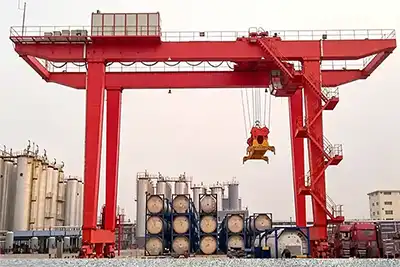
Outdoor gantry cranes play a critical role outside the main workshop. They are used in steel yards and prefabrication areas where building-mounted cranes cannot operate.
Why gantry cranes are essential in steel fabrication:
- They handle oversized and long structural members outdoors
- Operation does not rely on building structure or roof strength
- Flexible installation over storage yards and open assembly zones
Common applications include:
- Storing and retrieving steel sections and plates
- Pre-assembling large structures before indoor processing
- Loading finished steel components onto trucks for delivery
Because they work in open environments, outdoor gantry cranes are usually designed with weather protection and reinforced structures.
Most steel structure fabrication plants use a combination of these crane types rather than relying on just one.
In practice:
- Double girder cranes handle heavy and critical lifts
- Single girder EOT cranes support daily material flow
- Gantry cranes manage outdoor storage and logistics
This layered approach allows steel fabricators to control cost while keeping lifting operations smooth, safe, and aligned with real production needs.
Buyer Considerations Often Overlooked in Steel Fabrication
When selecting overhead cranes for steel structure fabrication, many buyers focus only on lifting capacity or initial price. But in reality, several practical factors can have a bigger impact on daily operation, safety, and long-term cost.
The crane's runway is literally the backbone of lifting operations. Even a perfectly rated crane will underperform if the runway is misaligned or the building structure cannot handle the load.
Key points for buyers:
- Ensure runway beams are straight, level, and properly supported
- Confirm the building structure can handle maximum crane load plus dynamic forces
- Check that multiple cranes on parallel runways do not overload columns or beams
Neglecting runway design can lead to vibration, uneven travel, and even structural damage over time.
Cranes in steel fabrication plants run for long shifts every day. Maintenance is not optional—it's critical.
Practical considerations:
- Easy access to motors, brakes, and wire ropes
- Space for inspection without interrupting workflow
- Readily available replacement parts compatible with local service
A crane that is difficult to maintain will cause downtime and reduce overall ROI, even if the upfront cost was low.
Workshops often grow, or new production lines are added over time. A crane that fits today may be inadequate tomorrow.
Buyers should consider:
- Space for additional cranes or longer runway spans
- Load capacity for potential future heavier assemblies
- Integration with expanded lifting zones or outdoor yards
Thinking ahead saves costly modifications or crane replacement in the near future.
Steel fabrication involves various load types that may require clamps, spreader beams, magnets, or slings.
Important points:
- Verify crane hook design and trolley compatibility with all lifting tools
- Ensure cranes can operate safely with multi-point lifting
- Consider whether the crane control system allows smooth, precise handling
Without proper tool integration, lifting efficiency drops and load safety is compromised.
All of these considerations directly affect long-term ROI, operational flexibility, and production efficiency.
Even a high-capacity crane can become a bottleneck if the runway is weak, maintenance is difficult, future growth is ignored, or lifting tools cannot be integrated.
For steel structure buyers in Al Daayen, Al Wakrah, and Doha, paying attention to these details ensures that the crane works reliably, safely, and efficiently for years, not just at installation.
Conclusion: Choosing the Right Crane for Steel Structure Fabrication
Steel structure fabrication is all about lifting large, heavy, and often irregular loads safely and efficiently.
Workshops in Al Daayen, Al Wakrah, and Doha rely on cranes not just to move steel, but to keep production flowing smoothly across multiple stations.
For most fabrication facilities, the best approach is a combination of crane types:
- Double girder bridge cranes for heavy-duty lifting and precise positioning
- Large-span single girder EOT cranes for medium loads and long-span coverage
- Outdoor gantry cranes for storage, pre-assembly, and oversized components
Choosing the right crane solution from the start has multiple benefits:
- Reduces downtime caused by insufficient capacity or interference
- Improves workflow continuity across cutting, welding, assembly, and finishing areas
- Supports future growth, allowing expansion or additional lifting stations
- Protects investment by avoiding unnecessary over-specification or maintenance issues
FAQ: Overhead Cranes for Steel Structure Fabrication
The ideal crane depends on the size of the workshop, lifting frequency, and type of steel components handled.
- Double girder bridge cranes are best for heavy-duty lifting of large welded beams, box girders, and columns.
- Large-span single girder EOT cranes handle medium loads and long spans cost-effectively.
- Outdoor gantry cranes are essential for material storage, pre-assembly, and oversized components outside the main building.
Most workshops use a combination of these cranes to balance capacity, efficiency, and cost.
The choice comes down to load weight, span, and duty cycle:
- Single girder cranes: Suitable for 5–20 ton loads, moderate spans, and medium lifting frequency. They reduce building load and initial investment.
- Double girder cranes: Required for 20–40 ton loads, high duty cycles, and heavy welded structures. They offer higher stiffness, better hook height, and precise control.
Tip: Match crane type to each bay's specific lifting tasks rather than using one crane for all operations.
Capacity depends on the heaviest load at each station:
- H-beams and steel plates: 5–20 tons for general handling
- Medium welded frames and trusses: 10–30 tons
- Heavy box girders or main structural assemblies: up to 40 tons
Always plan with a safety margin to account for uneven weight, long loads, and temporary fixtures during lifting.
Plants often run multiple cranes simultaneously across multi-span workshops. Safe operations require:
- Parallel crane runways with adequate spacing
- Clear assignment of each crane to specific zones
- Smooth, anti-sway crane motion for long or flexible loads
- Standard operating procedures and coordination between operators
Proper planning ensures continuous material flow without crane interference.
Outdoor gantry cranes are used when:
- Steel sections or assemblies are too large for indoor cranes
- Material storage and pre-assembly take place in open yards
- Truck loading or logistics require lifting independent of the building structure
These cranes complement indoor systems and are designed for long spans and heavy loads in outdoor conditions.
For workshops with long spans and daily heavy use, buyers should focus on:
- Structural stability and rigidity to prevent sway
- Smooth travel and precise positioning
- Adequate hook height for turning and assembly
- Maintenance access for high-frequency operations
- Compatibility with lifting tools like clamps, spreader beams, and magnets
Choosing a crane that performs consistently under real-world conditions improves workflow efficiency, safety, and ROI.