3–32 Ton Half Gantry Cranes for Large Workshops
3–32 Ton Half Gantry Cranes: Smart Lifting for Large Workshops Without Full Coverage
Most Important Takeaway (Read This First)
If your workshop span is large but lifting only happens in specific areas, a 3–32 ton half gantry crane can reduce crane cost, steel structure investment, and installation complexity—without sacrificing lifting efficiency or safety.
- Large building span does not mean you need a full-span overhead crane
- 3–32 ton half gantry cranes provide localized lifting where work actually occurs
- Avoid paying for unused runway beams, columns, and crane travel
- Lower civil work, faster installation, and easier future relocation
- Ideal for wide workshops, retrofit projects, and phased expansions
Introduction: Why Many Crane Buyers Over-Specify Span Length
In large workshops and factories, a common buying mistake is assuming that the crane must cover the full building span. On drawings, a wide plant looks like it needs a wide crane. In daily operation, that's rarely how work actually happens. Lifting usually takes place in specific bays, near certain machines, or along one production line.
Many buyers realize this only after the crane is installed—when a large part of the runway is barely used.
This way of thinking usually comes from early-stage planning or civil drawings, not from how materials move on the shop floor.
In practice:
- Assembly work happens in fixed zones, not everywhere
- Heavy components are lifted near machines or workstations
- Some areas are only for storage, walkways, or transport
Covering the entire width looks safe on paper, but it often adds capacity where no lifting is required.
Choosing a full-span overhead crane when only partial coverage is needed brings several practical problems.
It typically results in:
- Oversized crane spans that never get fully used
- Extra runway beams and support columns, increasing civil work
- Higher crane self-weight and wheel pressure, which affects building design
- Higher installation, inspection, and long-term maintenance costs
These are not theoretical issues. They show up in steel quantities, foundation size, rail alignment time, and maintenance access later on.
Many buyers focus heavily on tonnage—3 ton, 5 ton, or 10 ton—but span length can drive cost just as much as lifting capacity.
A small-capacity crane with an oversized span can:
- Cost more than a higher-capacity crane with a shorter working range
- Require heavier beams and rails
- Limit future layout changes
This is where planning based on actual lifting areas matters more than building width.
A 3–32 ton half gantry crane is designed for workshops that are wide, but don't need lifting everywhere.
This type of crane:
- Covers only the working zone, not unused space
- Runs on one runway beam and one ground rail
- Reduces steel structure and foundation requirements
- Acts as a practical overhead crane alternative for partial coverage
For many buyers looking at a small capacity gantry crane, this design solves the span problem without sacrificing lifting safety or control.
In short, large buildings don't always need large spans.
They need lifting where work actually happens—and nothing more.
What Is a 3–32 Ton half gantry crane?
A 3–32 ton half gantry crane is a hybrid lifting system that combines features of an overhead crane and a gantry crane. It's built for situations where the workshop is wide, but lifting only happens along one side or in a limited working zone.
Instead of requiring two elevated runway beams across the entire building, this crane uses one runway beam and one ground-supported rail. The result is controlled, localized lifting without overbuilding the structure.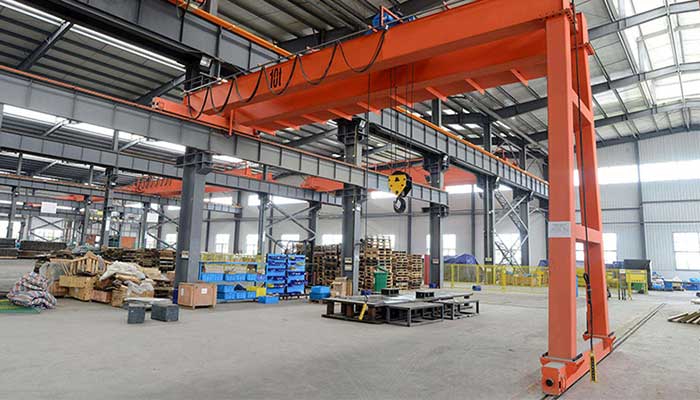 Double girder semi gantry crane for sale , Tialored half gantry crane
Structurally, a half gantry crane operates on two different support paths:
- One side on an elevated runway beam fixed to the building or columns
- The other side on a ground rail, supported by a leg running on wheels
This layout forms a stable bridge while removing the need for a second overhead runway beam. For existing plants, that often means less steel work and fewer building modifications.
In most industrial applications, half gantry cranes fall into a practical capacity range that matches real lifting needs.
Common working capacities include:
- 3 ton half gantry crane – light assemblies, machine parts, tooling
- 5 ton half gantry crane – general fabrication and maintenance lifting
- 8 ton half gantry crane – heavier components or bundled materials
- 10 ton half gantry crane – equipment handling and medium-duty production
Within this range, the crane remains compact while still handling daily lifting safely.
The value of a half gantry crane lies in what it avoids, not just what it does.
This hybrid crane design delivers:
- Targeted lifting coverage where materials are actually moved
- Flexible travel along production lines, machines, or workstations
- Lower structural load on the building, since only one runway beam is required
Because one side runs on the ground, wheel loads are split differently, often reducing pressure on the building columns compared to a full overhead crane with the same span.
A half gantry crane is best understood as a partial coverage crane. It's designed to support specific operations—loading, assembly, or maintenance—rather than acting as a general-purpose crane for the entire workshop.
This makes it suitable when:
- Lifting is concentrated near one wall or bay
- Only part of the shop floor requires crane access
- Future layout changes are likely
In these cases, a localized lifting system improves efficiency without locking the facility into a fixed, full-span solution.
From a buyer's point of view, 3–32 ton half gantry cranes are often selected when:
- Existing buildings can support only one runway beam
- Civil work needs to be minimized or phased
- Full overhead coverage adds cost without adding value
Used correctly, a half gantry crane fills the gap between a traditional overhead crane and a small capacity gantry crane—giving buyers a workable, cost-aware lifting solution tailored to how the space is actually used.
Typical Applications in Large Workshops
A 3–32 ton half gantry crane is most effective in large workshops where lifting needs are concentrated in specific zones, not spread across the full building width. In these environments, a full-span overhead crane often adds cost without improving productivity.
In machinery shops, lifting usually happens along assembly lines, test areas, or loading points. Components move in a linear flow rather than across the entire floor.
half gantry cranes are commonly used here because they:
- Serve long fabrication lines without covering unused space
- Handle assemblies, frames, and submodules within the 3–32 ton range
- Allow clear space on the non-crane side for forklifts and personnel
Steel fabrication and structure assembly often require repetitive lifting at fixed stations—welding tables, fit-up zones, and staging areas.
A half gantry crane supports this workflow by:
- Providing consistent lifting access along one side of the line
- Reducing runway steel compared to full overhead cranes
- Supporting beams, columns, and fabricated sections without oversizing the span
Maintenance areas inside large plants rarely need full crane coverage. Lifting is usually limited to service pits, machine bases, or repair platforms.
In these bays, a partial coverage crane:
- Focuses lifting power exactly where machines are serviced
- Keeps the rest of the workshop open and unobstructed
- Simplifies installation in existing buildings with limited headroom
For welding cells and machining zones, space control matters. Loads are frequent but predictable, and precise positioning is more important than wide travel.
A 3–32 ton half gantry crane offers:
- Localized lifting without interfering with adjacent operations
- Easy alignment with fixtures, jigs, and machine infeed points
- Reduced column and foundation work compared to gantry cranes covering the full floor
One of the most common uses is retrofit installations. Older plants often lack symmetrical columns or the structure needed for dual runway beams.
half gantry cranes solve this by:
- Using a single runway beam where the building allows
- Adding a ground rail instead of structural reinforcement
- Minimizing downtime during installation
half gantry cranes perform best where lifting is repetitive, predictable, and localized. If your crane is used daily—but only in certain bays or lines—a 3–32 ton half gantry crane avoids paying for span, steel, and runway you will never use.
.
Why Full-Span Overhead Cranes Often Add Cost Without Real Value
In oversized workshops, it is common to default to a full-span overhead crane. It feels like the safest option. In daily operation, however, this approach often leads to higher investment with little practical gain—especially when lifting work is limited to fixed bays or production lines.
In most large workshops, lifting activities stay within defined work zones such as assembly lines, maintenance bays, or loading points.
A full-span crane still has to reach every edge of the building, even if those areas are never used.
- Longer bridge girders increase fabrication cost
- Extended rails and power systems add material and labor
- Large travel zones remain unused during normal shifts
For procurement teams, this means paying for coverage that brings no daily benefit.
Crane self-weight increases quickly as span increases. Longer bridges require deeper girders and heavier end trucks.
This directly results in:
- Higher wheel loads on the runway
- Stronger rails and fastening systems
- Greater demands on columns and foundations
When buyers compare an overhead crane vs half gantry crane, this span-driven weight increase is often underestimated.
Installing a full-span overhead crane usually means two continuous elevated runways across the workshop.
In practice, this can involve:
- Reinforcing existing columns or adding new ones
- Structural checks across the full building width
- Longer installation and alignment time
half gantry cranes avoid much of this by combining one runway beam with one ground rail.
More steel and longer runways mean more inspection points. Over time, this increases maintenance workload and cost.
- Longer rails require regular alignment checks
- Higher wheel pressure increases wheel wear
- Heavier cranes amplify small runway deviations
Over a typical 10 to 15 year service life, these factors can significantly affect operating budgets.
Full-span cranes are suitable when loads truly move across the entire building width.
If lifting is localized and repetitive, full-span coverage often brings complexity instead of efficiency.
A half gantry crane aligns crane span with actual lifting zones. One side runs on an elevated beam, the other on a ground rail.
This structure reduces steel weight, simplifies installation, and keeps load paths predictable.
Crane span should follow usage, not building size.
If lifting happens mainly in defined bays, a 3–32 ton half gantry crane often provides the same working capability with less steel, lower wheel loads, and better cost control.
The most economical crane is rarely the one that reaches everywhere—it is the one that works where you actually lift.
Cost Advantage: half gantry crane vs. Full Overhead Crane (3–32 Ton Range)
In the 3–32 ton lifting range, overall crane cost is often influenced more by structural design and installation scope than by the hoisting mechanism itself. This is where a half gantry crane consistently shows a cost advantage over a traditional full-span overhead crane.
A full overhead crane depends on two elevated runway beams, columns, and reinforced building structure across the entire span.
A half gantry crane operates with:
- One elevated runway beam
- One ground-mounted rail
This configuration significantly reduces:
- Total runway steel volume
- Fabrication and erection work
- Structural reinforcement needs
For buyers, less steel directly translates into lower upfront project cost.
Installing a full-span overhead crane typically requires extended work at height, full-width rail alignment, and longer commissioning time.
With a half gantry crane:
- One travel side is installed at ground level
- Fewer alignment points are involved
- Electrical cable runs are shorter
This reduces installation labor hours and accelerates commissioning.
Civil work is a major hidden cost in crane projects.
A full overhead crane may require:
- Reinforced or new building columns
- Beam and column foundations
- Load redistribution within the structure
A half gantry crane typically needs:
- Simple ground rail foundations
- Civil work limited to one travel path
This is especially beneficial in existing plants where major structural changes are costly and disruptive.
Because the crane structure is lighter and less complex:
- Manufacturing lead times are shorter
- Transport costs are reduced
- On-site assembly is quicker
For buyers working against tight project deadlines, this time advantage can be as critical as initial price.
For 3–32 ton applications, a half gantry crane delivers required lifting performance without paying for excess span or structure.
Buyers benefit from:
- Lower initial capital expenditure (CAPEX)
- Reduced installation risk and downtime
- Faster return on investment (ROI)
The result is a cost-efficient lifting solution that matches real operational needs—without the long-term burden of an oversized overhead crane system.
How to Choose Between Semi-Gantry and Full Overhead Cranes
Choosing the right crane type and capacity in the 3–32 ton range requires looking beyond tonnage alone. Real cost, safety, and efficiency depend on how the crane is used on the shop floor, not just what it can lift on paper.
Selecting the correct capacity for a half gantry crane is critical. Oversizing increases cost, while undersizing limits safety and productivity.
Key points buyers should check:
- Actual maximum load plus margin
Always calculate the heaviest single lift and add a 10–20% safety margin. - Lifting frequency and duty class
Occasional use (A3), regular operation (A4), or heavier duty (A5) directly affects hoist and motor selection. - Required lifting height
Verify available headroom and beam height to avoid interference with the building structure. - Future flexibility
Consider possible changes in load size or handling process to reduce the risk of early upgrades.
Typical capacity guidance:
- 3–5 ton: light fabrication, maintenance lifting
- 5–8 ton: machine parts, steel frames, regular production
- 8–10 ton: heavier assemblies, molds, larger components
The right capacity balances safety, cost, and daily operating efficiency.
A 3–32 ton half gantry crane works best where lifting is concentrated in specific areas rather than across the full workshop.
It is usually the right choice when:
- Workshop width exceeds the actual lifting zone
Only part of the floor is used for hoisting, assembly, or maintenance. - Building structure limits full-span loads
One runway beam plus a ground rail reduces stress on columns and foundations. - Budget control matters
Less steel, fewer beams, and simpler installation keep project costs predictable. - Future layout changes are expected
half gantry cranes are easier to relocate or adapt than full-span systems.
For buyers, this means paying only for the lifting area that is actually used—nothing more.
While half gantry cranes cover many workshop needs, some operations still require a full-span overhead crane.
A full overhead crane is better when:
- Lifting is required across multiple bays
Materials must move freely across the entire workshop width. - High-frequency, multi-point lifting is involved
Regular lifts at many positions along the span demand continuous coverage. - Multi-crane or synchronized lifting is planned
Full-span systems provide better overlap and coordination.
In these cases, higher upfront cost is justified by smoother workflow and fewer operational constraints over time.
Conclusion: Buy Lifting Coverage That Matches Real Operations
Oversized cranes aren’t always the answer. What truly matters is matching the crane to your real lifting needs. For many large workshops, a 3–32 ton half gantry crane hits the sweet spot.
Key Takeaways for Crane Buyers
- Match lifting coverage to actual workflows
Only cover the bays or zones where lifting is needed—no paying for unused runway. - Reduce upfront investment and structural costs
half gantry cranes require less steel, smaller foundations, and simpler installation. - Improve flexibility for future layout changes
Localized lifting coverage allows you to adjust workflows without major reconstruction.
FAQ: Questions This Article Solves
Q1: Do I really need a full-span overhead crane for a wide workshop?
Not always. Many workshops only require lifting in specific bays or work areas. A full-span crane may cover more than you actually need, increasing costs and structural requirements unnecessarily.
Q2: How can I reduce crane cost without reducing lifting capacity?
Consider a half gantry crane. It provides the same lifting capacity but requires fewer runway beams, less steel structure, and smaller foundations, saving both upfront investment and ongoing maintenance.
Q3: What crane type is best for partial coverage lifting?
A 3–32 ton half gantry crane is ideal for localized lifting. It runs on one elevated runway and one ground rail, offering flexible coverage for specific areas without covering the entire workshop span.
Q4: When is a half gantry crane better than a bridge crane?
Choose a half gantry crane when your workshop layout doesn’t support a full runway, lifting is concentrated in certain zones, budget is limited, or you anticipate phased expansions.
Q5: What capacity range works best for localized industrial lifting?
For most partial-coverage lifting tasks:
- 3–5 ton: Light fabrication, maintenance, smaller parts
- 5–8 ton: Medium-duty assembly, steel frames, machine parts
- 8–10 ton: Heavier components, molds, and larger assemblies