2–8 Ton Semi-Gantry Cranes for Flexible Industrial Workstations
Introduction
Semi-gantry cranes are widely used in modern industrial buildings where flexibility, lighter structures, and cost-efficient material handling solutions are required. Their design allows efficient lifting without relying on full overhead runway systems, making them ideal for workshops, factories, and warehouses with changing layouts.
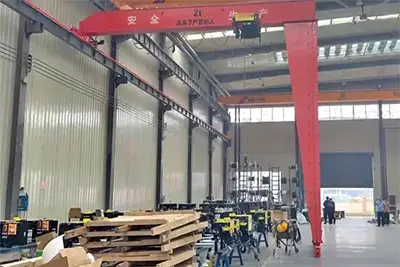
Semi-gantry cranes are a type of crane designed to operate along one side of a building, with one end of the crane supported by a runway and the other end traveling on wheels along the floor. Unlike full gantry cranes, they do not require overhead support across the entire span, which makes them lighter and easier to install in existing structures.
- Common lifting capacities range from 2 to 8 tons, suitable for light-to-medium loads.
- The crane consists of a bridge, trolley, hoist, and supporting legs, with one side fixed on a runway beam.
- They can handle materials across wide workstations without the need for complex building modifications.
Semi-gantry cranes are particularly well-suited for workshops, factories, and warehouses where flexibility and cost-efficiency are important.
In modern industrial operations, workflows are rarely static. Production lines, assembly stations, and storage areas often need to be rearranged based on changing orders, seasonal production, or new equipment.
- Semi-gantry cranes allow operators to move loads across different points without a permanent overhead structure.
- They can be relocated or repositioned within a building without major construction work.
- This flexibility reduces downtime and keeps production lines running smoothly.
For industrial managers, having a crane that can adapt to changing layouts means less disruption and more practical use of available space.
Lighter cranes bring several advantages beyond flexibility. They put less stress on the building structure, which can lower costs for foundations, floor reinforcement, and steelwork.
- Reduced civil work requirements, such as smaller or simpler foundations.
- Lower steel structure costs because the crane does not need full-span support.
- Easier installation and maintenance due to smaller, lighter components.
- Lower power consumption, since lighter loads require less energy to lift and move.
In short, semi-gantry cranes offer a balance of mobility, practicality, and cost-efficiency, making them a preferred choice for wide industrial buildings with dynamic production needs.
2–8 Ton Semi-Gantry Cranes
Semi-gantry cranes in the 2–8 ton range are designed for light to medium-duty material handling tasks. They provide an effective balance between lifting capacity, installation simplicity, and operational flexibility in industrial buildings.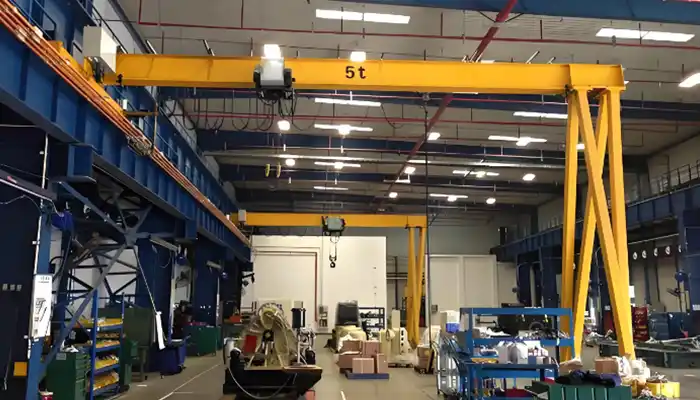 Single girder semi gantry crane for sale, 5 ton semi gantry crane for sale
A semi-gantry crane is a lifting system where one end of the bridge runs on an elevated runway beam while the other end moves on wheels along the workshop floor. This design reduces the need for full-span overhead support, making the crane lighter and easier to install.
- Bridge: Connects the two ends of the crane and carries the hoist or trolley.
- Trolley & Hoist: Moves along the bridge to lift and transport materials.
- Supporting Legs: One side is fixed to the runway, the other rides on the floor.
- Controls: Can be pendant, radio remote, or cabin-operated depending on the workflow needs.
This setup allows semi-gantry cranes to cover wide workstations without requiring major structural changes in the building.
These cranes are ideal for lighter to medium lifting tasks that do not require extremely high loads. Typical applications include:
- Transporting components between assembly lines.
- Handling raw materials such as steel sheets, pipes, or small machinery parts.
- Loading and unloading goods in warehouses or production areas.
- Supporting maintenance work, especially where mobility is required.
Because they are lighter than full gantry or overhead cranes, semi-gantry cranes are easier to install and operate, and they reduce wear on floors and supporting structures.
Understanding how semi-gantry cranes differ from other crane types helps buyers select the right solution:
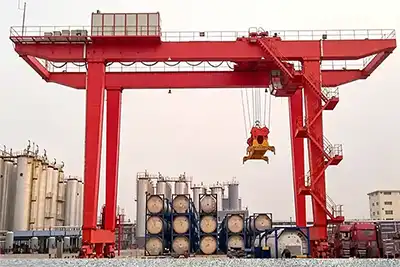
- Full Gantry Cranes: Span the entire width of the workshop with legs running on the floor on both sides. They can handle heavier loads but require larger floor space and stronger foundations.
- Overhead Bridge Cranes: Fully supported by overhead runways on both sides. They maximize lifting capacity and workspace clearance but involve higher civil and steelwork costs.
- Semi-Gantry Cranes: Only one end is supported on an elevated runway; the other runs on the floor. They offer a balance of load capacity, installation cost, and flexibility for wide workstations.
Flexibility in Wide Industrial Workstations
Semi-gantry cranes are particularly effective in wide industrial workstations where layouts, production lines, and material flow frequently change. Their partial runway design provides mobility and adaptability without requiring heavy structural investment.
The semi-gantry setup means the crane can move along the floor on wheels while also running on a partial overhead beam. This allows it to reach different areas of the workstation without the need for permanent structures.
- Operators can move the crane to multiple points without disassembling it.
- The floor-mounted end provides stability while keeping installation simple.
- Crane travel can be extended along the workshop without heavy steel modifications.
One of the biggest advantages of semi-gantry cranes is how they make workshop layouts more flexible. Workstations can be rearranged, added, or removed with minimal disruption.
- No need to redesign overhead structures when moving production lines.
- Temporary lifting points can be added quickly for short-term projects.
- Reduces downtime and keeps production running smoothly.
Semi-gantry cranes can be seamlessly integrated into existing workflows, including conveyor systems and assembly lines.
- Can lift materials directly onto conveyor belts or work tables.
- Moves components between stations without blocking floor space.
- Supports modular layouts, allowing new equipment to be added without crane relocation.
Because semi-gantry cranes do not require a full-span runway, they are ideal for industries where layouts change frequently or production lines are temporary.
- Can be relocated to different areas of the building as needed.
- Suitable for flexible manufacturing, contract assembly, or multi-purpose halls.
- Saves investment in permanent steel structures while still providing safe lifting.
Cost Advantages & V. Operational Benefits
Semi-gantry cranes offer both cost and operational advantages for industrial buildings. Their lighter design and partial runway support reduce installation costs, energy consumption, and structural requirements, while enhancing workflow flexibility and safety.
Semi-gantry cranes place less stress on building floors and foundations, translating into significant cost savings.
- Foundations can be smaller and shallower compared to full gantry systems.
- Floor loads are reduced, often avoiding the need for heavy reinforcements.
- Existing buildings can accommodate semi-gantry cranes without major structural upgrades.
Ideal for retrofitting older factories or expanding production without expensive construction.
Semi-gantry cranes require less steel for support since only one side runs on a runway beam.
- Reduced amount of overhead steel beams and supports.
- Lower material costs for custom-fabricated steel structures.
- Less engineering time required for structural calculations and design approvals.
Cuts initial investment costs and simplifies future modifications.
The lighter design and simpler structure allow faster installation with fewer workers.
- Fewer components to assemble and align.
- Shorter downtime during installation or relocation.
- Reduced dependency on specialized installation teams or cranes for setup.
Handling smaller loads requires less motor power, reducing energy consumption and operational costs.
- Hoists and trolleys consume less electricity.
- Reduced mechanical wear lowers long-term maintenance costs.
- More efficient for frequent lifts of medium and light components.
Semi-gantry cranes are highly mobile and can be relocated or reconfigured easily.
- Floor-mounted end allows for easy relocation without dismantling the entire crane.
- Quick setup for temporary projects or seasonal production lines.
- Ideal for facilities that handle varied product sizes or have changing workflows.
Flexible lifting and transport reduce delays and increase productivity.
- Operators can move materials directly between workstations.
- Reduces reliance on forklifts or manual handling.
- Supports multi-task workflows, where the same crane can serve several production lines.
Lighter cranes are easier to control, reducing the risk of accidents or material damage.
- Lower momentum reduces the chance of collisions.
- Safer for operators, especially in confined or busy workspaces.
- Easier to implement safety accessories like limit switches, overload protection, or travel sensors.
Semi-gantry cranes can accommodate a variety of standard equipment, making them versatile.
- Standard electric wire rope or chain hoists can be fitted easily.
- Compatible with lifting trolleys, clamps, grabs, or hooks.
- Can handle different product types without major customization.
These operational benefits make semi-gantry cranes a practical and cost-effective solution for medium to light lifting tasks in wide industrial buildings.
Typical Applications
Semi-gantry cranes are versatile lifting solutions used across multiple industries, especially where medium-weight components need safe and flexible handling.
Semi-gantry cranes are widely used in automotive workshops for moving engines, chassis components, and body parts, enabling safe handling without forklifts.
- Transporting engines or subassemblies between workstations.
- Supporting maintenance of heavy machinery without interrupting assembly lines.
- Ideal for flexible layouts where workstations change based on model or project type.
In metal fabrication shops, these cranes lift steel sheets, pipes, fabricated parts, or machine components up to 8 tons efficiently.
- Moving raw materials from storage to cutting or welding stations.
- Transporting partially completed parts across production areas.
- Reducing floor congestion by handling items overhead instead of relying solely on forklifts.
Warehouses with large floor space benefit from semi-gantry cranes for efficient handling of pallets, boxes, and medium-weight goods.
- Loading and unloading trucks or shipping containers.
- Transferring materials to high-density storage racks.
- Facilitating seasonal or temporary reorganization of storage layouts.
Lighter production environments, such as electronics assembly or small machinery workshops, benefit from semi-gantry cranes for precise, repeatable lifts.
- Moving machinery components safely without risking damage.
- Assisting in assembly lines where modular stations require flexible crane coverage.
- Handling tools or equipment that are awkward to move manually.
Selection Tips for Buyers
Selecting the right semi-gantry crane requires careful evaluation of building constraints, workload, flexibility needs, and potential future changes. Proper planning ensures efficiency, safety, and cost-effectiveness.
Before selecting a semi-gantry crane, check your building's dimensions and runway support. The crane should fit comfortably within the available width and allow smooth travel.
- Measure floor-to-ceiling height for sufficient lift clearance.
- Ensure floor can handle the load of the floor-supported end.
- Check for obstacles that could block crane travel, such as columns or equipment.
Choose a crane that suits the typical weight of materials you handle. Oversizing increases costs, while undersizing can slow operations or cause safety issues.
- Calculate maximum load per lift and add a safety margin of 20–30%.
- Consider average vs. peak lifting frequency to select motor and hoist type.
- Factor in accessories like grabs, clamps, or trolleys that add to the lifting weight.
Consider the level of mobility you need in your workspace. Semi-gantry cranes are ideal for flexibility and lower installation costs, but full gantry cranes offer higher lifting capacity.
- Use semi-gantry when only one side can have an elevated runway or for lighter loads.
- Use full gantry for heavy loads or when full-span lifting across the workshop is required.
- Evaluate how often workflows may change, and whether relocating the crane will be necessary.
A semi-gantry crane is a long-term investment. Think ahead about possible changes in production volume or workshop layout.
- Ensure runway beams and floor areas allow for future extension of travel distance.
- Confirm the crane design allows relatively easy relocation if production needs change.
- Plan for potential addition of more cranes or integration with automated handling systems.
By carefully considering these factors, buyers can choose a semi-gantry crane that fits current needs while remaining adaptable for future growth.
Conclusion
Semi-gantry cranes in the 2–8 ton range offer a practical solution for industrial buildings where flexibility, cost efficiency, and operational ease are priorities. By combining partial overhead support with floor-mounted mobility, these cranes allow operators to move materials across wide workstations without major structural changes.
- Flexibility: Easy relocation, adaptable to changing workflows, and integration with existing production lines.
- Cost Advantages: Reduced civil work, lower steel structure requirements, faster installation, and energy-efficient operation.
- Operational Benefits: Quick deployment, improved workflow, safer handling of lighter loads, and compatibility with standard lifting accessories.
For workshops, warehouses, or manufacturing facilities handling light-to-medium loads, semi-gantry cranes are an efficient way to lift and transport materials while keeping costs under control. Buyers should evaluate their workspace dimensions, lifting requirements, and future expansion plans to select the right crane.
In short, semi-gantry cranes provide a balanced solution: they give you the lifting capacity you need, the flexibility your operations require, and the cost savings that make the investment worthwhile.