Single vs Double Girder Cranes | Tight Workshop Guide
Compare single and double girder cranes for compact industrial spaces. Discover which crane fits tight workshops, lifting needs, and budget best.
Single Girder vs Double Girder Cranes: A Buyer’s Comparison for Tight Industrial Spaces
Introduction: Why Crane Choice Matters in Tight Industrial Spaces
Choosing between a single girder crane and a double girder crane may seem simple on the surface, but in tight industrial spaces, every millimeter counts. Many workshops today are built with limited headroom, narrow bays, and packed production lines, so the wrong crane design can quickly create unnecessary trouble. Sometimes it even leads to costly rework—no one wants that.
Modern factories, steel fabrication plants, and process industries are handling more equipment than ever. The workflow is tight, the deadlines are tighter, and space is often the biggest limitation. Because of this, the structure of the crane—single vs double girder—directly affects how easily the equipment fits into your building and how smoothly the operation runs.
Overview of Space Challenges in Modern Industrial Workshops
In many plants, the crane isn’t installed early in the construction stage. Instead, it’s added later, after machinery and production lines are already in place. This creates a set of practical challenges:
- Low headroom between the roof and the crane runway
- Short spans that don’t justify heavy structures
- Obstructed bays due to columns, ducts, and existing production machines
- Narrow aisles where even end carriages must be compact
- Limited freedom to modify the building structure
These challenges make crane sizing and girder selection more than a simple “capacity” question.
Why Single vs Double Girder Design Affects Layout Efficiency, Cost, and Usability
The girder choice influences far more than lifting capacity. It shapes the entire crane performance in a tight workshop:
- Overall crane height, which affects how much lifting height you can actually use
- Runway beam loading, which affects whether your existing beams can support the crane
- Span economics, especially when space is short or narrow
- Hoist type, because low-headroom hoists fit differently on single vs double girders
- Installation difficulty, especially in busy or active work environments
- Future usability, since some cranes leave more room for upgrades or automation
A single girder crane often fits better when the goal is simplicity and compactness. A double girder crane, however, can give you higher hook height and better durability when space is tight but the work is heavy.
When Compact Design Becomes a Priority
Some workshops simply cannot take a bulky crane. In these cases, choosing a compact crane design becomes not just a preference but a requirement.
You know compact design is a priority when:
- The bay width is narrow, and every side clearance feels tight.
- The roof height is low, and the hook must reach as high as possible.
- The workflow is dense, with many machines placed close to each other.
- The load is not extremely heavy, so a single girder may be enough.
- The installation area is restricted, like in mezzanine workshops or retrofitted buildings.
In short, when your space is already “crowded,” the crane you choose must help—not make things worse.
Overhead Crane Basics
Understanding the difference between a single girder overhead crane and a double girder overhead crane is the first step toward choosing the right system for a tight industrial space. The two designs may look similar at a glance, but their structure, lifting performance, and workshop fit are quite different. Let's break it down in a practical, easy-to-understand way.
A single girder overhead crane uses one main bridge beam to support the hoist and trolley. It's simple, lighter, and easier to install compared to heavier crane systems. Many buyers prefer this design for general lifting tasks where the working area isn't too large, and the loads aren't extremely heavy.
Structure
A single girder crane typically includes:
- One bridge beam running across the workshop span
- A trolley with an electric hoist, usually a low-headroom type for tight spaces
- Two end carriages running along the runway beams
- Lightweight components that reduce building load
Typical Capacities and Spans
Single girder cranes usually cover:
- Capacity range: 1 ton to 20 tons
- Recommended economic span: 6 meters to around 28 meters
- Duty rating: light to medium duty (FEM 1Bm–2m depending on usage)
- Hook height: moderate, sometimes limited by the hoist sitting under the girder
Common Applications in Light- to Medium-Duty Workshops
- Steel structure fabrication shops
- Machinery assembly workshops
- Maintenance and repair bays
- Warehouse material handling
- Plastic molding and small parts production
- General manufacturing plants
A double girder overhead crane uses two main girders side by side, with the trolley riding on top. The structure is stronger and offers much better hook height, making it suitable for more demanding industrial work.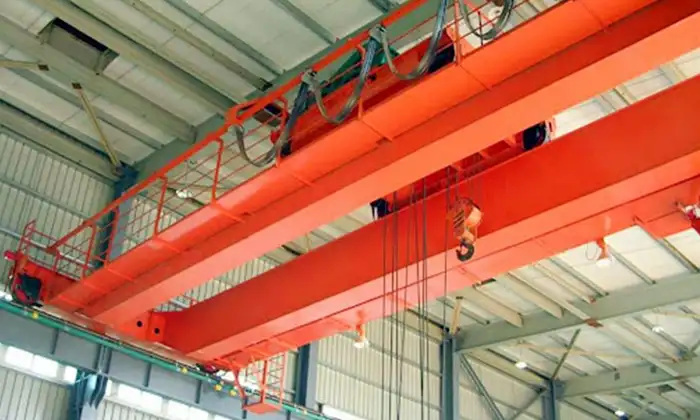
double girder overhead crane for sale
Structure
A typical double girder crane includes:
- Two bridge beams, allowing the trolley to run on top
- A crab-type trolley, which is heavier and stronger than a hoist trolley
- Robust end carriages designed for higher loads and longer spans
- More stable lifting performance due to the dual-girder structure
Typical Capacities and Spans
Double girder cranes are built for heavier loads and longer working areas:
- Capacity range: 10 tons to 100+ tons
- Span range: 10 meters to 40+ meters
- Duty rating: medium to heavy duty (FEM 2m–4m or higher)
- Hook height: excellent, often significantly higher than single girder systems
Common Applications in Medium- to Heavy-Duty Industrial Environments
- Steel mills and billet/coil handling workshops
- Heavy machinery manufacturing
- Foundries, forging plants, and casting shops
- Mold lifting in large injection molding factories
- Power plants and turbine workshops
- Shipbuilding and large fabrication halls
Key Comparison Factors for Tight Industrial Spaces
Choosing between a single girder and a double girder crane becomes much easier when you look at how each design performs in real workshops with limited space. In tight industrial environments, even small differences in headroom, end carriage size, or span range can influence the final decision. Here's a practical breakdown to help buyers understand what truly matters.
Headroom is often the first issue that shows up when installing a crane in a compact workshop. The available space between the runway beam and the roof decides how high the hook can travel—and this can make or break your lifting operation.
How Single Girder Cranes Save Vertical Space
- The hoist sits below the girder, keeping the overall structure compact
- Ideal for low or mid-height buildings
- Fewer structural parts mean less vertical clearance needed
- Works well when you need just enough lifting height without dealing with heavy loads
When Double Girder Cranes Achieve Better Hook Height
- The hook can travel higher, often reaching close to the girder level
- Useful when lifting tall molds, dies, or machines
- A good match for workshops that need maximum vertical travel
- Helps when equipment must be lifted above taller machinery already installed on the ground
Impact on Mold Handling, Machine Workshops, and Assembly Lines
- Mold handling (plastic, die-casting, rubber): taller molds need high lifting travel
- Machine workshops: moving big machines or parts often requires lifting over obstacles
- Assembly lines: precise positioning with minimal interference from the crane structure
Workshops are getting busier and more crowded. The crane's footprint—especially the end carriage size and required clearances—matters more than many buyers expect.
Differences in End Carriage Dimensions
- Single girder end carriages are usually smaller and lighter
- Double girder end carriages are wider, stronger, and built for higher loads
Clearances Required
- Single girder cranes generally need less side clearance
- Double girders need more approach distance due to their wider structure
- Tight workshops often prefer single girders for better hook approach and side reach
Suitability for Narrow Runways and Compact Facilities
- Bays are narrow
- Columns are placed closely
- Existing runway beams have limited width or load capacity
Span refers to the distance between the runway beams, and it plays a big role in selecting the right crane design.
Economic Spans: Single Girder vs Double Girder
- Single girder cranes are more economical for short to moderate spans, typically up to 20–28 meters
- Lighter structure reduces cost
- Perfect for compact workshops and small fabrication halls
- Double girder cranes handle longer spans much better, suitable for 20–40+ meters
- Provide better stability and lower deflection
- Required when the bay width is large, or heavy lifting is involved
Impact on Bay Width Planning
- Narrow bays → single girder is usually more practical
- Medium to wide bays → double girder becomes more reliable
- If heavy machines are placed near the runway columns, the added structural load of a double girder may require reinforcement
Single Girder Cranes
- Typical range: 1 ton to 20 tons
- Best for light to medium lifting tasks
- More economical for small to moderate workloads
Double Girder Cranes
- Typical range: 10 tons to 100+ tons
- Built to handle heavy loads regularly
- More stable for frequent lifting cycles and long spans
Duty Cycle: Light/Medium vs Medium/Heavy Duty (FEM/AIST)
- Single Girder Cranes: suitable for light to medium duty, FEM: 1Bm, 1Am, 2m
- Double Girder Cranes: suitable for medium to heavy duty, FEM: 2m, 3m, 4m
Structural Load Requirements
- Single girder cranes are lighter → less load on runway beams, suitable for older buildings, lower reinforcement cost
- Double girder cranes are heavier → may require runway strengthening or larger columns
Rail Size and Support Structure Differences
- Single girder: smaller rail size, compatible with lighter runways, easy installation on existing beams
- Double girder: larger rails, stronger beams, more sensitive to alignment
Fit-Out Considerations
- Low ceilings
- Existing machines
- Cable trays, ducts, and lighting
- Tight access points for lifting equipment
- Limited space for scaffolding or cranes
Direct Equipment Cost
- Single Girder Crane: lower purchase cost, simpler components, economical for moderate lifting
- Double Girder Crane: higher upfront cost, heavier steel, extra features like maintenance walkways
Installation and Civil Work Impact
- Single Girder Crane: faster installation, less civil work, fewer modifications
- Double Girder Crane: more complex hoisting, may require runway reinforcement, higher access needed
Long-Term Maintenance Cost Difference
- Single Girder Crane: fewer components → lower maintenance cost, easier hoist access, simpler electrical system
- Double Girder Crane: more wheels, motors, higher spare part cost, higher maintenance over 10–15 years
Feature Comparison Table (Single Girder vs Double Girder Cranes)
Below is a clean, practical, and buyer-friendly comparison table. Each category highlights what matters most when choosing a crane for tight industrial spaces. The wording is straightforward so it’s easy for Google, AI models, and human readers to understand and cite.
Single Girder vs Double Girder Overhead Cranes — Quick Comparison Table
| Feature | Single Girder Overhead Crane | Double Girder Overhead Crane |
|---|---|---|
| Lifting Capacity | 1–20 tons (best for light to medium loads) | 10–100+ tons (designed for medium to heavy lifting) |
| Hook Height | Moderate; hoist hangs below the girder | Excellent; trolley runs on top of dual girders for maximum lift height |
| Duty Rating | Light to medium duty (FEM 1Bm–2m) | Medium to heavy duty (FEM 2m–4m) |
| Span Range | Short to moderate spans (6–28 meters) | Medium to long spans (20–40+ meters) |
| Cost Level | Lower cost (equipment + installation) | Higher cost due to heavier structure and components |
| Space Efficiency | Very good for low headroom and narrow bays | Good vertical lift, but needs more side clearance and stronger building structure |
| Installation Requirements | Easier installation, lighter load on runways; fewer building modifications | Requires reinforced runways, larger rails, more installation space and heavier equipment |
| Ideal Applications | Light fabrication, machinery assembly, warehouses, maintenance shops, small production lines | Steel mills, heavy fabrication, foundries, large mold lifting, long-span workshops, high-duty industrial work |
Best Applications in Tight Industrial Spaces
Choosing the right crane for a compact workshop isn't just about lifting capacity—it's about how the crane fits into the workflow, the available space, and how often it will be used. Here's a practical guide to help buyers decide between single and double girder cranes based on real-world needs.
Single girder cranes are often the go-to choice when space is limited and lifting requirements are moderate. They're simple, cost-effective, and easier to install without major modifications to the building.
Practical Situations Where Single Girder Cranes Shine
- Low to medium capacity lifting – typically under 20 tons, perfect for light materials and components.
- Short spans – ideal for workshop bays up to around 28 meters.
- Limited budgets – lower purchase and installation costs make it more affordable.
- Low to normal duty cycles – suitable for occasional or moderate daily lifting.
Typical Applications
- Fabrication shops handling steel or light machinery parts
- Warehouse operations for loading/unloading materials
- Machinery assembly workshops where overhead space is limited
- Maintenance bays and small production lines
In short, if your workshop is compact and the loads aren't extremely heavy, a single girder crane usually offers the simplest, most practical solution.
Double girder cranes are better suited for environments where lifting requirements are heavier, more frequent, or more precise. Though they need more space, the added height, capacity, and stability often justify the investment.
Practical Situations Where Double Girder Cranes Excel
- High lifting height requirements – ideal for tall molds, machines, or stacked products.
- High capacity or frequent use – heavy loads and continuous operation demand a robust structure.
- Need for auxiliary hook or special lifting devices – double girder design allows multiple hoists or lifting systems.
Typical Applications
- Steel mill bays and coil handling workshops
- Heavy machinery manufacturing plants
- Mold handling in injection molding or die-casting factories
- Large assembly lines requiring precision positioning
In short, when the lifting task is demanding or repeated frequently, a double girder crane provides durability, stability, and higher hook height—despite needing more space and investment.
Special Design Considerations for Tight Workshops
Even after deciding on a single or double girder crane, tight industrial spaces often require additional design tweaks. These adjustments can make installation easier, improve efficiency, and maximize safety.
Low-headroom hoists are perfect when vertical space is limited. They allow the hook to reach higher without raising the crane structure.
- Maximizes lifting height in low-ceiling workshops
- Reduces building modifications, saving time and cost
- Lighter and easier to install than standard hoists
Ideal for:
- Small fabrication shops
- Mold handling in injection molding facilities
- Maintenance bays with low overhead clearance
Shorter end carriages reduce the crane's side clearance requirements and improve maneuverability in narrow bays.
- Fits narrow or crowded workshops
- Improves hook approach near walls or columns
- Reduces overall structural footprint
Points to consider:
- Ensure runway can safely support the reduced carriage
- Verify stability under expected loads
Side-mounted or underrunning cranes hang from the runway instead of sitting on top. This is a practical solution when floor or overhead space is limited.
- Frees up floor space for equipment or materials
- Reduces interference with existing structures
- Ideal for retrofitted workshops
Best for:
- Narrow or crowded workshops
- Areas with low ceilings or multiple obstructions
Columns in older or compact buildings can limit crane travel. Optimizing clearance is key for safe and efficient operations.
- Adjust crane width or end carriage length to fit between columns
- Custom trolley placement allows better hook access
- Plan runway layout carefully to avoid collisions
European-style compact hoists are smaller, more efficient, and perfect for tight workshops. Traditional hoists may still be used in some applications but have a larger footprint.
Advantages of European-style hoists:
- Smaller size under the girder
- Smooth operation and higher efficiency
- Works well with low-headroom or short-span cranes
When traditional hoists work:
- Budget limitations
- Taller workshops where space isn't an issue
- Heavy-duty lifting requiring frequent maintenance
Buyer Checklist: What Information You Should Confirm Before Selecting a Crane
Choosing the right crane isn't just about capacity. In tight industrial spaces, every detail matters. Use this checklist to gather the information you need before making a decision.
Before you pick a crane, know exactly what weight it needs to lift and how often.
- Maximum load per lift
- Frequency of operation (occasional, daily, continuous)
- Duty rating required (light, medium, or heavy)
This ensures you choose a crane that is strong enough without overbuilding and wasting space or money.
Space above and below the crane determines which design will fit.
- Distance from runway beam to roof
- Beam-to-beam width for hook travel
- Clearance needed for maintenance access
This is especially important in low-ceiling workshops where every centimeter counts.
The distance between runway beams and the overall travel length affect crane selection.
- Span of the bay (distance between runway beams)
- Total length of the runway
- Any obstructions along the path
Single girder cranes are better for short to moderate spans, while double girder cranes handle longer spans and heavier loads.
Different materials and shapes require different crane designs.
- Steel plates, billets, or coils
- Molds and dies
- Machinery components or assemblies
Knowing the type of load helps determine hook type, hoist selection, and any special attachments needed.
Make sure your workshop can support the crane's electrical requirements.
- Voltage and phase type
- Control method: pendant, radio remote, or cabin operation
- Compatibility with existing equipment
Correct specifications prevent costly electrical upgrades or performance issues.
Think ahead before installation. Today's small workshop may grow, and tomorrow you may want automation.
- Plans for higher capacity or additional cranes
- Possibility of adding automation or remote operation
- Need for integration with existing material handling systems
Selecting a crane that can adapt saves both money and downtime in the long run.
Conclusion
Selecting the right crane for a tight industrial space is about more than lifting capacity. It’s about matching the crane’s design to the physical constraints, operational needs, and long-term workflow of your workshop.
Which Crane Suits Which Industrial Condition
Single Girder Cranes
- Best for low to medium loads
- Short spans and low headroom spaces
- Workshops with moderate duty cycles and tighter budgets
Double Girder Cranes
- Ideal for heavier loads and frequent operation
- Taller hook heights and longer spans
- Workplaces that may use auxiliary hoists or special lifting devices
Understanding these distinctions helps ensure your crane works efficiently and safely without wasting space or investment.
Matching Crane Type to Workshop Constraints
Every workshop has unique limitations: ceiling height, bay width, column placement, or machinery layout. Choosing a crane without considering these constraints can lead to installation difficulties, workflow interruptions, or costly modifications.
- Evaluate headroom, span, and floor clearance
- Consider load types and lifting frequency
- Plan for electrical supply, controls, and maintenance access
Seeking Customized Solutions
Even within single or double girder designs, small adjustments can make a big difference in tight workshops.
- Low-headroom hoists for maximum lift in low ceilings
- Short end carriages for narrow bays
- Side-mounted or underrunning options to free up floor space
- Compact European-style hoists for smoother operation
Consulting with an experienced crane supplier can help you design a solution tailored to your space, ensuring safety, efficiency, and long-term reliability.