Overhead Bridge Crane Span Basics: Design, Cost, Layout Impact
Learn how crane span affects bridge crane type, cost, lifting capacity & workshop layout—essential for smart planning& design.Get customized bridge crane!
Overhead Bridge Crane Span Basics: How It Impacts Your Crane Design, Cost, and Workshop Layout
Introduction: Why Span Matters When Buying a Bridge Crane
When you're looking to buy an overhead bridge crane, there's one number that plays a bigger role than most people think: the span. Simply put, it’s the distance between the two runway rails the crane travels on.
Now, that might sound like just another spec on the datasheet. But here’s the thing — span affects everything:
- how the crane is designed,
- how it fits your workshop,
- how much it costs,
- and how easy it is to install or expand in the future.
If you’re installing a crane in an existing building, you’ll need to match the span to your current runway or building width. If you're building from scratch, you’ll want to design your workshop with the crane's span in mind — not the other way around.
Let’s break down why span matters:
- Impacts the steel structure: A longer span means a heavier bridge beam. That means more material, more cost, and often higher support needs.
- Affects the crane’s capacity and stability: Wider spans can introduce deflection and vibration if not properly supported.
- Ties directly to your building layout: You can’t just choose a crane span and hope it fits. It has to work with your column spacing, runway beam position, and even your wall clearance.
So whether you’re buying a crane for a finished workshop or designing a new facility, understanding and planning around the crane’s span — from the start — will save you time, money, and future headaches.
In the sections that follow, we’ll look at:
- How span varies between single girder, double girder, and underhung bridge cranes.
- Typical span ranges for each type.
- And some practical buying tips, especially when working with existing workshops or planning a new one.
Crane Span and Workshop Width: What Comes First?
This is a common question, especially for first-time buyers: Do I choose the crane span based on my workshop, or do I design the workshop around the crane? The answer depends on whether your building already exists or is still on the drawing board.
For Existing Workshops
If the workshop is already built, the span of your bridge crane is mostly locked in. It’s defined by the distance between the two runway beams or support columns — which are part of the structure. In this case, your crane must be designed to fit the building, not the other way around.
- Your options might be limited to a certain crane type (like a single girder) depending on height and width.
- You’ll need to measure the clear inside width, from column to column, and subtract space for end clearance.
- Make sure there’s enough headroom if you're considering a top-running system.
For New Workshops or Facilities
If you’re still in the planning phase of your facility, you’ve got more freedom. In fact, this is the best time to optimize the workshop layout around the crane, not just for function, but for long-term savings.
- You can design the span to match an efficient and cost-effective crane type.
- Structural supports (columns, beams) can be spaced to suit the crane’s needs.
- It opens up room for future expansion or automation without major redesigns.
A Few Practical Points to Remember:
- The crane span is typically 0.5 to 1 meter shorter than the clear internal width of the building, to allow for safe end clearances.
- Longer spans mean heavier and costlier girders — especially for double girder designs.
Always leave room for:
- side clearances (about 200–500 mm each side, depending on crane type),
- maintenance walkways if required,
- future runway extension or capacity upgrades.
If you’re building new, always bring in your crane supplier early. They can help your civil engineer design a workshop that works with the crane system — not against it. That alone can save you weeks of rework and thousands in unnecessary costs.
Understanding Span by Crane Type
The span of an overhead bridge crane isn’t just a structural dimension — it’s closely tied to the type of crane you choose. Different crane designs handle span and load in different ways. Here’s how span considerations vary, starting with the most commonly used crane type: the single girder overhead crane.
This crane type uses one main beam (the girder), across which the hoist and trolley move. The hoist typically runs on the bottom flange of the beam. Because of its simplicity, it’s widely used in small to mid-sized workshops.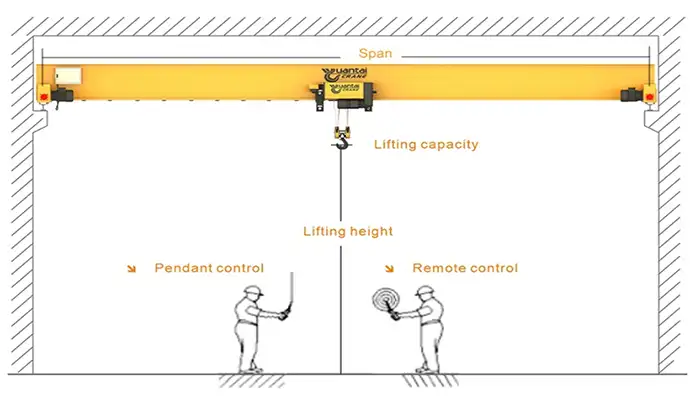
Typical Span Range:
- 6 to 22 meters
The actual span limit depends on load capacity, building structure, and hoist type. Some custom models can exceed this, but that’s less common.
Practical Notes:
- Ideal for light to moderate loads, usually up to 20 tons.
- Best suited for short to medium span requirements.
- Hoist is underslung (below the beam), which saves cost but slightly reduces the effective lifting height.
Buying Tips:
- Great choice if your workshop has limited headroom. The compact design fits tight vertical spaces.
- Faster to install and easier to maintain compared to double girder cranes — fewer parts, simpler alignment.
- Offers a more budget-friendly option, especially for basic material handling needs.
- Ensure the runway beams and structure can support the side thrust created by the trolley movement.
A double girder crane features two parallel beams, with the hoist and trolley system running on top of the girders. This design provides superior strength, stability, and lifting height, making it suitable for more demanding industrial applications.
Typical Span Range:
10 to 35 meters (can be extended with custom engineering solutions)
Where It Works Best:
- Large industrial workshops
- Steel and fabrication plants
- Environments with high lifting frequencies and heavy-duty operations
Buying Considerations:
- Offers higher lifting height because the hoist sits on top of the girders, not underneath.
- Longer hook travel makes it ideal when you need precise positioning across wide spaces.
- More expensive than a single girder crane, due to added structural materials, engineering, and installation requirements.
- Heavier self-weight means your runway and columns must be stronger, especially for long spans.
Good to Know:
- Double girder cranes often support additional features like maintenance walkways, auxiliary hoists, and cab control.
- If your plant layout demands frequent, heavy, or large-object handling — this crane type gives you room to grow
Underhung (Underrunning) Bridge Crane
The underhung bridge crane is a unique solution where the crane rides beneath the runway beams, rather than on top. The runway beams themselves are often suspended from the roof structure, making this crane ideal for buildings with spatial or structural limitations.
Typical Span Range:
- 3 to 20 meters, depending on load capacity and roof structure strength
Where It Works Best:
- Lightweight manufacturing and assembly workshops
- Warehouses with low headroom
- Facilities where floor space and structural columns are limited
Buying Considerations:
- Underhung cranes are perfect when you want to avoid adding support columns on the ground.
- The system can be suspended directly from the ceiling or roof trusses — saving floor space.
- These cranes usually carry lighter loads, often under 10 tons, and are used for less intensive lifting cycles.
Important Structural Note:
- Before installation, you must evaluate your building’s roof load-bearing capacity. Not all existing structures can safely support an underhung system.
- Custom runway design may be needed if the structure isn’t strong enough to carry the full weight of the crane and load.
Practical Span Planning: What Buyers Should Know
When planning to install a bridge crane—whether it’s a top-running single girder, double girder bridge crane, or an underhung (underrunning) crane—getting the span right is critical. It affects the crane's performance, cost, and long-term flexibility.
For Existing Buildings:
If your building is already constructed, here’s what you need to do before purchasing a bridge crane:
- Measure the clear span between the runway beams or supporting columns.
- Verify available headroom, especially if you're considering a top-running double girder crane, which requires more vertical space.
- Inspect the roof structure or building frame to determine if it can safely support an underhung bridge crane.
- Plan for end clearances—you’ll need space for crane travel at both ends of the runway and for hoist positioning.
- Check support alignment—especially important if you are retrofitting a crane system into an older workshop.
Tip: Existing buildings often limit your crane span options. In these cases, customizing your crane’s span or choosing a modular bridge crane design can help overcome layout constraints.
For New Workshop Designs:
If you’re still in the planning or construction phase, you have an opportunity to optimize your bridge crane system from the ground up.
- Consult your crane manufacturer or supplier early—ideally before finalizing the workshop’s structural layout.
- Design the building width to suit standard crane spans, which are often 7.5m, 10m, 15m, 20m, etc. This minimizes customization costs.
- Choose column spacing that matches the bridge crane runway beam design—this will reduce unnecessary structural adjustments later.
- Reserve enough vertical space for the selected crane type—top-running double girder bridge cranes need the most headroom, while underhung cranes are better for low ceilings.
- If heavy-duty usage is expected, plan for future scalability—for example, allowing space for longer spans or dual hoists.
Tip: A well-planned crane span can also reduce building material costs and increase operating efficiency across your production line.
Final Tips for Bridge Crane Buyers
Selecting the correct span is just as important as choosing the right crane type or lifting capacity. A well-planned span ensures smooth crane operation, accurate load movement, and reduced long-term maintenance.
Avoid specifying an oversized span without structural reinforcement. Excessive span lengths can cause beam deflection, uneven wheel loading, rail misalignment, or even unsafe operating conditions.
Always provide your bridge crane supplier with accurate workshop dimensions, including internal width, column spacing, runway beam length, and available headroom. These details are essential for designing a reliable and efficient crane system.
Consider potential future changes, such as increasing load capacity, adding new machinery, or extending the workshop bays. These factors may impact your crane span requirements and influence your choice of crane type.
Involve your crane manufacturer early in the planning stage. Their technical team can help you determine whether a top-running or underhung bridge crane is better suited for your current layout and future expansion needs.