
How Span Affects Overhead Crane Design: Single or Double Girder
Bridge span size guides the choice between single and double girder 5-ton cranes, impacting cost, performance, and installation.Bridge cane span size guides the choice between single and double girder 5 ton overhead cranes, impacting cost, performance, and installation. Check how crane span length affects the selection of 5 ton overhead crane girder designes.
How Bridge Crane Span Affects Crane Design: Choosing Between Single and Double Girder 5-Ton Overhead Cranes
Introduction
If you're planning to buy a 5-ton overhead crane, one of the most important things to get right from the start is the bridge span. That’s the distance between the two rails—or runway beams—that the crane bridge travels on. It sounds simple, but this one measurement can affect your entire crane design, from the girder type to the hoist selection and even your workshop layout.
In short, the bridge span controls how wide your crane can operate—and it’s not something you want to guess. Whether you’re working in an existing factory or designing a new workshop, getting the span right can save you a lot of trouble later.
Now here’s where the next decision kicks in:
Should you go for a single girder or double girder crane? For a 5-ton capacity, both are technically possible—but which one fits best really depends on the span.
Why Bridge Span Matters in Crane Design
The longer the span, the more pressure is placed on the crane structure and the building. A wider span usually means a stronger girder—and that means more cost and more weight. Not all buildings can support it.
- For short spans (typically under 15–18 meters), single girder cranes are usually the go-to.
- When spans start pushing past 20 meters, the structure gets more complex. In many cases, double girders are preferred to maintain stability and reduce beam deflection.
- For tight ceiling heights, the span might also affect your hoist clearance—single girders give more headroom flexibility in some situations.
Single Girder vs. Double Girder for 5-Ton Cranes: Why Span Makes the Difference
It’s easy to assume that a 5-ton load can go either way—and it can. But span tips the balance.
- Single Girder Cranes are lighter and more economical. They’re ideal for moderate spans up to about 18–20 meters, depending on your building’s structural support and hoist type.
- Double Girder Cranes become more practical when the span gets wider or when you need extra features like walkways or maintenance platforms. They also give you more lifting height because the hoist can sit between the girders instead of below them.
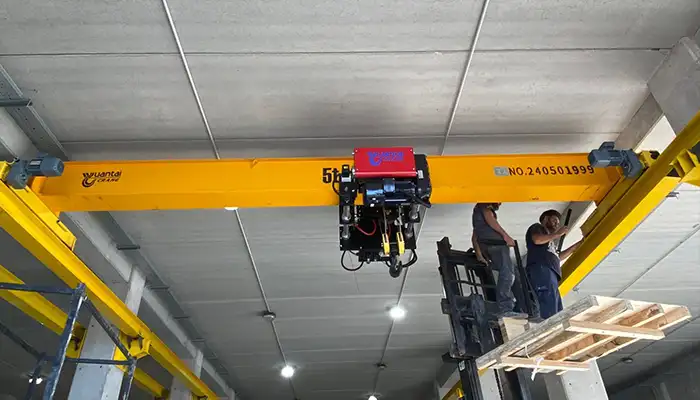
What This Section Will Cover
This article will break down:
- How to measure and plan your bridge span properly
- At what span size you should consider switching to a double girder
- Real-life examples of span vs. crane structure for 5-ton cranes
- Tips for aligning your crane selection with your existing or planned building layout
By the end of this guide, you'll have a better handle on what type of 5-ton bridge crane makes sense for your span—without wasting time or overspending.
Bridge Span and Its Role in Crane Design
Before getting into beam types and crane options, let’s clarify what bridge span actually means. In overhead crane terms, the span is the horizontal distance between the centerlines of the two runway rails. It’s not the total width of the crane—it’s the space the crane bridge travels across, usually mounted on top of the building’s runway beams.
This one measurement has a big impact on nearly every part of your crane’s design and performance. Here’s how.
Span Determines Structural Strength Requirements
A wider span means the crane bridge needs to stretch further while still supporting the load. That introduces more stress into the beam and end carriages.
- For short spans (under 15 meters), standard beams and basic hoists are usually enough.
- As the span increases, deflection (bending of the beam) becomes a real concern. The beam must be engineered to resist sagging under the crane’s own weight plus the load.
- Wider spans also require higher safety margins to ensure long-term performance.
Span Directly Affects Beam Size and Weight
To keep the crane stable over a wider distance, the beam (girder) must either be deeper, wider, or made from stronger material. All of this adds weight, which puts more load on the building structure.
- Single girder cranes will often max out in span before they max out in load—especially at 5 tons.
- A double girder design may be needed not because of the weight, but because of the span-induced stress.
- Heavier beams may also require heavier-duty runway rails and supports.
End Carriage Design Changes with Span
The end carriages—which hold the crane wheels and connect to the bridge—need to match the span. With wider spans, end carriages must be longer, stiffer, and better aligned to prevent tracking issues.
- Long spans can cause wheel misalignment or uneven rail wear if not properly supported.
- Skewing, where the crane twists slightly as it moves, is more common on wider spans and needs to be corrected through proper carriage design and installation.
Span Influences Overall Crane Stability and Performance
Wider spans increase the chance of unwanted movement, vibrations, or lateral sway, especially under load. This affects operator safety and lifting precision.
- Wider cranes may need frequency-controlled drives to ensure smooth travel and prevent jerking.
- Structural stiffness must be matched with rigid connections between girders and end trucks.
- Taller workshops may help compensate for wider spans, but in low headroom spaces, span choices become even more sensitive.
In short, the bridge span isn't just a number—it's a design driver. For a 5-ton overhead crane, knowing your span range upfront will help you choose the right girder type, hoist configuration, and building support. Get it right, and everything works smoother. Get it wrong, and costs climb fast—or worse, you run into performance limits later on.
Single Girder Overhead Crane for 5 Tons
When you're considering a 5-ton overhead crane, a single girder design is often the most economical and practical choice—especially when your span requirements are moderate.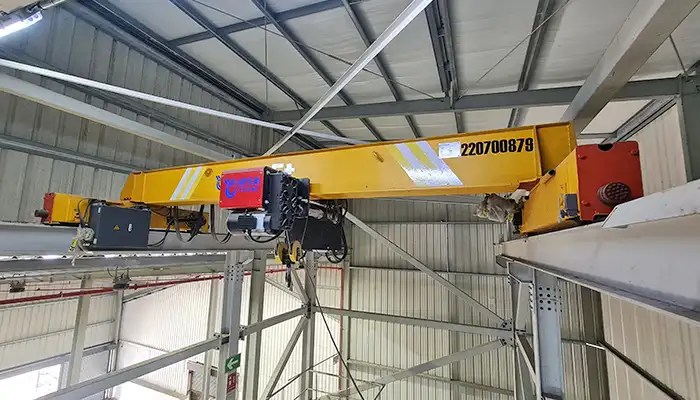
5 ton single girder overhead crane for sale and check more specifications
Typical Span Range for Single Girder
- Single girder overhead cranes are generally recommended for spans up to about 20 meters.
- Beyond this, deflection and structural limitations start to make them less efficient or cost-effective.
- The ideal span for a 5-ton single girder crane is usually between 6 to 18 meters, depending on the specific use case and building structure.
Advantages of a 5-Ton Single Girder Crane
- Lower Cost
Compared to double girder cranes, single girder systems use fewer materials and are faster to fabricate, reducing both upfront cost and shipping expenses. - Simpler Design & Faster Installation
With fewer structural components, single girder cranes are easier to install and require less alignment work. This can also shorten project timelines. - Great for Low Headroom Workshops
When paired with a low-headroom hoist, single girder cranes are well-suited for buildings where vertical space is limited.
Limitations to Keep in Mind
- Reduced Lifting Height
Most single girder cranes use an underslung or side-mounted hoist, which hangs below the beam. This eats into the available lifting height—something to consider in tight vertical spaces. - Less Stiffness Over Long Spans
As the span increases, a single beam tends to flex more under load, especially at the center. Excessive deflection can reduce precision and increase wear on the crane structure over time.
Best Applications for a 5-Ton Single Girder Crane
- Light-duty production lines with consistent loads and short travel distances
- Maintenance workshops and repair bays that don’t require full-time crane operation
- Small to medium-span installations (under 20 meters) where budget, simplicity, and quick installation are priorities
- Ideal for industrial buildings with tight vertical clearance but strong lateral support walls or steel frames
In summary, for a 5-ton crane working within modest span ranges, the single girder design offers excellent value and simplicity. But if you're pushing toward longer spans or need more lifting height, it's time to start thinking about double girder alternatives.
Double Girder Overhead Crane for 5 Tons
While many buyers assume double girder cranes are only necessary for high-capacity lifting, that’s not always the case. Even at 5 tons, span and operational demands can make a double girder system the smarter choice—especially in larger or more demanding workshops.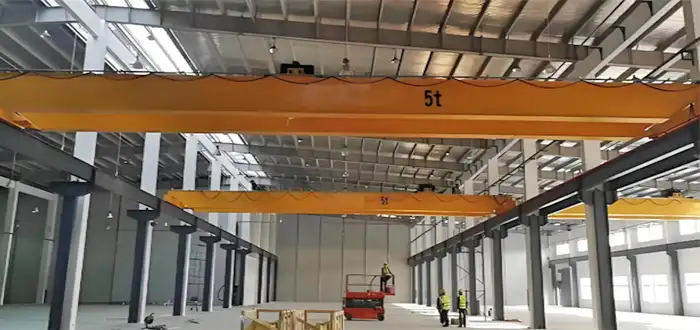
5 ton double girder overhead crane for sale and check more on specifications
Typical Span Range for Double Girder Cranes
- Double girder cranes are typically used for spans of 20 meters and above, often stretching to 30 meters or more.
- When a 5-ton crane needs to cover a wide area or support long travel distances, a double girder design ensures better performance and safety over time.
Advantages of a 5-Ton Double Girder Crane
- Higher Lifting Height
The hoist sits on top of the girders, which means you gain extra vertical clearance. This can make a big difference in operations that require lifting close to the ceiling or stacking materials at height. - Improved Rigidity and Minimal Deflection
With two main beams sharing the load, the crane structure is more stable. This results in less deflection during lifting and smoother trolley movement—important when precision matters. - Better for Frequent or Heavy-Duty Operation
If the crane will be used multiple times per hour or in tough conditions, the double girder setup offers the durability and endurance needed to avoid early wear and tear.
Limitations to Consider
- Higher Cost and More Complex Installation
You’ll pay more for materials, shipping, and labor, and the installation process requires more alignment work. However, the investment often pays off in performance and lifespan. - Requires More Vertical Clearance
Since the crane girders sit above the runway beams and the hoist rides on top, additional headroom is necessary. That can be a limiting factor in older or low-clearance facilities.
Best Applications for a 5-Ton Double Girder Crane
- Large-span workshops and warehouses where single girders fall short
- Frequent-use environments like steel fabrication or assembly lines with continuous lifting operations
- Precision lifting needs, especially where minimal sway and deflection are essential
- Facilities that require future upgrades, such as automation or tandem lifting systems, which are easier to integrate into double girder setups
Bottom line: if your 5-ton crane project involves longer spans, tight lifting tolerances, or high usage frequency, a double girder crane isn’t just overkill—it’s a reliable, long-term solution built for serious work.
How Bridge Span Guides Your Choice: Single vs. Double Girder
When selecting between a single girder and a double girder overhead crane—especially for a 5-ton capacity—the bridge span is often the most decisive factor. Here's how it plays into your decision:
General Span-Based Guidance
Bridge Span < 18–20 Meters → Single Girder Often Sufficient
- For short to moderate spans, a single girder crane can meet structural and operational requirements with a simpler, more economical design.
- Ideal for light-duty applications, low to moderate lifting frequency, and workshops with limited ceiling height.
Bridge Span > 20 Meters or Need for Higher Lifting Height → Double Girder Recommended
- As the span increases, a single girder may suffer from increased deflection, reduced precision, and limited hook height.
- Double girder designs provide enhanced rigidity, greater vertical lift, and are better suited to demanding environments.
Additional Factors That Influence the Decision
Available Headroom
- Low headroom? Single girder with an underslung hoist might be better.
- Sufficient clearance? Double girder offers better lifting height.
Frequency and Type of Lifting
- Occasional or maintenance lifting: Single girder is typically enough.
- Frequent, repetitive, or precise lifting: Double girder offers long-term durability and performance.
Budget Constraints
- Single girder systems are more cost-effective up front (lower fabrication, installation, and material costs).
- Double girder cranes have higher initial costs, but may offer better ROI in heavy-use scenarios.
Future Expansion or Automation Needs
- Double girder cranes are easier to upgrade with platforms, walkways, maintenance rails, or automation features.
Quick Reference Summary
| Bridge Span | Recommended Crane Type | Notes |
|---|---|---|
| < 18 meters | Single Girder | Cost-effective for light/medium use |
| 18–20 meters | Single or Double | Based on lift height, use frequency |
| > 20 meters | Double Girder | Better structural performance, higher lift |
Bridge span doesn’t just affect how your crane fits in the building—it directly impacts safety, performance, and long-term value. For 5-ton overhead cranes, keeping the span in mind helps you make the right call between simplicity and strength.
Practical Buying Tips for 5-Ton Overhead Cranes
Buying a 5-ton overhead crane involves more than just selecting the load capacity. Factors such as bridge span, lifting height, headroom, and workshop layout all play a critical role in determining whether a single or double girder design is more suitable. Use the following tips to guide your decision:
- Bridge span: Distance between runway rails (center-to-center)
- Clear height: Floor to the lowest overhead obstruction (e.g., beams, trusses)
- Runway length and end approach: Space available for crane travel
Accurate measurements ensure your crane fits the space and meets lifting coverage needs.
- Hook height: Maximum height you need to lift the load
- Working area: How far the crane needs to reach
- Lifting frequency: Light maintenance vs. frequent industrial use
These parameters influence whether a single or double girder crane is better suited.
- Provide span, lifting height, and clear height details
- Mention building restrictions, environmental conditions, and workflow layout
- Explain application needs (e.g., indoor/outdoor, high dust, or heat)
Clear communication helps the supplier recommend the most efficient design.
- Ask for layout drawings for both single and double girder types
- Review hoist and trolley specifications
- Check for load deflection, clearances, and component dimensions
Side-by-side comparisons allow you to assess performance, clearance, and structural demands.
- Include installation, runway fabrication, and alignment costs
- Evaluate ease of maintenance and local support
- Account for spare parts availability and service intervals
While double girders often have higher upfront costs, they may offer better long-term value in demanding operations.
A properly selected 5-ton overhead crane improves efficiency and safety. Always evaluate your workshop's span, lifting height, operational frequency, and expansion potential. Consult with experienced suppliers for tailored, cost-effective solutions.
Conclusion
Choosing the right overhead crane starts with understanding how your workshop’s bridge span affects crane design. For a 5-ton crane, this decision impacts not just performance but also cost and safety. Here’s a quick summary to help guide your choice:
- Bridge span is a critical factor that influences overhead crane design, especially for 5-ton capacities.
- Single girder cranes are ideal for shorter spans and lighter workloads.
- Double girder cranes are better for larger workshops and heavier or more frequent lifting.
- Making the right choice helps optimize cost, performance, and safety.
- Collaborate with experienced crane suppliers to find the best fit for your specific span and capacity needs.