
Best Overhead Crane Configurations for Auto Assembly
Best Overhead Crane Configurations for Automotive Assembly Workshops
Key Takeaways
- Selecting the right overhead crane ensures efficient automotive assembly, safer lifting, and optimized workflow.
- Single girder cranes are ideal for light to medium loads; double girder cranes excel for heavy components like engine blocks and chassis.
- Top-running cranes maximize floor space, while under-running cranes fit low-ceiling workshops.
- Proper planning of lifting capacity, span, speed, and hoist type reduces costly downtime and improves safety.
- Automation-ready and multiple-hoist configurations can boost productivity in modern automotive assembly lines.
Introduction
Overhead cranes are at the heart of automotive assembly workshops. They move engines, transmissions, chassis, and large body panels—sometimes several tons—safely and efficiently. Choosing the right crane configuration isn’t just about lifting capacity. It affects workflow, safety, and overall production speed.
Here’s what matters most:
- The crane must match the weight and size of components.
- It must fit the workshop layout and not interfere with assembly lines.
- Operators need smooth, reliable control to avoid accidents or damage.
In this guide, we’ll break down:
- How to understand your workshop’s requirements.
- Which crane types and configurations work best.
- Practical considerations for safety, efficiency, and long-term use.
Your Workshop Needs
Before investing in an overhead crane, it’s essential to get a clear picture of what your workshop actually needs. Not all automotive assembly lines are the same, and mismatched cranes can cause delays, extra costs, and even safety hazards.
Focus on three key areas: component weights, lifting frequency, and workshop layout.
Every part in your assembly line has its own handling requirements. Knowing these will help you select the right crane and hoist combination.
- Engines and transmissions – Typically 200 kg up to 1.5+ tons. Heavy components need steady, smooth lifts.
- Chassis assemblies – Often between 1 and 3 tons. Cranes must support stable travel across long spans.
- Body panels & subassemblies – Lighter, but usually wide or awkwardly shaped. Requires precise control to avoid damage.
Practical Tip: Always plan for a 20–30% safety margin. Loads can vary, and future upgrades may increase component weights.
Keywords: automotive component handling, engine lifting crane, chassis assembly overhead crane.
It’s not just what you lift—it’s how often you lift it. Frequency impacts crane type, hoist speed, and maintenance schedules.
- High-frequency lifting: For assembly lines running multiple shifts. Cranes should be designed for constant operation with smooth acceleration, anti-sway control, and higher hoist speeds.
- Occasional lifting: For maintenance or moving heavy subassemblies. Slower operation is acceptable, but the crane must still handle peak loads safely.
Practical Tip: Cranes used frequently require regular inspections and preventive maintenance. Ignoring this can shorten the crane’s lifespan and increase downtime.
Your building’s layout heavily influences which crane will work best. Don’t overlook space planning.
- Floor space and aisle width: Narrow aisles may require compact under-running cranes.
- Ceiling height: Taller workshops can install top-running cranes for full coverage; low ceilings usually need under-running systems.
- Integration with assembly lines: Cranes must move parts without blocking conveyors, robots, or workstations.
Callout: Take the time to map your workflow before choosing a crane. Identify blind spots, congestion points, and areas where multiple cranes or longer spans could help. A little planning now prevents operational headaches later.
Key Crane Specifications for Automotive Assembly
Selecting the right overhead crane for an automotive assembly workshop goes beyond simply choosing a lifting machine. You need a system that matches your components, workflow, and workshop layout. The following specifications are critical when evaluating options:
The lifting capacity determines what your crane can safely handle. It's not just about today's components; you also need to consider future requirements.
- Match the crane's rated capacity to the heaviest part you expect to lift.
- Include a safety margin of 20–30% to account for variations in load weight or occasional heavier assemblies.
- Overloading a crane can lead to mechanical failure, safety hazards, and downtime, so never cut corners here.
Practical Tip: Keep a record of all component weights in your assembly line. It makes choosing the right hoist easier and helps during audits or maintenance planning.
The crane span affects how much of your workshop the crane can cover and how efficiently it moves components.
- Measure the distance between rails or runway beams—the crane must cover all critical stations.
- Longer spans allow fewer cranes to cover the same area, but may require double girder configurations for stability.
- For smaller workstations or short transfer distances, a single girder crane may be sufficient.
Practical Tip: Map your assembly stations on a floor plan. Visualize where the crane needs to reach and where parts are loaded and unloaded. This prevents blind spots and overlapping crane traffic.
Hoist speed and precision determine how smoothly and safely parts move across the workshop.
- High-speed hoists are ideal for busy assembly lines where time is critical.
- Precision control is essential for delicate components, such as body panels or electronics, to avoid damage.
- Consider variable speed drives or anti-sway mechanisms for larger or awkward loads.
Practical Tip: If your line involves frequent starts and stops, or tight positioning of heavy parts, prioritize precision over raw speed. A slightly slower, controlled lift is safer and reduces damage.
Your crane must be compatible with the workshop's electrical infrastructure.
- Check the voltage, phase, and current ratings before purchasing.
- Some workshops may need transformers or dedicated circuits for large cranes.
- Consider future expansion—adding cranes or robotic systems may increase electrical load.
Practical Tip: Always involve an electrician or facility engineer during crane planning. Installing a crane with the wrong power setup can lead to delays, equipment damage, and safety hazards.
Recommended Overhead Crane Configurations
Choosing the right crane configuration can make or break your workflow. The type you pick depends on component weight, workshop size, lifting frequency, and layout flexibility. Let’s break down the options commonly used in automotive assembly workshops.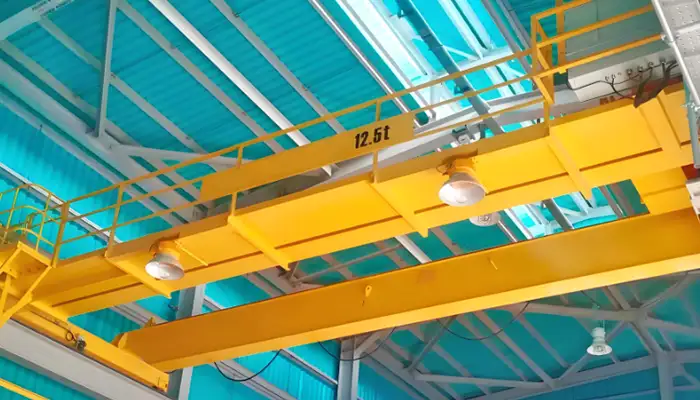
Single girder cranes are simple, reliable, and cost-effective. They’re ideal for lifting lighter components and short to medium spans.
Pros:
- Lower initial cost than double girder systems.
- Easier and faster to install.
- Lightweight design, reducing load on the building structure.
Ideal Use:
- Component transfer stations.
- Small assembly zones where loads are moderate.
- Workshops with lower ceilings or limited space.
Practical Tip: Single girder cranes are perfect for handling subassemblies or individual parts. If your workshop mainly deals with loads under 5 tons, this is usually sufficient.
For heavier components like engines and chassis, a double girder overhead crane provides extra lifting capacity, stability, and longer span coverage.
Pros:
- Can handle heavier loads safely.
- Longer spans allow coverage of wide assembly lines.
- More stable for lifting large or awkward parts.
Ideal Use:
- Engine assembly stations.
- Chassis handling areas.
- Subassembly zones where multiple heavy components are moved simultaneously.
Practical Tip: Double girder cranes are also easier to upgrade with multiple hoists or automation features, making them a smart investment for growing workshops.
The way a crane is mounted affects workshop layout and floor space.
Top-Running Cranes:
- Run on rails above the workshop.
- Free up floor space for assembly lines or conveyors.
- Suitable for large workshops with high ceilings.
Under-Running Cranes:
- Suspended from the building’s ceiling beams.
- Easier to retrofit in low-ceiling facilities.
- Ideal for workshops where floor support or runway beams are limited.
Practical Tip: Consider how much floor space you can dedicate to assembly lines and whether future expansion is planned. Top-running cranes give more flexibility for large, busy workshops.
Sometimes, a standard crane isn’t enough. These specialized setups help boost flexibility and productivity:
- Multiple Hoists per Crane: Lift more than one part at a time—perfect for heavy or paired components.
- End Trucks & Modular Gantries: Allow cranes to be repositioned or extended for changing assembly layouts.
- Automation-Ready Cranes: Designed for integration with robotic assembly lines and automated workflows.
Practical Tip: If your workshop handles mixed loads or variable workflows, investing in modular or automation-ready cranes can save time and reduce manual handling risks.
Safety and Compliance Considerations
Safety is not optional when working with overhead cranes in automotive assembly workshops. Heavy loads, moving parts, and busy production lines make accidents costly and dangerous. Following proper safety and compliance standards ensures workers, equipment, and components are protected while maintaining productivity.
Compliance with international and local safety regulations is the first step.
- ISO and OSHA standards: Ensure your cranes meet recognized quality and safety requirements.
- Local regulations: Check building codes, electrical standards, and workshop-specific requirements.
Practical Tip: Always request documentation from crane manufacturers showing compliance certificates and load test reports. This can save you from legal or insurance issues later.
Keywords: automotive assembly crane safety standards, overhead crane compliance automotive workshop.
Modern cranes should come equipped with built-in safety features to prevent accidents and equipment damage.
- Anti-sway devices: Reduce swinging of heavy or awkward loads.
- Emergency stop systems: Allow operators to halt movement instantly if a problem arises.
- Overload protection: Prevents the crane from lifting loads beyond its rated capacity.
Practical Tip: Inspect and test these devices regularly. Even the best cranes can become unsafe if safety systems are ignored or malfunctioning.
Keywords: industrial crane safety features, overhead crane anti-sway device, overload protection crane.
Even the most advanced crane is only as safe as the person operating it.
- Train operators in proper lifting techniques, load balancing, and emergency procedures.
- Provide periodic refresher courses and certifications to ensure skills stay up-to-date.
- Make safety protocols visible in the workshop and enforce them consistently.
Practical Tip: Consider cross-training multiple staff members so that crane operation is never dependent on a single operator, reducing downtime and improving safety coverage.
Cost vs. Efficiency Trade-Offs
When selecting an overhead crane for an automotive assembly workshop, it's tempting to focus only on the upfront purchase price. But the real cost of a crane extends far beyond installation. Evaluating cost versus efficiency ensures you choose a solution that saves money over the long term while keeping production running smoothly.
Single girder cranes are budget-friendly and suitable for lighter loads or smaller assembly stations.
- Lower upfront cost: Easier on the initial budget and installation time.
- Good for light to medium loads: Works well for subassemblies, body panels, or occasional engine lifts.
- Simpler maintenance: Fewer components make servicing easier and faster.
Practical Tip: Single girder cranes can be cost-effective, but avoid overloading them. If your workshop's lifting needs grow, you may need to upgrade sooner than expected.
Double girder cranes cost more upfront but deliver long-term efficiency and safety, especially for heavy lifting.
- Higher lifting capacity: Handles engines, chassis, and other heavy subassemblies with ease.
- Longer lifespan: Robust construction resists wear even under frequent use.
- Greater efficiency: Can incorporate multiple hoists or automation, reducing handling time.
Practical Tip: Consider double girder cranes as an investment. Although more expensive initially, they often save money on downtime, repairs, and upgrades over time.
To make an informed decision, factor in the total cost of ownership, not just the purchase price:
- Maintenance: Regular inspections, lubrication, and part replacements.
- Downtime: Lost production if the crane is underpowered, overloaded, or poorly maintained.
- Energy consumption: Faster hoists and frequent usage can increase electricity costs.
Practical Tip: Compare options using a workshop crane ROI analysis. Sometimes a slightly higher upfront investment pays off in reduced long-term operating costs and increased productivity.
Maintenance and Operational Planning
Proper maintenance and operational planning are essential to keep overhead cranes in automotive assembly workshops running safely and efficiently. A crane that isn't maintained can cause production delays, increased repair costs, and safety hazards. Planning ahead ensures long-term reliability and smooth workflow.
Regular inspections help catch problems before they become serious.
- Check hoists, trolleys, rails, and structural components for wear or damage.
- Lubricate moving parts according to the manufacturer's schedule.
- Inspect wires, chains, and hooks for fraying, deformation, or corrosion.
- Document all maintenance activities for compliance and safety audits.
Practical Tip: Set up a weekly, monthly, and annual inspection schedule. Consistency is key—small issues caught early save major downtime later.
Keywords: overhead crane maintenance plan automotive workshop, preventive maintenance crane, industrial crane inspection schedule.
If your assembly line runs multiple shifts or handles heavy loads continuously, predictive maintenance can help avoid unexpected failures.
- Use sensors and monitoring systems to track motor performance, vibration, and load stress.
- Identify wear trends before they lead to breakdowns.
- Schedule repairs during planned downtime to minimize production disruption.
Practical Tip: Even basic vibration or temperature monitoring can extend crane life and reduce emergency repairs in high-frequency operations.
Keywords: predictive maintenance automotive crane, high-frequency overhead crane maintenance, industrial crane condition monitoring.
Cranes are long-term investments, so planning for future expansion is important.
- Consider modular or upgradeable crane designs that can handle heavier loads or longer spans later.
- Allow room for additional hoists if assembly operations increase.
- Ensure your electrical and structural setup can support new features or automation systems without costly retrofits.
Practical Tip: Include expansion plans in your initial crane selection. It's much easier to future-proof your workshop than to retrofit later.
FAQs: Overhead Cranes for Automotive Assembly Workshops
A: The right type depends on your component weights and workflow:
- Single girder cranes: Best for lighter loads and small assembly zones. They are cost-effective and easier to install.
- Double girder cranes: Ideal for heavy components such as engines, chassis, and subassemblies. They provide higher lifting capacity, longer spans, and better stability for frequent use.
A: Consider the heaviest load you plan to lift and add a safety margin of 20–30%. Also:
- Evaluate lifting frequency—high-frequency lines need faster hoists with anti-sway mechanisms.
- Select spans and hoist precision based on component size and workflow.
- Factor in your workshop layout to ensure the crane reaches all necessary assembly stations.
A: It depends on load and coverage needs:
- Single girder cranes: Suitable for light loads, short spans, and smaller workshops. Easier to maintain and install.
- Double girder cranes: Better for heavy-duty lifting, longer spans, multi-hoist operation, or future expansion. Provides more stability and safety for large components.
Safety is critical in automotive workshops:
- Follow ISO, OSHA, and local safety standards.
- Install anti-sway devices, emergency stops, and overload protection.
- Provide operator training and maintain visible safety protocols.
- Regularly inspect and maintain all crane components to prevent downtime.
Planning ahead reduces long-term costs and downtime:
- Set up preventive and predictive maintenance schedules, especially for high-frequency operations.
- Choose modular or upgradeable cranes that can handle heavier loads or additional hoists in the future.
- Consider automation-ready cranes if integrating with robotic assembly lines.
- Factor in lifecycle costs, electrical requirements, and structural support for future upgrades.
Conclusion & Key Buyer Takeaways
Selecting the right overhead crane for an automotive assembly workshop isn’t just about picking the heaviest or most expensive option. It’s about matching the crane’s type, lifting capacity, span, and hoist performance to your workflow and component requirements. The right choice improves safety, efficiency, and long-term return on investment.
Key Takeaways for Buyers:
- Match Crane Type to Load: Single girder cranes are great for lighter components, while double girder cranes handle heavier engines, chassis, and subassemblies.
- Consider Workshop Layout: Top-running cranes free up floor space and cover large areas; under-running cranes work well for low ceilings or retrofit applications.
- Plan for Frequency & Precision: High-frequency assembly lines need faster, more precise hoists with anti-sway features.
- Factor in Maintenance & Lifecycle Costs: Routine inspections, preventive and predictive maintenance, and long-term planning reduce downtime and increase ROI.
- Future-Proof Your Investment: Modular designs, additional hoist options, and automation-ready cranes allow for easy upgrades as your assembly operations grow.
By carefully evaluating these factors, buyers can ensure smooth operations, minimize downtime, and maintain a safe workshop environment. Proper planning at the selection stage saves money, prevents workflow interruptions, and allows your automotive assembly line to operate at maximum efficiency.