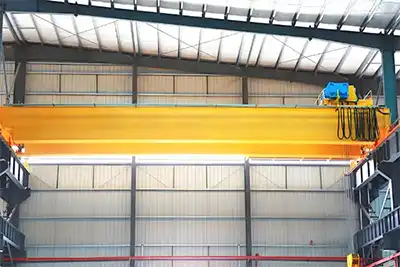
Indoor Overhead Crane Solutions for Plastic, Rubber & Packaging
Indoor Overhead Crane Solutions for Plastic, Rubber, and Packaging Plants: 5-Ton & 10-Ton Options
Most Important Takeaway
For plastic, rubber, and packaging plants, choosing the right 5-ton or 10-ton indoor overhead crane is critical to ensure safe, efficient, and reliable material handling. The correct crane addresses common plant concerns—lifting molds, rolls, and pallets safely, optimizing workshop space, and maintaining smooth production workflows.
Key Takeaways
- Capacity selection is crucial: 5-ton cranes handle molds, small rolls, and palletized goods; 10-ton cranes manage heavy molds, large rolls, and bulk packaging.
- Single vs. double girder: Single girder for light-duty lifts; double girder for heavy-duty or frequent operations.
- Top-running vs. underhung: Top-running cranes suit large spans and heavy loads; underhung cranes are ideal for workshops with limited headroom.
- Hoist selection: Wire rope hoists for heavier 10-ton loads, chain hoists for smaller 5-ton applications.
- Safety first: Overload protection, limit switches, anti-collision devices, and emergency stops are essential.
- Operational efficiency: Correct crane layout, motorized trolleys, and smooth bridge travel optimize workflow and reduce manual labor.
- Maintenance matters: Regular inspection and durable components prevent downtime in high-use plastic, rubber, and packaging environments.
Overhead Crane Use in Plastic, Rubber, and Packaging Plants
Working in plastic, rubber, and packaging plants requires understanding unique material handling and operational challenges. This guide helps plant managers select the right crane solutions for their workflow.
Working in plastic, rubber, and packaging plants brings unique demands for overhead crane use. Loads vary in shape, size, and weight, and workshops often have limited space. Understanding these challenges helps plant managers choose the right crane solution.
In these plants, cranes handle a wide variety of items:
Raw Materials:
- Plastic resins and powders (bags, drums, or hoppers)
- Rubber compounds in slabs, sheets, or rolls
Semi-Finished Products:
- Injection molds
- Plastic or rubber sheets and rolls
- Extrusion dies
Finished Products:
- Palletized boxes and crates
- Packaged goods ready for storage or shipping
Each material comes with its own lifting challenges. For example, heavy rubber rolls require careful handling, while molds need precise placement to avoid machine downtime.
Cranes in these plants face repeated and sometimes unpredictable demands:
- Frequent lifting of heavy or awkward items – Loads are often uneven or bulky. Cranes must handle them repeatedly without causing wear or safety issues.
- Limited workshop space and headroom – Many plants are compact, so cranes need to fit within height limits and move smoothly in tight areas.
- Precise placement requirements – Misalignment can disrupt production, damage molds, or cause material waste.
- High throughput demands – Plants may operate multiple shifts, requiring cranes that can work continuously without slowing production.
Plant managers often ask the same questions when selecting a 5-ton or 10-ton overhead crane:
Capacity Planning:
- Will the crane handle current loads like molds and pallets?
- Can it support potential future needs, such as heavier rolls or bulk materials?
Safety and Compliance:
- Does the crane meet safety standards?
- Does it include overload protection and anti-collision systems?
Workflow Integration:
- Can the crane fit the existing workshop layout?
- Will it move materials efficiently without blocking machines or aisles?
- Loads in plastic, rubber, and packaging plants vary from light powders to heavy molds and pallets.
- Frequent lifting, tight spaces, and high throughput are the main operational challenges.
- Buyers must choose the right capacity, ensure safety compliance, and integrate the crane with the plant workflow.
Best Crane Types for Plastic, Rubber, and Packaging Plants
Selecting the right crane type is one of the most important decisions for plant managers. In plastic, rubber, and packaging plants, cranes must handle different weights, shapes, and lifting frequencies while fitting into limited workshop layouts. Choosing the right type ensures smooth material flow, safety, and efficiency.
Single girder overhead crane for indoor material handling with capacity 1-20 ton
Single girder cranes are the go-to choice for lighter loads, typically up to 5 tons, and smaller workshop spans. They are compact, cost-effective, and easy to install, making them ideal for low-frequency lifting tasks such as moving molds, small rolls, or palletized goods.
Advantages of single girder cranes:
- Lightweight design saves space and reduces installation costs
- Simple structure requires less maintenance
- Suitable for workshops with limited ceiling height
- Easy to integrate with existing workflow for small or medium loads
Best for: Light molds, sheets, or pallets that don't require frequent lifting.
For heavier loads, usually 10 tons or more, double girder cranes are the better choice. They are stronger, more stable, and can handle high-frequency operations, such as moving large molds, heavy rubber rolls, or bulk palletized products. Double girder cranes also support higher lifting heights and longer spans, making them suitable for larger plant areas.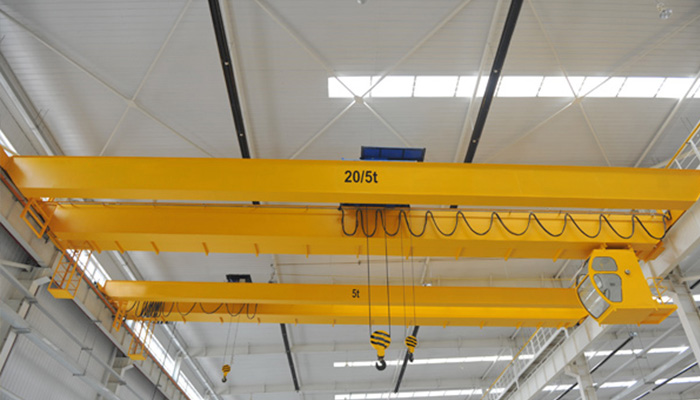
Double girder overhead crane for indoor material handling
Advantages of double girder cranes:
- Higher lifting capacity and load stability
- Can cover larger spans without compromising safety
- Durable design for frequent or continuous operations
- Supports advanced hoist configurations for precise load control
Best for: Heavy molds, large rubber rolls, or bulk packaged goods requiring repeated handling.
The choice between top-running and underhung cranes depends on workshop layout and ceiling height.
Top-Running Cranes:
- Run on rails above the workshop floor
- Can handle heavier loads and longer spans
- Ideal for plants with open ceiling space and wide production areas
Underhung Cranes:
- Hang from the ceiling or an elevated runway
- Take up less headroom, perfect for low-ceiling workshops
- Best for smaller loads or areas where floor space must remain free
Some plants have specific handling needs that require more advanced crane setups:
- Dual-trolley cranes: Lift multiple items at the same time for faster workflow
- Explosion-proof or dust-proof cranes: Required in sensitive environments with powders, dust, or flammable materials
- Semi-automated or fully automated cranes: Ideal for repetitive or high-speed lifting, reducing manual handling and increasing consistency
- Single girder cranes: Best for light loads (5 tons), compact workshops, and low-frequency lifting
- Double girder cranes: Handle heavy loads (10 tons), frequent lifting, and large spans
- Top-running vs. underhung: Choose based on ceiling height and load weight
- Special configurations: Useful for high-speed, dual-lift, or sensitive plant environments
Key Components and Features for Plant-Specific Needs
Selecting the right overhead crane for a plastic, rubber, or packaging plant isn't just about lifting capacity. Each component plays a key role in efficiency, safety, and reliability. Here's a breakdown of the most important features.
The hoist is the core lifting system, determining how heavy loads are handled and how smoothly they move. Choosing the right hoist depends on load weight, lift frequency, and workshop layout.
- Wire rope hoists – Ideal for heavy 10-ton molds, large rubber rolls, or palletized goods. Durable, precise, and suitable for long spans or high lifting heights.
- Chain hoists – Best for lighter 5-ton loads, such as small molds, sheets, or pallets. Compact, easier to install, and cost-effective for low-frequency lifting.
The trolley moves the hoist along the bridge. The choice between motorized or manual trolleys affects speed, operator control, and overall workflow efficiency.
- Motorized trolleys – Recommended for frequent or heavy lifting. Provides smooth travel and precise placement, reducing operator fatigue.
- Manual trolleys – Suitable for occasional lifts or light-duty tasks. Simple design and low maintenance make it ideal for smaller workshops.
The bridge supports the hoist and trolley and determines the crane's span, stability, and adaptability to plant layout.
- Modular bridges – Flexible and adjustable. Easier to transport and install in compact workshops or plants with evolving layouts.
- Welded bridges – Stronger and more stable. Best for heavy loads, long spans, or high-frequency lifting operations.
Safety is critical when moving heavy or awkward materials. The following features prevent accidents and protect both operators and equipment.
- Limit switches – Stop the hoist from exceeding safe travel distances.
- Overload protection – Prevents lifting beyond the crane's rated capacity.
- Anti-collision devices – Protect against collisions with machines, walls, or other cranes.
- Emergency stop mechanisms – Immediately halts crane operation in case of danger.
Control systems determine how the operator interacts with the crane and can improve visibility, safety, and workflow efficiency.
- Pendant control – Reliable and simple. Best for small workshops or light-duty lifts.
- Radio remote – Allows operators to move with the load, improving visibility and safety.
- Smart automation integration – Optional for repetitive or high-speed operations. Reduces human error and increases efficiency.
- Wire rope hoists for 10-ton loads, chain hoists for 5-ton applications.
- Motorized trolleys improve speed and precision; manual trolleys are cost-effective for light or infrequent lifts.
- Modular bridges offer flexibility; welded bridges provide strength and stability.
- Safety systems like limit switches, overload protection, and emergency stops are essential.
- Control options should match workflow needs, from pendant controls to fully automated systems.
Selecting the Right Crane Capacity
Choosing the correct crane capacity is one of the most critical decisions for plant managers. The wrong capacity can slow production, damage materials, or create safety risks. When selecting a crane, consider the type of load, how your workshop is laid out, and the operational demands of your plant.
Start by understanding what your crane will actually lift. Typical loads in plastic, rubber, and packaging plants vary widely, and it's better to plan for slightly more than your current needs to accommodate future growth.
- 5-ton cranes – Suitable for molds, small rolls, and palletized goods. Ideal for lighter materials and lower-frequency lifting.
- 10-ton cranes – Designed for larger molds, heavy rubber rolls, and bulk packaged goods. Handles high-frequency lifting with stability and precision.
Your workshop dimensions and structural limitations play a big role in crane selection. Make sure the crane fits comfortably without compromising safety or workflow.
- Ensure adequate headroom for the crane and load clearance.
- Check runway beam spacing to cover the production area efficiently.
- Confirm floor capacity to support any loads if underhung or mobile cranes are used.
Crane speed, lift frequency, and integration with the workflow affect overall productivity. A well-chosen crane can reduce downtime and improve material handling efficiency.
- Match crane speed to the production line pace.
- Plan for seamless integration with other equipment, conveyors, or storage areas.
- Consider how often each load will be lifted to determine motorized or manual options.
A crane that is difficult to inspect or maintain can quickly become a bottleneck. Select features and designs that simplify routine maintenance and maximize service life.
- Ensure easy access for inspections of hoists, trolleys, and bridges.
- Choose robust components that can withstand humid, dusty, or hot environments common in plastic and rubber plants.
- Regular maintenance schedules should be straightforward to follow without halting production.
- Match crane capacity to current and expected future loads: 5-ton for lighter materials, 10-ton for heavier molds and bulk packages.
- Check workshop layout: headroom, runway spacing, and floor capacity are critical.
- Optimize operational efficiency by considering speed, lift frequency, and workflow integration.
- Prioritize cranes with easy access and durable components for long-term reliability.
Benefits of Overhead Cranes in Plastic, Rubber, and Packaging Plants
Installing an overhead crane in a plastic, rubber, or packaging plant goes beyond just lifting heavy items. A well-selected crane improves workflow, enhances safety, and helps plants run more efficiently. Here's why these cranes are so valuable.
Cranes allow operators to move molds, rolls, sheets, and pallets precisely and consistently. This reduces the risk of damaging sensitive materials and ensures production processes stay on schedule.
- Precise placement of molds reduces downtime on machines.
- Large rolls and sheets can be lifted and transported safely.
- Palletized goods can be stacked and stored without errors or collisions.
Overhead cranes take the strain off workers, eliminating heavy lifting and minimizing repetitive strain. This makes plants safer and helps avoid common workplace injuries.
- Less manual handling of heavy molds and rolls.
- Fewer incidents of slips, trips, or dropped loads.
- Safer working environment for operators, especially in compact workshops.
Unlike forklifts or ground-based lifting methods, overhead cranes free up floor space and improve overall plant layout. This allows smoother movement of materials without interrupting production.
- Keeps aisles and pathways clear for other operations.
- Improves workflow efficiency by reducing material congestion.
- Maximizes usable floor space, especially in smaller workshops.
Plastic, rubber, and packaging plants deal with a wide variety of load sizes and shapes. A properly designed crane can lift small molds one moment and heavy rolls or bulk pallets the next.
- Handles variable weights from 5-ton molds to 10-ton rolls.
- Adjustable lifting speeds for delicate or heavy items.
- Can support both high-frequency lifting and occasional heavy lifts.
- Overhead cranes provide precise and smooth material handling, reducing errors.
- They reduce manual labor and workplace injuries, keeping operators safe.
- They optimize workshop space and improve production flow.
- They offer flexibility to lift various loads, making them suitable for multiple plant operations.
Common Questions and Concerns of Plant Buyers
When planning to install an overhead crane, plant managers often have several key questions. These concerns are practical and directly related to daily operations, safety, and long-term efficiency. Addressing them helps ensure the crane meets the plant's specific needs.
One of the first questions is whether a 5-ton or 10-ton crane is needed. The decision depends on the type of loads, lifting frequency, and future growth.
- 5-ton cranes are suitable for molds, small rolls, and palletized goods.
- 10-ton cranes handle heavier molds, large rolls, and bulk packages.
- Consider occasional heavier loads or potential plant expansions when selecting capacity.
Plant layouts vary, so the crane type must match available space, ceiling height, and workflow requirements.
- Single girder cranes fit compact workshops and lighter loads.
- Double girder cranes are better for heavy loads and frequent lifting.
- Top-running cranes suit high ceilings and long spans; underhung cranes work well in low-headroom areas.
Cranes must move heavy or awkward items without damaging them or interrupting production.
- Use hoists appropriate to load type: wire rope hoists for heavy items, chain hoists for lighter loads.
- Motorized trolleys allow smooth, precise placement.
- Safety features like overload protection, anti-collision devices, and limit switches prevent accidents.
Plastic, rubber, and packaging plants can be dusty, humid, or hot. Cranes must be durable and easy to maintain.
- Inspect hoists, trolleys, and bridges regularly.
- Choose robust components designed for challenging plant environments.
- Keep maintenance schedules simple to avoid production delays.
The crane should enhance efficiency, not disrupt it. Proper planning ensures smooth material flow.
- Align crane paths with production lines and storage areas.
- Ensure adequate headroom and clearances for safe operation.
- Consider automation or dual-trolley setups for high-speed or repetitive lifting tasks.
- Select capacity based on current and future loads: 5-ton for lighter items, 10-ton for heavier or bulk materials.
- Match crane type to workshop layout and ceiling height.
- Prioritize safety when handling molds, rolls, and pallets.
- Maintain cranes regularly, even in dusty, humid, or hot environments.
- Plan crane placement and workflow integration to maximize efficiency.
Cases for Reference
Seeing real-world applications helps plant managers understand how different crane capacities and types fit specific workflows. Here are practical examples from plastic, rubber, and packaging plants.
In a plastic injection molding plant, molds must be transferred between machines frequently. A 5-ton single girder crane is often sufficient for this task.
- Efficiently moves molds without disrupting production.
- Fits low-ceiling workshops and compact machine layouts.
- Reduces manual handling and the risk of mold damage.
Rubber processing plants often deal with heavy rubber rolls that require careful handling. A 10-ton double girder crane is ideal for this scenario.
- Lifts and moves large rolls safely to cutting or processing stations.
- Handles high-frequency lifting without equipment fatigue.
- Provides stability and precise placement for long or awkward loads.
Packaging plants handle palletized goods of varying sizes and weights. Depending on plant requirements, a 5-ton to 10-ton overhead crane may be used.
- Moves palletized boxes, crates, or bulk packages efficiently.
- Dual-trolley setups allow simultaneous handling of multiple items.
- Helps optimize floor space and improves workflow between storage and shipping areas.
- Plastic plants: 5-ton cranes handle molds safely and efficiently.
- Rubber plants: 10-ton cranes are necessary for heavy rolls and continuous operation.
- Packaging plants: 5-10 ton cranes provide flexibility for different pallet sizes and weights.
- Real-world applications demonstrate the importance of matching crane type and capacity to plant-specific workflows.
FAQs: Overhead Cranes for Plastic, Rubber, and Packaging Plants
Q1: What type of overhead crane is best for plastic, rubber, and packaging plants?
A: It depends on your materials and workflow. Plastic plants often need light- to medium-duty cranes for mold handling. Rubber plants usually require heavier-duty cranes for moving rolls. Packaging plants focus on smooth handling of palletized goods rather than extreme lifting capacity.
Q2: Should I choose a 5-ton or 10-ton crane for molds, rolls, or pallets?
A: A 5-ton crane works for most small-to-medium molds, standard rubber rolls, and typical pallet loads. Choose a 10-ton crane if your loads are heavier, you handle multiple items at once, or you anticipate future production increases. Always include a safety margin in your selection.
Q3: Is a single girder or double girder crane better for my plant’s workflow?
A: Single girder cranes are cost-effective, ideal for lighter loads, lower lifting heights, and moderate usage. Double girder cranes provide higher lifting heights, more stability, and handle heavier loads or continuous operation more efficiently.
Q4: Should I use a top-running or underhung crane for limited headroom or large spans?
A: Top-running cranes suit large spans and higher capacities if your building can support runway beams. Underhung cranes work well for limited headroom or existing buildings without major structural changes, but they generally support lighter loads and shorter spans.
Q5: What hoist type is ideal for my load requirements?
A: Wire rope electric hoists are best for heavier loads and frequent lifting, offering smooth operation. Chain hoists are compact, suitable for lighter loads or maintenance tasks. Consider load weight, speed, duty cycle, and precision when choosing.
Q6: How can I ensure workplace safety and compliance?
A: Safety requires cranes built to proper standards, correct installation, trained operators, and regular inspections. Use overload protection, limit switches, emergency stops, and clear operating procedures to maintain a safe environment.
Q7: What installation, operational, and maintenance issues should I consider?
A: Check building readiness, power supply, and crane runway alignment during installation. Plan for maintenance access, spare parts availability, and realistic duty cycles. Long-term maintenance planning reduces downtime and total ownership costs.
Conclusion
For plastic, rubber, and packaging plants, choosing the right 5-ton or 10-ton indoor overhead crane is essential to maintain safe, efficient, and reliable operations. By selecting the appropriate crane type, hoist, and configuration—and ensuring proper maintenance—plant managers can reduce manual labor, prevent accidents, and streamline workflow. Addressing plant-specific challenges such as limited space, high throughput, and heavy or awkward loads ensures maximum ROI and smooth material handling.