30T & 50T RTG Gantry Cranes in Mexico | Supply & Commissioning
Supply & Commissioning — 30T & 50T RTG (Rubber-Tired Gantry) Cranes — Mexico
A mobile heavy-lift gantry solution for industrial yards and fabrication workshops
Project Overview:
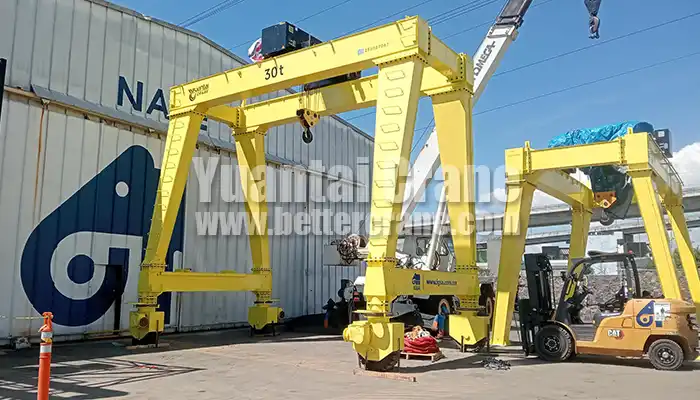
This project covers the supply, installation, and commissioning of two rubber-tired gantry cranes (RTGs) — one with a 30-ton lifting capacity and the other 50 tons — for an industrial client based in Mexico.
Both cranes are designed for a 6-meter lifting height (H6M) and powered by a 440V / 60Hz / 3-phase electrical system, ensuring smooth compatibility with Mexico’s industrial power network.
Purpose & Application:
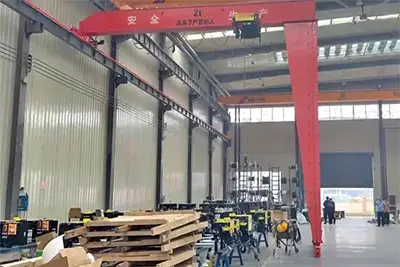
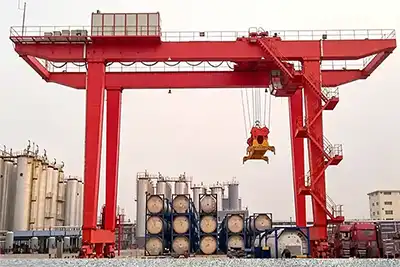
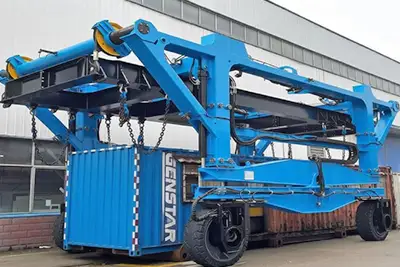
The cranes will be used in open fabrication yards, heavy equipment workshops, and modular assembly zones where mobility and lifting flexibility are essential. Their rubber-tired chassis allows them to move across wide operational areas without permanent rail foundations — ideal for facilities that handle large components or frequently change layout.
Key Features:
- Capacities: 30T and 50T
- Lifting Height: 6 meters (H6M)
- Power Supply: 440V / 60Hz / 3-phase
- Mobility: Rubber-tired system for flexible operation
- Use Case: Heavy fabrication, machinery assembly, containerized storage
By combining high lifting capacity with on-site mobility, these 30T and 50T RTG cranes deliver a practical, power-compatible solution for industrial operations in Mexico. They help local manufacturers handle large loads safely and efficiently without the cost or complexity of fixed rail systems.
Executive Summary
The client’s main challenge was achieving high-capacity lifting and yard mobility without installing fixed crane runways. Their production area frequently changes layout, and large equipment or steel modules must be moved, stacked, and positioned across different work zones. A traditional overhead crane setup couldn’t meet this need.
To address this, Yuantai Crane proposed and delivered two rubber-tired gantry cranes (RTGs) — a 30-ton model and a 50-ton model, each designed for a 6-meter lifting height (H6M) and powered by 440V / 60Hz / 3-phase electricity, fully compatible with Mexico’s industrial standards.
By implementing these mobile RTG cranes, the buyer gained a flexible handling solution that allows smooth movement across the yard, higher operational throughput, and a reduction in fixed infrastructure investment. The cranes’ reliable structure and efficient power system help maintain consistent lifting performance with predictable maintenance costs and stable total cost of ownership (TCO).
Client Background / Site Description
Buyer Profile
The buyer operates a heavy fabrication and machinery assembly plant in Mexico. Their core work involves lifting and positioning large steel structures and equipment modules during fabrication and assembly. Daily operations demand flexible lifting systems that can move freely around the yard without the limits of a fixed runway.
Site Conditions
- Yard Surface: The working area includes both paved zones and compacted soil sections, providing sufficient ground support for rubber-tired gantry movement.
- Access Routes: The site is equipped with wide gates and internal roads suitable for crane transport, though load-bearing limits were reviewed before installation to prevent ground pressure issues.
- Environmental Factors: The facility experiences moderate wind levels and humid seasonal weather, making corrosion resistance and stable outdoor operation key design considerations.
- Power Supply: The plant runs on a 440V / 60Hz / 3-phase power system, available directly from an on-site transformer, ensuring smooth electrical integration for both the 30T and 50T RTG cranes.
This industrial yard offered ideal conditions for deploying rubber-tired gantry cranes. The combination of a solid ground surface, ample maneuvering space, and compatible power supply made it possible to install 30-ton and 50-ton mobile cranes capable of moving heavy loads efficiently without building fixed rails or foundations.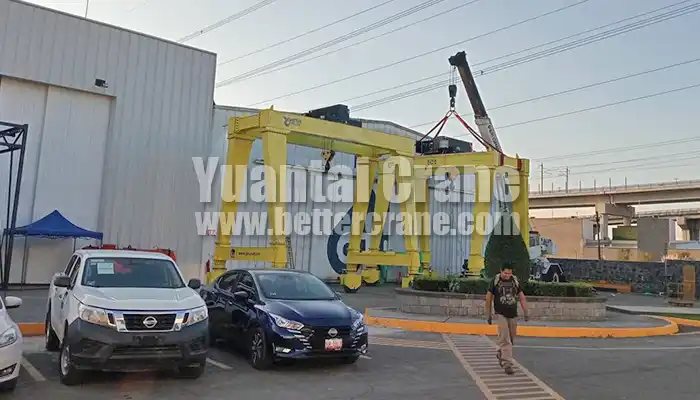
Objectives & Buyer Requirements
The buyer outlined a clear set of technical and operational goals to ensure the gantry cranes could handle their daily workload with flexibility and reliability. Below are the main requirements defined during the project discussions:
- Capacities: Two crane units — 30-ton and 50-ton — to manage a variety of heavy lifting tasks across the fabrication yard.
- Operation Scenarios: Designed for single lifts, tandem operations, and stacking of large components or modules as part of daily production flow.
- Lifting Height: Both cranes feature a 6-meter lifting height (H6M) suitable for handling steel assemblies and large equipment frames.
- Crane Type: Rubber-tired gantry (RTG) configuration to allow free movement without fixed rails.
- Travel Speed & Steering: Adjustable travel speeds for both loaded and unloaded conditions, with multi-directional steering for tight yard turns.
- Tyres: Heavy-duty rubber tyres capable of operating on mixed surfaces, including concrete and compacted ground.
- Duty Rating: Classified as H6M, matching the plant's moderate-to-high duty requirements.
- Buyer Note: The buyer was advised to confirm whether "H6M" follows FEM or ISO classification standards to align with local inspection and certification protocols.
- Operation Modes: Choice of operator cabin and radio remote control for different working conditions.
- Control System: Integrated PLC and VFD systems for smooth movement, anti-sway control, and safe operation.
- Safety Devices: Overload limiters, travel limit switches, emergency stops, and anti-collision sensors included as standard.
- Standards Required: Compliance with Mexican electrical and safety codes.
- Certifications: CE / ISO certification provided upon request.
- Testing: Third-party inspection and load testing to verify performance and structural reliability before commissioning.
Technical Solution
The project includes two rubber-tired gantry cranes (RTGs) — one rated at 30 tons and the other at 50 tons — both designed to provide mobile, heavy-duty lifting in open yard conditions. Each unit features a double-girder bridge structure for strength and stability, paired with European-style wire rope electric hoists for smooth and precise lifting operations. The overall system is engineered to support flexible movement, steady performance, and low maintenance, making it ideal for large fabrication or assembly yards in Mexico.
Electrical Configuration
Both cranes are configured for 440V / 60Hz / 3-phase power, fully compatible with the buyer’s existing electrical supply. All drives and motors are equipped with VFD (Variable Frequency Drive) controls for energy efficiency and smooth speed regulation during lifting and travel.
Key Subsystems
- Structural Gantry & Girders:
Heavy-duty double-girder frame fabricated from high-strength steel, ensuring rigidity under full load. Optional corrosion-resistant coating applied for outdoor durability. - Undercarriage & Tyre/Wheel Assemblies:
Rubber-tired wheel sets support full crane mobility without rail installation. The undercarriage is designed for even weight distribution, minimizing ground pressure and improving stability during operation. - Hoist and Trolley System:
Equipped with wire-rope electric hoists capable of precise vertical movement and horizontal travel along the girder. The trolley design allows fast positioning and smooth start/stop control. - Drive & Steering System:
Powered by electric drive motors with integrated gearboxes for dependable travel performance. The cranes feature multi-directional steering for flexible maneuvering within confined yard spaces. - Control System:
Integrated PLC-based control platform with VFDs for all major motion axes. Operators can control the cranes via cabin or wireless remote, depending on job requirements. - Safety System:
Multiple protective features including limit switches, overload sensors, anti-collision devices, and emergency stop controls. These systems ensure safe operation and compliance with modern industrial standards.
The combination of rubber-tired mobility, robust girder structure, and precision hoist control provides a versatile and reliable lifting solution. Both cranes — the 30T and 50T models — are built to perform efficiently under Mexico’s industrial conditions, offering smooth operation, low downtime, and long service life.
Design & engineering considerations
- Ground bearing & tyre pressure
Check actual ground bearing capacity where the RTG will travel. Wheel loads concentrate a lot of weight in small footprints; if the soil or pavement can’t carry it, you’ll need reinforcement (concrete pads, compacted base, or load-distributing mats). Measure tyre contact pressure and compare it to surface ratings before any movement. - Lifting gear selection (single hoist vs. tandem / spreader beam)
Decide whether each lift will be a single-hook operation or require tandem lifts. For long, awkward modules a spreader beam or tandem hoisting is safer and reduces bending on the load. If you choose tandem, design the control and synchronization system up front — don’t try to improvise this in the field. - Power interface & harmonics
Confirm the site supply is truly 440V / 60Hz / 3-phase at the crane connection point. If not, plan for a transformer or dedicated switchgear. Also evaluate harmonic distortion from existing loads; VFDs and large motors can be sensitive. A simple power quality check (voltage, imbalance, THD) avoids headaches later. - Steering & maneuvering clearances
Map turning radii, aisle widths, and gate clearances against the crane’s wheelbase and steering geometry. Include slope limits for travel paths — even small grades change load distribution and braking behavior. Leave extra clearance for emergency maneuvers and operator visibility. - Environmental protections
Specify paint systems and corrosion protection based on local conditions. Coastal or humid sites usually need higher-grade coatings and sealed enclosures for drives and electricals. Add UV-resistant materials for exposed cables and components. Small investment here extends service life. - Local fabrication vs. factory-built
Weigh transport limits (road width, bridge heights, customs) against on-site assembly capability. Factory-built modules reduce site welding and alignment work; on-site fabrication can cut shipping costs and avoid oversized transport permits. Choose the option that minimizes overall risk and downtime.
Buyer Benefits Summary
The 30T and 50T rubber-tired gantry cranes (RTGs) delivered for the Mexico site provide clear, practical advantages for industrial operations. This one-page summary highlights the key benefits:
- The RTG cranes do not require fixed rails, so they can be repositioned quickly as yard layouts change.
- Ideal for dynamic production yards, modular assembly areas, and facilities where equipment or material flow frequently shifts.
- Rubber-tyred movement allows smooth travel on paved or compacted surfaces, giving flexibility without costly civil works.
- Two models cover a range of heavy-duty needs: 30 tons for mid-sized modules and 50 tons for larger containers or equipment.
- Suitable for single lifts, tandem operations, and stacking, enabling efficient handling of large, bulky components.
- Both cranes are designed for 440V / 60Hz / 3-phase supply, matching local industrial standards.
- Supports seamless integration with existing electrical infrastructure, avoiding costly transformer upgrades or custom power solutions.
- All units undergo Factory Acceptance Tests (FAT) and Site Acceptance Tests (SAT).
- Full documentation and inspection reports ensure compliance with Mexican safety regulations, and CE/ISO certification is available on request.
- Safety systems include limit switches, overload protection, anti-collision devices, and emergency stops, protecting operators and loads.
- Energy-efficient drives and variable frequency motors reduce electricity consumption.
- Planned maintenance schedules and local spare parts availability ensure minimal downtime.
- Long-term durability and reliable performance reduce replacement and repair costs.
- Faster handling of heavy modules improves yard throughput and reduces bottlenecks.
- Fewer infrastructure constraints save on civil works and construction time.
- Overall, the cranes support efficient, flexible, and cost-effective operations across the facility.
Suggested on How to Get Your RTG Cranes
To move the project forward efficiently, the following steps should be taken:
- Check that the yard surface can support the cranes' concentrated wheel loads.
- Verify the availability and quality of the 440V / 60Hz / 3-phase power supply at the installation site.
- Review the general arrangement (GA) drawings and provide approval.
- Confirm the H6M duty cycle classification for both the 30T and 50T cranes to match operational requirements.
- Include options for hoist types, operator cabin versus remote control, and any additional features.
- Ensure all specifications, optional features, and delivery timelines are clearly documented.
- Conduct an on-site survey to finalize installation logistics, access routes, and crane positioning.
- Arrange Factory Acceptance Test (FAT) to validate crane performance and compliance before shipment.
- Develop a timeline for installation, commissioning, operator training, and handover.
- Confirm all safety, operational, and maintenance procedures are in place.
- Ensure the client receives complete handover documentation, including manuals, inspection reports, and maintenance schedules.