40 to 65 Ton Wheeled Gantry Cranes for Container Yards
40 to 65 Ton Wheeled Gantry Cranes for Container Yards: Mobile RTGs to Maximize Stacking Efficiency
Introduction
What Are Rubber-Tired Gantry (RTG) Cranes in Port Operations?
Rubber-Tired Gantry cranes, or RTGs, are one of the most commonly used container handling machines in ports and inland container yards. Unlike rail-mounted gantries, these cranes are mobile—they run on rubber tires, which gives them flexibility to move between container stacks without fixed tracks.
RTGs are built to straddle multiple rows of containers. They can pick and place standard shipping containers from trucks or other stacks within the yard, making them essential for efficient container movement and space management.
Here’s what makes mobile RTG cranes practical in daily port operations:
- They can handle a wide range of container sizes: 20 ft, 40 ft, and 45 ft containers.
- They reduce the need for fixed infrastructure like rail lines.
- RTGs operate within confined terminal layouts, turning narrow aisles into working zones.
- They support stacking containers up to 5 or even 6 high, optimizing vertical space.
In simple terms, if you’re managing thousands of containers and limited on space, an RTG makes that space go further.
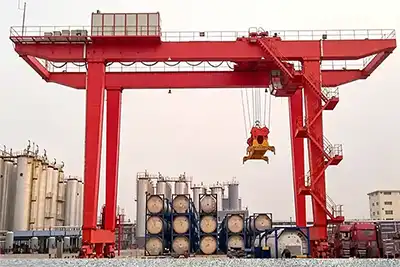
 rubber tyed wheeled gantry crane for container handling
Why the 40 to 65 Ton Capacity Range Matters
As global shipping volumes continue to grow, so does the weight and density of each container load. Today’s ports are no longer just dealing with standard containers. They’re managing reefer containers, twin lifts, heavy tank containers, and transloading demands—all of which increase the average weight per lift.
That’s where 40 to 65 ton wheeled gantry cranes step in.
These high-capacity RTGs are designed to keep up with heavier lifts and busier cycles. If your yard sees frequent twin lifts (two 20 ft containers at once), a 50+ ton crane is no longer optional—it’s expected.
Why higher capacity is important in modern container yards:
- Avoid double handling: Instead of transferring heavy containers to reach others, higher-capacity RTGs can directly lift and stack them.
- Accommodate future fleet growth: Container weights and traffic aren’t going down. Planning for larger loads now avoids early crane upgrades later.
- Support tandem lift requirements: Some ports are adopting twin-lift spreaders for better efficiency, which require cranes above 50 tons capacity.
- Enhance terminal resilience: When your crane can do more in one move, it frees up time and reduces traffic jams in the yard.
If you're planning for today while thinking about tomorrow, the 40 to 65 ton range gives you both coverage and cushion.
What This Guide Will Help You Do
This guide is written for port operators, container terminal managers, and procurement teams who are exploring options for mobile RTGs in the 40 to 65 ton capacity class.
We know there are many crane suppliers, and specs can get overwhelming. But your buying decision shouldn't be based on capacity alone.
This content will walk you through:
- What features matter in 40 to 65 ton wheeled gantry cranes
- How stacking height, yard layout, and container volume affect crane selection
- The pros and cons of different drive systems—diesel, hybrid, and electric
- Practical selection tips based on your budget, maintenance capacity, and long-term goals
- Real-world use cases from busy terminals using high-capacity mobile RTGs effectively
By the end, you’ll have a clearer idea of what crane fits your yard, what to ask your supplier, and what kind of long-term performance you can expect.
Key Features of 40 to 65 Ton Wheeled Gantry Cranes
A well-equipped RTG crane in the 40 to 65-ton range should easily handle the most common container sizes—20-foot, 40-foot, and 45-foot. These are the backbone of global container transport and the standard units moving through terminals every day.
But handling one container at a time isn’t always enough, especially in busy yards. That’s where twin-lift or tandem lifting comes in. It allows the crane to lift two 20-foot containers side by side or handle a heavy 40 or 45-footer with better balance and speed.
What to look for in terms of container handling:
- Lifting capability for 20’, 40’, and 45’ ISO containers
- Twin-lift spreaders for handling two 20’ containers at once
- Load stability features to handle asymmetric weights
- Precise spreader adjustment for mixed container sizes
In short: the more versatile your crane, the less it will bottleneck your yard.
Rubber-tired gantry cranes (RTGs) offer one huge advantage over rail-mounted cranes—they can move. They don’t need fixed rails, which means the yard layout can change without needing to rebuild tracks or install guideways.
That mobility pays off when the terminal grows or if you're managing several container blocks. RTGs can simply be driven from one stacking area to another, which isn't an option with rail-bound models.
Why mobile RTGs are often the better choice:
- No fixed rails or civil work required
- Quick relocation from one part of the yard to another
- Simplifies operations during yard expansion or reorganization
- Ideal for ports with non-uniform ground layouts
If your port sees changing traffic patterns or seasonal variations, a mobile RTG is easier to adapt than a fixed system
The crane’s span and height determine how many containers it can straddle and how high it can stack them. Most 40 to 65 ton RTG cranes can span five to seven rows of containers (plus a truck lane). This is wide enough to stack efficiently while still allowing room for maneuvering.
As for stacking, these RTGs typically handle up to 1 over 5 or 1 over 6, meaning they can place one container on top of five or six others. That’s a big help when space on the ground is tight.
Key stacking and layout specs to consider:
- Span width: Usually covers 5–7 container rows, plus a truck lane
- Stacking height: Typically 1 over 5 or 1 over 6 for optimal density
- Clearance height: Must accommodate high-cube containers
- Truck passage: Space under the crane must allow for efficient in/out movement
Efficient vertical stacking is often the fastest way to increase yard capacity without needing more land
The drive system you choose affects everything from daily operating costs to environmental compliance. Traditional RTGs run on diesel, but newer models include hybrid systems or full electric options that help reduce fuel costs and emissions.
Hybrids use a smaller engine paired with an energy storage system, often cutting fuel use by 30–50%. Full electric RTGs, while requiring infrastructure, produce no local emissions and can be more cost-efficient in the long term.
RTG drive system options include:
- Diesel-powered: Good for remote or smaller yards without electric infrastructure
- Hybrid systems: Combine diesel and batteries for improved fuel efficiency
- Electric RTGs: Ideal for ports with shore power or sustainability mandates
- Cable reel or busbar systems: Common for semi-fixed yard setups with long-term planning
Tip: Hybrid or electric RTGs may qualify for green port incentives or emissions credits depending on your country.
Newer RTGs are equipped with control systems that do much more than lift and lower. Automation, remote monitoring, and integrated yard control allow operators to get more done with less stress and more safety.
For example, anti-sway technology helps steady loads during movement. Remote controls let operators manage the crane from a central cabin instead of staying onboard. Integration with yard management software helps assign container moves automatically and tracks crane productivity.
Smart control features worth having:
- Remote operation: Reduces operator fatigue and improves visibility
- Anti-sway systems: Prevents swinging during lifts for faster positioning
- Auto-positioning: Aligns the crane over target containers or trucks automatically
- TOS integration: Syncs with yard software for job assignment and container tracking
- Safety sensors and alarms: Helps prevent collisions with people, trucks, or containers
These features don’t just make things easier—they reduce wear and tear, cut down on mistakes, and improve safety
Benefits for Port and Terminal Operators
Container yards are getting tighter. Land is expensive, and expansion isn’t always possible. So, using the available space more efficiently becomes the only real option. This is where 40 to 65 ton wheeled gantry cranes come into play.
With higher stacking capabilities—such as 1 over 5 or even 1 over 6—you can store more TEUs (Twenty-foot Equivalent Units) within the same footprint. Instead of spreading containers out horizontally, these cranes let you grow vertically.
Benefits of better space use with mobile RTGs:
- Stack more containers per square meter
- Free up room for truck lanes and additional operations
- Handle seasonal surges without expanding your yard
- Organize container blocks with tighter spacing and still operate efficiently
Put simply, you get more throughput from the same land area, which means better ROI on every square meter of your yard.
In container terminals, speed matters. Trucks waiting in line, cranes moving slowly, or misaligned stacking plans all lead to costly delays. A modern mobile RTG with high lifting capacity helps speed up the whole process—from unloading to stacking to truck loading.
These cranes are designed for continuous operation and faster cycle times. Twin-lift handling and automatic positioning features also help move more containers per hour, without sacrificing safety or accuracy.
How high-capacity RTGs help move containers faster:
- Reduce truck turnaround times by handling containers quicker
- Decrease cycle time for stacking and retrieval
- Allow multiple cranes to work simultaneously in a single yard block
- Improve flow between quay and yard by clearing incoming loads more efficiently
Less time spent waiting means more time moving cargo—and that’s what keeps operations running smoothly.
Older crane systems often come with frequent mechanical issues and longer downtimes. But modern 40 to 65 ton RTGs are built with smart design in mind. These machines are easier to service, come with fewer mechanical complications, and often include built-in self-diagnostic systems.
This means problems can be detected early—sometimes before they cause failure. Maintenance teams can plan ahead instead of reacting to unexpected breakdowns.
Key maintenance advantages of modern RTGs:
- Modular components make repairs quicker and easier
- Built-in diagnostics reduce troubleshooting time
- Fewer moving parts in electric and hybrid systems = fewer wear points
- Digital monitoring systems track performance and alert operators
It’s not just about reducing downtime—it’s about avoiding it altogether when possible.
Sustainability is becoming a requirement, not a bonus. Ports and terminals worldwide are under pressure to cut emissions and improve energy efficiency. 40 to 65 ton wheeled gantry cranes with hybrid or electric drives are a practical way to make progress.
Hybrid RTGs use battery storage and energy recovery systems to cut fuel consumption—often by 30% or more. Full-electric RTGs eliminate local emissions altogether, making them ideal for eco-conscious or urban port environments.
How modern RTGs help reduce environmental impact:
- Lower diesel fuel consumption with hybrid or full-electric models
- Regenerative braking systems store energy instead of wasting it
- Quiet operation reduces noise pollution in nearby communities
- Helps terminals meet environmental compliance targets and green port standards
And let’s be honest—saving on fuel also helps your bottom line. Cleaner cranes are not just about the planet; they’re good for business too.
Buyer Considerations When Choosing a 40–65 Ton RTG
Not all terminals are built the same—and neither are their daily container volumes. Before choosing a 40 to 65 ton RTG, it’s important to match the crane’s working performance with your projected TEU (Twenty-foot Equivalent Unit) growth and actual yard space.
Are you handling 100,000 TEUs a year or pushing beyond 500,000? Will you need more stacking capacity during peak seasons, or is steady throughput your baseline?
What to assess before sizing your RTG fleet:
- Average daily container moves and peak-hour workloads
- Projected TEU growth over the next 5–10 years
- Required stacking density and crane cycle time
- Yard layout: number of blocks, truck lanes, and stacking zones
It’s tempting to buy just what you need today—but if volume is rising year over year, it pays to plan ahead.
The sticker price is only one part of the cost equation. Sure, diesel RTGs might cost less upfront, but hybrid or electric cranes often pay for themselves over time—through lower fuel use, reduced maintenance, and fewer unplanned downtimes.
Understanding the full lifecycle cost helps you make smarter decisions.
Compare the cost breakdown like this:
- CapEx (Capital Expense): Upfront purchase price, delivery, and installation
- OpEx (Operating Expense): Fuel or electricity, spare parts, labor, and servicing
- Return on Investment (ROI): Fuel savings, lower wear-and-tear, and longer intervals between overhauls
- Upgrade readiness: Can your crane adapt to new yard software or automation later?
Try to balance your short-term budget with long-term cost recovery. A slightly higher initial investment can bring greater value over a 10- or 15-year operating life.
If you're considering hybrid or fully electric RTGs, your existing infrastructure needs to be up to the task. That means checking whether your port or yard has stable access to grid power, sufficient transformer capacity, and—if needed—charging or cable reel setups.
In some cases, electrical upgrades are straightforward. In others, they can delay your deployment or add hidden costs.
Before going electric, confirm the following:
- Is high-voltage power available at the crane area?
- Do you have cabling routes or rail power busbar systems in place?
- Is the local utility service stable and reliable?
- Will you need backup diesel generators for redundancy?
Don’t let infrastructure limitations force you into design compromises later. Confirm what’s possible now—and what’s realistic in the next upgrade phase.
Port environments vary a lot—from dry inland depots to humid coastal terminals, or high-wind open yards to scorching desert zones. Your crane must be built for your specific climate, or it may suffer performance drops, faster wear, or even safety risks.
This isn’t just about corrosion resistance. It’s about cooling systems, wind tolerance, insulation, and more.
Environmental factors to check before ordering:
- Wind zones: Does the crane design include storm tie-downs or wind sensors?
- Temperature extremes: Is your operating range between -20°C and 50°C?
- Humidity and salt air: Will you need marine-grade coatings or stainless components?
- Rain and drainage: Is the cab or control panel sealed against heavy rainfall?
Make sure the crane you choose can work well where it will live—not just in the factory specs
Even the best cranes need care. When evaluating RTG suppliers, look beyond the equipment brochure. Ask: Who’s going to help when something breaks? Can you get parts locally? Will your team be trained to handle routine service?
Support after delivery can make or break the usefulness of a crane—especially during peak season.
What to confirm before purchase:
- Is there a local or regional support team available?
- How fast can key parts (like spreaders or drives) be delivered?
- Does the OEM provide technician training or remote diagnostics?
- Are consumables and filters standard or proprietary?
Reliable support helps keep your yard moving—even when something doesn’t go according to plan
Future Trends and Upgrades
Autonomous RTG Systems
The next generation of RTG cranes is rapidly moving toward autonomous and semi-autonomous operation, reducing the need for onboard operators and enabling continuous, predictable container movements.
Key Developments
- Remote operation cabins: Operators control multiple RTGs from a central control room using real-time video and joystick interfaces.
- Semi-autonomous guidance: GPS, laser scanners, and onboard sensors allow RTGs to drive, align, and position automatically with minimal human input.
- Safety features: Advanced anti-collision systems, auto-slowing, and path correction improve safety in mixed traffic yards.
Industry Example
At a smart port in Northern Europe, 80% of RTG movements are now handled via remote control systems, reducing labor costs and increasing consistency in container stacking accuracy.
What It Means for Buyers
Ports investing in autonomous RTGs can achieve faster cycle times, better shift efficiency, and safer operations—especially in 24/7 yards. However, this requires investment in IT infrastructure, wireless coverage, and operator training for remote workstations.
Integration with Terminal Operating Systems (TOS)
Modern RTGs are designed to communicate seamlessly with a port’s Terminal Operating System, allowing real-time coordination of container pick-up, drop-off, and job scheduling.
Benefits of TOS Integration
- Live job assignment: RTGs receive container handling jobs directly from the TOS, eliminating paper-based workflows or manual instructions.
- Data feedback: RTGs report their exact location, working status, fuel consumption, and maintenance needs back to the central system.
- Reduced idle time: By synchronizing RTG moves with yard truck arrivals and vessel loading schedules, crane idle time is minimized.
Buyer Tip
When purchasing a new RTG fleet, verify TOS compatibility upfront—especially for hybrid or autonomous cranes—to avoid costly post-installation integration efforts.
Electrification and Emissions Regulations
With stricter emissions regulations and climate goals being implemented across major economies, RTG buyers are increasingly turning to electric or hybrid-electric options to future-proof operations.
Trends in Electrification
- Full-electric RTGs (E-RTGs): Powered by cable reels or busbar systems, these cranes produce zero onsite emissions and are ideal for high-volume terminals with stable power grids.
- Hybrid RTGs: Combine diesel engines with energy storage (batteries or supercapacitors), reducing fuel usage by 30–50%.
- Onshore incentives: Many ports now receive government subsidies or carbon credits when transitioning to clean RTG technologies.
Example
A leading Asian port replaced 12 diesel RTGs with electric busbar-powered units, reducing annual CO₂ emissions by over 2,000 tons and lowering energy costs by 35%.
Buyer Consideration
For ports aiming to meet ISO 14001, IMO, or national green port standards, investing in low-emission RTG systems will be essential—not only for compliance, but also for attracting sustainable logistics partners.
Why Partner with a Reliable RTG Supplier
Choosing the right supplier for your 40–65 ton wheeled RTG cranes is just as critical as choosing the crane itself. A reliable partner ensures that your equipment is tailored, supported, and built for long-term success.
Customization Based on Yard Needs
Every container yard has unique characteristics—from layout and throughput volume to local regulations and power infrastructure.
- Tailored designs: Adapt crane span, height, wheelbase, and energy systems to your site’s needs.
- Operational compatibility: Match RTG capabilities with yard traffic patterns, stacking targets, and container types (20’, 40’, 45’, twin-lift, tandem, etc.).
- Future scalability: Select suppliers who offer modular upgrades and tech-ready designs for automation or electrification.
After-Sales Service and Training
High-capacity RTGs require ongoing technical support and skilled operators to deliver optimal performance.
- Commissioning support: Onsite setup, load testing, and operator training.
- Maintenance services: Scheduled inspections, remote diagnostics, and emergency response.
- Training programs: For operators, technicians, and yard planners—both initial and refresher sessions.
Reliable suppliers ensure minimal downtime and faster return on investment through expert support and training infrastructure.
Global References and Certifications
Working with a proven, certified RTG manufacturer gives buyers confidence in performance, safety, and compliance.
- CE, ISO, and other international standards: Ensure quality, safety, and environmental compliance.
- Successful case studies: Look for RTGs operating in similar yard sizes or throughput conditions.
- Third-party inspection and testing: Verifies lifting performance, structural strength, and system reliability before shipment.
Conclusion
Summary of RTG Benefits for Container Yards
40 to 65 ton mobile RTG cranes offer container terminals:
- Higher stacking density and better yard space utilization
- Faster turnaround and reduced port congestion
- Improved fuel efficiency and lower emissions (especially with hybrid/electric models)
- Compatibility with automation and yard management systems
Encouragement to Evaluate Yard Needs and Future Growth
Before investing, port operators should:
- Analyze current TEU volume and future expansion plans
- Consider automation readiness and energy infrastructure
- Prioritize flexibility for mixed container sizes and tandem lifts
A well-matched RTG solution leads to long-term operational savings, smoother logistics, and scalability.
Ready to upgrade your container yard with high-capacity RTG cranes? Request a consultation or quotation tailored to your operational needs, yard layout, and growth strategy.