Runway Track Capacity: Solutions for Overhead Cranes
Optimizing Runway Track Capacity for Overhead Cranes
Operating multiple overhead cranes on the same runway can quickly become tricky. While the idea is simple—two cranes sharing a track—structural limits often get in the way. Every runway has a maximum load it can safely carry at any given point, and when cranes get too close, the combined weight can exceed that limit. That’s what we call a capacity restriction on the runway track.
These restrictions aren’t just technical rules on paper—they affect real operations every day. For example:
- Cranes may need to maintain extra distance between each other, which can slow down material handling.
- Workflow efficiency drops because operators can’t move cranes freely where they need them.
- Safety risks rise. Overloading a runway can lead to structural fatigue, damage, or even accidents.
The challenge is clear: how can you use your existing cranes efficiently without compromising safety? That’s where practical solutions come in. The goal is to maximize the usage of each crane, keep material moving smoothly, and protect both the runway and your team.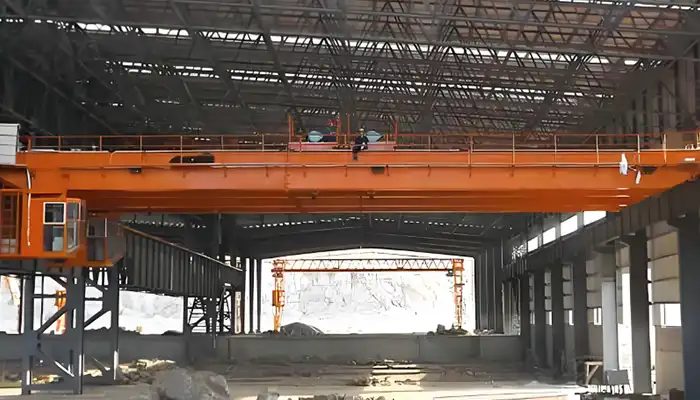
Runway Track Capacity Limits
Before trying to squeeze more cranes onto a runway, it's crucial to understand the limits of the structure itself. Every runway track is designed with a maximum load capacity that varies along its length. Some sections, like the spans between columns, can handle less weight than areas closer to supports. Ignoring these differences can lead to problems very quickly.
- Runway beams are rated for a specific maximum load, which includes both the crane's weight and the lifted load.
- Structural strength is not uniform along the track. Mid-spans often carry less load than areas near columns.
- Safety factors are built into the design, but they are not infinite. Exceeding these limits risks permanent damage.
- Minimum crane spacing: To prevent overloading, cranes are often required to maintain a minimum distance from each other.
- Weight per span: Each span of the runway has a maximum combined load it can carry. Operators must account for both crane weight and the materials being lifted.
- Speed limits: Some runways impose reduced travel speeds when loads approach the upper limit to reduce dynamic stress.
- Structural fatigue: Repeated overloading weakens the beams and supports, shortening their lifespan.
- Unexpected downtime: Exceeding limits can trigger emergency stops or require repairs, slowing production.
- Safety risks: Overloaded runways increase the chance of crane derailment, falling loads, or structural failure, putting personnel at risk.
Review of Original 7 Solutions
When faced with capacity restrictions on a runway track, industrial facilities usually turn to one or more of seven common solutions. Each has its strengths and weaknesses, and understanding them helps you make informed decisions about which approach—or combination—fits your operation best.
- Uses sensors or lasers to monitor the distance between cranes in real time.
- Automatically prevents cranes from moving too close and exceeding the runway's load capacity.
- Practical note: Works well in high-speed operations where operators may lose track of spacing, but it requires proper calibration and regular maintenance to remain reliable.
- Physical barriers or stops prevent cranes from moving into restricted zones.
- Simple, reliable, and low-tech solution.
- Practical note: While effective for safety, it can limit operational flexibility and slow down workflow if frequent crane movements are required.
- Sensors placed on critical sections of the runway monitor local loads.
- Stops or warnings are triggered only when the load on a specific section approaches the limit.
- Practical note: Ideal for runways with uneven structural capacity, ensuring that operators can use stronger sections fully without overloading weaker spans.
- Relies on operators to monitor crane spacing and load distribution.
- Often involves charts, tables, or simple rules-of-thumb for safe operation.
- Practical note: Low cost, but highly dependent on human judgment and training. Errors can lead to unsafe conditions or downtime.
- Cranes are allowed to operate closer together if the combined load stays within a predetermined safe limit.
- Requires careful planning of lifting operations in advance.
- Practical note: Efficient for repetitive or predictable workflows, but less flexible when loads or operations change frequently.
- The safe distance between cranes adjusts dynamically depending on the load each crane carries.
- Often uses software or control systems to calculate real-time spacing.
- Practical note: Offers greater flexibility and efficiency than fixed spacing, but requires accurate monitoring and reliable control systems.
- Strengthening beams or supports increases the runway's load capacity.
- Can involve steel plate reinforcement, additional columns, or full beam replacement.
- Practical note: Long-term solution that allows closer crane operation. It requires upfront investment and possible downtime during construction but offers the most permanent relief for capacity constraints.
Optimization Strategies for Each Solution
Even with the original seven solutions in place, there's room to make crane operations safer, more efficient, and better suited to real-world workflows. The following strategies focus on practical improvements that can be applied individually or combined for maximum effect.
Keeping an eye on crane loads in real time is critical. Digital indicators connected to PLC or SCADA systems allow operators to see exactly how much weight each crane is carrying at any moment.
- Displays both individual crane load and combined runway load.
- Shows safety thresholds, alerting operators before the runway reaches its limit.
- Can integrate alarms or notifications for operators on mobile devices or control panels.
Why it matters: Operators no longer have to guess or rely solely on memory. Real-time monitoring reduces risk and keeps the workflow smooth.
Sometimes, cranes need to operate closer than usual for short periods. Automated overrides with role-based authentication ensure that only authorized personnel can temporarily reduce spacing limits.
- Requires operators to authenticate via RFID cards or control panel login.
- Generates an audit trail for every override, making it easier to track compliance and safety.
Why it matters: Prevents unauthorized adjustments while keeping the system flexible for planned operations.
Instead of reacting after loads exceed limits, predictive systems anticipate stress on the runway based on crane paths, current loads, and planned lifts.
- Calculates combined load for every section of the runway in real time.
- Sends preemptive warnings before the structural limit is reached.
- Helps plan tandem lifts or complex moves safely.
Why it matters: Reduces emergency stops, improves scheduling, and protects the structure from unexpected overloading.
Not every section of a runway is equal. Using multi-zone sensors with 3D positional tracking, you can monitor structural load with precision.
- Assigns different safety limits to different zones (e.g., weaker mid-span vs. stronger support areas).
- Alerts operators only when a specific zone is nearing capacity.
- Can integrate with crane control systems to automatically limit travel in risky areas.
Why it matters: Maximizes usable runway space while respecting structural limits.
Static signs don't always help in real-time situations. Programmable LED displays on cranes and runway supports provide context-aware alerts that adjust based on the current operation.
- Displays current crane spacing, combined load, and operational instructions.
- Can flash warnings or show color-coded alerts when approaching limits.
- Works with both automated and manual crane operations.
Why it matters: Keeps operators informed at a glance and reduces reliance on memory or separate monitoring systems.
Sometimes, the best solution is to strengthen the runway itself. Targeted reinforcement focuses on the sections that experience the highest stress.
- Can include adding steel plates, extra supports, or reinforcing beams.
- Works best when combined with smart load monitoring, allowing closer crane operation safely.
Why it matters: Provides a long-term solution for capacity issues, allowing more flexible operations and better utilization of the cranes.
Data collected from crane operations can guide future planning. By analyzing historical load and movement patterns, facilities can make better decisions.
- Identifies runway sections frequently overloaded or underutilized.
- Supports decisions on runway redesign, reinforcement, or crane relocation.
- Helps plan expansions or upgrades with real operational data.
Why it matters: Ensures that improvements aren't just temporary fixes, but part of a long-term, data-driven strategy.
Implementation Guidelines
Putting these strategies into practice is where the real difference happens. It's not enough to install sensors or reinforce a runway; you need a plan that balances safety, workflow efficiency, and cost.
- Use electrical spacing (like laser or proximity sensors) together with mechanical stops to prevent cranes from getting too close.
- Add real-time load monitoring to track each crane's weight and the combined load on the runway.
- Integrate both systems with your control panel or PLC/SCADA, so operators can see the full picture in one place.
Why it matters: This hybrid approach keeps cranes operating safely while minimizing unnecessary downtime.
- Identify sections of the runway where two cranes often operate close together.
- Focus sensor upgrades, dynamic signage, and structural reinforcement in these high-stress areas first.
- Keep less critical sections on standard monitoring to control costs.
Why it matters: You get the most impact for your investment, improving safety and workflow exactly where it matters most.
- Safety should always come first, but it doesn't mean slowing everything down.
- Smart monitoring and predictive systems allow closer crane operation without exceeding structural limits, saving both time and money.
- Consider long-term planning, including potential expansion or additional cranes, to avoid repeated upgrades.
Why it matters: A practical, balanced approach ensures the runway can handle current operations and future growth, keeping both productivity and safety in check.
Benefits of Optimized Runway Capacity Management
Optimizing runway capacity isn't just a technical exercise—it has real, measurable effects on daily operations. When done right, the improvements touch productivity, safety, and long-term planning.
- Smarter spacing and load management allow cranes to operate closer together safely.
- Operators can move materials faster without waiting for clearance or worrying about overloading.
- Workflow becomes smoother, and overall production capacity increases.
Practical note: Even small improvements in crane spacing can have a big impact on throughput in busy facilities.
- Monitoring systems and predictive load management prevent unplanned stops due to overloading.
- Structural reinforcement in critical areas reduces wear and tear on runway beams.
- Fewer breakdowns and repairs mean less disruption to production schedules.
Practical note: Facilities often save thousands per year in maintenance when capacity is actively managed.
- Real-time alerts, dynamic signage, and smart overrides keep operators informed at all times.
- Automated systems reduce reliance on memory or guesswork.
- Ensures compliance with safety standards and reduces the risk of accidents.
Practical note: Operators feel more confident and less stressed, which indirectly improves productivity.
- Data from optimized systems helps plan for runway upgrades, expansions, or additional crane installations.
- Reinforced or smart-monitored runways can handle higher loads in the future without major reconstruction.
- Keeps your facility ready for evolving production needs and changing material-handling demands.
Practical note: Investing in capacity management now avoids costly surprises later and gives your operation flexibility to grow safely.
Conclusion
Managing runway capacity for overhead cranes isn’t about relying on a single solution. The best results come from a hybrid approach—combining smart monitoring, targeted structural reinforcement, and predictive load management. Each element supports the others: sensors and software keep operators informed, reinforcements strengthen critical sections, and predictive systems help plan safe crane movements in advance.
For industrial buyers and engineers, this approach offers both immediate and long-term benefits:
- Immediate efficiency gains: Cranes can operate closer together safely, reducing downtime and improving material flow.
- Long-term resilience: Reinforced and well-monitored runways last longer and handle future production demands without expensive surprises.
In practice, this means you can get the most out of your current crane setup while planning for growth, safety, and reliability. With careful planning and the right mix of solutions, runway capacity restrictions no longer have to slow down your operations—they can be managed proactively and practically.