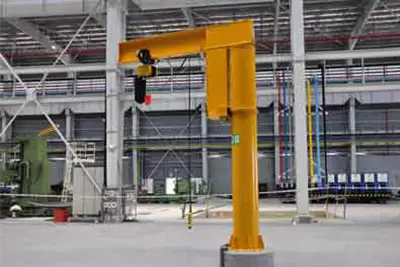
Comparison Table: Which 1 Ton Jib Crane Fits My Workshop?
Quickly compare free-standing, wall-mounted, articulating, & portable 1 ton jib cranes to choose the best fit for your workshop. Get your 1 ton jib crane.
Introduction
When you’re setting up or upgrading your workshop, a 1-ton jib crane often becomes one of the most useful lifting tools you can add. It’s not just about lifting a ton of weight—it’s about how smoothly that weight moves, how much floor space the crane takes, and how well it fits into your daily workflow.
The right jib crane makes lifting safer and easier, while the wrong choice can slow down operations or cause extra costs later. That’s why it’s worth looking closely at details like:
- Available space – How much floor or wall space can you actually spare?
- Load handling – Are you lifting the same type of load every day, or is it different each time?
- Rotation range – Do you need a full 360° swing, or will a fixed or 180° arm do the job?
- Boom length – Does the crane need to reach over machines, workbenches, or vehicles?
- Installation needs – Will you anchor it permanently to a foundation, mount it on a wall, or prefer a mobile unit?
These are not just “specs” on a paper—they directly affect how the crane works in your workshop. For example, a wall-mounted jib crane may save space, but it won’t serve you well if you need to move loads across an open area. On the other hand, a free-standing crane can give full coverage, but it requires a solid foundation and more room around it.
That’s where a comparison table comes in handy. Instead of juggling different features in your head, you can see the main options side by side. With a quick look, you’ll spot which crane type matches your workshop conditions and lifting needs best.
Key Selection Criteria
Before you decide on a 1-ton jib crane, it helps to break the decision down into a few key factors. Each workshop is different, so the right choice really depends on how you plan to use the crane and the physical limits of your space.
Crane Type / Mounting Style
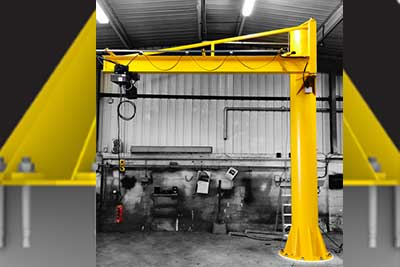
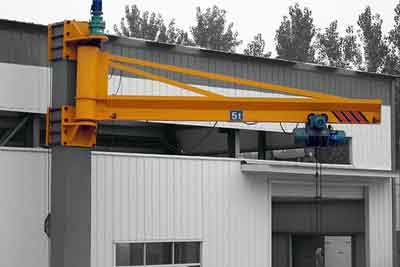
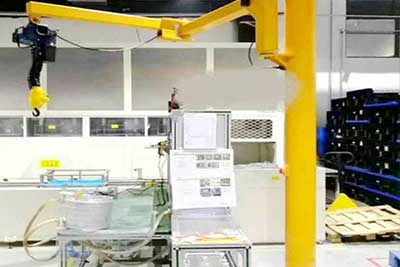
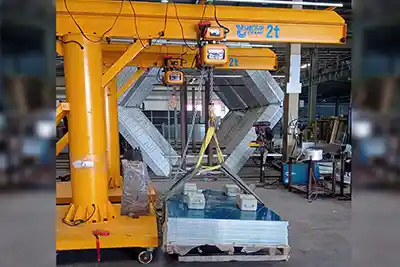
The first thing to consider is how the crane will be supported. This determines both the space it takes and the flexibility it gives you.
- Free-standing jib crane – Stands on its own base and usually requires a foundation. Offers the widest coverage and 360° rotation.
- Wall-mounted jib crane – Fixed directly to a wall or building column. Saves floor space but offers limited reach and rotation.
- Articulating jib crane – Has a jointed boom that can reach around corners or obstacles. Ideal for workshops with irregular layouts.
- Portable jib crane – Mounted on a movable base. Great for temporary work areas or workshops where the lifting point changes often.
Boom Length
Boom length defines the crane’s reach, and this is where a lot of buyers miscalculate.
- Shorter booms (1–3 meters) work well for small spaces or lifting directly beside machines.
- Medium lengths (3–5 meters) give balanced coverage for most workshops.
- Longer booms (5–6 meters) can cover wide areas but require strong foundations and more clearance.
Tip: Always measure the farthest point you need to reach before finalizing the crane size.
Rotation / Slewing Range
Not every workshop needs a full 360° rotation. Sometimes less is more.
- Fixed or 180° rotation – Suitable if you only need to move loads within a narrow work zone.
- 270° rotation – Useful for covering corners or two adjacent work areas.
- 360° rotation – The most flexible option, but it requires a clear circle around the crane without obstructions.
Footprint / Space Requirements
Space is money in a workshop, so don’t overlook how much room the crane itself takes.
- Free-standing cranes need open floor space.
- Wall-mounted types minimize footprint but rely on strong building structures.
- Portable cranes take minimal permanent space but still need safe storage when not in use.
Installation Needs
The installation method can be the difference between a smooth setup and a drawn-out project.
- Foundation required – Free-standing cranes usually need a reinforced concrete base.
- Wall fixing – Wall-mounted cranes need strong building columns or beams to handle the load.
- Portable setup – No foundation needed, just a level surface for mobility.
Think about not just the cost of the crane, but also the time, labor, and structural requirements for getting it installed and ready for work.
Comparison Table
Not every 1-ton jib crane is built for the same kind of workshop. Some cranes cover large open spaces, while others are better suited to tight corners or temporary jobs. The table below gives you a quick side-by-side look at the main types, their reach, rotation, and where they work best.
| Crane Type | Boom Length (m) | Rotation | Footprint | Installation Needs | Best For |
|---|---|---|---|---|---|
| Free-Standing | 2–6 | 360° | Moderate | Requires reinforced foundation | Open workshops, heavy daily lifting, multiple work zones |
| Wall-Mounted | 1.5–5 | 180° | Minimal | Bolted to wall or column | Small shops, limited floor space, fixed lifting points |
| Articulating | 1–4 | 180–270° | Small | Wall or post mount | Areas with obstacles, machinery corners, flexible positioning |
| Portable | 1–3 | 360° | Minimal | Mobile base, no foundation | Temporary setups, shared work areas, light and frequent moves |
How to Read the Table:
- Boom length shows how far the crane can reach across your workspace.
- Rotation tells you whether the crane can cover just one side of the area or a full circle.
- Footprint indicates how much permanent space the crane will occupy.
- Installation needs help you plan for foundations, wall strength, or mobility.
- Best for gives practical examples so you can picture how the crane would actually fit into your workshop routine.
Practical Tips for Choosing
Even if you already know the main types of jib cranes, the final decision really depends on how the crane will fit into your actual workshop. Specs on paper are one thing, but day-to-day use often tells a different story. Below are some detailed points to think through before you sign off on a 1-ton jib crane.
Boom Length
The boom defines how far the crane can reach into your workspace. Getting this wrong is one of the most common mistakes buyers make.
- Measure carefully: Mark out the maximum area you need to cover, including any future work zones. It’s better to measure twice than find out later that the crane can’t reach where you need it.
- Avoid oversizing: A boom that is too long won’t just cost more—it may also interfere with nearby machines, walls, or doorways.
Match to workshop type:
- Repair or service shops often only need a short boom (1–3 m) for spot lifting beside benches or equipment.
- Fabrication or assembly workshops may require a medium or long boom (4–6 m) to cover larger floor areas and handle multiple stations.
Rotation
Rotation (or slewing) is about how much swing you get when moving loads. It directly affects coverage and flexibility.
- 180°: Works fine when lifting within a defined area along a wall. Cost-effective and space-saving.
- 270°: Useful when you have machinery in one corner or need to serve two adjacent work zones.
- 360°: Gives full freedom but needs clear space all around the crane. A free-standing crane with 360° rotation is perfect for open workshops, but in a crowded floor it can feel more like a hindrance than a help.
Tip: Always visualize the rotation path. Walk it out in the workshop and see what obstacles might be in the way.
Footprint
The crane’s footprint is often overlooked until installation day—but by then it’s too late.
- Free-standing types: Require a stable base and occupy moderate floor space. If not positioned correctly, the column can become an obstruction.
- Wall-mounted or articulating types: Save floor area but depend on your building’s strength.
- Portable cranes: Need very little space permanently but require enough clearance for safe movement.
Think of the footprint as “the space the crane takes away from you.” If every square meter counts in your workshop, this factor becomes critical.
Installation
The installation process is not just a technical step; it directly affects cost, downtime, and future flexibility.
- Foundation requirement: Free-standing jib cranes almost always need a reinforced concrete foundation. That means extra expense and a bit of disruption during construction.
- Wall fixing: Cheaper and faster, but only if your wall or building column is strong enough to take the load. Always check with a structural engineer if you’re unsure.
- Portable setup: Quick to move, easy to relocate, and no foundation required. But they usually can’t handle nonstop, heavy-duty use like a fixed crane can.
Future Needs
Don’t just think about what you’re lifting today. A crane should serve you for years.
- Growth in lifting demand: Will you eventually move heavier or larger items? If so, plan for an upgrade path now.
- Workshop layout changes: Machinery and workstations often move around as business grows. A portable or articulating jib crane may give you more flexibility.
- Cost of replacement: Swapping a crane later is much more expensive than choosing one with a bit of extra capability at the start.
Conclusion
A 1-ton jib crane may seem like a straightforward piece of equipment, but the right choice makes a noticeable difference in daily work. It can reduce manual handling, improve safety, and free up workers to focus on tasks instead of struggling with heavy loads.
The comparison table gives you a solid starting point: match the crane type with your workshop’s layout, lifting tasks, and installation limits. From there, use the practical tips above to refine your choice.
Finally, don’t skip the supplier conversation. Ask about installation requirements, structural checks, and whether custom boom lengths or rotation limits are possible. Getting clear answers now helps avoid costly adjustments later.
When chosen carefully, a 1-ton jib crane is not just another piece of equipment—it becomes a reliable partner in keeping your workshop efficient, safe, and productive for years to come.