100 to 600 Ton Shipbuilding Gantry Cranes:Choose Right Capacity
Shipbuilding is all about moving big, heavy parts into the right place with precision. In a modern shipyard, nothing plays a bigger role in this than the shipbuilding gantry crane. These massive cranes, often ranging from 100 tons to 600 tons, are the backbone of block assembly, hull erection, and final ship construction. Without them, lifting and positioning huge steel blocks and hull sections would be nearly impossible.
Choosing the right capacity crane is not just a matter of budget—it directly affects safety, efficiency, and even the size of ships a yard can build. A 100 ton shipbuilding gantry crane may be enough for smaller blocks and medium-sized vessels, but when you move into 200 ton, 300 ton, or even 600 ton goliath cranes, you’re talking about handling the heaviest sections of large container ships, tankers, and offshore vessels. In other words, the crane you choose determines the scale of your shipyard’s capabilities.
This guide will walk you through what capacity means in practical terms and how to match a crane to your shipyard’s needs. Along the way, it answers the exact questions many buyers ask before making a decision:
- What size gantry crane is used in shipbuilding?
- Can one crane handle both block assembly and hull erection?
- What is the lifting capacity of a goliath crane in shipyards?
If you’re planning a new shipyard, expanding your existing one, or just want to ensure your lifting equipment matches your production goals, this breakdown will help you see where a 100 ton, 200 ton, 300 ton, 400 ton, or 600 ton heavy-duty shipbuilding crane fits best.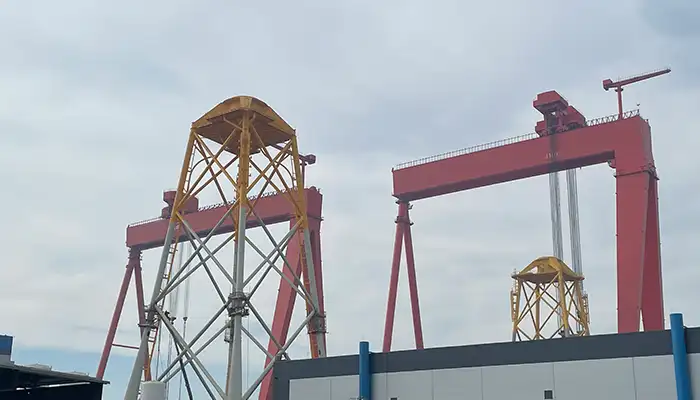
Yuantai bettercrane.com shipbuilding gantry crane for sale
Overview of Shipbuilding Gantry Crane Capacities (100t – 600t)
When it comes to choosing a shipbuilding gantry crane, the first question is always capacity. Each tonnage level is designed for a different type of yard, different ship sizes, and different handling needs. Below is a breakdown of the most common ranges, from 100 ton shipbuilding gantry cranes up to 600 ton goliath cranes.
A 100 ton crane is usually the entry point for many shipyards.
- Well-suited for small to medium shipyards that focus on smaller vessels or lighter prefabricated sections.
- Often used for block assembly where individual blocks don't exceed 80 tons.
- Can also handle auxiliary lifting tasks like lifting outfitting equipment, machinery, or smaller hull parts.
- Practical choice for shipyards that don't plan on building very large ships but still need reliable heavy lifting.
The 200 ton gantry crane steps things up for shipyards handling heavier blocks.
- Ideal for mid-sized shipyards producing medium to large vessels.
- Commonly used for lifting and positioning steel blocks that weigh between 120–180 tons.
- Gives more flexibility compared to 100t cranes, making it suitable for block assembly and partial hull erection.
- Often designed with dual trolleys to balance loads and improve safety when handling longer or awkward sections.
A 300 ton shipyard crane is where heavy ship construction starts to get serious.
- Used for large hull block assembly and prefabricated structures that are simply too heavy for lower-capacity cranes.
- Frequently found in yards building bulk carriers, large cargo ships, and offshore vessels.
- Offers the strength to handle longer blocks in fewer lifts, reducing assembly time.
- Typically built as a double girder gantry crane, giving higher stability and better load distribution.
The 400 ton capacity is widely regarded as the standard for large-scale shipbuilding.
- Essential for heavy hull erection, especially in container ship and tanker construction.
- Capable of lifting entire hull blocks or superstructure sections in one go.
- Reduces the need for multiple smaller lifts, which lowers labor hours and improves assembly accuracy.
- Can be customized with anti-sway systems for precise alignment during hull positioning.
The 600 ton goliath crane represents the top tier of heavy-duty shipbuilding cranes.
- Designed for mega shipyards building the largest vessels, including VLCC tankers, LNG carriers, and naval ships.
- Handles massive hull blocks, sometimes weighing 500 tons or more, with a built-in safety margin.
- Allows for dual-block or tandem lifts, making complex assembly tasks more efficient.
- Built to operate on rail-mounted systems covering large construction docks.
- Provides the lifting power required for both block assembly and full hull erection in one crane system.
How Capacity Links to Ship Size and Assembly Needs
Choosing the right capacity is not only about the crane itself—it's directly tied to the size of the ships you plan to build, the weight of prefabricated blocks, and the method of hull assembly. Below is a practical way to see how tonnage connects to real-world shipyard operations.
The size of the vessel determines how heavy each block or section will be, and that sets the minimum crane capacity.
- Small vessels (fishing boats, patrol boats, small ferries): Usually require 100–200 ton shipbuilding gantry cranes for lifting lighter blocks and outfitting parts.
- Medium-sized cargo ships or bulk carriers: These projects call for 200–300 ton shipyard cranes, since individual blocks can weigh over 150 tons.
- Large ships (container ships, oil tankers, naval ships): These demand 400–600 ton goliath cranes, powerful enough to lift entire hull blocks or superstructures in one piece.
In short, if your yard plans to build larger vessels, higher-capacity cranes are not optional—they're essential.
Every ship is built in blocks, and those blocks vary greatly in weight. A 50-ton block is one thing; a 400-ton hull section is a completely different story.
- Prefabricated blocks: Commonly used in small and medium yards, typically weighing 50–150 tons. Easily handled by 100t–200t cranes.
- Heavy hull blocks: Found in larger ships, often weighing 200–400 tons per section. These require 300t–400t cranes.
- Massive single blocks or combined lifts: In mega-yards, blocks can exceed 500 tons, and that's where the 600 ton goliath crane comes in.
The rule of thumb: always choose a crane that covers the heaviest block weight with at least a 20–30% safety margin.
Assembling the hull is the most demanding stage of shipbuilding. Each section has to be lifted, aligned, and placed with high precision.
- Larger hulls demand larger cranes because lifting small sections piece by piece slows down the process and increases labor costs.
- Dual-trolley systems give flexibility by allowing two hooks to handle long or irregular blocks at once. This makes alignment easier and reduces stress on the structure.
- Efficient hull erection often depends on whether the crane can handle both block assembly and full hull lifting—something only 400t to 600t cranes can reliably do.
Safety Margins and Load Factors
When it comes to heavy-duty shipbuilding cranes, capacity alone is not enough. What really matters is how much extra strength the crane has beyond the expected block weight. This is where safety margins and load factors become critical.
Why Safety Margins Matter
In shipbuilding, blocks are rarely uniform in weight. Some can be heavier than expected due to additional steel thickness, outfitting, or design changes. That’s why most shipyards use a 20–30 percent safety margin when selecting crane capacity.
- A 300 ton shipyard crane should ideally handle blocks up to 230–250 tons comfortably.
- A 600 ton goliath crane may be required to safely lift a 480–500 ton hull block.
- The margin ensures the crane isn’t working at its absolute limit during every lift.
In practice, this translates to smoother operation, longer crane service life, and fewer chances of costly downtime.
Risks of Under-Sizing a Crane
Using a crane that is too small for the job can create serious safety and efficiency problems.
- Overloading risks: The crane may experience stress, wear, or even structural damage.
- Production delays: Blocks may need to be split into smaller sections, slowing down assembly.
- Worker safety: An under-sized crane increases the risk of accidents during lifts.
A common mistake buyers make is choosing a crane that is “just enough” for their current needs, only to realize later it cannot handle heavier blocks when production scales up.
Standards and Certifications for Shipbuilding Cranes
To ensure safety and reliability, heavy-duty shipbuilding gantry cranes must comply with recognized industry standards. These cover design, testing, and operational safety requirements.
- ISO (International Organization for Standardization): Sets global safety and quality benchmarks.
- CE Certification (Europe): Ensures the crane meets strict safety and environmental requirements.
- GB/T Standards (China): Cover structural strength, load testing, and safe operation.
- Third-party inspections: Often carried out by agencies such as SGS, BV, or TUV to verify compliance.
For buyers, checking certifications is just as important as checking tonnage. A certified heavy-duty shipbuilding crane guarantees safer lifts and fewer operational headaches in the long run.
Crane Customization Options for Shipyards
No two shipyards are exactly the same. That’s why selecting a gantry crane isn’t just about capacity—it’s also about customization. From layout flexibility to precise lifting control, modern shipbuilding cranes can be tailored to meet specific operational needs.
Rail-Mounted vs. Fixed Gantry
Choosing between a rail-mounted or fixed gantry crane depends on the yard layout and production flow.
- Rail-mounted cranes can move along the length of the dock, allowing a single crane to cover multiple assembly stations.
- Fixed gantry cranes are ideal for smaller yards or areas where space is limited and repetitive lifting is required.
- Rail-mounted systems offer more flexibility for future expansion, while fixed designs are often simpler and cost-effective.
Double Girder Goliath Cranes
For large shipyards handling blocks of 400 tons or more, a double girder crane is often the best solution.
- Provides additional strength and stability for heavy lifts.
- Reduces deflection when lifting very long or heavy blocks.
- Commonly used in 400t–600t goliath cranes, making it possible to lift massive hull sections safely.
Dual Trolley Design
Dual trolley systems are a practical choice when you need to handle multiple blocks simultaneously or longer, awkwardly shaped sections.
- Each trolley can lift a separate block, or they can work together to lift a single oversized block.
- Improves precision and balance, reducing the risk of misalignment during hull assembly.
- Saves time by allowing simultaneous operations at different points along the gantry span.
Advanced Control Systems
Modern shipbuilding cranes often come with advanced control systems that make lifting safer and more precise.
- Anti-sway technology stabilizes the load, especially for long or heavy blocks.
- Precise positioning systems allow accurate alignment during hull erection.
- Remote operation and automated functions improve safety, reducing the need for operators to be directly under heavy loads.
Buyer's Key Questions Answered
When buying a shipbuilding gantry crane, many shipyard managers have similar questions. Choosing the right crane can be confusing, so here's a clear breakdown.
The right crane size depends on several factors:
- Ship size: Smaller vessels need less lifting power, while large cargo ships, tankers, and naval vessels require high-capacity cranes.
- Block weight: The heaviest blocks in your assembly determine the minimum crane tonnage.
- Assembly method: Whether you lift single blocks or multiple sections together affects crane choice.
In practice, a small yard may operate with 100–200 ton cranes, mid-sized yards often use 200–300 ton cranes, and large shipyards rely on 400–600 ton goliath cranes for heavy hull blocks.
Yes, but it requires proper customization:
- Dual-trolley design: Lets a single crane lift multiple blocks at once or handle long, heavy sections safely.
- Advanced control systems: Anti-sway and precise positioning ensure accurate block alignment during hull erection.
- Capacity matching: The crane must be rated high enough to cover the heaviest blocks plus a safety margin.
With the right setup, a single gantry crane can manage both block assembly and full hull erection efficiently.
Goliath cranes in shipyards vary depending on size and application:
- Typical range: 100 tons to 600 tons for most shipyards.
- Custom options: Mega-shipyards building very large vessels may require cranes exceeding 800 tons.
- Practical tip: Always choose a crane with at least a 20–30% safety margin above the heaviest block to ensure safe operation.
Conclusion
Choosing the right shipbuilding gantry crane is not just about picking a number. Whether it’s a 100 ton, 200 ton, 300 ton, 400 ton, or 600 ton crane, the decision depends on several practical factors:
- Shipyard scale: Smaller yards may get by with 100–200 ton cranes, while large-scale shipyards need 400–600 ton goliath cranes for heavy hull blocks.
- Block size and weight: Always consider the heaviest sections you will lift. Oversized blocks require higher-capacity cranes or dual-trolley systems.
- Safety requirements: Build in a 20–30% safety margin above maximum block weight to ensure safe and reliable operation.
- Future production expansion: Choose a crane that can handle not only current projects but also larger vessels or heavier blocks down the line.
Investing in the right crane upfront saves time, reduces risks, and increases operational efficiency. It’s highly recommended to consult a trusted manufacturer, like Yuantai Crane, to get a tailored solution. They can advise on capacity, customization options, and control systems, ensuring the crane fits your shipyard layout, production goals, and safety standards.
Selecting the right shipbuilding gantry crane today ensures smoother assembly, safer operations, and a yard capable of tackling tomorrow’s bigger projects.