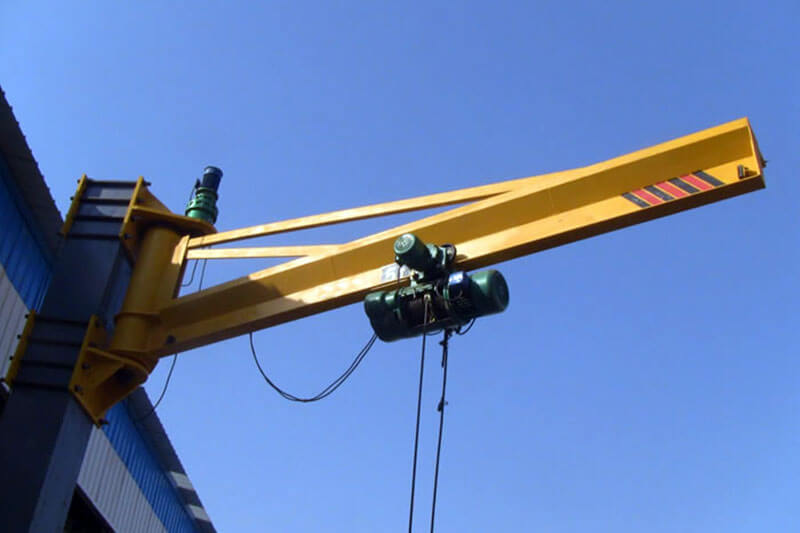
How to Get Wall Jib Crane at Right Price – Buyer’s Checklist
Learn practical steps to select the correct wall jib crane, confirm specifications & get accurate pricing from reliable suppliers. Get your wall jib crane!
Introduction
A wall jib crane is a compact lifting device fixed to an existing wall or building column. Unlike freestanding jib cranes, it doesn’t require a floor-mounted support, which makes it a smart choice for workshops or factories where floor space is already crowded. With a rotating jib arm and a hoist, it allows workers to lift, move, and position loads efficiently within a limited working radius.
You’ll often see wall jib cranes in machine shops, small assembly lines, and maintenance areas. They’re especially handy for repetitive lifting tasks, like loading parts into a machine, moving components along a workstation, or handling materials near walls or corners where a larger overhead crane can’t reach.
Choosing the right wall jib crane isn’t just about picking a lifting capacity and moving on. If the specifications don’t fit your workshop conditions, the crane may end up being underutilized or, worse, unsafe. The supplier you choose also matters—a reliable manufacturer will not only deliver the correct crane but also provide technical drawings, installation guidance, and long-term spare parts support.
In short, getting the right wall jib crane at the right price comes down to two things:
Matching the crane’s specifications to your actual lifting needs
- Load capacity, arm length, lifting height, and rotation angle all directly affect how useful the crane will be in your space.
Working with a trustworthy supplier
- Look for a supplier with certifications, proven experience, and the ability to customize solutions for your workshop or production line.
By paying attention to both, you’ll avoid overspending on unnecessary features and prevent downtime caused by poor installation or mismatched equipment. And honestly, that’s what every buyer wants: a crane that does the job, fits the space, and lasts for years without becoming a maintenance headache.
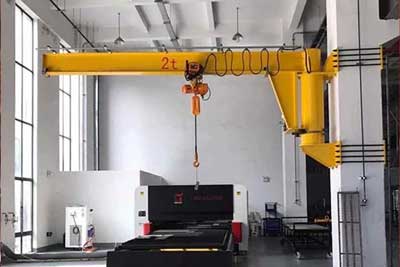
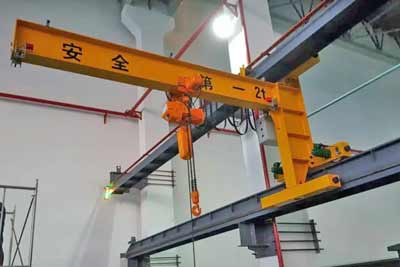 wall travelling jib crane for sale
Basics of Wall Jib Cranes
Definition and Structure
A wall jib crane is a jib crane installed on an existing wall or building column, designed to handle loads in a limited working area without occupying floor space. There are two main types:
- Wall-Mounted Jib Crane – Fixed to the wall or column, with a rotating jib arm. Commonly used for localized lifting tasks near workstations.
- Wall-Travelling Jib Crane – Installed to run along a track mounted on the wall or columns, allowing the jib to move horizontally across a longer section of the workshop.
Both types share the same purpose: to improve lifting efficiency in areas where overhead cranes or freestanding jib cranes are either unnecessary or impractical.
Load Capacity Range
- Standard wall-mounted jib cranes usually handle capacities from 0.25 ton up to 5 tons.
- With customized designs and reinforced structures, they can even reach up to 10 tons.
- Wall-travelling jib cranes typically handle light to medium loads, often between 0.5 ton and 5 tons, but cover a wider working area thanks to the travelling rail system.
Advantages of Wall Jib Cranes
- Save Floor Space – Since the cranes are attached to the wall or run along it, no extra foundation or floor support is needed.
- Flexible Operation – Wall-mounted types provide a fixed working radius, while wall-travelling types extend coverage along the length of a workshop.
- Cost-Effective – Installation is simpler compared to freestanding cranes, and they’re cheaper than full overhead crane systems.
- Practical for Workstations – Ideal for machining, assembly, and maintenance areas where materials need to be lifted and positioned repeatedly.
Limitations of Wall Jib Cranes
- Restricted Load Capacity – Even with customization, wall-mounted types are not ideal for heavy-duty lifting beyond 10 tons.
- Dependence on Building Structure – The wall or supporting columns must be strong enough to handle the loads and dynamic forces.
- Limited Coverage – While wall-travelling jib cranes offer more reach, they’re still limited to a specific section of the workshop.
Key Specifications Buyers Must Confirm
When buying a wall jib crane, it’s not enough to know the model name or lifting capacity. Each specification has a direct impact on how well the crane fits into your workshop. Confirming the details early will save you from costly mistakes and unnecessary modifications later.
Load Capacity
The first question to ask is always: how heavy are the loads you need to lift?
- Standard wall jib cranes usually range from 0.25 ton to 5 tons.
- With a customized design, wall-mounted jib cranes can even go up to 10 tons.
- Always include a safety margin of 20–30% above your regular load weight. For example, if you often lift 2 tons, choose a 3-ton jib crane.
This ensures smooth operation and prevents overloading the crane during peak usage.
Jib Arm Length (Slew Radius)
The jib arm length determines how far the crane can reach from the mounting point.
- Typical arm lengths range from 2 meters up to 6 meters.
- A longer arm covers more working area but requires stronger wall support.
- Before deciding, measure the floor space, nearby machines, and any obstacles in the rotation path.
A well-matched arm length avoids wasted reach while still giving workers enough freedom to handle loads efficiently.
Lifting Height
Lifting height is the distance the hook can travel—from the floor to its maximum position.
- Consider the height of your machines, workbenches, or assembly stations.
- Leave enough clearance so the hook doesn’t hit overhead beams, lighting, or ducts.
- For workshops with low ceilings, shorter hoists or low-headroom designs may be needed.
Getting this wrong can limit crane usability. It’s frustrating if the hook can’t reach high enough to clear a machine, or drops too low for safe load pickup.
Slewing Angle
The slewing angle defines how far the jib arm can rotate.
- Standard wall-mounted jib cranes rotate about 180°.
- Some designs allow up to 200° or more if space permits.
- In tight workshops, rotation may need to be restricted to avoid hitting walls or equipment.
Always picture the real working area. A crane that rotates too much in a cramped space can be more trouble than help.
Hoist Type
The hoist is the working heart of the jib crane. Choosing the right one makes daily lifting smoother.
- Electric Chain Hoist – Compact, reliable, and suitable for loads up to around 5 tons. Ideal for frequent, light-to-medium lifting.
- Wire Rope Hoist – Faster lifting speeds and smoother operation. Better suited if you’re handling heavier loads or require higher lifting height.
- Manual Hoist – Simple and low-cost, but only practical for occasional lifting with lighter loads.
When in doubt, most buyers go for an electric chain hoist, as it balances price, performance, and durability.
Installation and Workshop Considerations
A wall jib crane is only as reliable as the structure it’s fixed to and the conditions of the workshop around it. Before placing an order, it’s worth taking a closer look at your installation site. A well-prepared workshop means smoother installation and safer operation later on.
Wall Strength and Structure
The crane will put constant pressure and shock loads on the wall or column. If the structure isn’t strong enough, cracks or failures can occur over time.
- Concrete or reinforced steel columns are usually required for safe installation.
- For lighter walls, extra steel reinforcement plates or brackets may be necessary.
- If unsure, ask your supplier to provide load drawings so an engineer can check your building’s capacity.
Ignoring this step is one of the most common mistakes buyers make.
Power Supply Compatibility
Most wall jib cranes are powered by an electric hoist, which must match your workshop’s electrical system.
- Common options: 380V/50Hz/3-phase in many countries, 220V or 440V in others.
- Always confirm your local voltage and frequency before ordering.
- If the workshop has unstable power or frequent surges, consider installing a voltage stabilizer to protect the hoist motor.
Mismatched or unstable power can shorten motor life and cause unnecessary downtime.
Space Constraints
Even though wall jib cranes save floor space, they still need a clear working area.
- Measure the swing radius to make sure the jib arm won’t collide with machines, doors, or walkways.
- Check the height of the arm and hoist against ceilings, beams, and overhead piping.
- Plan for operator movement — workers should be able to move safely around the crane without squeezing past other equipment.
A good rule of thumb: picture the crane in action and trace the path of the hook with your arm. If you “hit” something, the crane will too.
Cost Factors That Affect Wall Jib Crane Price
The price of a wall jib crane is not just about the lifting capacity. Several elements affect the final quotation, and understanding these will help you judge whether a supplier’s offer is reasonable.
Design and Customization
Standard designs are cheaper and faster to deliver. These cover the common ranges: 0.25 ton to 5 tons, with fixed arm lengths and rotation angles.
Customized designs cost more but may be necessary for special cases, such as:
- Higher capacities (up to 10 tons for wall-mounted types)
- Non-standard arm lengths
- Limited ceiling height or tight workshop layout
- Reinforced structures for weak walls
If your workshop has unique constraints, customization is usually worth the investment.
Hoist Selection
The choice of hoist can shift the price significantly.
- Manual hoist – Cheapest, but only suitable for very light and occasional lifting.
- Electric chain hoist – Most common option, offering a balance of price, performance, and durability.
- Wire rope hoist – Higher cost, but smoother, faster, and better for frequent heavy-duty work.
Tip: For most workshops, an electric chain hoist is the most cost-effective choice.
Rotation Mechanism
The jib’s slewing mechanism can be manual or motorized:
Manual slewing – Cheaper and good for light loads or short working radiuses.
Motorized slewing – Adds cost but reduces operator effort, especially useful if:
- Loads are heavy
- The jib arm is long
- Frequent rotation is needed
Think about operator comfort and efficiency — sometimes spending a little more saves time and effort every day.
Additional Features
Special features can add to the price but may be necessary depending on the environment:
- Explosion-proof design – Required for hazardous areas with flammable dust or gases.
- Outdoor protection – Weather-resistant covers, anti-rust painting, and sealed electrical parts.
- Frequency control (VFD) – Allows smoother lifting, lowering, and slewing, reducing wear and improving precision.
These extras should be matched carefully with your workshop’s real working conditions.
Shipping, Installation, and After-Sales Service
The purchase price is only part of the cost.
- Shipping – Heavier and bulkier cranes mean higher freight charges.
- Installation – Some suppliers provide drawings only, while others send installation teams at extra cost.
- After-sales service – Availability of spare parts, warranty length, and local service partners all affect long-term expenses.
A cheaper upfront price isn’t always better if service and spare parts are difficult to get later.
Buyer’s Checklist Before Requesting a Quotation
Before asking for a price, it’s smart to prepare the key information suppliers always need. A complete checklist not only speeds up the quotation process but also ensures the design matches your workshop conditions. Here’s what you should confirm:
✅ Required Load Capacity
- Identify your heaviest regular load, not just the average weight.
- Add a 20–30% safety margin. For example, if your usual load is 2 tons, request a 3-ton jib crane.
- If loads vary a lot, tell the supplier the range of weights so they can suggest the right capacity.
✅ Jib Arm Length and Rotation Angle
- Measure the working radius needed from the mounting point.
- Standard arms are between 2 m to 6 m, but can be customized longer if space and wall strength allow.
- Decide the rotation angle (180°, 200°, or restricted) based on surrounding obstacles like walls, machines, or walkways.
✅ Lifting Height and Hook Coverage
- Define the lowest pickup point (e.g., from the floor, pit, or loading bay).
- Define the highest lifting point (e.g., machine top, mezzanine, or truck bed).
- Check for overhead clearance — beams, lighting, and piping often interfere if not planned in advance.
✅ Wall or Column Specifications (Strength, Space)
- Provide details of the wall material (concrete, steel column, brick, etc.).
- Indicate thickness and load-bearing capacity if known.
- Share photos or drawings of the wall/column so the supplier can assess mounting requirements.
✅ Hoist Type and Lifting Speed Preference
- Choose between electric chain hoist, wire rope hoist, or manual hoist.
- Consider whether you need single-speed or dual-speed lifting for more precise positioning.
- Mention if you prefer VFD (frequency control) for smoother starts and stops.
✅ Power Supply Details
- Confirm voltage and frequency (e.g., 220V/60Hz, 380V/50Hz, 440V/60Hz).
- State if you use single-phase or three-phase power.
- If power conditions are unstable, ask about protective devices.
✅ Any Special Environment (Explosive, Outdoor, Corrosive)
- For hazardous areas, specify if you need explosion-proof components.
- For outdoor use, request weatherproof designs, special coatings, and motor covers.
- For corrosive environments (e.g., chemical plants, coastal areas), consider stainless steel parts or heavy anti-rust paint.
✅ Quantity Required (Single or Multiple Cranes)
- A single crane has a straightforward design.
- Multiple cranes may allow for bulk pricing or customized production.
- If you plan to add more cranes in the future, mention it — some suppliers design with future expansion in mind.
Practical Tip: The more detailed information you provide, the faster you’ll get a tailored drawing and an accurate price. A vague request like “I need a 3-ton wall jib crane” often leads to back-and-forth emails and delays.
Questions to Ask Your Supplier
Even when two suppliers quote for the same “3-ton wall jib crane,” what’s included in the offer can be very different. Asking clear questions helps you avoid hidden costs and ensures you’re working with a reliable partner. Here’s what you should check:
Make sure the crane complies with recognized safety and quality rules.
- Do you provide CE, ISO, or local safety certifications?
- Are the certificates valid and up to date?
- Can you share copies for verification before purchase?
Clarify exactly what you are paying for. Some suppliers quote just the structure, while others include the full system.
- Is the electric hoist (chain or wire rope) included in the price?
- Does the quote cover the motor for slewing (if motorized)?
- Are mounting brackets, bolts, and installation kits part of the package?
- Is the control system and wiring provided?
A drawing is the only way to confirm the crane fits your space properly.
- Can you provide a general arrangement drawing before the order is confirmed?
- Will the drawing include dimensions, rotation angle, and mounting details?
- Do you offer support to check the crane’s fit with my workshop layout?
The warranty and parts supply determine how easy it is to keep your crane running long-term.
- What is the standard warranty period (12 months, 24 months)?
- Which parts are covered — structure, hoist, motors, or electricals?
- How quickly can you supply spare parts like chains, motors, or brakes?
A crane is a long-term investment. Reliable service matters just as much as the crane itself.
- Do you provide remote technical support for installation and troubleshooting?
- Will you supply manuals, drawings, or installation videos?
- Can an engineer visit the site if needed (and at what cost)?
- Do you guarantee lifetime technical service after the warranty ends?
Conclusion
Choosing the right wall jib crane isn’t just about picking a lifting capacity and calling it a day. Careful consideration of specifications, installation conditions, and workshop requirements ensures the crane performs safely and efficiently over the long term.
Using a detailed buyer’s checklist before requesting quotations helps you:
- Provide suppliers with complete and accurate information.
- Get tailored drawings and correct pricing from the start.
- Avoid unexpected installation issues, downtime, or unsafe conditions.
- Ensure the crane fits your workflow, space, and lifting needs precisely.
In short, spending time upfront on preparation makes all the difference. A well-planned wall jib crane purchase not only saves money but also keeps your workshop running smoothly for years to come.