10 Ton Gantry Crane Pricing: What Every Buyer Should Know
10 ton gantry crane for sale. Learn the main factors affecting 10 ton gantry crane prices, helping buyers make informed, practical, and cost-effective purchasing decisions.
Introduction
A 10 ton gantry crane is a versatile lifting solution used across manufacturing plants, logistics warehouses, construction sites, and shipyards. Its main purpose is to move heavy materials safely and efficiently—think steel plates, machinery, containers, or other bulky loads. These cranes are often the backbone of daily operations, handling repetitive lifting tasks that would be impossible or unsafe with manual labor alone.
While many buyers focus on the “10 ton” capacity, that’s only part of the story. Price is influenced by much more than lifting capacity. Two cranes with the same weight limit can have very different costs depending on their design, operational requirements, and the environment they operate in.
Understanding these cost-driving factors upfront can save you money, prevent installation headaches, and ensure you select a crane that truly fits your needs. In this guide, we’ll walk you through seven key factors that affect the price of a 10 ton gantry crane:
- Specifications & Design: Span, cantilever, lifting height, and travelling length.
- Control Systems & Automation: Pendant, remote, cabin, or automated operations.
- Operating Environment: Indoor vs. outdoor, marine, dusty, or hazardous zones.
- Compliance & Safety Requirements: Local and international standards, safety devices, and certifications.
- Supplier & Market Considerations: Local vs. international suppliers, shipping, tariffs.
- Lifecycle & Maintenance Costs: Total cost of ownership, energy consumption, and service needs.
- Custom vs. Standard Models: Tailored designs vs. off-the-shelf solutions.
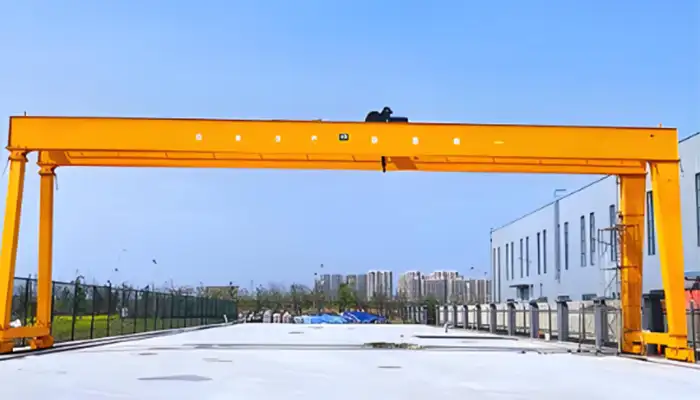
Factor 1 — Specifications & Design
Span and Cantilever
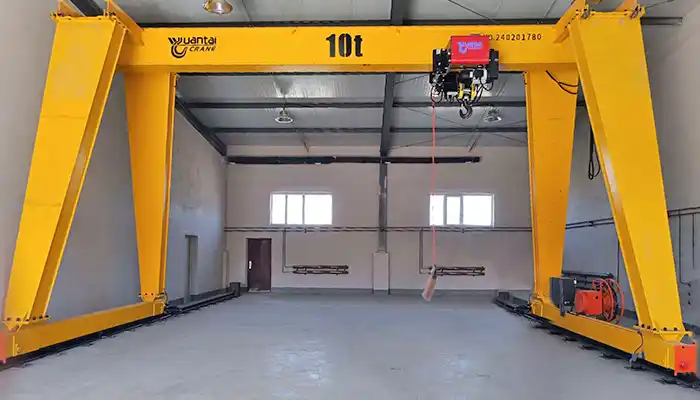
The span of a gantry crane is the distance between the rails or wheel tracks that the crane moves along. In simple terms, it’s how wide the crane can reach to lift and move loads. A longer span allows you to cover more area but comes with higher material and engineering costs.
Cantilevers are the extensions beyond the main rails, giving the crane extra reach outside the tracks. There are three common options:
- No cantilever: Most economical; lifting is confined within the rails.
- Single cantilever: Extends the reach on one side; moderate increase in cost.
- Double cantilever: Reaches both sides; requires stronger steel, bracing, and careful engineering, making it the most expensive option.
Lifting Height
Lifting height is the vertical distance from the floor to the hook at its highest point. Higher lifts require taller legs, longer hoist ropes or chains, larger drums, and stronger bracing to maintain stability. For example:
- Indoor cranes usually lift 3–8 meters, suitable for machinery, racks, and medium-height loads.
- Outdoor or yard cranes can lift 5–12 meters, accommodating stacked materials, containers, or vehicles.
Travelling Length
Travelling length is how far the crane can move along its rails. Longer travel distances affect both the crane and the supporting infrastructure:
- More steel rails and stronger foundations are needed.
- Longer power supply systems, like festoon cables, conductor bars, or cable reels, add to costs.
- Drive motors may need more power to handle extended travel.
Practical Tip
- Match span, cantilever, lifting height, and travelling length to your actual operational needs.
- Avoid oversizing “just in case,” which can unnecessarily increase steel, fabrication, and installation costs.
2- 7 Factors Affect Your 10 Ton Ganry Crane Prices
Control Options
How you control your crane affects both cost and daily efficiency. Common options include:
- Pendant Control: Simple, wired, and the lowest cost. Operator moves with the crane.
- Wireless Remote Control: Allows operation from a distance; adds 5–15% to the price.
- Cabin Control: Operator sits in a cabin on the crane; ideal for long travel distances or outdoor work; costs 20–40% more.
- Semi/Fully Automated: Pre-programmed or sensor-guided movement; precise and efficient, but increases cost 30–60%, depending on complexity.
Operational Advantages
- Pendant: Simple, reliable, minimal setup.
- Remote: Improves safety and visibility, especially outdoors.
- Cabin: Comfortable for long operations, protects the operator from weather.
- Automation: Reduces labor, increases precision, especially in repetitive tasks.
Buyer Advice
- Choose a control method based on facility size, operational safety, and precision requirements.
- Don’t overspend on automation if your operation doesn’t require it—balance cost with actual workflow needs.
- Always check for local safety regulations that may require specific control types.
Indoor vs. Outdoor Cranes
The environment where your crane operates plays a big role in cost and design.
- Indoor cranes are generally simpler. They don't face weather exposure, so standard steel structures and motors are sufficient.
- Outdoor cranes require extra protection, including corrosion-resistant coatings, IP-rated motors, and weather covers to protect electrical components from rain, dust, and sunlight.
Ignoring environmental factors can lead to faster wear, downtime, and additional maintenance costs.
Special Environments
Some facilities have unique conditions that demand additional design considerations:
- Coastal/marine areas: Salt in the air accelerates corrosion. Cranes need anti-rust coatings, stainless-steel fasteners, and corrosion-resistant paint.
- Dusty or abrasive environments: Cement plants, foundries, or mines require sealed motors, enclosed gearboxes, and dust-proof control panels.
- Hazardous or explosive zones: Flammable gases or dust require ATEX/IECEx compliant components, spark-proof materials, and strict safety measures.
Buyer Tip
- Specify protections only for the actual conditions in your facility. Over-specifying increases costs unnecessarily.
- Consider both current and potential future conditions. Discuss options with your manufacturer to ensure the crane is safe and cost-effective.
Impact on Design & Cost
Compliance with safety standards is mandatory and affects both design and pricing:
- Local and international standards such as CE, ISO, or ATEX dictate materials, electrical components, and structural design.
- Some regulations require third-party inspections or certifications, which add cost but guarantee reliability and safety.
- Enhanced safety devices like overload protection, limit switches, emergency stops, and anti-collision systems may be necessary depending on the facility or country.
Ignoring compliance can lead to legal problems, safety risks, or costly retrofits.
Buyer Tip
- Identify applicable standards early in the planning process to avoid redesign or retrofitting later.
- Work closely with your manufacturer to ensure the crane meets all required certifications without unnecessary extras.
- Remember, compliance protects your staff, equipment, and investment.
Price Differences: Local vs. International Suppliers
Where you buy your crane has a direct impact on price.
- Local suppliers may offer faster delivery, easier communication, and lower shipping costs. However, selection might be limited, and prices could be slightly higher due to smaller production scale.
- International suppliers, especially factory-direct from countries like China, often provide lower base prices and more customization options. But keep in mind shipping fees, customs duties, and tariffs, which can add significantly to the final cost.
Shipping, Tariffs, and Delivery Times
- Longer shipping routes may require extra freight, insurance, and port handling fees.
- Delivery times can range from weeks to months, depending on factory schedules and international logistics.
- Tariffs or import duties vary by country and can affect the total price unexpectedly if not planned for.
Factory-Direct vs. Distributors
- Factory-direct purchases usually allow better customization and direct communication with engineers.
- Distributors can simplify purchasing for smaller buyers, provide local support, and sometimes offer maintenance packages.
- The key is balancing cost, support, and delivery speed with your operational needs.
Total Cost of Ownership
Buying a crane is more than the upfront price. Consider the long-term costs:
- Energy consumption: More powerful motors or longer travel distances can increase electricity costs.
- Maintenance: Regular inspections, lubrication, and part replacements are needed to keep the crane safe and efficient.
- Operation: Skilled operators may require training depending on complexity or automation features.
Spare Parts Availability and Service Contracts
- Ensure spare parts are available locally or can be delivered quickly.
- Service contracts can reduce downtime and prevent unexpected repair costs.
- Some manufacturers provide extended warranties, which can offset maintenance expenses over time.
Buyer Tip
- Don't just compare purchase prices—consider energy use, maintenance, and potential downtime.
- Sometimes paying a bit more upfront for a reliable crane with available parts and service saves significant money over its lifespan.
When Customization Is Necessary
Not every facility can work with a standard crane. Customization becomes important when:
- Your workspace has unique dimensions or restricted clearance.
- You need special lifting configurations, like extended cantilevers or dual hooks.
- The crane must operate in extreme or unusual environments, such as coastal, dusty, or hazardous zones.
Custom designs ensure the crane fits your specific operational needs, but they come at an extra cost compared to standard, off-the-shelf models.
Cost Implications
- Steel Structure: Customized spans, double cantilevers, or taller legs require more material and engineering work.
- Hoist Design: Specialized hoists or longer rope/chain lengths increase both material and manufacturing costs.
- Control Systems: Custom automation, cabin layouts, or remote-control setups add to the price, depending on complexity.
Balancing Flexibility with Budget
- Only request customization for essential requirements—adding features “just in case” can significantly raise costs.
- Compare standard models first; sometimes minor adjustments can meet your needs without full customization.
- Work closely with the manufacturer to find a balance between functionality and price, ensuring your crane is practical, safe, and cost-effective.
Combined Impact & Pricing Examples
How Multiple Factors Influence Total Cost
When considering a 10 ton gantry crane, it’s important to remember that all cost factors interact. A single specification might only add a small amount, but when combined, costs can increase significantly.
- A long-span, high-lift crane requires more steel, taller legs, longer hoist ropes, and stronger motors.
- Adding extended travelling length increases foundation work, rail materials, and power supply systems.
- Choosing remote or cabin controls adds comfort and safety, but also increases complexity and cost.
- Operating in outdoor, marine, or hazardous environments adds protective coatings, sealed components, and certifications.
Example Scenarios
Basic Indoor Crane:
- Short span, standard lifting height, pendant control, indoor environment.
- Minimal structural steel, standard hoist, and simple installation.
- Most economical option for light and standard operations.
Fully Customized Outdoor Crane:
- Long span, high lifting height, double cantilever, extended travelling length.
- Remote control or cabin, IP-rated motors, corrosion-resistant coatings for coastal use.
- ATEX/IECEx compliance for hazardous areas.
- Can cost 2–3 times more than a basic indoor crane due to combined factors.
Key Takeaway: Consider all specifications together, rather than individually, to understand the true cost and avoid surprises.
Conclusion & Buyer Recommendations
Choosing the right 10 ton gantry crane is about matching specifications to operational needs—not just picking a crane based on lifting capacity. Clear and detailed requirements help manufacturers provide accurate quotes and prevent overspending.
- Balance current needs with future expansion: Oversizing can inflate costs unnecessarily, while undersizing may limit productivity later.
- Consult experienced manufacturers: They can guide you through design, control options, environmental protections, and compliance requirements.
- Plan for the long term: Consider not only upfront costs but also maintenance, energy consumption, and parts availability to reduce lifetime expenses.
By taking a structured approach and working with trusted suppliers, you can select a crane that is safe, reliable, cost-effective, and perfectly suited to your facility.