Cost-Saving Overhead Cranes for Low-Headroom Workshops
The Cost-Saving Overhead Crane Solution for Limited Headroom Spaces
Introduction
Limited headroom workshops come with a unique set of challenges. Cranes are essential for moving materials, but standard overhead cranes can take up too much vertical space, leaving less room for operations. In these situations, every centimeter matters.
Choosing the right crane isn’t just about fitting it in—it’s about making the most of the space you have. The right system allows you to:
- Lift heavy loads safely without reducing usable height
- Avoid expensive structural modifications or building changes
- Reduce installation time and long-term maintenance costs
This guide is aimed at workshop engineers who want practical, cost-saving crane solutions for low-ceiling spaces. It will cover:
- Types of cranes suited for limited headroom
- Key design considerations for maximizing lifting height
- Installation strategies that save time and money
- Tips for maintaining crane efficiency and safety over time
By the end, you’ll have a clear understanding of how to choose and implement a crane solution that fits your workshop, handles the required loads, and keeps operations smooth—all without unnecessary expenses.
Limited Headroom Challenges
Working in a workshop with limited headroom requires careful planning. Not all cranes fit every space, and installing the wrong type can lead to wasted time, reduced productivity, or even safety issues. Before choosing a solution, it’s important to understand what “limited headroom” really means and how it affects operations.
Limited headroom typically refers to a workshop where the vertical distance from the floor to the lowest obstruction—like the ceiling, beams, or other equipment—is less than what standard overhead cranes require. In practical terms:
- Ceiling height minus required hook approach is minimal
- Space for crane girders, trolley, and hoist is constrained
- Extra lifting height is not available without custom solutions
Working with restricted headroom can affect several aspects of workshop operations:
- Reduced lifting height: Loads cannot be raised to the full potential of standard cranes, limiting vertical handling and sometimes requiring multiple lifts.
- Safety concerns: Less space between crane components and other equipment increases the risk of collisions. Operators must work more carefully, and emergency procedures may need adjustment.
- Crane type limitations: Not all cranes fit; standard double girder cranes, for example, may be too tall. Engineers must consider single girder, low-headroom, or compact modular designs.
Limited headroom is common in facilities that were not originally designed for large cranes. Examples include:
- Small manufacturing plants with low ceilings
- Automotive workshops where lifts and machinery reduce available space
- Metal fabrication shops with mezzanines or overhead piping
Cost-Saving Crane Options for Low Headroom
When headroom is limited, the right crane can make a big difference in both cost and efficiency. Engineers have several practical options to maximize lifting height, reduce installation expenses, and maintain safety. Let’s break down the main choices.
Low-Headroom Overhead Cranes ( EOT Cranes)
Low-headroom overhead cranes are specifically designed for spaces where every centimeter counts. They achieve this through compact components and smart design.
single girder overhead crane with low headroom wire rope hoists
Key Features:
- Compact trolley that fits in tighter vertical space
- Reduced hook approach, allowing maximum lifting height in the workshop
- Optimized girder design to minimize crane height without compromising strength
Benefits:
- Maximizes usable lifting height even in low-ceiling areas
- Reduces steel usage and structural requirements, cutting material costs
- Lowers installation costs by avoiding major ceiling or building modifications
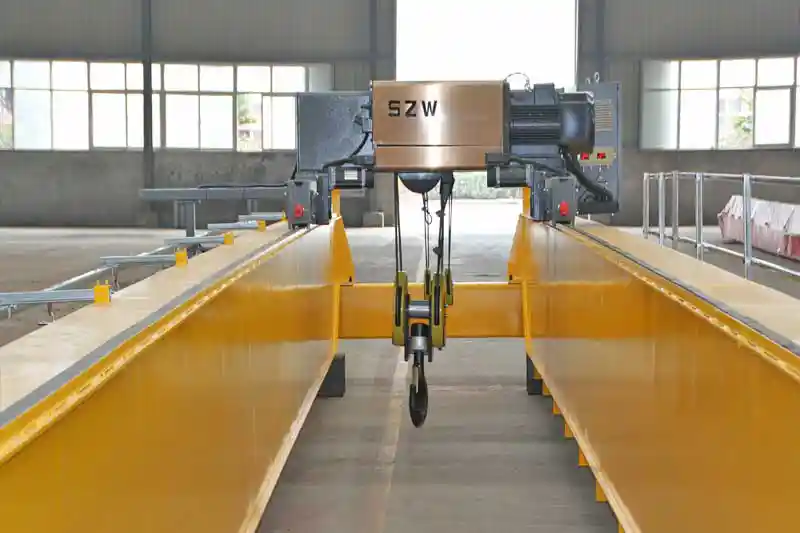
double girder overhead crane with low headroom hoist trolley
Single Girder Cranes vs. Double Girder Cranes
Choosing between single and double girder cranes depends on load requirements, space, and budget.
Considerations:
- Cost Comparison: Single girder cranes are generally less expensive to purchase and install. Double girder cranes can handle heavier loads but come with higher material and installation costs.
- Space Efficiency: Single girder cranes take up less vertical and horizontal space, making them ideal for low-headroom workshops.
- Maintenance: Single girder systems are easier and quicker to maintain. Double girder systems require more complex inspections and part replacements.
Compact Electric Hoists and Trolleys
For workshops where headroom is tight, compact hoists are essential. They allow for safe lifting without needing extra vertical clearance.
Practical Options:
- Wire Rope Hoists: Suitable for heavier loads, offering strength in a smaller vertical space
- Chain Hoists: Ideal for lighter loads and occasional lifting tasks
- Adjustable Lifting Speeds: Improve workflow efficiency while preventing overloading or jerky movements
Customized or Modular Solutions
Sometimes, off-the-shelf cranes still don’t fit the space. Customized or modular cranes provide flexibility without overspending.
Advantages:
- Tailored crane heights and spans designed to match your existing workshop dimensions
- Pre-fabricated modular kits reduce installation time and labor costs
- Allows engineers to select only the components needed, avoiding unnecessary expenses
Practical Tip: Always measure the available headroom carefully and consider the hoist, trolley, and girder height together. Even a few centimeters can make a big difference in crane performance and installation cost
Design Considerations for Limited Headroom
Designing an overhead crane for a low-headroom workshop requires careful planning. Small miscalculations can reduce lifting efficiency or even create safety risks. Engineers must focus on measurements, capacity, and integration with existing equipment to make the most of limited space.
Before selecting a crane, you need precise measurements of the vertical space available. Take note of:
- Lowest overhead obstruction (beams, pipes, lighting fixtures)
- Any slope or variation in ceiling height across the workshop
- Clearance needed for crane components, including trolley, hoist, and hooks
Accurate measurements ensure the crane will fit without compromising lifting height or safety.
The maximum hook height is the highest point the crane hook can reach. Compare this with the height needed to handle your heaviest loads:
- Ensure the hook can reach above the load without hitting the ceiling
- Consider the hook approach distance required for safe lifting and load stability
- Factor in future operational needs—sometimes a slightly higher crane can prevent costly upgrades later
Limited headroom can affect crane capacity calculations:
- Check that the hoist can handle the intended load at full lifting height
- Include a safety margin of 10–20% for unexpected weight variations
- Consider the effect of compact design on load distribution and trolley movement
This ensures the crane performs efficiently without overloading components.
The crane's span—the distance between rails or beams—must fit the workshop layout:
- Wider spans allow greater coverage but may require stronger girders
- Narrow spans reduce material costs and installation complexity
- Plan the runway to avoid interference with machinery, walkways, or storage areas
Low-headroom cranes must work around what's already in place:
- Check for obstacles like mezzanines, ducting, or cranes on adjacent runways
- Ensure smooth crane movement without collisions
- Consider workflow efficiency—position cranes so operators can lift and move loads without extra handling steps
Practical Tip: For limited headroom spaces, a slightly smaller crane span or a compact trolley design often saves both vertical space and installation cost, while still handling all required loads efficiently.
Installation & Operational Efficiency
Installing an overhead crane in a workshop with limited headroom requires careful planning. The goal is to reduce labor costs, avoid major building modifications, and ensure safe operation. Proper installation not only saves money upfront but also improves long-term productivity.
Pre-assembling crane components before installation can significantly reduce labor time and complexity. Consider:
- Assembling the trolley, hoist, and hook mechanism off-site or in a staging area
- Testing crane movement and hoist functions before final installation
- Using modular components that fit together easily on-site
These strategies minimize installation downtime and reduce the risk of errors during assembly.
Limited headroom often means you can't raise ceilings or move beams. In such cases:
- Choose low-headroom or compact cranes that fit within existing space
- Use modular runway supports that attach to walls or columns instead of modifying ceilings
- Adjust girder height and hook approach to match the workshop's fixed dimensions
Minimizing structural changes keeps costs down and avoids lengthy construction work.
Operating a crane in a confined vertical space introduces additional safety concerns. Key measures include:
- Emergency Stop Systems: Allow operators to immediately halt crane movement if a collision or overload is detected.
- Anti-Collision Devices: Prevent the crane from hitting walls, equipment, or other cranes running on the same runway.
- Load-Limiting Mechanisms: Ensure the crane does not lift beyond its rated capacity, protecting both the equipment and operators.
Practical Tip: Even small adjustments in installation—like pre-assembling the hoist or choosing the right anti-collision system—can improve operational efficiency and prevent costly accidents in tight workshops.
Maintenance & Long-Term Cost Savings
Selecting the right crane for a low-headroom workshop isn't just about installation—it's also about keeping costs low over the long term. Compact and well-designed cranes can save money on maintenance, reduce energy consumption, and extend the equipment's lifespan.
Cranes designed for limited headroom often use fewer components and a simpler structure. This has practical benefits:
- Less steel and fewer moving parts reduce potential wear and tear
- Fewer high points mean easier inspections and cleaning
- Compact design simplifies lubrication points and routine checks
Maintenance becomes much easier when hoists and trolleys are accessible:
- Modular hoist components can be replaced without dismantling the entire crane
- Trolley maintenance is straightforward, reducing downtime
- Operators can quickly swap out parts without specialized tools or extensive labor
Modern low-headroom cranes often use energy-efficient motors:
- Reduce electricity consumption during lifting operations
- Adjustable speed motors allow smoother starts and stops, saving energy and preventing wear
- Lower operational costs over the crane's lifetime
A well-installed crane combined with careful operation lasts longer:
- Proper alignment of rails and girders prevents uneven wear
- Correct load handling avoids over-stressing components
- Regular preventive maintenance ensures consistent performance
Practical Tip: Investing in a low-headroom crane with easy-to-service components and efficient motors may cost slightly more upfront, but it typically pays off quickly through lower maintenance costs and reduced energy consumption.
Case Studies for Your References
Seeing how low-headroom cranes work in real workshops can give engineers a clear idea of their benefits. The following examples highlight cost savings, improved workflow, and practical solutions for tight spaces.
Example 1: Workshop Retrofitted with Low-Headroom Single Girder Crane
A small metal fabrication workshop had a ceiling height just under 5 meters, making standard double girder cranes impossible.
- Solution: Installed a low-headroom single girder crane with a compact trolley and optimized girder design
- Outcome: Achieved maximum lifting height for existing space without structural changes
- Cost Benefits: Reduced material and installation costs by 25% compared to a custom double girder system
Example 2: Cost Savings Using Modular Wire Rope Hoist System
An automotive parts workshop needed to lift medium-weight components but had uneven ceiling heights across bays.
- Solution: Implemented modular wire rope hoists with adjustable spans
- Outcome: Crane components pre-assembled off-site and installed in stages, avoiding lengthy downtime
- Cost Benefits: Lower labor and installation costs, plus minimal disruption to ongoing operations
Example 3: Productivity Improvement in Limited Space with Optimized Trolley Design
A small manufacturing plant struggled with slow material handling due to narrow workshop aisles and low ceilings.
- Solution: Added a compact trolley with adjustable lifting speeds on a single girder low-headroom crane
- Outcome: Operators could move loads faster and more safely, with less risk of collision
- Cost Benefits: Improved workflow reduced handling time per load by 30%, increasing daily productivity without expanding the workshop
Practical Takeaway: These examples show that careful selection of crane type, hoist, and trolley design can solve space restrictions, reduce costs,
Conclusion
Low-headroom overhead cranes provide practical solutions for workshops with limited vertical space. Choosing the right system allows engineers to optimize space, reduce costs, maintain safety, and improve productivity.
Key Benefits:
- Space Optimization: Compact designs maximize lifting height without requiring structural changes.
- Cost Efficiency: Lower material, installation, and maintenance costs compared to standard cranes.
- Safety: Reduced risk of collisions and overloads in tight spaces.
- Productivity: Smooth crane operation and faster handling improve workflow in confined workshops.
Recommendation for Workshop Engineers:
When working in a low-headroom environment, consider cranes specifically designed for compact spaces, such as single girder low-headroom systems or modular wire rope hoists. Tailoring the crane to your workshop’s dimensions ensures efficient, safe, and cost-effective operations.
Measure your workshop’s available headroom, identify lifting requirements, and explore tailored crane options. Even small adjustments in crane type or design can result in significant savings and improved performance.
Optional Add-ons (Technical Supplement)
For engineers looking for detailed planning tools, these add-ons provide practical guidance:
Quick-Reference Table:
- Crane Type
- Lifting Capacity
- Span
- Required Headroom
- Estimated Cost
Checklist for Engineers:
- Floor-to-ceiling measurements
- Maximum load requirements
- Hook approach and lifting height
- Safety devices and operational considerations
Comparison Chart:
- Low-Headroom Cranes vs. Standard Cranes
- Factors: Cost, space usage, installation complexity, maintenance needs
Practical Tip: Using these supplements can help engineers make informed decisions, plan installations accurately, and ensure that the crane solution fully meets operational needs in limited headroom workshops.