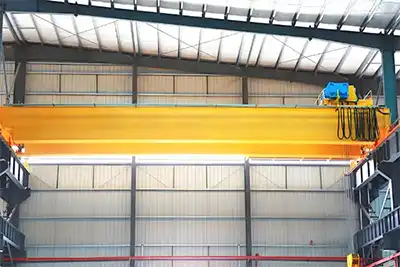
10-Ton Double Girder Crane Optimizes PV Module Handling
How a 10-Ton Double Girder Overhead Crane Helps PV Assembly Plants
Audience: Plant engineers, maintenance managers, logistics planners, crane buyers
Purpose: Show practical benefits of using a 10-ton double girder crane for efficiency, safety, and throughput
Key Benefits:
- Move Modules Faster – Lift and transport modules quickly from storage to assembly lines.
- Safer Handling – Stable lifting reduces risk of cracks, damage, and worker injuries.
- Smooth Workflow – Covers multiple areas overhead, reducing delays and congestion.
- Save Labor & Costs – Fewer workers needed and less product damage.
- Reliable & Durable – Strong design with low maintenance keeps production running.
- Ready for Automation – Can work with future robotic or semi-automated systems.
Introduction
Large solar photovoltaic (PV) module assembly plants are complex operations combining automated processes with manual handling at multiple stages. Modules can be heavy and fragile, requiring careful movement to prevent damage and ensure efficiency.
Large PV assembly plants include module stacking areas, stringing and lamination lines, testing stations, and packing zones. Modules often exceed 2 meters and weigh hundreds of kilograms. Material movement is constant and must protect fragile glass and cells.
- Module sizes: 1.6–2.2 m length, 1–1.2 m width
- Module weight: 20–50 kg depending on type
- Production lines can span hundreds of meters
- High volume requires repeated lifting several times per day
Handling PV modules in large-scale plants presents practical challenges that affect safety and workflow efficiency.
- Size and fragility: Large glass surfaces can crack or chip easily
- Weight and repetitive lifting: Manual handling causes fatigue and risk of injury
- Volume and throughput: Hundreds to thousands of modules move daily, creating bottlenecks if not managed
- Safety concerns: Narrow aisles and busy lines increase accident risk
Overhead cranes move modules quickly, accurately, and safely, covering long distances and reducing physical strain on workers.
- Reduced manual labor: Workers no longer carry modules long distances
- Precision placement: Modules are positioned directly on assembly lines or racks
- Consistent speed: Avoids bottlenecks with repeatable movement
- Enhanced safety: Reduces injuries and module damage
For plants optimizing workflow and protecting expensive modules, selecting the right overhead crane is essential.
10-Ton Double Girder Overhead Crane
A 10-ton double girder overhead crane is a type of bridge crane where the bridge itself consists of two parallel girders that span the width of the workspace. The hoist travels on a trolley mounted on these girders, distributing weight evenly for higher lifting capacities and longer spans compared to single girder cranes.
- Load capacity: Double girder cranes handle heavier loads (up to 20 tons or more) vs. single girder cranes (10–15 tons)
- Bridge deflection: Stiffer girders mean less sag and precise positioning
- Hoist arrangement: Hoist rides on top, providing more headroom and flexibility for oversized modules
- Maintenance access: Easier inspection of trolley and hoist on double girder designs
- Span: Usually 10–30 meters, depending on assembly hall width
- Lifting height: 6–12 meters, sufficient for moving modules over lines, racks, or conveyors
This combination makes double girder cranes ideal for large PV plants where modules require repeated careful handling.
Lifting capacity:
- Rated at 10 tons, covering multiple modules or heavier utility components
Hoist types:
- Wire rope hoists: Durable, precise, suitable for frequent heavy lifting
- Electric chain hoists: Compact, cost-effective, for lighter loads or small batches
Control options:
- Pendant control: Simple and reliable for direct manual operation
- Radio remote control: Allows free movement around the workspace while controlling the crane safely
- Cabin control: Full view for long-span or high-capacity applications, often used in very large PV plants
These specs make the crane adaptable to different layouts, load types, and operational preferences.
- High stability and low deflection: Ensures precise placement of fragile modules
- Supports heavy and oversized modules: Lifts multiple modules or large-format panels safely
- Longer service life with high duty cycle: Handles frequent lifting while minimizing downtime and maintenance costs
By combining capacity, stability, and reliability, this crane improves workflow, reduces manual labor, and maintains safe operations in PV assembly plants.
Typical PV Module Handling Challenges
This section outlines the main challenges faced in large PV assembly plants when handling increasingly large and fragile solar modules. Understanding these challenges helps in selecting the right overhead crane solutions to improve efficiency, safety, and module protection.
Industrial PV panels often exceed 2 meters in length and weigh 40–50 kg per unit. Glass surfaces and silicon cells are highly sensitive to impact, vibration, and sudden shocks.
- Modules are typically rectangular, 1.6–2.2 meters long and 1–1.2 meters wide.
- Fragile glass surfaces require gentle handling and stable lifting methods.
- Errors during storage, assembly, or packaging can lead to significant material losses.
Modules are moved multiple times along production lines, creating bottlenecks when lifting is inefficient or manual.
- Multiple lifts per module increase labor time and reduce throughput.
- Workers may fatigue quickly, causing slower operations or errors.
- Manual handling limits the number of modules moved simultaneously, affecting overall efficiency.
Handling heavy and fragile modules without proper equipment can cause injuries to personnel and hazards from dropped modules.
- Frequent manual lifting increases risk of musculoskeletal injuries.
- Module drops can cause cuts from broken glass or damage to equipment.
- High-traffic areas need clear pathways and controlled lifting methods to prevent accidents.
Compact layouts with multiple lines, racks, and conveyors make ground-based handling difficult, especially for oversized modules.
- Modules may need to be lifted over machinery, conveyors, or storage racks.
- Narrow aisles increase the risk of collisions or accidental damage.
- Overhead lifting solutions, like double girder cranes, utilize vertical space effectively, freeing floor space for other operations.
Streamlining Material Handling with a 10-Ton Double Girder Crane
This section explains how a 10-ton double girder overhead crane improves workflow efficiency, safety, and labor utilization in large PV module assembly plants.
The crane allows PV modules to move efficiently across the plant without manual carrying or forklifts, minimizing handling errors.
- From storage to assembly lines: Lift modules directly from racks or storage areas to assembly lines in one smooth motion.
- Between production stages: Move modules from stringing to lamination, testing, and packing stations seamlessly, keeping workflow continuous.
Centralized lifting ensures gentle handling, reducing risks of cracks or cell misalignment.
Double girder cranes cover wide areas overhead, freeing floor space and supporting simultaneous operations across multiple zones.
- Overhead coverage: Serve several assembly lines or staging zones with a single crane, reducing the need for smaller cranes or forklifts.
- Reduced ground congestion: Floor pathways remain clear for personnel and equipment, lowering collision risks and delays.
The crane acts as a "backbone" connecting storage, assembly, and packaging areas efficiently.
Overhead cranes enhance safety by reducing manual handling and securing heavy modules during lifting.
- Reduced manual handling: Operators no longer carry heavy or oversized modules repeatedly, minimizing fatigue and injury risk.
- Stable lifting: Ensures even, secure movement of modules, preventing drops or tipping that could damage glass or harm personnel.
Remote or pendant operation allows operators to control the crane from a safe distance.
Double girder cranes streamline handling tasks, reducing time per module and lowering labor requirements.
- Faster cycle times: Modules are picked up, transported, and set down in one motion without waiting for forklifts.
- Reduced handling downtime: Minimal manual intervention reduces delays from equipment swaps, human errors, or congested areas.
Over time, this results in higher throughput, lower labor costs, and smoother production workflow.
Cases for References
This section illustrates how a 10-ton double girder overhead crane improves workflow and efficiency in a large PV assembly plant through a typical module handling process.
Modules are received from suppliers, stored in racks, and moved through production stages with minimal manual handling.
- Unloading from trucks: Lift modules directly from pallets to temporary staging areas.
- Transfer to storage racks: Move modules overhead to designated racks, avoiding floor congestion.
- Feeding the assembly line: Transport modules to stringing, lamination, or testing stages.
- Inter-stage transfers: Move modules between stages without extra handling, maintaining product integrity.
- Packing and dispatch: Lift finished modules to packing or staging areas for shipment.
This workflow reduces manual intervention and keeps modules moving efficiently.
Efficient crane operation relies on well-planned load patterns and staging areas. Proper grouping allows multiple modules to be moved safely if within weight limits.
- Receiving area: Palletized modules for easy crane access.
- Intermediate staging: Short-term holding near assembly lines to reduce waiting times.
- Final dispatch: Staging zones near packing or shipping for smooth transitions.
- Load balancing: Position heavy or oversized modules for optimal crane access and stable lifting.
Proper staging ensures the crane can handle multiple tasks without slowing down operations.
Specialized attachments improve safety and efficiency when handling fragile PV modules.
- Vacuum lifters: Handle glass surfaces without pressure points; can lift multiple modules depending on size and weight.
- Mechanical clamps: Grip module edges securely while maintaining stability.
- Custom frames: Adaptable for stacking or moving modules in configurations required by production or storage constraints.
Attachments integrate with double girder cranes to take advantage of stability and lifting capacity.
Using a 10-ton double girder crane improves module handling efficiency in multiple ways:
- Faster movement: Direct transport from storage to production without detours.
- Reduced handling errors: Stable lifting and attachments minimize damage.
- Higher throughput: Single crane services multiple assembly stations, moving dozens of modules per hour.
- Labor optimization: Operators focus on assembly, testing, or quality control instead of manual transport.
Plants using this crane can reduce module handling time by 30–50%, resulting in smoother operations and lower costs.
Key Considerations for Selecting a Crane in PV Plants
Selecting the right overhead crane for a PV assembly plant involves more than lifting capacity. Careful planning ensures safe module handling, smooth production, and manageable maintenance.
The crane must handle the maximum weight expected, including individual modules and stacked bundles.
- Determine the heaviest single module and any potential bundles.
- Include a 20–30% safety margin above the maximum expected load.
- Consider future module sizes if plant expansion or larger panels are planned.
Span determines the coverage of the crane; runway length dictates travel along the production floor.
- Measure the width of assembly lines, storage racks, and staging areas.
- Ensure the crane can reach all critical points without interference.
- Plan for future plant expansion to avoid costly runway modifications.
The hoist affects efficiency and precision; gentle handling is crucial for PV modules.
- Wire rope hoists: Durable and precise, ideal for heavy or oversized modules with frequent lifting.
- Electric chain hoists: Compact and suitable for smaller or lighter modules.
- Lifting speed should balance production speed and module safety.
Crane design must match the plant environment to prevent wear, contamination, or operational issues.
- Indoor vs outdoor: Outdoor cranes require weather protection and corrosion-resistant coatings.
- Cleanroom or low-dust assembly: Smooth surfaces and sealed electricals prevent contamination.
- Temperature and humidity: Extreme conditions may need specialized motors or hoist protection.
Safety and uptime are critical; cranes must be maintainable and equipped with proper safety features.
- Include emergency stops, overload protection, and limit switches.
- Regularly inspect hoist, trolley, rails, and electrical systems.
- Train operators on safe handling, including use of attachments like vacuum lifters or clamps.
- Design for easy maintenance access to reduce downtime.
ROI and Operational Benefits
Investing in a 10-ton double girder overhead crane improves efficiency, safety, and workflow, delivering measurable returns for PV assembly plants.
Manual handling of heavy modules increases risk and requires multiple workers. A double girder crane improves efficiency.
- Fewer personnel needed per lift: One operator moves modules that previously required several workers.
- Reduced handling errors: Stable lifting and attachments like vacuum lifters prevent cracks and misalignment.
- Lower training requirements: Operators focus on crane control rather than physical handling.
The crane accelerates module movement through the plant, shortening time from storage to assembly to shipment.
- Reduced cycle times: Modules move quickly between stages without waiting for forklifts.
- Continuous workflow: A single crane serves multiple lines or staging areas, avoiding bottlenecks.
- Higher throughput: Faster handling means more units assembled, tested, and shipped daily.
A double girder crane designed for frequent heavy lifting lasts longer when maintained properly.
- Durable components: Girders, wire rope hoists, and trolleys withstand constant use.
- Predictable maintenance schedule: Easy access reduces downtime.
- Consistent performance: Less deflection and wear prolong operational efficiency.
Double girder cranes can integrate with automated systems, boosting efficiency and scalability.
- Remote operation or semi-automated trolleys for module placement.
- Integration with sensors and PLCs for coordinated module transfer.
- Compatible with future upgrades like robotic vacuum lifters or automated stacking systems.
Conclusion
Optimizing Module Handling with a 10-Ton Double Girder Crane
A 10-ton double girder overhead crane is a practical solution for large PV assembly plants, handling heavy and oversized modules with ease. By combining high lifting capacity, stable operation, and long spans, it streamlines the movement of modules across storage areas, assembly lines, and packing stations.
Key outcomes for PV plants:
- Modules are transferred efficiently with minimal handling.
- Workflow bottlenecks are reduced, keeping production lines moving smoothly.
- Fragile panels are protected, lowering the risk of damage.
Emphasis on Safety, Efficiency, and Plant Throughput
The crane improves safety by reducing manual lifting and minimizing the potential for accidents. At the same time, it boosts efficiency by cutting cycle times, supporting multiple workstations, and allowing operators to focus on assembly rather than transport. Overall plant throughput increases, which is critical for meeting high production targets.
Practical benefits include:
- Reduced labor costs and fewer handling errors.
- Faster movement from storage to assembly and shipping.
- Reliable, high-duty operation with minimal downtime.
Evaluating Overhead Crane Solutions for PV Assembly Plants
When selecting an overhead crane, plant managers should consider lifting capacity, span, hoist type, environmental conditions, and safety features. A well-chosen 10-ton double girder crane is not just lifting equipment—it becomes a central part of the production workflow.
Investing in the right crane ensures that modules are handled safely, production stays on schedule, and the plant operates efficiently. For PV assembly plants looking to optimize material handling, a double girder overhead crane offers a practical, reliable, and cost-effective solution.