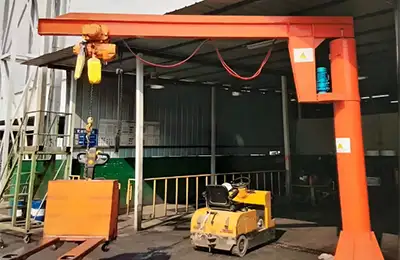
1–3 Ton Jib Cranes in Automotive Assembly Use Cases
How 1 Ton, 2 Ton, and 3 Ton Jib Cranes Are Used in Automotive Production
Most Important Takeaway
In automotive production, and honestly this is the key point you should keep in mind, jib crane capacity selection is not determined only by part weight. It is actually driven by a combination of fixture load, lifting frequency, safety margin, and how the crane fits into the workflow on the shop floor.
Key Takeaways
- 1 ton jib cranes are mainly used for fast, repetitive light assembly handling like gearboxes and EV battery modules.
- 2 ton jib cranes handle medium-heavy subassemblies such as transmissions, axles, and welding fixtures.
- 3 ton jib cranes are used for heavy-duty lifting like engines, molds, and chassis assemblies.
- Correct selection improves production flow, reduces downtime, and improves operator safety.
- In practice, automotive efficiency depends on matching crane capacity with working conditions, not just theoretical load weight.
FAQ: Jib Cranes in Automotive Assembly Lines
In automotive production, jib cranes are selected and applied based on lifting capacity, workstation demand, and production flow requirements. The following FAQs explain how different capacities and operational factors are used in real assembly environments.
In automotive production, different jib crane capacities are used at different workstation levels. A 1 ton jib crane is commonly used for light assembly tasks like gearboxes and engine accessories. A 2 ton jib crane is used in medium-duty areas such as transmission and axle assembly. A 3 ton jib crane is applied in heavy assembly zones like engine installation, chassis integration, and large tooling handling.
In simple terms, each capacity matches a different production stage. Light, medium, and heavy work are separated to keep the line running smoothly.
For automotive components, selection is usually based on real working weight plus fixtures.
- Gearboxes and engine accessories: typically 1 ton jib crane
- Transmission systems and axle modules: typically 2 ton jib crane
- Complete engines and chassis assemblies: typically 3 ton jib crane
In practice, engineers also consider lifting fixtures and positioning tools, not only the part weight.
In automotive plants, selection is not only about maximum load. It also depends on how often the crane is used.
High-frequency lifting stations usually use 1 ton cranes for fast repetitive work. Medium-frequency zones often use 2 ton cranes for mixed workloads. Low-frequency but heavy lifting areas rely on 3 ton cranes.
Fixture weight also matters because tooling and clamps can significantly increase the real lifting load during operation.
Light-duty workstation lifting focuses on small components and frequent handling. It usually involves fast pick-and-place movements, such as engine accessories or battery modules.
Heavy-duty workstation lifting is used for large assemblies like engines, chassis frames, and molds. The movement is slower, more controlled, and safety-focused due to higher load risk.
So basically, light-duty is about speed, while heavy-duty is about control and safety.
Jib cranes improve workflow by placing lifting capability directly at each workstation. This reduces waiting time for overhead cranes and keeps production moving.
They also improve safety by reducing manual lifting and minimizing load handling errors. When parts are lifted, rotated, and positioned mechanically, workers have better control and less physical strain.
In real factory use, this leads to smoother material flow, fewer delays, and more stable assembly line operation.
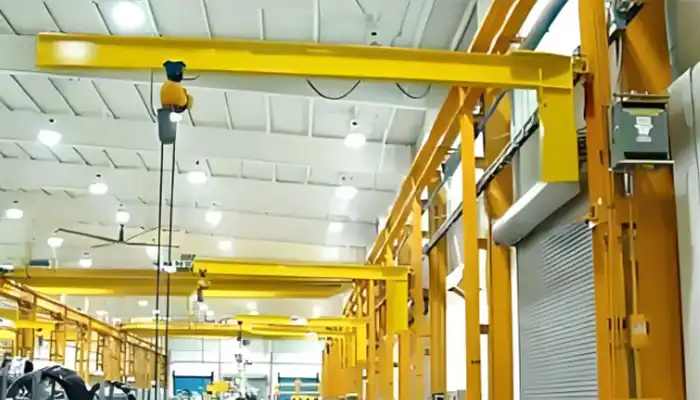
Role of Jib Cranes in Automotive Production Systems
Jib cranes are used at workstation level in automotive plants. They support assembly, welding, and machining tasks right where the operator is working. In simple terms, they bring lifting right to the point of use, so parts do not need to travel far just to be handled.
Instead of depending only on overhead cranes, many production lines add jib cranes at key stations. This allows parts like gearboxes, fixtures, and subassemblies to be lifted locally. It keeps the work moving. No long waiting for a central crane. Just lift, rotate, position, and continue.
This setup helps material flow between stations in a more direct way. Operators do not stop work to wait for lifting support. The cycle becomes more stable. You can see it clearly in assembly lines where each station has its own lifting point.
In daily operation, it also reduces unnecessary handling steps. Parts move less, and that usually means fewer delays. Over time, the workflow becomes easier to control, especially in mixed assembly environments where different components are handled in parallel.
1 Ton Jib Cranes in Automotive Light Assembly Operations
In automotive production, a 1 ton jib crane is widely used for light assembly operations where lifting is frequent but not extremely heavy. It is typically installed at workstation level, giving operators direct lifting support throughout the production cycle. In simple terms, it is often described as a “daily-use workstation crane” because it supports repeated handling of small-to-medium components.
In many factories, it is applied when parts are too heavy for manual lifting but do not require overhead crane intervention. Once installed at the station, it becomes a fixed part of the workflow and is used continuously during production.
A 1 ton jib crane is commonly used in automotive production lines for light assembly work. It is usually installed at workstation level where operators need lifting support repeatedly during daily production. In many workshops, it is referred to as a "light assembly crane" because it handles frequent small-to-medium parts efficiently.
In practical operation, it is placed directly at the workstation so operators can lift, position, and assemble components without waiting for overhead lifting equipment.
Typical components handled include:
- Gearboxes in subassembly, inspection, or maintenance work
- Engine accessories like pumps, alternators, intake parts
- EV battery modules in electric vehicle production lines
- Medium-sized fixtures, welding jigs, and positioning tools
- Small driveline and support components used in assembly flow
These parts are handled many times per shift, so operators rely on quick, local lifting support directly at the workstation.
The main role of a 1 ton jib crane is to support fast and repeated lifting at workstation level. In daily operation, the workflow is simple and repetitive: lift, move, position, and continue assembly.
Operators typically rotate the jib arm, position the load, complete assembly tasks, and repeat the cycle throughout the shift. This continuous support helps maintain production rhythm.
Main functional roles include:
- Supporting daily workstation assembly tasks in automotive plants
- Moving parts between assembly, welding, and inspection stations
- Reducing waiting time for overhead crane access
- Maintaining continuous engine and gearbox assembly flow
- Improving handling efficiency in EV battery and component assembly zones
In real workshop conditions, operators often describe it as "swing and place." This reflects its role in keeping material movement continuous and predictable.
A 1 ton jib crane is designed for frequent lifting throughout the entire shift. It is not intended for occasional heavy lifting, but for repeated daily handling tasks in production environments.
Depending on workshop layout and structure, it can be installed as either a wall-mounted or column-mounted jib crane. Both configurations are widely used in automotive assembly lines.
Key operational characteristics include:
- Designed for high-frequency lifting cycles throughout the workday
- Smooth rotation and precise load positioning control
- Suitable for compact workstation layouts and narrow production spaces
- Reduces manual lifting strain in gearbox and engine accessory handling
- Improves consistency in repetitive assembly operations across shifts
In actual use, operators quickly integrate it into daily routines. It often becomes essential for consistent workflow in gearbox handling, EV battery lifting, and general workstation material movement.
2 Ton Jib Cranes in Medium-Duty Assembly Workflows
In automotive production environments, a 2 ton jib crane is mainly used in medium-duty assembly zones where powertrain, chassis, and structural components are handled. This is a common configuration in transmission lines, axle assembly workshops, and welding-integrated production cells.
In practice, operators usually refer to it as the “mid-line crane” because it sits between light assembly handling and heavy final assembly lifting.
In automotive production environments, a 2 ton jib crane is mainly used in medium-duty assembly zones where powertrain, chassis, and structural components are handled. This is a common configuration in transmission lines, axle assembly workshops, and welding-integrated production cells.
In practice, operators usually refer to it as the "mid-line crane" because it sits between light assembly handling and heavy final assembly lifting.
Typical components handled include:
- Transmission assemblies used in powertrain assembly lines
- Axle modules and suspension subassemblies for chassis systems
- Heavy welding fixtures and jigs used in body-in-white (BIW) and fabrication lines
- Large tooling systems shared across multiple automotive workstations
These components are not only heavier, but also more sensitive in positioning. So lifting is not just about capacity, it is about controlled movement and repeatable accuracy during assembly and alignment.
In automotive manufacturing systems, the 2 ton jib crane is used in zones where subassembly and integration processes are tightly connected. This is typical in transmission assembly lines, chassis build stations, and welding-to-assembly transition areas.
It supports a production environment where parts move frequently between machining, assembly, and inspection stages. In simple terms, it keeps the mid-section of the production line stable and flowing.
From a workflow point of view, it acts as a transition lifting system between light workstation cranes and heavy overhead crane operations. Many production engineers describe it as “the linking point in the assembly chain.”
Main functional roles include:
- Supporting medium-duty automotive subassembly and integration workflows
- Handling transmission, axle, and driveline movement between stations
- Assisting welding and machining lines with fixture positioning and adjustment
- Reducing dependency on overhead cranes for repetitive mid-weight lifting
- Maintaining balanced flow in multi-stage automotive production lines
In factory operation, this crane is often used in areas where production starts to become structurally heavier, especially in chassis and powertrain assembly segments.
A 2 ton jib crane in automotive plants is designed for continuous industrial duty in medium-load environments. It is commonly installed as wall-mounted or pillar-mounted systems depending on workshop layout and production line structure.
Compared to light-duty systems, it requires stronger structural support and more stable anchoring, especially when handling dynamic loads in rotating movement.
Key operational characteristics include:
- Designed for medium-duty automotive production environments such as transmission and chassis lines
- Requires reinforced structural mounting for stable operation under load
- Handles mixed-load workflows across multiple adjacent production stations
- Maintains controlled rotation under medium-heavy industrial lifting conditions
- Supports continuous assembly flow in multi-step automotive manufacturing processes
In production settings, operators often rely on it as a standard lifting unit for mid-level assembly tasks. It is not occasional-use equipment. It is part of the daily production rhythm in automotive powertrain, chassis, and welding integration zones.
3 Ton Jib Cranes in Heavy Automotive Assembly
In automotive production plants, a 3 ton jib crane is used in heavy-duty assembly zones where large, high-value components are handled. This is common in final assembly lines, engine integration areas, chassis build stations, and heavy fabrication workshops.
In practical factory terms, operators often call it the “heavy station crane” because it is used when components are too large or too critical for smaller workstation cranes.
In automotive production plants, a 3 ton jib crane is used in heavy-duty assembly zones where large, high-value components are handled. This is common in final assembly lines, engine integration areas, chassis build stations, and heavy fabrication workshops.
In practical factory terms, operators often call it the "heavy station crane" because it is used when components are too large or too critical for smaller workstation cranes.
Typical components handled include:
- Complete engine assemblies used in powertrain final installation
- Automotive molds and large stamping dies used in body production
- Chassis subassemblies and structural frames in vehicle assembly lines
- Heavy production tooling systems used in machining and assembly integration
These parts are not only heavy, but also high-value and safety-critical. So handling is always controlled, slow, and carefully positioned.
In automotive manufacturing systems, the 3 ton jib crane is mainly used in final assembly zones and heavy fabrication areas. This is where large structural components are integrated into the vehicle or production process.
At this stage, lifting is not frequent, but each lift is important. One mistake can affect assembly quality or even production safety. That is why control and stability matter more than speed.
In many plants, it reduces dependency on overhead cranes for local heavy lifting tasks. Instead of waiting for a central crane, operators can handle heavy components directly at the workstation.
Main functional roles include:
- Supporting heavy-duty automotive final assembly operations
- Handling engine installation and chassis integration tasks
- Assisting mold, die, and tooling movement in production workshops
- Reducing overhead crane congestion in localized lifting areas
- Supporting safe positioning of high-value automotive components
In factory conditions, engineers often describe it as "the last-stage lifting support" because it is used close to final assembly and integration points.
A 3 ton jib crane used in automotive plants is built for high structural load and strict operational control. It is typically installed as a reinforced wall-mounted or heavy-duty column-mounted system with strong foundation support.
Compared to lower capacities, the design focus shifts heavily toward safety and stability during movement.
Key operational characteristics include:
- High structural strength with reinforced mounting and foundation support
- Designed for low-frequency but high-importance lifting operations
- Safety control is critical in every lifting and positioning step
- Smooth, slow, and stable rotation under full load conditions
- Suitable for heavy automotive assembly and final integration zones
In production use, operators treat it with extra care. Every movement is controlled and planned. It is not about speed. It is about safe and accurate placement of heavy automotive components in final assembly processes.
Key Engineering Factors in Jib Crane Selection
In automotive production, selecting a jib crane based only on rated capacity is not sufficient. On paper, the crane may be specified as 1 ton, 2 ton, or 3 ton, but actual working conditions in production environments are more complex and variable.
In real factory operation, the lifted load often includes not only the component itself but also fixtures, lifting tools, clamps, and positioning devices used during handling. As a result, the effective working load is often higher than the nominal part weight.
In actual factory use, the lifted load often includes more than the part itself. You also have fixtures, lifting hooks, clamps, and sometimes positioning tools attached during handling.
So in real operation, a "1 ton load" can easily behave like more than 1 ton once all auxiliary equipment is included.
Key practical considerations include:
- Weight of the actual automotive component (engine part, gearbox, axle, etc.)
- Added weight of lifting fixtures and tooling attachments
- Load changes during movement and rotation (dynamic loading effect)
- Off-center lifting during positioning at workstation level
In many plants, engineers commonly follow a practical rule: design is based on working load, not nameplate capacity. This ensures real operating conditions are properly covered.
In automotive manufacturing, different production zones operate with different lifting frequencies and duty cycles. This directly influences jib crane selection and structural requirements.
Light assembly stations often operate continuously, while final assembly zones handle fewer but heavier lifting events.
Typical lifting patterns include:
- High-cycle repetitive lifting in assembly stations (frequent pick-and-place of small components such as gearboxes or engine accessories)
- Medium-cycle handling in subassembly areas (movement of transmissions, axles, and welding fixtures between stations)
- Low-cycle but heavy lifting in final assembly zones (engine installation, chassis integration, mold and die handling)
In simple terms, selection depends not only on "how heavy" but also on "how often." In engineering planning, this has a direct impact on crane structure, duty rating, and service life expectations.
In automotive workshops, safety margin is a fundamental requirement in jib crane design. It is not optional, because every lifting operation must account for real working risks rather than only theoretical calculations.
During operation, loads are rarely perfectly stable. Movement, slight swing, and minor misalignment commonly occur during rotation and positioning.
Key safety-related factors include:
- Structural fatigue caused by repeated daily lifting cycles
- Operator variation during manual control of rotation and positioning
- Load swing during start-stop and slewing movement
- Uneven load distribution when components are not perfectly centered
- Long-term wear under continuous automotive production use
In industrial environments, engineers prioritize stability over time rather than only theoretical safety on paper. A properly designed jib crane must maintain consistent performance over years of continuous automotive production.
Integration into Automotive Production Layouts
Jib cranes are not standalone machines. In automotive plants, they are part of the full material handling system. You can think of them as “workstation lifting points” inside a larger production network.
In factory layout planning, their position is decided together with assembly sequence, not separately. They are installed exactly where parts need to be lifted, rotated, or positioned during work. In simple words, “put the crane where the work happens.”
They are also commonly used together with other handling systems such as conveyors, AGVs, and overhead cranes. Each system has its own role, and they support each other across the production line.
Typical integration points include:
- Engine and gearbox assembly stations with local workstation lifting
- Welding and fabrication cells where fixtures need frequent adjustment
- Chassis and body assembly zones requiring controlled part positioning
- Buffer areas between machining, assembly, and inspection processes
- Final assembly zones where overhead cranes handle main lifting and jib cranes handle local positioning
In many automotive factories, the flow looks like this: AGVs or conveyors move parts into the area, jib cranes handle station-level lifting, and overhead cranes take care of heavy or long-distance moves.
When this layout is well planned, material flow becomes more stable. There are fewer waiting points. Operators do not need to pause work just to wait for lifting equipment. Things simply move from one stage to the next.
In practice, engineers often say, “if the crane placement is right, the line runs smoothly.” And that is ly the key point. Proper integration reduces congestion, avoids handling delays, and keeps production rhythm consistent across the entire automotive line.
To sum it up, selecting between 1 ton, 2 ton, and 3 ton jib cranes in automotive production is ly about understanding the actual work process, not just the weight on paper.
If you match the crane properly with the job requirements, you get smoother workflow, better safety, and higher production efficiency. And in factory operations, that difference is very noticeable.