Electric Chain vs Wire Rope Hoist for Wall Jib Crane
Electric Chain Hoist vs Wire Rope Hoist for Wall Travelling Jib Cranes
Most Important Takeaway
The correct hoist selection for a wall travelling jib crane directly determines lifting efficiency, positioning accuracy, maintenance cost, and workshop productivity—especially in metal processing and manufacturing environments where load type, lifting height, and duty cycle vary significantly.
- How to choose between electric chain hoist and wire rope hoist for wall travelling jib cranes
- What lifting capacity range is suitable for each hoist type in workshop use
- How lifting height and duty cycle affect hoist performance and lifespan
- Why wrong hoist selection reduces productivity and increases maintenance cost
- What hoist type works best for welding, machining, and fabrication applications
- How to match hoist system with wall-mounted or travelling jib crane structure
FAQ – Electric Chain Hoist vs Wire Rope Hoist for Jib Crane Systems
Below are common questions from workshop buyers and engineers when selecting hoists for wall travelling jib crane systems. These answers are based on real workshop use, not just technical catalog descriptions.
A: The main difference is in lifting mechanism and working range.
Electric chain hoists use a load chain and are more compact, suitable for lighter and frequent lifting. Wire rope hoists use a drum and steel rope system, designed for heavier loads and longer lifting heights. In wall travelling jib crane systems, chain hoists are more common in small workshops, while wire rope hoists are used in heavier industrial applications.
A: It depends on workload and working environment.
- 500 kg to 2 tons → electric chain hoist is usually more practical
- Around 2 to 3+ tons → wire rope hoist becomes more suitable
In real workshop use, it is not only about capacity, but also how often lifting is done and how heavy the parts are in daily production.
A: A wire rope hoist is preferred when the workload is heavier or more continuous.
If the workshop handles large steel structures, long shafts, machine bases, or requires higher lifting height, then wire rope hoist is the better choice. It also performs more consistently in longer duty cycles.
A: Yes, but it depends on structural design.
Wall travelling jib cranes can be designed for both chain hoists and wire rope hoists. However, wire rope hoists require stronger wall support and reinforced jib arm structure due to higher load and dynamic forces. Chain hoists need less structural reinforcement.
A: Lifting height is a key selection factor.
Chain hoists are better for standard workshop heights and limited headroom conditions because of their compact structure. Wire rope hoists require more vertical space but are better suited for taller workshops or deeper lifting requirements.
A: Electric chain hoist is usually the better option.
In welding and machining stations, lifting is often short, repetitive, and frequent. Chain hoists fit this workflow well. They allow quick "lift–move–position" operations, without slowing down production flow.
Application Background: Wall Travelling Jib Cranes in Workshops
Wall travelling jib cranes are widely used in steel fabrication workshops, machining lines, and welding stations where material handling must be fast, localized, and space-efficient. They combine wall-mounted support with a travelling beam or rail system, enabling flexible coverage across multiple work zones.
In these environments, the choice between an electric chain hoist and a wire rope hoist is not only about lifting capacity, but also about duty cycle, headroom limitations, and operational workflow.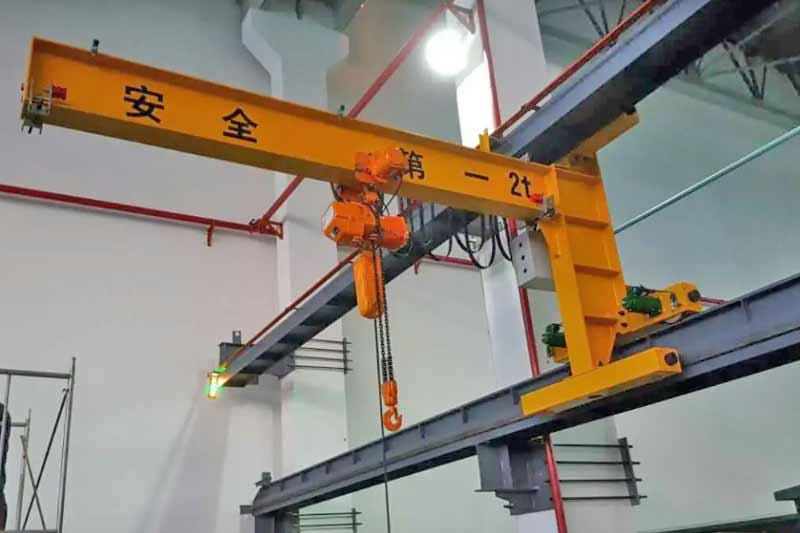
Electric Chain Hoist for Wall Travelling Jib Cranes
An electric chain hoist is commonly used in compact workshop lifting systems where frequent short-distance lifting is required. It operates through a load chain and sprocket mechanism, offering smooth and precise vertical movement.
In metal processing workshops, chain hoist systems are often paired with wall-mounted jib cranes for handling machine parts, welding assemblies, pipes, and steel components under 2 tons.
Typical Advantages in Workshop Use
- Compact structure suitable for limited headroom environments
- High positioning accuracy for assembly and welding tasks
- Lower structural load on wall travelling jib crane beam
- Easier maintenance and lower operating cost
Typical Working Range
- Best suited for light to medium duty applications around 500 kg to 2 tons
- Ideal for frequent lifting cycles with short travel distances
Wire Rope Hoist for Wall Travelling Jib Cranes
A wire rope hoist uses a drum and steel wire rope system, making it suitable for higher lifting heights and heavier duty applications. It is widely used in larger fabrication plants, steel structure workshops, and machining lines handling heavier assemblies.
When integrated into a wall travelling jib crane system, it requires stronger structural support due to higher self-weight and dynamic load impact.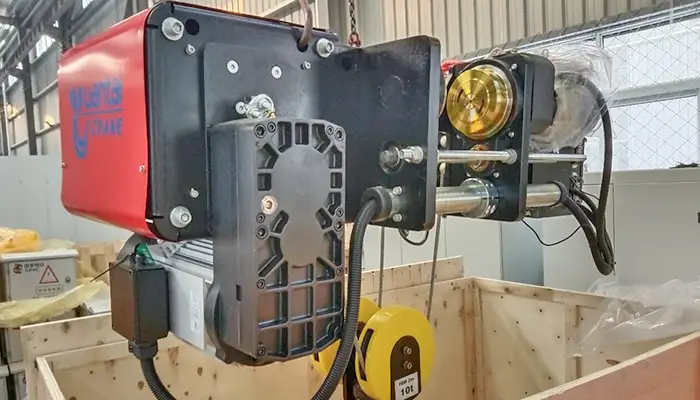
European style low headroom wire rope hoist
Typical Advantages in Industrial Use
- Suitable for higher lifting height requirements in taller workshops
- Better performance under continuous or semi-continuous duty cycles
- Higher load capacity potential for heavy fabrication tasks
- Stable operation for large steel components and assemblies
Typical Working Range
- Commonly used from 2 tons and above depending on crane structure
- Preferred in heavy-duty production environments
Capacity, Duty Cycle, and Performance Comparison
In real workshop operation, the decision between an electric chain hoist and a wire rope hoist is usually based on actual lifting workload, not theory. Most fabrication shops quickly find that load weight, lifting frequency, and working height naturally point toward one solution. That is the practical reality in metal processing environments.
| Item | Electric Chain Hoist | Wire Rope Hoist |
|---|---|---|
| Typical Capacity Range | 500 kg – 2 tons | 2 tons – 3+ tons (higher depending on design) |
| Best Working Condition | Light to medium lifting in frequent short cycles | Medium to heavy lifting with longer operation time |
| Typical Workshop Use | Welding stations, assembly benches, small fabrication areas | Machining workshops, steel structure handling, heavy assembly zones |
| Load Type Suitability | Small steel parts, pipe sections, welding assemblies, tooling | Large steel structures, machine bases, long shafts, heavy cylinders |
| Lifting Height Performance | Suitable for standard workshop heights, limited headroom advantage | Better for taller workshops and higher lifting requirements |
| Duty Cycle Behavior | Moderate duty, intermittent operation with frequent starts/stops | Higher duty classification, suitable for longer and more continuous operation |
| Operation Style | Fast, repetitive, short lifting movements | Stable, controlled lifting for heavier and larger loads |
| Maintenance Consideration | Simpler structure, easier routine maintenance | More components, requires regular inspection of rope and drum system |
In workshop use, chain hoists are commonly selected where operators repeat short lifting tasks many times during a shift. The workflow is simple: lift, position, weld or assemble, then repeat again. It fits light fabrication and assembly work.
Wire rope hoists are chosen when the workload increases in both weight and duration. In machining shops or structural steel workshops, lifting is often higher, heavier, and more continuous. The equipment is expected to run longer hours with stable performance, even under tougher duty conditions.
Structural and Installation Considerations
In wall travelling jib crane systems, the hoist is not only a lifting device, it also affects how forces are transferred into the building structure. This is why structural compatibility needs to be checked early, before final selection. In real workshop projects, this step often decides whether installation is straightforward or requires reinforcement work.
| Item | Electric Chain Hoist | Wire Rope Hoist |
|---|---|---|
| Structural Load on Jib Arm | Lower load impact, suitable for lighter jib crane structures | Higher load impact, requires stronger jib arm design |
| Wall Bracket Requirements | Can work with standard wall-mounted support in many workshops | Requires reinforced wall brackets and load-bearing checks |
| Structural Reinforcement Need | Usually minimal or none in retrofit installations | Often required, including steel reinforcement plates or support beams |
| Load Distribution Behavior | More uniform and lighter dynamic effect on structure | Higher dynamic forces during lifting and travel |
| Headroom Requirement | Compact design, suitable for low-clearance workshops | Requires more vertical space due to rope drum system |
| Installation Flexibility | Easier integration into existing workshop layouts | Needs more engineering preparation before installation |
| Best Use Condition | Light duty or space-limited workshops | Heavy duty or taller industrial workshop buildings |
From an installation point of view, chain hoists are usually more forgiving. They fit into existing wall travelling jib crane setups with fewer modifications and less structural change. This is why they are often used in retrofit or small workshop upgrades.
Wire rope hoists need a more planned approach. When they are selected, the building structure, wall strength, and beam design must be reviewed together. In return, they support heavier lifting tasks and longer working heights when the structure is properly designed.
Practical Selection Guide for Buyers
In real workshop planning, this is not only a technical comparison on paper. It is more about daily operation—how the lifting actually happens on site, step by step. Once the working condition is clear, the selection becomes much easier.
Light-duty workshop application (below 2 tons)
For compact welding workshops and machining stations where lifting loads are generally below 2 tons, an electric chain hoist integrated with a wall travelling jib crane provides the most efficient and cost-effective solution.
- Suitable for small fabrication and assembly areas
- Works well for frequent short lifting cycles
- Compact structure fits limited workshop space
- Easier installation with minimal structural modification
- Good for repetitive "lift–move–position" workflow
In practice, operators often say it is simple and direct to use. You just press, lift, move, and continue working without delay.
Heavy-duty fabrication and machining application
For heavier fabrication environments where steel structures, cylinders, or large assemblies are frequently handled, a wire rope hoist system offers better long-term performance and lifting stability.
- Suitable for medium to heavy steel fabrication
- Performs better under longer lifting height requirements
- More stable when handling large or long workpieces
- Designed for longer duty operation during production shifts
- Common in machining workshops and structural steel plants
In real operation, it feels more solid when lifting heavier loads, especially when the crane runs continuously through the working day.
Final selection logic (what really matters on site)
At the end, the decision is not complicated if the real working conditions are clear. It always comes back to how the crane is actually used.
- Lifting frequency during a normal working shift
- Maximum load of typical workpieces
- Available installation space and headroom
- Required lifting height across working zones
Once these points are confirmed, the selection becomes quite straightforward.
Chain hoists are generally chosen for lighter, frequent, short-cycle lifting work.
Wire rope hoists are more suitable for heavier, continuous, and higher-demand lifting tasks.
Conclusion
The decision between an electric chain hoist and a wire rope hoist for wall travelling jib cranes directly impacts workshop productivity, safety, and long-term operating cost. Chain hoists deliver compact efficiency and precision for light to medium lifting tasks, while wire rope hoists provide strength and endurance for heavy-duty industrial applications.
A properly matched hoist system ensures smoother material flow, reduced maintenance interruptions, and optimized performance in metal processing and manufacturing workshops.