5–40 Ton Electromagnetic Cranes with Spreaders: Buyer Guide
5–40 Ton Electromagnetic Overhead Cranes with Spreaders: Buyer Guide for Steel Mills and Scrap Yards
Most Important Takeaway
For steel mill and scrap yard buyers, choosing the right 5–40 ton electromagnetic overhead crane with spreaders ensures maximum safety, efficiency, and material protection, while supporting diverse handling applications from hot slabs to bulk scrap. Proper spreader design and load distribution are critical to avoid material damage, improve productivity, and reduce operational costs.
Key Takeaways
- Safety First: Non-contact magnetic lifting reduces operator exposure to hot, sharp, or irregular materials.
- Optimal Load Distribution: Adjustable spreaders and multi-point lifting prevent deformation of slabs, coils, and scrap.
- Efficiency Gains: Mid- to heavy-duty cranes (5–40 tons) handle higher volumes per lift, improving throughput.
- Maintenance and ROI: Lifecycle planning and preventive maintenance extend crane life and reduce downtime.
- Versatility Across Industries: Suitable for steel mills, rolling mills, recycling plants, and scrap yards.
- Automation Ready: Sensors, load monitoring, and remote operation can integrate cranes into smart factory workflows.
Questions This Guide Answers
- What are the typical applications for 5–40 ton electromagnetic cranes with spreaders?
- How do buyers select the right crane capacity for slabs, coils, plates, or scrap?
- What are the safety and maintenance considerations for hot or irregular materials?
- How can spreader design reduce material damage and improve handling efficiency?
- What is the ROI and lifecycle cost for mid- to heavy-duty magnetic cranes?
Typical Applications by Industry
Electromagnetic overhead cranes with spreaders are widely used in steel mills because they match the way steel products are produced, moved, and stored. Below are the most common applications, with practical details buyers care about when selecting a 5–40 ton crane.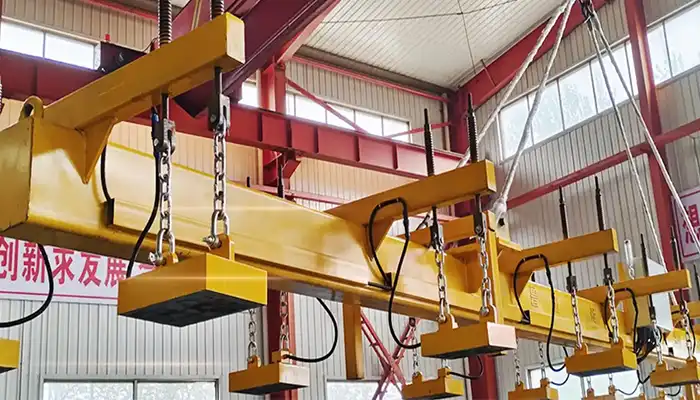
Magnetic overhead crane with spreader for billets, pipe, plate, rebar, handling
Typical Crane Capacity: 10–40 tons per lift
Steel slabs, billets, and blooms are dense, heavy, and often handled at elevated temperatures. In most mills, these materials must be moved repeatedly between furnaces, rolling lines, cooling beds, and outdoor storage yards.
An electromagnetic overhead crane with a spreader allows multiple magnets to share the load evenly. This is especially important when handling long slabs or mixed-length billets, where uneven lifting can cause bending or twisting during travel.
Typical usage scenarios include:
- Moving hot slabs from reheating furnaces to rolling mills
- Transferring billets between casting areas and storage bays
- Loading and unloading blooms in outdoor yards
Buyer notes to consider:
- Always size the crane for the maximum possible slab or billet weight, not the average.
- Spreader-mounted magnets reduce point stress on the steel surface, lowering the risk of cracks or permanent deformation.
- For hot material, confirm magnet insulation and cable protection are rated for high ambient temperatures.
Typical Crane Capacity: 5–25 tons per coil
Steel coils require stable, balanced lifting. Uneven magnetic force can distort the coil shape, which later affects uncoiling and downstream processing. This is why electromagnetic cranes with adjustable spreaders are common in coil storage areas and processing lines.
In practice, the crane moves coils between warehouses, loading bays, slit lines, or transport vehicles. Precise positioning matters, especially in narrow aisles or rack systems.
Typical usage scenarios include:
- Loading coils onto trucks or railcars
- Stacking coils in storage yards or warehouses
- Feeding coils into processing or slitting lines
Buyer notes to consider:
- Adjustable spreaders help match magnet spacing to different coil diameters and widths.
- Multi-point lifting keeps the coil level during hoisting and travel.
- Fine-speed control on hoist and trolley movement improves placement accuracy and reduces handling damage.
Typical Crane Capacity: 5–30 tons per plate bundle
Steel plates and sheets are commonly moved in bundles. These bundles can vary in size, thickness, and total weight depending on order requirements and production schedules. Electromagnetic cranes make this process faster by lifting complete bundles without slings or clamps.
A well-matched spreader ensures that the magnetic force is distributed across the full surface area of the plate pack. This helps prevent sagging during lifting and keeps bundles aligned during transport.
Typical usage scenarios include:
- Feeding plate bundles into cutting or plasma lines
- Moving finished plates to welding or fabrication stations
- Stacking plates in indoor or outdoor storage areas
Buyer notes to consider:
- Confirm the magnet layout matches plate size, not just bundle weight.
- A stable spreader design improves placement accuracy, which matters in automated or semi-automated lines.
- For thin plates, check that the magnetic system provides sufficient holding force without slippage.
Scrap Yards & Recycling Plants
Electromagnetic overhead cranes with spreaders are widely used in scrap yards and recycling facilities. These environments present unique challenges: loads are irregular, weights vary widely, and speed is important to keep operations moving. Here's a closer look at the main applications and practical considerations for buyers.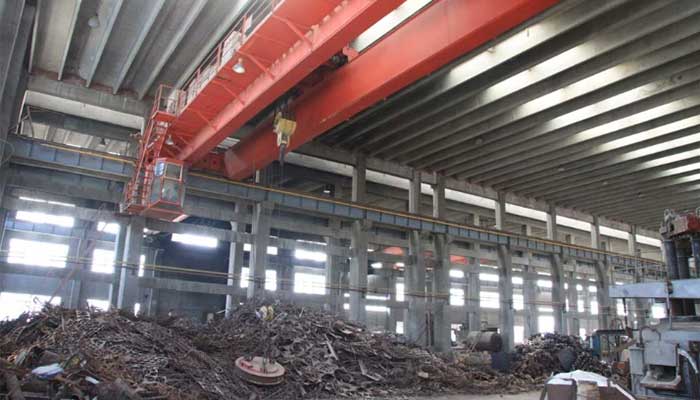
Scrap handling magentic overhead cranes
Typical Crane Capacity: 5–40 tons per lift
Scrap yards handle everything from old machinery to structural steel beams. These items are often irregularly shaped and unevenly weighted, which makes stable lifting difficult. Electromagnetic cranes with spreaders allow operators to lift large volumes safely, keeping loads balanced and reducing the risk of falling debris.
Typical usage scenarios include:
- Moving scrap piles from storage to processing areas
- Transferring old machinery or structural steel to shredders or shears
- Relocating scrap to sorting stations for further classification
Buyer notes to consider:
- Ensure the crane's magnetic force can handle irregularly shaped loads without slippage.
- Adjustable spreaders help manage varying scrap sizes and shapes.
- Safety checks on load attachment points and magnet strength are critical in high-volume operations.
Typical Crane Capacity: 10–35 tons per load
In recycling plants and foundries, scrap must often be fed into melting furnaces. Efficient feeding reduces downtime and keeps production continuous. Electromagnetic cranes simplify this process, allowing operators to move heavy scrap loads directly to the furnace while maintaining a safe distance from heat and sparks.
Typical usage scenarios include:
- Lifting and feeding large scrap batches into furnaces
- Moving scrap from staging areas to melting lines
- Coordinating crane movement with furnace operation schedules
Buyer notes to consider:
- Verify that the crane and spreader can handle peak load weights safely.
- Magnetic cranes reduce manual handling and associated risks.
- Consider heat-resistant components if the scrap is hot or near furnace openings.
Typical Crane Capacity: 5–30 tons per lift
After processing or shredding, scrap must be sorted and loaded for shipment. Accuracy and stability are important to prevent load shifting during transport. Electromagnetic cranes with adjustable spreaders allow operators to pick up bundles or irregular scrap piles and place them safely onto trucks, railcars, or storage racks.
Typical usage scenarios include:
- Organizing scrap into defined load categories for recycling
- Loading processed scrap onto trucks or railcars
- Preparing scrap for export or internal plant transfer
Buyer notes to consider:
- Adjustable spreaders improve precision and reduce the risk of load tipping.
- Ensure the crane's lifting speed and control allow smooth placement in tight spaces.
- Check that the magnetic holding force is sufficient for irregular or mixed loads.
Advantages of 5–40 Ton Electromagnetic Cranes with Spreaders
Electromagnetic overhead cranes with spreaders in the 5–40 ton range offer practical benefits for steel mills, scrap yards, and recycling plants. Buyers often focus on safety, efficiency, material protection, and long-term cost savings. Here's a detailed look at the advantages that matter most in real-world operations.
Non-contact magnetic lifting eliminates the need for hooks, slings, or clamps that can slip or fail. Spreaders distribute the load evenly, reducing the risk of falling materials. Many cranes also feature anti-drop systems and emergency stop functions to protect operators and nearby personnel.
Key points for buyers:
- Reduces workplace accidents associated with manual handling.
- Minimizes exposure to hot or sharp materials in steel mills and scrap yards.
- Anti-drop and fail-safe features prevent accidental release of heavy loads.
These cranes handle larger volumes per lift compared to traditional mechanical systems. Faster cycle times mean more material moved in less time, which directly impacts throughput in production lines or scrap processing areas.
Key points for buyers:
- Move multiple slabs, coils, or scrap pieces in a single lift.
- Shorter load/unload times increase overall plant productivity.
- Adjustable spreaders allow handling of varying load sizes without changing equipment.
Even distribution of the magnetic force ensures that steel slabs, coils, or plate bundles are lifted uniformly. This reduces bending, scratching, and deformation that can occur with clamps or uneven lifting.
Key points for buyers:
- Protects valuable material during handling and transport.
- Prevents quality issues that can affect downstream processes.
- Spreaders can be tailored to match load shape and size for maximum protection.
With a 5–40 ton range, these cranes cover most mid- to heavy-duty industrial needs. From small steel coils to massive slabs or scrap bundles, a properly selected crane fits diverse applications without overloading.
Key points for buyers:
- Select capacity based on maximum expected load rather than average weight.
- One crane can handle a variety of material types and sizes.
- Avoids the need for multiple cranes for different load categories.
Modern cranes can be equipped with remote controls, load sensors, and monitoring systems that improve precision and reduce human error. Integration with production lines or warehouse management systems streamlines operations.
Key points for buyers:
- Remote operation keeps operators out of hazardous areas.
- Load monitoring ensures safe lifting within crane limits.
- Smart factory integration supports predictive maintenance and workflow automation.
Preventive maintenance, standardized spare parts, and durable components reduce long-term operational expenses. A well-maintained electromagnetic crane will last many years, providing a better return on investment compared to less sophisticated lifting systems.
Key points for buyers:
- Schedule regular inspections for magnets, spreaders, and trolleys.
- Standardized spare parts reduce downtime and simplify repairs.
- Longer crane lifespan reduces the frequency of replacements and capital expenditure.
Practical Buyer Insights
When investing in a 5–40 ton electromagnetic overhead crane with spreaders, understanding the practical considerations can save time, reduce costs, and ensure smooth operations. Here's what buyers should focus on.
Crane tonnage should always be selected based on the heaviest expected load, not the average. Underestimating the maximum weight can lead to safety hazards, accelerated wear, or unexpected downtime.
Tips for buyers:
- Calculate the heaviest slab, coil, plate, or scrap bundle the crane will handle.
- Factor in any future increases in load size or weight.
- Avoid oversizing unnecessarily, as higher-capacity cranes can increase initial investment and energy costs.
The spreader is the key to stable, safe lifting. Adjustable or multi-point spreaders accommodate different load shapes and sizes, ensuring balanced lifting and reducing the risk of material damage.
Tips for buyers:
- Use adjustable spreaders for varied slab lengths or coil diameters.
- Multi-point spreaders are best for long billets, irregular scrap, or mixed bundles.
- Check that magnet placement matches the center of gravity for each load type.
Production needs change over time. Choosing a crane that can handle a wider range of materials, sizes, or operational layouts ensures long-term value and reduces the need for replacement or additional equipment.
Tips for buyers:
- Consider potential increases in slab or coil size.
- Verify whether the crane can integrate with future automation or smart factory upgrades.
- Ensure spreaders can be reconfigured or upgraded for different load types.
Routine maintenance is critical to keep electromagnetic cranes performing reliably. Scheduled inspections of magnets, trolleys, hoists, and electrical systems prevent unexpected downtime and extend crane lifespan.
Tips for buyers:
- Create a preventive maintenance schedule, including daily, monthly, and annual checks.
- Inspect magnet surfaces for wear and ensure electrical connections are secure.
- Keep a stock of commonly needed spare parts to reduce repair times.
Summary for Buyers:
By focusing on proper capacity selection, spreader design, adaptability, and maintenance, buyers can maximize safety, efficiency, and ROI from their electromagnetic overhead crane investment.
Conclusion
5–40 ton electromagnetic overhead cranes with spreaders are a practical and reliable solution for steel mills, scrap yards, and recycling plants. When properly selected and maintained, these cranes provide safer operations, faster material handling, and minimal damage to steel products or scrap.
For buyers, the key is to focus on:
- Right Capacity: Match the crane to the heaviest expected load, not the average.
- Spreader Design: Use adjustable or multi-point spreaders for balanced lifting of slabs, coils, plates, and scrap.
- Maintenance Planning: Regular inspections of magnets, trolleys, and electrical systems reduce downtime and extend crane life.
- Future-Proofing: Choose a crane that can adapt to new load sizes, materials, or automation upgrades.
By understanding these practical considerations, buyers can make informed choices that maximize ROI, maintain continuous operations, and ensure safe and efficient handling of heavy materials.
Bottom line: A well-planned investment in a 5–40 ton electromagnetic crane with spreaders doesn’t just move material—it supports productivity, safety, and long-term cost efficiency in demanding industrial environments.