Why Magnetic Cranes Are Ideal for Hot Billet Yards
Main Takeaway
Magnetic cranes are the safest, most efficient, and cost-effective solution for handling hot billets in steel storage yards. They reduce operator risk, improve handling speed, minimize equipment wear, and offer a higher return on investment compared to clamp cranes.
Key Takeaways (Bulleted)
- Non-contact lifting eliminates direct heat exposure to crane mechanisms and operators.
- Can lift multiple billets simultaneously, improving throughput in hot billet storage yards.
- Reduces maintenance frequency and downtime, ensuring longer service life.
- Ensures consistent handling of irregular-shaped or oxidized billets.
- Offers better ROI over the lifecycle compared to mechanical clamp cranes.
Questions This Guide Solves
- What is the safest crane option for handling hot billets above 500°C?
- How does high temperature affect clamp crane components and operations?
- Can multiple billets be lifted per cycle efficiently and safely?
- What are the long-term maintenance and lifecycle costs of magnetic cranes?
- How to integrate magnetic cranes into existing hot billet storage yards?
Hot Billet Storage Yards and Crane Selection
Hot billet storage yards are high-temperature areas in steel mills where billets are temporarily held before they move to rolling, forging, or shipment. Temperatures often range from 500°C to 600°C, making handling more than just a simple lifting task.
In these yards, every move counts. Mishandling a hot billet can lead to accidents, equipment damage, or costly production delays. That’s why the type of crane you use here is not just a technical choice—it’s a safety and efficiency decision.
Challenges in hot billet storage yards:
- Billets are often lifted in bundles, which can be heavy and uneven.
- Heat can accelerate wear on crane components, especially mechanical clamps.
- Operations must stay fast and precise to prevent bottlenecks in the mill.
Picking the wrong crane isn’t just inconvenient—it can slow down your entire operation and increase long-term costs. The right crane protects your team, improves workflow, and keeps maintenance low.
Benefits of the right crane in a hot billet yard:
- Safety for Operators: Reduces the risk of burns and accidents by minimizing direct contact with hot billets.
- Efficiency: Moves billets faster and allows multiple lifts per cycle, keeping production smooth.
- Lower Maintenance Costs: Minimizes wear on mechanical parts, reducing downtime and repair expenses.
Magnetic cranes lift billets without mechanical contact. This means less stress on hoists, trolleys, and the crane structure itself. Clamp cranes, by contrast, rely on mechanical gripping, which wears out faster under heat and requires frequent maintenance.
Why magnetic cranes are preferred in hot billet operations:
- Non-contact lifting for safer operations.
- Ability to handle multiple billets at once.
- Reduced wear and lower long-term operational costs.
Operators should always use heat-resistant gloves and protective gear. Workflows should be designed to minimize manual intervention with hot billets.
Using magnetic cranes can enable simultaneous multiple-billet lifts, reducing cycle time and keeping production lines running smoothly. Properly designed spreaders ensure balanced lifting and prevent shifting of hot billets.
Non-contact lifting reduces mechanical wear, resulting in lower maintenance costs and fewer unexpected downtimes. Regular inspection of magnetic elements ensures consistent lifting performance.
Choosing the right crane for a hot billet storage yard is critical for safety, efficiency, and cost control. Magnetic cranes offer clear advantages over mechanical clamp cranes in high-temperature operations.
Hot Billet Handling
What Makes Hot Billets Unique
Hot billets aren’t just heavy—they’re extremely hot, often reaching 500–600°C straight from the casting or reheating furnace. At these temperatures, even small handling mistakes can damage equipment or put operators at serious risk.
Their size and weight vary widely. Some billets are short and manageable, while others are long and heavy. They are often lifted in bundles, which increases the total weight per lift and changes how the crane needs to handle them.
Surface condition also matters. Many hot billets develop oxidation, scaling, or rough edges, which affects grip and stability during movement. A crane must account for these irregularities to prevent slips or accidents.
Key points to remember:
- Temperature: 500–600°C or higher.
- Size & Weight: Variable; bundles may exceed the capacity of standard cranes.
- Surface: Oxidized, scaled, or rough surfaces affect safe lifting.
Challenges in Handling Hot Billets
Moving hot billets isn’t as simple as pushing a button and lifting. The heat, combined with irregular shapes and heavy weights, creates several operational challenges:
- Safety Hazards: Direct contact with hot billets or mechanical clamps puts operators at risk of burns and injury. Even brief exposure can be dangerous.
- Equipment Wear: Heat accelerates wear on clamps, hoists, trolleys, and girders. Cranes not designed for high temperatures will need more frequent maintenance.
- Efficiency Limitations: Mechanical clamps often require manual adjustments when lifting bundles of different sizes. This slows down operations and can create bottlenecks in the yard.
Magnetic Cranes vs. Clamp Cranes
Clamp cranes are the traditional solution for handling billets in steel yards. They use mechanical or hydraulic clamps to grip and lift billets, relying on direct contact between the clamp and the steel.
While they can work well in cooler environments or for individual billets, clamp cranes face challenges in hot billet storage yards. The high temperatures can accelerate wear on the clamps, hoists, and trolley components. Over time, this means more frequent maintenance, more downtime, and higher operating costs.
Another practical limitation is efficiency. When lifting multiple billets or irregularly shaped bundles, clamps often require manual adjustment or repositioning to secure the load safely. This slows down operations and can create bottlenecks in the yard.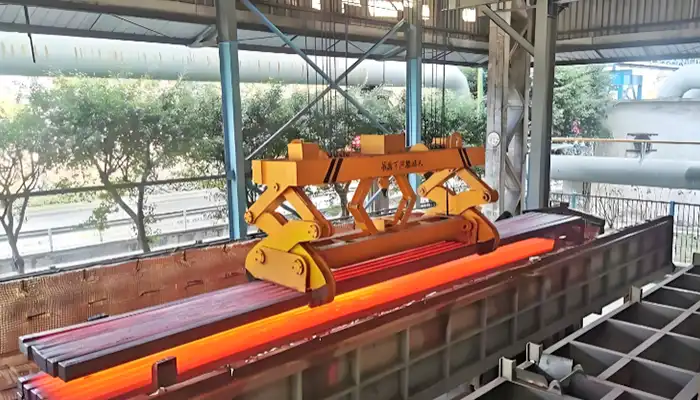
Key Limitations of Clamp Cranes:
- Direct contact with hot billets exposes mechanical parts to heat, causing faster wear.
- Frequent maintenance is required to keep the crane operational.
- Lifting multiple billets or uneven bundles is slower and less stable.
- Safety relies heavily on operator skill and precision.
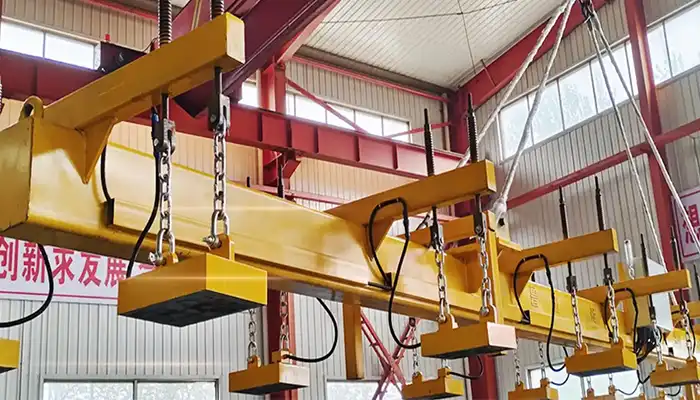
Magnetic cranes take a different approach. They use electromagnets to lift billets without any mechanical gripping. This non-contact lifting method makes them particularly well-suited for hot billet handling.
Because the crane does not touch the billets directly, heat has minimal impact on the mechanism. Electromagnets can also lift multiple billets in a single cycle, significantly improving throughput. Operations are faster because there’s no need for repeated clamp adjustments or repositioning.
Maintenance requirements are lower as well. With fewer mechanical parts exposed to extreme temperatures, wear is reduced, meaning less downtime and lower long-term costs.
Practical Advantages of Magnetic Cranes:
- Heat does not affect the crane mechanism, ensuring long-term reliability.
- Multiple billets or bundles can be lifted per cycle, improving productivity.
- Faster pick-and-place operations reduce handling time.
- Reduced mechanical wear lowers maintenance needs and costs.
- Safer for operators, as there’s no direct contact with hot billets.
| Feature | Clamp Crane | Magnetic Crane |
|---|---|---|
| Contact with billet | Direct | Non-contact |
| Heat impact on mechanism | High | Low |
| Maintenance frequency | High | Low |
| Lifting speed | Moderate | High |
| Safety for operators | Moderate | High |
Practical Takeaways for Buyers:
- If your yard handles hot billets regularly, magnetic cranes reduce wear, maintenance, and safety risks.
- For multiple-billet lifting or irregular shapes, magnetic cranes provide faster, more reliable handling.
- Clamp cranes may still be useful for smaller operations or cooler environments, but in high-temperature storage yards, they fall short in efficiency and durability.
Key Advantages of Magnetic Cranes in Hot Billet Storage Yards
Handling hot billets is inherently risky. Operators face the danger of burns, heat exposure, and heavy-load accidents when using conventional clamp cranes. Magnetic cranes eliminate direct contact with the billets, keeping both operators and mechanical components safe.
Practical benefits for safety:
- Operators stay clear of extreme heat during lifting and moving.
- Reduced risk of accidents from dropped or slipping billets.
- Lower chance of injuries caused by mechanical clamp failures.
Magnetic cranes can lift multiple billets at once, which speeds up handling cycles compared to mechanical clamps that often require one-by-one adjustments. Faster pick-and-place operations mean smoother workflow and less downtime in hot billet storage yards.
Throughput advantages include:
- Ability to handle bundles of varying shapes and sizes efficiently.
- Shorter cycle times per lift, keeping production lines moving.
- Less manual intervention required, allowing operators to focus on monitoring and safety.
Clamp cranes rely on mechanical gripping, which wears down quickly under heat. Magnetic cranes use non-contact lifting, which dramatically reduces wear on the hoist, trolley, and crane structure.
Practical benefits for maintenance:
- Lower frequency of repairs and part replacements.
- Reduced downtime due to fewer mechanical failures.
- Longer lifespan for crane components operating in high-temperature environments.
Magnetic cranes provide consistent gripping and handling, even when billets are oxidized, scaled, or irregularly shaped. This reliability is crucial in busy yards where every second counts and mistakes can be costly.
Operational advantages include:
- Stable handling of uneven or bundled billets.
- Accurate placement on storage racks or transport lines.
- Reduced risk of dropped billets, protecting equipment and inventory.
Although magnetic cranes may have higher upfront costs compared to clamp cranes, the long-term savings are substantial. Less downtime, reduced maintenance, and higher operational efficiency translate into a better return on investment (ROI).
Financial benefits include:
- Lower operational costs due to fewer repairs and replacements.
- Increased productivity reduces labor and energy costs.
- Extended equipment life delays capital expenditure on new cranes.
Practical Considerations for Buyers
Magnetic cranes rely on electromagnets to lift billets, which requires a reliable and sufficient power supply. Without proper electrical capacity, the crane may not operate at full lifting strength, which can affect safety and efficiency.
Key points to check:
- Ensure the workshop or storage yard has the correct voltage and current to support the crane’s magnet system.
- Verify that power fluctuations will not disrupt lifting cycles or reduce magnetic strength.
- Consider installing surge protection or backup power systems for continuous operation.
Although magnetic cranes have fewer moving parts than clamp cranes, regular maintenance is still essential. This ensures long-term reliability and safe operation, especially in high-temperature environments.
Maintenance best practices:
- Periodically inspect coil insulation to prevent heat damage.
- Test the magnetic field strength to ensure consistent lifting performance.
- Check the crane trolley, rails, and hoist system for wear, even if mechanical stress is reduced.
For optimal performance, magnetic cranes must be carefully integrated into the storage yard or workshop layout. Misalignment or inadequate space can reduce efficiency and safety.
Considerations for layout:
- Crane span: Ensure the crane can reach all required storage areas without obstruction.
- Trolley speed: Match lifting speed with operational workflow to avoid bottlenecks.
- Rail load capacity: Confirm that rails and runway beams can handle the weight of fully loaded billets plus the crane.
- Clearance: Ensure adequate space for safe movement of operators and materials.
Magnetic cranes may have higher upfront costs compared to clamp cranes. However, long-term savings in maintenance, downtime, and operational efficiency often outweigh the initial investment.
Financial considerations:
- Reduced maintenance frequency lowers ongoing operational expenses.
- Faster handling and multiple-billet lifts increase productivity and throughput.
- Longer equipment lifespan delays the need for replacement, improving total ROI.
- Consider total lifecycle cost rather than just purchase price when comparing crane options.
Case Studies
Several steel mills have successfully upgraded from clamp cranes to magnetic cranes in their hot billet storage yards. The results demonstrate clear operational and safety benefits.
Key improvements observed after switching to magnetic cranes:
- Fewer Accidents: Operators are no longer exposed to direct contact with hot billets, reducing the risk of burns and mechanical injuries.
- Faster Handling: Magnetic cranes can lift multiple billets in one cycle, cutting handling time and speeding up production lines.
- Reduced Maintenance: Non-contact lifting minimizes wear on mechanical parts, lowering downtime and repair costs.
- Higher Productivity: Faster cycle times and more reliable handling allow mills to move more billets per shift without increasing labor or operational stress.
For example, one medium-sized steel mill reported that after switching to magnetic cranes, daily handling capacity increased by 30%, while maintenance downtime decreased by nearly 25%. Another large facility noted a significant drop in clamp-related failures, resulting in smoother production schedules and fewer unexpected shutdowns.
These real-world examples confirm that magnetic cranes are not just theoretical improvements—they deliver measurable, practical benefits for hot billet storage yards.
Conclusion
Handling hot billets is a demanding task that requires careful attention to safety, efficiency, and equipment longevity. Magnetic cranes provide a practical solution that addresses all of these needs:
- Non-contact lifting protects operators and reduces equipment wear.
- Faster cycle times increase throughput and overall yard productivity.
- Lower maintenance requirements and longer lifespan improve total lifecycle ROI.
For buyers planning new installations or upgrades in hot billet storage yards, magnetic cranes should be a top consideration. By choosing the right crane for high-temperature operations, mills can maximize safety, maintain continuous production, and achieve long-term cost savings.