Mechanical Clamp Cranes for Billet & Slab Handling
Mechanical Clamp Cranes for Steel Billets and Slab Handling | Overhead & Gantry Solutions
Introduction
Mechanical clamp cranes are a staple in many steel mills and workshops. Unlike cranes that rely on hooks or magnets, these cranes use mechanical clamps to securely lift and move billets and slabs. They are widely used in environments where simplicity and reliability are key, such as rolling mills, casting lines, and storage yards.
Even though they might look straightforward, these cranes are carefully engineered to handle heavy, high-temperature, or awkwardly shaped steel products safely and efficiently. For buyers and engineers, understanding the practical benefits and limitations of mechanical clamp cranes can make a big difference in daily operations.
Key benefits of mechanical clamp cranes:
- Simplicity: Fewer components mean less can go wrong, which reduces downtime.
- Reliability: No motors or hydraulics, so the system works even in hot, dusty, or outdoor conditions.
- Cost-effectiveness: Lower maintenance costs and fewer repairs compared to powered clamping systems.
- Versatility: Can handle different sizes of billets and slabs with the right clamp design.
Focus applications:
- Moving billets from casting lines to rolling mills.
- Handling slabs in storage yards or workshops.
- Efficiently transferring steel in indoor and outdoor environments.
What Are Mechanical Clamp Cranes?
Mechanical clamp cranes are crane systems equipped with clamps that use the weight of the load itself to grip. Unlike hydraulic or electrically powered clamps, these cranes don’t require additional energy to hold the steel products. The clamp’s jaws tighten automatically as the load is lifted, making the grip stronger as the weight increases.
This design is simple, but it’s very effective. Because the clamp relies on physics rather than power, the risk of failure is lower, and the operation is predictable. Operators can quickly adapt to different billets or slabs as long as the load falls within the clamp’s rated range.
Key points about mechanical clamp cranes:
- Load-induced gripping: The weight of the billet or slab activates the clamp automatically.
- No external power required: Fully mechanical operation, no motors, hydraulics, or electronics.
- Safety and reliability: Fewer failure points mean fewer unexpected issues during lifting.
- Difference from powered clamps: Powered clamps may offer precise control, but they require maintenance, power supply, and more complex components. Mechanical clamps trade precision for simplicity and durability, which is often preferred in steel handling environments.
Types of Mechanical Clamp Cranes
Mechanical clamp cranes come in two main forms: overhead cranes and gantry cranes. Each has its advantages depending on the workspace, product size, and handling requirements. Understanding the differences helps buyers choose the right solution for their steel handling operations.
Overhead Cranes with Mechanical Clamps
Overhead clamp cranes are most commonly used indoors, where steel products like billets and slabs need to be moved along a fixed path, such as a workshop, rolling mill, or casting line.
They offer precise handling in controlled environments, allowing operators to lift, move, and position billets or slabs efficiently.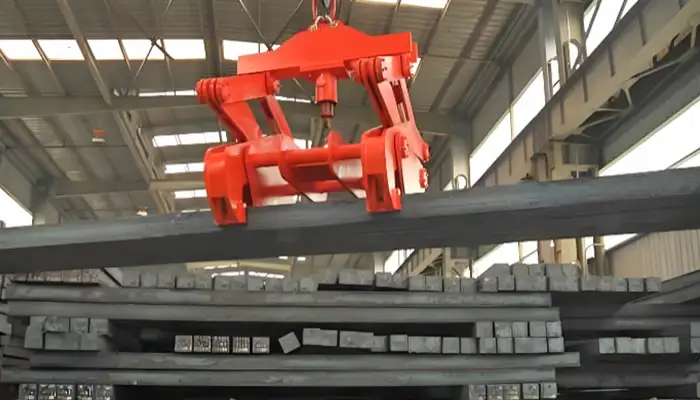
billet handling clamp overhead crane
Key features and considerations:
- Indoor applications: Ideal for steel mills, workshops, and rolling mill bays.
- Single-girder configuration: Best for lighter loads, simpler installations, and smaller spans.
- Double-girder configuration: Suited for heavier billets and slabs, longer spans, and higher lifting capacities.
- Integration with clamps: The crane structure, hoist, and clamp must be designed as a system to safely handle dynamic forces during lifting.
- Practical tip for buyers: Ensure the crane runway and building clearances accommodate the full range of slab or billet sizes you plan to handle.
Gantry Cranes with Mechanical Clamps
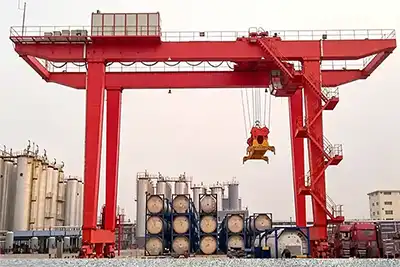
Gantry clamp cranes are designed for outdoor applications, such as slab or billet storage yards. They are ideal for covering large areas, where flexibility and ground-level operation are needed.
These cranes can span wide storage zones, moving heavy steel products without being constrained by indoor structural limitations.
Key features and advantages:
- Outdoor yard applications: Common in steel storage yards, port loading areas, or open-air workshops.
- Large coverage: Gantry cranes can operate over broad areas, making them efficient for stacking and moving slabs or billets across multiple lanes.
- Heavy lifting capacity: Available in larger tonnages to handle slabs and billets of significant weight.
- Durable design: Mechanical clamps are less affected by weather conditions, dust, or high temperatures.
- Practical tip for buyers: Check wind load limits and ensure proper anti-sway measures are in place for safe operation.
Clamp Designs for Steel Handling
Choosing the right clamp design is crucial for safe and efficient handling of billets and slabs. Mechanical clamps are engineered to fit the shape, weight, and surface of the steel product. Using the wrong clamp type can lead to instability, unsafe lifts, or damage to the steel.
Billet clamps are specifically designed for narrow, square, or rectangular steel products. They are commonly used in rolling mills and billet transfer lines, where products are long and uniform.
Key considerations for billet clamps:
- Shape and size: Suited for square or rectangular billets. Clamp jaws are narrower to grip the edges securely.
- Hot or cold handling: Clamps can be designed for hot billets straight from the caster or cooled billets for workshop movement. Material and jaw design may differ depending on temperature conditions.
- Safety features: Proper alignment is critical to prevent slippage. Always match clamp size to the billet dimensions and weight.
Slab clamps are intended for wider, heavy flat loads, such as slabs from casting yards or storage stacks. They focus on stability and center-of-gravity control, since slabs are often heavy and bulky.
Key considerations for slab clamps:
- Load width: Wider jaw design to distribute gripping force evenly across the slab.
- Stability: Center-of-gravity alignment is critical to prevent tilting or uneven lifting.
- Weight handling: Slab clamps must be rated for higher tonnages, often 20–50 tons or more.
- Surface condition: Slabs may have scale, oil, or rough surfaces that affect gripping. Choose jaw materials and designs suitable for surface conditions.
When selecting a mechanical clamp for billets or slabs, consider the following practical points:
- Product dimensions: Width, length, and thickness must match clamp jaw size.
- Weight: Ensure crane capacity includes the clamp and safety margin.
- Surface condition: Hot, cold, oily, or scaled surfaces influence jaw material and grip design.
- Handling frequency: High-frequency operations may require more durable clamps.
- Application environment: Indoor vs outdoor, workshop vs yard, hot vs ambient temperature.
Capacity Ranges
Selecting the right lifting capacity for a mechanical clamp crane is not just about the weight of the billet or slab. It also involves understanding how clamps add load, how often lifting occurs, and how stable the operation needs to be over time.
Below is a practical breakdown of typical capacity ranges used in real steel handling operations.
5–10 Tons — Light-Duty Billet Handling
This range is commonly used in workshops and smaller rolling mill sections. It suits lighter billets that are handled frequently but with shorter spans and lower lifting heights.
- Usually paired with single-girder overhead cranes
- Suitable for indoor environments with stable layouts
- Cost-effective choice for light and repetitive operations
20–32 Tons — Medium-Duty Billet and Slab Handling
This is one of the most common capacity ranges in steel mills. It balances lifting power with flexibility and is suitable for both billets and slabs.
- Typically requires double-girder overhead cranes
- Can handle higher working frequencies
- Provides better stability for longer steel products
50 Tons and Above — Heavy-Duty Slab Handling
Used for large slabs in casting yards and outdoor storage areas. At this level, crane and clamp design must be carefully matched.
- Often combined with gantry cranes
- Designed for heavy slabs and wide handling zones
- Requires strict control of load distribution and crane stiffness
One common mistake buyers make is focusing only on slab or billet weight. In reality, mechanical clamps can add significant weight to the lifting system.
Before finalizing crane specifications, buyers should always confirm:
- The actual weight of the mechanical clamp
- The maximum weight of the heaviest billet or slab
- A reasonable safety margin, typically 10–20%, depending on duty cycle
By accounting for clamp weight and safety margins early, buyers avoid under-sized cranes and ensure long-term, stable, and safe operation.
Advantages of Mechanical Clamps
Mechanical clamps are widely used in billet and slab handling not because they are complex, but because they are predictable and easy to live with. In steel plants, where uptime matters more than features, this practical advantage often outweighs more advanced systems.
Below are the main reasons buyers continue to choose mechanical clamps.
Mechanical clamps rely on basic mechanical linkages, pins, and jaws. There are no motors, sensors, hoses, or control signals involved.
In daily operation, this means:
- Fewer parts to inspect and replace
- Shorter maintenance stops
- Easier troubleshooting for plant maintenance teams
Most routine checks focus on wear components such as jaws and pins, which can be visually inspected without special tools.
Steel handling environments are rarely clean or gentle. Mechanical clamps perform well in conditions where powered systems struggle.
They are commonly used in:
- High-temperature areas near casting lines
- Dusty rolling mills and storage yards
- Outdoor slab and billet yards exposed to rain and wind
Because gripping force is generated by load weight, performance is not affected by heat, moisture, or dirt.
Mechanical clamps function without electricity or hydraulics. This eliminates many common sources of failure.
From a buyer's perspective, this reduces risk related to:
- Power supply interruptions
- Hydraulic leaks or pressure loss
- Electrical control malfunctions
With fewer systems involved, overall reliability improves, especially during continuous or repetitive lifting operations.
For operations that move billets or slabs every day, mechanical clamps offer lower total operating cost over time.
This cost advantage comes from:
- Lower initial equipment cost
- Reduced maintenance labor
- Minimal spare parts inventory
For plants focused on stable, repeated lifting rather than frequent changeovers, mechanical clamps remain a practical long-term solution.
Safety and Operating Considerations
Mechanical clamp cranes are safe when used correctly, but they follow strict operating rules. Most issues occur not because of poor design, but because load limits or operating procedures are ignored. Understanding these basics helps prevent accidents and equipment damage.
Mechanical clamps are designed to work within a specific load range. Both the minimum and maximum limits matter.
- Minimum load: If the billet or slab is too light, the clamp may not generate enough gripping force.
- Maximum load: Exceeding rated capacity increases stress on jaws and linkages and can lead to failure.
- Practical reminder: Always confirm the weight of the heaviest billet or slab, including scale or temperature-related weight changes.
Operating below or above rated limits is one of the most common causes of unsafe lifting.
Correct alignment is critical before lifting begins.
- The clamp must sit squarely on the billet or slab.
- The crane hook and lifting line should be vertical.
- The load should be lifted smoothly, without sudden acceleration.
Taking a few seconds to check alignment reduces the risk of uneven jaw pressure and slipping during the lift.
Mechanical clamps are designed for vertical lifting only.
- Side pulling introduces uncontrolled forces on the clamp jaws.
- Dragging billets or slabs across the ground reduces grip effectiveness.
- Sudden horizontal movement can damage clamp components or deform the load.
If the steel needs to be repositioned, lower it fully before moving horizontally.
Regular inspection keeps mechanical clamps reliable over long service life.
Buyers and operators should check:
- Jaw surfaces for wear or damage
- Pins and linkages for deformation or looseness
- Proper movement of mechanical parts without obstruction
Worn components should be replaced promptly. Delaying maintenance increases risk and reduces gripping performance.
Buyer Checklist for Selecting Mechanical Clamp Cranes
When sourcing a mechanical clamp crane for billet or slab handling, the goal is not to select a clamp first and a crane later. Both must work together as a single lifting system. The checklist below helps buyers avoid common mistakes and mismatched specifications.
Start with the product itself. Clamp selection depends heavily on shape and width.
- Billets are typically square or rectangular and relatively narrow.
- Slabs are wide, flat, and heavier, requiring better load balance.
Using the wrong clamp type increases the risk of unstable lifting and uneven jaw pressure.
Exact load information is essential, not estimates.
- Confirm maximum single-piece weight.
- Record width, thickness, and length ranges.
- Consider surface scale, temperature, and handling condition.
Remember to include the weight of the mechanical clamp when calculating total lifting load.
The work environment determines crane type.
- Overhead cranes are typically used indoors with fixed runways.
- Gantry cranes are preferred for outdoor yards and large storage areas.
Span, lifting height, and travel distance should match daily operating needs.
How often the crane lifts matters as much as how heavy it lifts.
- High-frequency billet handling requires a higher working class.
- Occasional slab movement may allow a lower duty cycle.
Ensure the crane and clamp meet applicable local and regional regulations.
- Rated capacities and safety factors must comply with standards.
- Markings, documentation, and inspection requirements should be verified.
Compliance is not optional and should be confirmed during the quotation stage.
The crane, hoist, hook assembly, and clamp must be engineered together.
- Hook head size must suit the clamp connection.
- Crane capacity must include clamp weight and safety margin.
- Structural strength should account for dynamic forces during lifting.
A properly matched system improves safety, performance, and service life.
Typical Applications
Mechanical clamp cranes are widely used across different stages of steel production and processing. Their simple structure and stable gripping make them suitable for both continuous operations and intermittent handling tasks. Below are the most common application scenarios.
In steel mills, mechanical clamp cranes are commonly used to transfer billets and slabs between production stages.
Typical use cases include:
- Moving billets from continuous casting machines to cooling beds
- Transferring slabs to intermediate storage areas
- Feeding billets or slabs into rolling mill lines
In these environments, reliability matters more than automation. Mechanical clamps perform well under high temperatures and repetitive lifting conditions.
Rolling mills require steady material flow. Mechanical clamp cranes help maintain this flow by handling billets at different stages of processing.
Common tasks include:
- Lifting billets before reheating
- Moving partially processed billets between rolling stands
- Positioning billets for secondary operations
Because billet dimensions are consistent, mechanical clamps provide predictable grip performance throughout the process.
In workshops and fabrication areas, mechanical clamp cranes are often used for short-distance, frequent lifts.
Typical applications include:
- Moving billets between machines
- Handling slabs during inspection or storage
- Loading and unloading steel within a confined space
Overhead cranes with mechanical clamps are especially suitable for indoor environments with fixed layouts and controlled conditions.
Outdoor yards demand equipment that can operate reliably in open conditions. Mechanical clamp cranes are commonly used for slab stacking and loading.
Typical yard operations include:
- Stacking slabs in designated storage lanes
- Loading slabs onto transport vehicles or railcars
- Rearranging slabs for inventory management
Gantry cranes equipped with mechanical clamps provide wide coverage and stable performance, even in dusty or weather-exposed environments.
Conclusion
Mechanical clamp cranes are widely used in billet and slab handling because they solve a clear operational problem in a straightforward way. By relying on load-activated gripping rather than powered systems, they deliver stable performance in steel plants where working conditions are often demanding.
From a buyer’s point of view, results depend less on features and more on how well the system is specified. Clamp type must match the steel product. Crane capacity must account for clamp weight and lifting frequency. The crane configuration—overhead or gantry—must suit the actual layout of the plant or storage yard.
When these points are addressed early, mechanical clamp cranes offer:
- Consistent lifting performance
- Predictable maintenance requirements
- Long service life in indoor and outdoor environments
For steel industry buyers, plant engineers, and procurement managers looking for a reliable approach to billet and slab handling, mechanical clamp cranes remain a practical and well-established solution.