Free Standing Gantry Cranes Avoid Costly Building Changes
Introduction: What Are Free Standing Gantry Cranes?
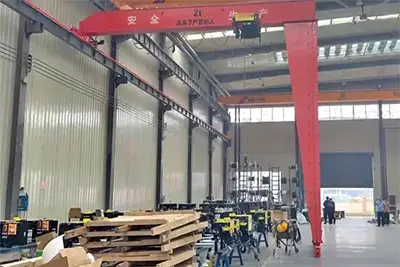
Free standing gantry cranes are lifting systems that don’t rely on the building’s structure for support. Instead of being mounted to the roof or walls, these cranes have their own vertical columns and a bridge beam, creating a completely independent framework. This means they can be installed almost anywhere there’s enough floor space.
- Independent columns support the crane’s weight and load.
- Equipped with a trolley and hoist to move materials across the span.
- Available in single girder or double girder designs depending on lifting needs.
- Can handle light to heavy loads, from a few tons to over 50 tons.
Basically, they give you the same functionality as a traditional overhead crane but without having to touch your building’s structure.
Challenges With Installing Traditional Overhead Cranes
Many buyers are surprised by how complicated it can be to add a conventional overhead crane to an existing facility. Traditional overhead cranes usually rely on strong roof beams or reinforced walls to carry the load. Without proper support, installing these cranes can mean major building work.
- Roof or wall reinforcement may be needed, adding thousands of dollars to the project.
- Concrete foundations may require modification or strengthening.
- Installation often takes longer, disrupting normal operations.
- Lead times increase due to additional engineering and construction requirements.
In short, installing a conventional overhead crane in an existing workshop is not always simple. The costs, both in money and downtime, can add up quickly.
If you are a crane buyer working with an existing facility or leased space, free standing gantry cranes offer a solution that is practical and cost-conscious. They provide flexibility for your operations and allow you to avoid expensive building modifications.
- Reduce costs by eliminating the need for structural reinforcement.
- Install quickly with minimal disruption to your current workflow.
- Move or expand the crane easily in the future if your operation changes.
- Ensure safety and compliance without depending on the building’s support.
In this article, we’ll explain how free standing gantry cranes can save you time, money, and headaches while still providing reliable lifting performance.
Free Standing Gantry Cranes for Sale
What They Are
Free standing gantry cranes are self-supporting lifting systems that don’t rely on the building’s structure. Instead of attaching to roof beams or walls, these cranes stand on vertical columns, making them ideal for workshops, rented spaces, or facilities where structural modifications would be expensive or impractical.
Key features:
- Independent columns support the entire crane and its load.
- The bridge beam spans between columns, carrying the hoist and trolley.
- Moves materials across the workspace efficiently and safely.
Main Components Explained
Every free standing gantry crane has a few core parts, each serving a specific purpose:
- Columns: Vertical supports that bear the weight of the crane and load.
- Bridge Beam: Horizontal structure connecting the columns, supporting the trolley and hoist.
- Trolley: Runs along the bridge to position the hoist over the load.
- Hoist: Lifts and lowers materials, available as electric, chain, or manual versions.
- End Trucks: Wheels at the bridge ends allowing the crane to move along floor rails or runway tracks.
Together, these components create a stable, flexible lifting system without depending on the building itself.
Types of Freestanding Gantry Cranes
Freestanding gantry cranes are self-supporting lifting solutions that do not rely on a building’s structure. Their modular design makes them highly adaptable for indoor use, particularly in leased, temporary, or evolving facilities. Different configurations allow buyers to match the crane to their load, span, and operational requirements.
Single Girder vs. Double Girder Freestanding Gantry Cranes
Freestanding gantry cranes are available in single girder and double girder designs. The choice impacts load capacity, span, lifting height, and overall stability. Understanding these differences helps buyers select a crane that meets both current and future needs.
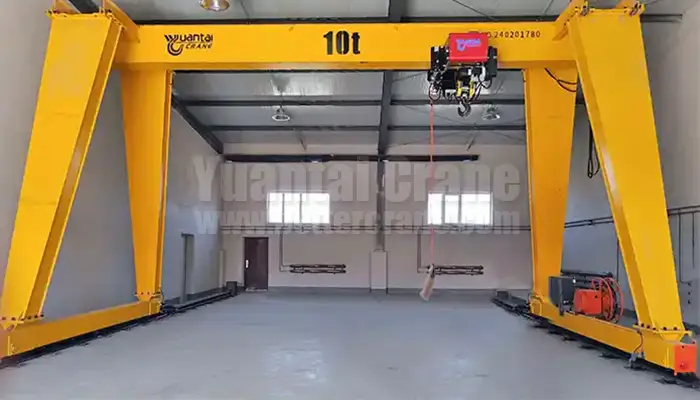
Single Girder Freestanding Gantry Cranes
- Designed for lighter loads and shorter spans, making them cost-effective.
- Easier to install, relocate, and maintain due to simpler structure.
- Ideal for light-duty indoor operations such as warehouses, workshops, or temporary setups.
- Provides sufficient lifting capability while minimizing investment and installation time.
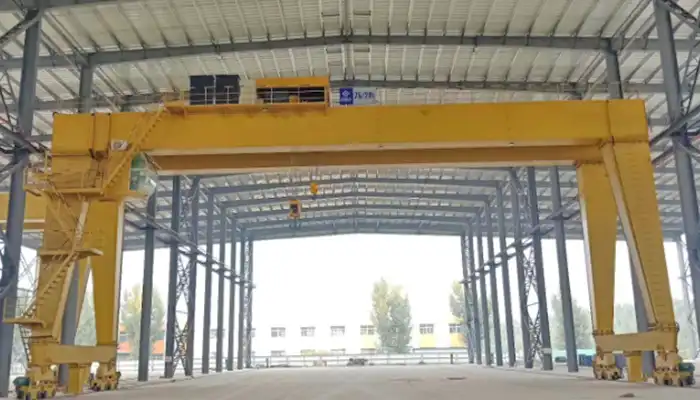
Double Girder Freestanding Gantry Cranes
- Built for heavier loads and longer spans, offering greater lifting height.
- Provides enhanced stability and durability for industrial or continuous indoor use.
- Suitable for steel workshops, machinery plants, or other heavy-duty operations.
- Slightly higher cost and more complex installation, but delivers long-term reliability and safety.
Rail Travelling vs. Wheel Travelling Freestanding Gantry Cranes
Freestanding gantry cranes can be designed to travel on rails or wheels. Each option provides different advantages in terms of mobility, precision, and facility layout. Buyers should consider how often the crane will be relocated and the level of positioning accuracy required.
Rail Travelling Freestanding Gantry Cranes
- Operates on fixed rails installed on the floor or overhead tracks.
- Offers smooth and precise movement along a predetermined path.
- Ideal for indoor facilities with repetitive lifting tasks, assembly lines, or fixed workstations.
- Provides excellent load stability and accurate positioning.
- Less flexible in relocation and requires proper rail foundations.
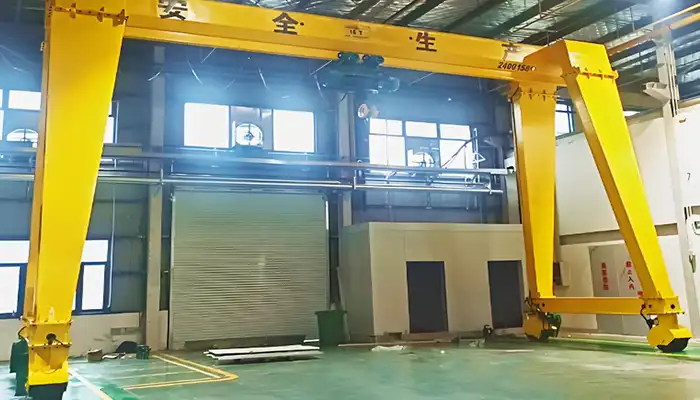
Wheel Travelling Freestanding Gantry Cranes
- Moves on wheels directly on the floor without permanent rails.
- Highly flexible and can be repositioned as workshop layouts change.
- Suitable for temporary or evolving indoor setups, including leased facilities.
- Quick to install and adaptable for different indoor configurations.
- May require reinforced flooring to support wheel loads and is slightly less precise than rail travelling cranes.
Capacities and Spans You Can Expect
Free standing gantry cranes cover a wide range of operational needs:
- Light-duty: 1–5 tons – small workshops, maintenance, or assembly lines.
- Medium-duty: 5–20 tons – manufacturing plants or steel processing areas.
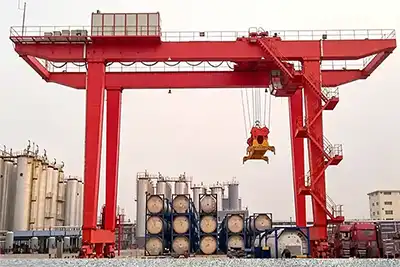
- Heavy-duty: 20–50+ tons – industrial facilities, shipping yards, container handling.
Span options:
- Small spans: 3–10 meters – compact indoor areas.
- Medium spans: 10–20 meters – standard factories or warehouses.
- Long spans: 20 meters and above – heavy-duty outdoor or large warehouses.
This flexibility allows buyers to choose a crane tailored to their specific lifting needs while avoiding over-investment.
Challenges with Traditional Overhead Cranes
- Roof or wall structures may not meet the required load ratings.
- Unsupported spans can lead to unsafe conditions or limit crane capacity.
- In many older buildings, additional engineering checks are necessary before installation.
- Reinforcing roof beams or walls: Installing steel supports or strengthening existing structures.
- Foundation adjustments: Upgrading or adding concrete foundations to carry the extra weight.
- Custom engineering: Designing and installing supports that meet safety codes.
- High labor and material costs for structural work.
- Engineering approvals and inspections can delay the project.
- Downtime during installation can disrupt normal operations and reduce productivity.
How Free Standing Gantry Cranes Reduce Building Modification Costs
- No need to reinforce roof beams or walls.
- Eliminates concerns about building load capacity.
- Reduces engineering approvals for structural modifications.
- Can be installed directly on existing floors with proper load checks.
- Load is spread across columns, minimizing point loads on the floor.
- Avoids expensive foundation reinforcement or concrete pouring.
- Columns can be taller or shorter depending on ceiling height.
- Bridge span can match the width of your floor area.
- Hook height and trolley travel can be optimized for your operations.
- Additional spans or sections can be added as needed.
- Crane can be relocated to a different part of the facility.
- Reduces long-term costs by avoiding repeated building modifications.
Practical Benefits for Buyers
- Avoid costly roof or wall strengthening.
- Reduce the need for concrete foundation upgrades.
- Lower overall project expenses by minimizing extra labor and materials.
- Can be relocated to different parts of the facility without major work.
- Adjustable span and height allow you to match crane coverage to your workflow.
- Modular designs support future expansions or reconfigurations.
- Less disruption to daily operations.
- Reduced installation labor compared with roof-mounted cranes.
- Faster return on investment due to quicker operational readiness.
- Built to meet CE, ISO, or local safety regulations.
- Stable, independent structure reduces risks associated with weak or modified buildings.
- Designed to carry rated loads safely without stressing existing building components.
Buyer Considerations Before Purchase
- Measure the length, width, and height of your workspace.
- Check floor load capacity to ensure it can handle the crane and lifted loads.
- Consider aisle space for material movement and operator access.
- Identify the maximum load you'll lift on a daily basis.
- Calculate the span between columns to cover the operational area.
- Plan for occasional peak loads by adding a safety margin of 20–30%.
- Single Girder: Ideal for lighter loads and shorter spans; simpler to install and maintain.
- Double Girder: Better for heavier loads, longer spans, or higher hook heights; more stable for continuous industrial use.
- Look for CE, ISO, or local compliance certifications.
- Confirm availability of technical support, spare parts, and maintenance services.
- Check manufacturer experience with similar projects and customer references.
- Choose a modular crane design for easy expansion.
- Ensure the crane can be relocated if you reconfigure the facility.
- Factor in potential increases in lifting capacity or span.
Cases for References
Scenario 1: Medium-Sized Workshop Upgrade
A medium-sized metal fabrication workshop wanted to install an overhead crane to move steel plates. The building’s roof beams were not strong enough for a traditional overhead crane, and reinforcing them would have cost tens of thousands of dollars.
Solution: The buyer opted for a single girder free standing gantry crane.
Outcome:
- Avoided expensive roof reinforcement.
- Installation completed in 2 weeks instead of 6–8 weeks.
- Minimal disruption to daily operations.
This example shows how a freestanding crane can fit within existing buildings without costly structural changes.
Scenario 2: Leased Warehouse for Assembly Line
A company leasing a warehouse needed to add lifting capacity for an assembly line. Since the lease was short-term, structural modifications were not feasible.
Solution: Double girder free standing gantry crane was installed on the existing concrete floor.
Outcome:
No structural modifications were required.
- The crane could be relocated easily after the lease ended.
- Operational efficiency improved immediately.
This demonstrates the flexibility of freestanding gantry cranes for leased or temporary spaces.
Scenario 3: Outdoor Storage Yard
A logistics company needed to move heavy containers in an outdoor yard. Installing a traditional overhead crane would have required extensive foundations and structural supports.
Solution: Outdoor double girder free standing gantry crane with weatherproof coating.
Outcome:
- Reduced installation costs by 40–50% compared to a roof-mounted crane.
- Quick setup with minimal downtime.
- Modular design allowed future expansion to handle larger containers.
Key Takeaways from Case Examples
- Free standing gantry cranes eliminate the need for building modifications.
- Cost savings can be significant, often reducing expenses by tens of thousands.
- Installation times are faster, reducing downtime and disruption.
- Flexibility allows relocation or expansion as operations change.
Conclusion
Why Free Standing Gantry Cranes Make Sense
Free standing gantry cranes offer buyers a lifting solution that doesn’t depend on the building structure. They stand on their own columns, which means you can install them without expensive roof or wall reinforcements.
- Flexible design allows customization of span, height, and load capacity.
- Minimal foundation requirements save time and money.
- Quick installation reduces downtime and disruption to operations.
- Modular options support future expansion or relocation.
Overall, they combine reliability, safety, and practicality, making them a smart choice for a wide range of facilities.
Final Recommendation for Buyers
If you are working in a leased space, rented warehouse, or any facility where building modifications are impractical or costly, free standing gantry cranes are a practical and cost-effective alternative.
- Avoid unnecessary structural upgrades.
- Ensure safe and efficient material handling.
- Maintain flexibility for future growth or relocation.
In short, a free standing gantry crane is not just a lifting solution—it’s an investment in operational efficiency, safety, and long-term adaptability.