
Gantry Crane & Overhead Crane 2–15 t for EV Battery Laser Assembly
Gantry and Overhead Cranes (2–15 t) for EV Battery Laser Assembly: Buyer Considerations
Most Important Takeaway
For EV battery laser assembly, selecting the right crane—whether gantry crane or overhead bridge crane—in the 2–15 ton range directly impacts precision, safety, and operational efficiency. Buyers must align crane capacity, precision, hoist type, and control systems with assembly line requirements to ensure smooth and safe material handling of sensitive EV battery modules.
Key Takeaways
- Choose between gantry cranes (flexible, relocatable) and overhead cranes (precise, space-efficient) based on factory layout and assembly line requirements.
- Ensure crane lifting capacity accounts for maximum EV battery weight plus safety margin.
- Integrate precision hoists and smooth control systems for laser-guided assembly tasks.
- Consider automation compatibility and potential integration with MES (Manufacturing Execution System) or robotic assembly systems.
- Prioritize safety, vibration control, and environmental suitability, especially for cleanroom or dust-sensitive facilities.
- Plan for maintenance, spare parts, and energy efficiency to reduce downtime and operational costs.
- Verify compliance with CE, ISO, or local safety standards to avoid regulatory issues.
Introduction
Manufacturing EV batteries, especially when laser assembly is involved, is all about precision. Every battery module needs to be positioned accurately, and even slight misalignment can affect welding quality or assembly accuracy. In these high-tech assembly lines, components are heavy but fragile, and operators cannot rely on manual handling alone. This is where material handling equipment, particularly cranes, becomes essential.
- Battery modules typically weigh anywhere from 500 kg to 12 tons, depending on whether it's a single module or a complete pack.
- Laser-guided assembly requires stable, vibration-free movement. Even small swings or jerks can ruin welds or sensors.
- Efficient handling reduces production bottlenecks and helps maintain consistent quality across the assembly line.
Gantry cranes and overhead bridge cranes are the backbone of material movement in EV battery production. They allow teams to lift and transport battery packs safely, accurately, and repeatedly without relying on manual labor.
- Gantry cranes are usually mobile or semi-permanent, ideal for flexible setups or lines that may be reconfigured.
- Overhead cranes are top-running bridge systems that offer stability and precision, especially in confined spaces where floor space is limited.
- Both types can be equipped with wire rope or chain hoists, depending on the weight and handling precision required.
By integrating cranes into the workflow, manufacturers can ensure that battery modules move smoothly from one station to another, reducing the risk of damage and improving overall production efficiency.
This guide focuses on 2–15 ton gantry and overhead cranes, the range most suitable for small-to-medium EV battery assembly operations.
- These capacities cover single battery modules, battery packs, and partially assembled units.
- The range is practical for assembly lines that do not require ultra-heavy lifting but still need reliable, repeatable handling.
- Both mobile and fixed installations are considered, depending on factory layout, headroom, and workflow needs.
Application Requirements
Choosing the right crane for EV battery laser assembly involves evaluating weight, precision, and operational frequency. Correct selection ensures safety, reduces downtime, and improves workflow efficiency.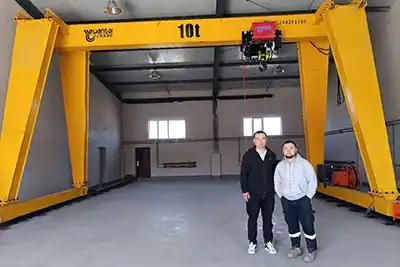
One of the first things to think about is how much weight your crane will need to handle. EV battery modules can vary a lot—small modules might be just 500 kg, while full battery packs can weigh up to 12 tons. That's a big range, so you need to size your crane with a safety margin.
- Industry practice is to add 20–30% above the maximum load to account for unexpected handling situations.
- Remember to include any fixtures, lifting attachments, or tooling that might be used—these add weight to the total load.
- Overestimating slightly is better than underestimating. A crane rated too low can cause downtime or safety issues.
By accounting for realistic weights and safety margins, you protect both your operators and your expensive battery modules.
EV battery laser assembly is highly sensitive. Even minor swaying or misalignment can affect weld quality or sensor placement. This makes precision one of the most important factors when choosing a crane.
- Look for cranes with anti-sway technology or smooth start/stop control to minimize jerky movements.
- Hoists should allow fine positional adjustments, especially for laser alignment tasks.
- If your process is automated, ensure the crane can integrate with robotic guidance systems or assembly line control software.
Precision doesn't just improve quality—it also reduces scrap and rework, which can be costly in battery manufacturing.
How often the crane will lift loads also impacts your choice. Some battery assembly lines are intermittent, while others require continuous lifting for high-volume production.
- Intermittent use: Light-duty cranes can be sufficient if the lifting is occasional and not high-speed.
- Continuous use: Choose cranes rated for heavy-duty or high-duty cycles to avoid overheating and excessive wear.
- Semi-automated operations: Integration with conveyors or robotic systems may require cranes with programmable speeds and repeatable motion.
Gantry vs. Overhead Cranes
When it comes to EV battery module handling cranes, the choice between a gantry crane and an overhead bridge crane is one of the first decisions a buyer needs to make. Each type has its own advantages and limitations depending on factory layout, precision needs, and budget.
Gantry cranes are usually mobile or semi-permanent, making them a flexible option for assembly lines that may change over time. They are particularly useful in smaller factories or temporary setups where floor layout adjustments are common.
Advantages:
- Flexible installation and easy relocation along the factory floor.
- Generally lower upfront cost compared to fixed overhead cranes.
- Can be used in multiple areas without major structural modifications.
Considerations:
- Requires clear floor space; may interfere with other equipment or workflow.
- Moderate precision and speed—less ideal for high-accuracy laser-guided assembly.
- Limited span and lifting height compared to top-running overhead cranes.
Overhead cranes, or top-running bridge cranes, are fixed installations that run on beams supported by the factory structure. These cranes are built for precision and high stability, making them ideal for sensitive laser assembly of EV batteries.
Advantages:
- Excellent stability and precise control, reducing sway during lifting.
- Minimal obstruction on the factory floor—equipment and operators can move freely underneath.
- Can handle heavier loads and longer spans efficiently.
Considerations:
- Higher upfront cost due to structural support and installation requirements.
- Less flexibility; once installed, the crane cannot be easily moved.
- Requires careful planning of factory layout and headroom.
- Use gantry cranes when flexibility, lower cost, and short-term setups are priorities.
- Choose overhead cranes when precision, stability, and unobstructed floor space are critical, especially for laser-guided EV battery assembly.
- Always align your crane choice with weight handling, span requirements, and integration with automated assembly systems.
Technical Specifications to Consider
Selecting the right technical specifications is critical for a 2–15 ton gantry or overhead crane used in EV battery laser assembly. The goal is to ensure smooth, safe, and precise handling of battery modules without slowing down the production line or risking damage.
The first thing to check is the crane's lifting capacity. EV battery modules and packs can vary widely in weight, so you need a crane that can comfortably handle the maximum load.
- For most assembly lines, a 2–15 ton capacity covers everything from single modules to fully assembled battery packs.
- Always include a 20–30% safety margin above the heaviest load to account for lifting attachments, tools, or unexpected variations.
- Overloading a crane can lead to mechanical failure, downtime, and safety hazards—so it's better to slightly oversize than undersize.
The crane's span and lifting height need to match your factory layout and workflow.
- Span: Should cover the width of your assembly line without causing interference with other equipment.
- Lifting Height: Ensure the crane can reach all stations, including racks, welding areas, and laser assembly positions.
- Proper planning avoids costly adjustments or structural modifications later.
Practical tip: Measure the maximum module height, add any tooling or fixtures, and include extra clearance for safe operation.
Keywords integrated: "overhead bridge crane span for EV battery assembly," "gantry crane lifting height EV battery line."
Choosing the right hoist is key for precision and efficiency.
- Wire rope hoists: Best for heavier battery packs or long spans. They provide smooth lifting and are more durable for repeated cycles.
- Chain hoists: Suitable for lighter loads and tasks that require fine positioning, like laser-guided assembly.
- Variable speed hoists can help reduce sway and improve control during sensitive operations.
The crane control system affects both productivity and safety. Modern EV battery assembly lines may integrate cranes with automated or semi-automated systems.
- Manual controls: Simple and cost-effective for basic operations.
- Pendant controls: Common for operator-guided lifting with precise movement.
- Radio remote controls: Allow mobility and operator flexibility without being tied to a panel.
- Automated controls: Can integrate with MES (Manufacturing Execution System) or robotic assembly systems for repeatable, precise movement.
Practical tip: Match the control system to your workflow—if modules move along conveyors or robots, consider automation-ready cranes.
Safety is non-negotiable, especially when lifting expensive and delicate battery modules.
- Anti-sway mechanisms reduce load movement and improve laser alignment accuracy.
- Overload protection prevents the crane from lifting beyond its rated capacity.
- Limit switches ensure the crane stops at defined positions.
- Soft start/stop reduces jerking motions that could damage modules or equipment.
- Vibration damping protects sensitive battery packs and welding or laser assemblies.
Practical Takeaway:
Choosing the right technical specifications ensures that your crane can handle battery modules safely, maintain precision during laser assembly, and integrate seamlessly into your production line. Overlooking these details can lead to production delays, equipment damage, or safety hazards.
Environmental & Facility Considerations
When selecting a 2–15 ton gantry or overhead crane for EV battery laser assembly, it's not just about capacity or precision. The environment and facility setup play a huge role in safe and efficient operation. Overlooking these factors can cause downtime, increase maintenance costs, or even damage sensitive battery modules.
Before installing a crane, check whether your factory floor and building structure can support the load. Overhead cranes, in particular, rely on strong runway beams or gantry legs.
- Confirm floor load capacity for mobile gantry cranes; concentrated load points can exceed limits if not properly reinforced.
- Overhead cranes may require structural modifications, including reinforced beams or columns to handle repeated lifting cycles.
- Always include the weight of the heaviest battery module, lifting attachments, and crane components in your calculations.
Some battery assembly lines, especially those involving laser welding or sensitive electronics, may operate in cleanroom or low-dust conditions.
- Select crane systems that minimize dust generation, such as enclosed hoists or covered wire ropes.
- Consider corrosion-resistant finishes or coatings if the facility uses humidity or cleaning controls.
- Smooth crane motion reduces particle disturbance around sensitive laser or welding stations.
Noise and vibration are not just an operator comfort issue—they can affect assembly precision.
- Anti-vibration pads or damping systems can reduce the impact on delicate battery modules.
- Soft start/stop mechanisms minimize sudden movements and mechanical stress.
- Noise reduction features help comply with workplace safety regulations while creating a better working environment.
Keywords integrated: "vibration control crane EV battery line," "low-noise gantry crane."
A crane should fit seamlessly into your production flow, not disrupt it.
- Plan crane runways, span, and positioning to avoid blocking conveyor belts or robotic systems.
- Mobile gantry cranes can be repositioned for flexible lines, while overhead cranes are best for fixed, repeatable workflows.
- Proper layout planning helps reduce lifting distances, cycle times, and potential collisions with equipment or operators.
Practical Takeaway:
Consider environmental and facility factors early. Floor strength, cleanroom requirements, vibration control, and layout optimization all affect crane performance, safety, and longevity. A well-planned installation ensures smooth, precise, and uninterrupted material handling for EV battery laser assembly.
Operational Efficiency & Maintenance
A crane's performance isn't just about lifting capacity or precision. In EV battery laser assembly, operational efficiency and maintenance planning are just as important. Downtime or unexpected repairs can slow the line, affect quality, and increase costs. Planning ahead ensures your crane delivers reliable service over its full lifetime.
Regular inspection and maintenance keep the crane running safely and efficiently. Accessibility matters a lot.
- Ensure that motors, hoists, brakes, and control panels are easy to reach for inspection and service.
- Include space for hoist lubrication, wire rope checks, and mechanical adjustments without requiring disassembly.
- Set up a maintenance schedule based on crane usage frequency and duty cycle.
Crane components like hoists, motors, and control systems wear over time. Having ready access to spare parts can prevent long production delays.
- Work with suppliers who provide fast replacement parts and technical support.
- Consider modular crane designs that allow quick replacement of high-wear parts.
- Ensure the supplier can support both gantry and overhead crane systems within your 2–15 t range.
Energy use and operating costs are significant, especially for continuous production lines.
- Look for variable frequency drives (VFDs) or energy-efficient motors to reduce electricity consumption.
- Soft start/stop controls not only improve precision but also lower mechanical stress and energy use.
- Consider the total cost of ownership, including energy, maintenance, and potential downtime—not just the initial purchase price.
Cranes used in EV battery assembly often operate daily, sometimes continuously. Selecting equipment built for high-duty cycles ensures longevity.
- A well-maintained 2–15 t gantry or overhead crane can last 15–20 years in moderate usage, and 10–15 years in heavy, continuous operations.
- Duty rating, load handling, and maintenance schedule all affect expected service life.
- Proper installation, aligned with manufacturer guidelines, reduces premature wear on mechanical and electrical components.
Practical Takeaway:
Planning for maintenance, spare parts, energy efficiency, and service life ensures that your crane continues to perform safely and reliably. Investing time in these considerations upfront can save hours of downtime, costly repairs, and production delays in the long run.
Compliance & Certification
When it comes to EV battery laser assembly, safety and regulatory compliance are not optional—they are critical. Cranes handle heavy, delicate battery modules, and any failure could lead to serious accidents, costly damage, or production downtime. Ensuring your gantry or overhead crane meets international and local standards protects both your team and your investment.
Cranes must comply with recognized standards to guarantee safe operation and reliability.
- CE Certification: Confirms the crane meets European Union safety requirements for mechanical and electrical systems.
- ISO Standards: Covers manufacturing quality, load testing, and safety systems. Common standards for industrial cranes include ISO 4301 (crane classification) and ISO 9927 (inspection and maintenance).
- Local Safety Standards: Depending on your location, local authorities may require additional certifications or compliance checks. Always verify before purchase or installation.
The crane's electrical and lifting components must be certified and tested to ensure safe, reliable operation.
- Hoist Certification: Confirms the hoist can handle rated loads safely and withstand repeated cycles.
- Electrical Compliance: Includes proper grounding, overload protection, and adherence to local voltage and frequency standards.
- Mechanical Testing: Load testing, braking tests, and limit switch verification ensure the crane operates correctly under maximum load.
Keywords integrated: "hoist certification for EV battery crane," "electrical safety crane standards."
Battery laser assembly lines require frequent and thorough inspections because even minor deviations can affect production quality.
- Perform daily checks of wire ropes, hooks, limit switches, and brakes.
- Schedule periodic mechanical and electrical inspections, including load testing and vibration analysis.
- Maintain detailed inspection records for safety audits and regulatory compliance.
Practical Takeaway:
Compliance and certification ensure your crane operates safely, reliably, and in line with regulations. Properly certified cranes reduce risk, prevent production interruptions, and protect both employees and expensive EV battery modules. Choosing a supplier experienced in certified gantry and overhead cranes is just as important as selecting the right capacity and specifications.
Buyer Decision Checklist
When purchasing a 2–15 ton crane for EV battery laser assembly, there are many factors to consider. A checklist can help ensure you make a smart, safe, and cost-effective decision. This section highlights the key points buyers should evaluate before committing to a gantry or overhead crane.
The first step is choosing between gantry cranes and overhead bridge cranes.
- Gantry cranes are mobile or semi-permanent and work well for flexible layouts.
- Overhead cranes provide stability, precision, and unobstructed floor space.
- Consider your factory layout, headroom, and workflow to decide which type fits best.
Make sure the crane can handle the heaviest battery modules or packs, including any tooling or fixtures.
- Include a 20–30% safety margin above the maximum expected load.
- Verify that the crane's duty cycle matches your operation frequency—intermittent, continuous, or semi-automated.
Laser-guided assembly requires minimal sway and accurate positioning.
- Wire rope hoists are ideal for heavier modules, while chain hoists offer fine control for lighter loads.
- Check for anti-sway features, smooth start/stop, and vibration control to protect sensitive battery components.
Keywords integrated: "precision hoist EV battery assembly," "anti-sway crane for laser assembly."
Modern EV battery lines often include robotic assembly or conveyor systems.
- Evaluate whether the crane supports manual, pendant, radio, or automated controls.
- Ensure compatibility with your MES (Manufacturing Execution System) or robotic guidance systems for repeatable, precise movement.
Confirm that the crane can operate safely within your facility.
- Check floor load capacity and any required structural reinforcement for overhead cranes.
- Consider cleanroom or low-dust requirements if laser welding or sensitive electronics are involved.
- Account for noise and vibration mitigation to maintain quality and operator comfort.
Long-term reliability depends on planning ahead.
- Ensure easy access for inspection and preventive maintenance.
- Verify spare parts availability and supplier support.
- Choose energy-efficient motors and controls to reduce operating costs over time.
Finally, confirm that the crane meets all relevant safety and quality standards.
- Look for CE, ISO, or local certifications.
- Verify electrical safety, hoist certification, and mechanical testing.
- Maintain inspection records for audits and regulatory compliance.
Practical Takeaway:
Following this checklist helps buyers select a crane that is safe, precise, compatible with assembly workflows, and cost-effective over its lifetime. It ensures your EV battery line operates efficiently, reliably, and without unexpected downtime.
FAQ: Questions Solved in This Guide
Gantry and overhead cranes serve the same purpose—moving heavy battery modules safely—but they differ in installation, precision, and workflow impact.
- Gantry Cranes: Mobile or semi-permanent, flexible, and lower cost. Best for layouts that may change or require occasional relocation. Takes floor space and offers moderate precision.
- Overhead Cranes: Fixed top-running bridge cranes that provide high stability, precise control, and minimal floor obstruction. Better for long-term assembly lines with repeated laser-guided operations.
- Key Takeaway: Choose based on floor space, layout flexibility, and precision requirements.
Capacity and lifting height are critical for safety and efficiency.
- Calculate the maximum weight of battery modules and packs, including fixtures or attachments.
- Add a 20–30% safety margin to avoid overloading the crane.
- Set lifting height based on assembly line workflow, storage racks, and tooling stations, ensuring enough clearance for safe handling.
Practical Tip: Overestimating slightly is safer than underestimating—downtime due to insufficient capacity can be costly.
The hoist and control system directly affect accuracy in laser-guided assembly.
- Wire Rope Hoists: Ideal for heavier modules and longer spans. Provide smooth motion for delicate lifts.
- Chain Hoists: Better for lighter loads and tasks that require fine positional adjustments.
- Control Systems: Manual, pendant, radio remote, or automated. For laser-guided assembly, automation-ready systems integrated with MES or robotics improve repeatability and reduce errors.
- Anti-sway, vibration damping, and soft start/stop mechanisms are critical for protecting modules.
Integration ensures smooth workflow and reduces handling errors.
- Ensure the crane supports programmable movement for robotic or conveyor systems.
- Control systems must be compatible with MES, laser-guided stations, or robotic welding arms.
- Consider motion repeatability, speed control, and positional accuracy when coordinating with automated stations.
Practical Tip: Early collaboration with crane suppliers and automation engineers avoids costly retrofits later.
Environmental and regulatory factors are just as important as technical specifications.
- Floor Load & Structural Support: Ensure your factory floor or runway beams can safely carry crane loads.
- Cleanroom or Low-Dust Requirements: Use cranes with minimal dust generation and smooth operation for sensitive laser assembly.
- Noise and Vibration: Anti-vibration systems and soft start/stop mechanisms protect modules and operators.
- Compliance & Certification: CE, ISO, and local standards ensure safe and legal operation. Verify hoist testing, limit switches, and electrical safety.
Conclusion
Selecting the right 2–15 ton gantry or overhead crane for EV battery laser assembly isn’t just a purchase—it’s a critical operational decision. The wrong crane can slow production, risk damage to expensive battery modules, or even create safety hazards for operators.
To make the right choice, buyers need to carefully evaluate several key factors:
- Load Capacity: Ensure the crane can lift the heaviest battery modules or packs, including lifting attachments, with a 20–30% safety margin. This protects the crane, operators, and battery components from accidental overload.
- Hoist Type and Precision: Wire rope hoists are ideal for heavier loads and longer spans, while chain hoists allow fine positioning for sensitive laser assembly. Anti-sway mechanisms, smooth start/stop, and vibration damping are essential for maintaining assembly accuracy.
- Control Systems and Automation: Consider manual, pendant, radio, or automated controls, and ensure the crane can integrate with MES or robotic assembly systems for repeatable, precise operations.
- Workflow and Environmental Compatibility: Floor load, structural support, cleanroom requirements, and layout planning must align with your assembly line to prevent interference, reduce cycle times, and protect sensitive equipment.
- Maintenance and Operational Efficiency: Easy access for inspection, availability of spare parts, and energy-efficient operation reduce downtime and long-term costs. Planning for preventive maintenance ensures the crane performs reliably throughout its service life.
- Compliance and Certification: CE, ISO, or local safety certifications, along with hoist testing and inspection protocols, ensure safe operation and regulatory compliance.
By evaluating these technical, environmental, and operational factors, and working closely with experienced crane manufacturers, EV battery assembly lines can achieve:
- Reliable, high-precision material handling for laser-guided battery assembly.
- Reduced risk of damage to delicate modules and tooling.
- Minimized downtime and maintenance interruptions.
- The flexibility to scale production efficiently as battery designs evolve or output increases.
Ultimately, investing the time to choose the right crane upfront protects your production line, improves safety, and ensures consistent quality in every battery module manufactured.