Diesel Straddle Carrier Guide: Features, Uses & Specs
Most Important Takeaway
The Diesel Straddle Carrier is a practical heavy-duty container handling solution for ports and logistics yards that need continuous operation, strong lifting capacity, and independence from charging infrastructure.
Key Takeaways
- Designed for continuous container handling in 24/7 port and yard operations
- Works without charging systems, suitable for infrastructure-limited sites
- Combines diesel engine power with hydraulic drive for stable heavy lifting
- Flexible yard mobility with no rail or fixed runway requirements
- Widely used in ports, steel plants, and industrial logistics yards
FAQ – Diesel Straddle Carrier
The following FAQ explains diesel straddle carrier applications, performance, selection, and operational considerations in real port and logistics environments.
A: It is a container handling machine used for lifting, stacking, and transporting containers inside ports and logistics yards.
Explanation:
In daily container terminal operation, it moves containers between quay cranes, yard storage blocks, and truck loading areas in continuous working cycles. Operators use it for standard container transport, yard stacking, and short-distance container transfer in busy port environments where steady flow is required.
A: It is most suitable for container terminals, inland depots, rail freight yards, and intermodal logistics hubs with continuous container flow.
Explanation:
It is commonly used in real-world applications such as container yard stacking operations, port cargo handling systems, and intermodal freight transfer where equipment must support high-frequency container movement and 24-hour yard operation without interruption.
A: Performance mainly depends on lifting stability, engine output, control precision, and structural durability during continuous yard work.
Explanation:
In practical use, operators look at stable container lifting, smooth travel between yard blocks, and reliable operation under heavy-duty cycles. Good performance also comes from consistent hydraulic response, safe container handling, and stable operation during peak terminal workload.
A: Key parameters include lifting capacity, stacking height, travel speed, engine power, and yard layout compatibility.
Explanation:
When selecting equipment for port logistics or container yard operations, buyers usually consider whether it matches container throughput volume, yard space design, and handling efficiency requirements. These factors directly affect container handling productivity and long-term operational efficiency.
A: Optional systems such as fuel optimization, improved hydraulic control, and safety monitoring help improve efficiency and reduce long-term operating cost.
Explanation:
In real terminal operations, features like fuel-saving systems, operator assistance functions, and maintenance-friendly design are often used to reduce fuel consumption in continuous operation, improve container handling efficiency, and support lower total cost of ownership in long-term yard use.
Diesel Straddle Carrier
Introduction to Diesel Straddle Carrier
This section explains what a diesel straddle carrier is, how it works in real operations, and why it is widely used in ports, logistics yards, and industrial container handling environments.
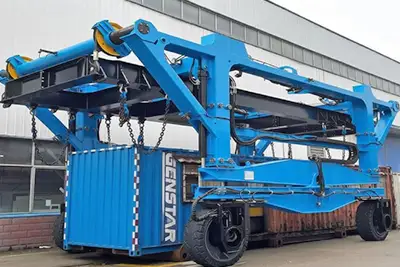
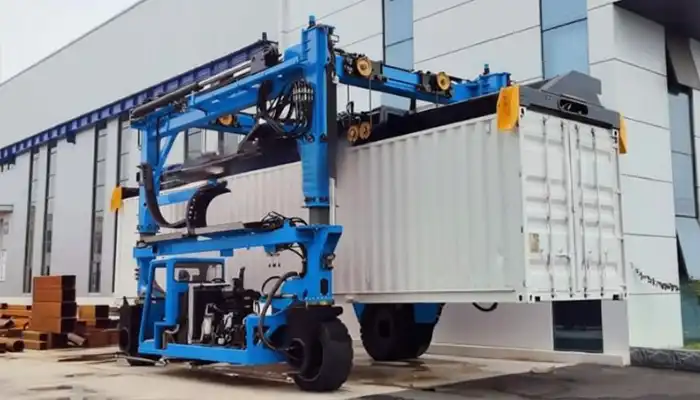
A diesel straddle carrier is a container handling machine used in ports, logistics yards, and industrial storage areas. In simple terms, it lifts containers from the ground or from stacks and moves them directly within the yard. No extra lifting crane is needed for short-distance transport inside the operation zone.
In practical projects, it is used where container flow is continuous. Not occasional work, but daily, repeated movement. You see it in container terminals, steel yards, and inland depots where cargo never really stops moving.
- Designed for direct container lifting and transport within yard areas
- Commonly used in port container handling and logistics distribution centers
- Suitable for high-frequency, continuous material flow operations
- Works as both lifting and transport equipment in one machine
It is often described by operators in a simple way: it just keeps moving containers all day.
In modern port and logistics systems, the diesel straddle carrier plays a flexible role between storage and transport. It connects different yard zones without needing fixed rail systems or permanent lifting infrastructure.
In many industrial layouts, it is used to reduce dependence on static equipment. You can change yard layout, expand storage areas, or adjust container flow paths without rebuilding the whole system.
- Acts as a mobile container transfer unit between yard zones
- Supports flexible yard planning without fixed infrastructure
- Helps balance container flow between storage and dispatch areas
- Reduces reliance on cranes and rail-mounted systems
In real-world operations, it is often the "bridge" machine between trucks, stacks, and shipping areas.
Diesel power is still widely used in straddle carrier systems because it supports long working hours without interruption. In ports and industrial yards, machines are expected to run for full shifts, sometimes 24 hours a day.
Electric systems depend on charging cycles, which can interrupt continuous operations. Diesel systems avoid that limitation.
- Continuous operation without charging downtime
- Suitable for multi-shift and 24/7 working environments
- Easy refueling in industrial and port sites
- Stable power output under heavy load conditions
In practical use, many operators still prefer diesel equipment when uptime matters more than anything else.
Different power types are used depending on site conditions, energy availability, and operating cost strategy. In real projects, the choice is usually not theoretical. It depends on whether the yard can support charging systems or not.
Diesel straddle carriers are more flexible in remote or high-intensity environments. Electric ones are cleaner but depend heavily on charging infrastructure. Hybrid systems try to balance both, but are more complex.
- Diesel straddle carrier: best for continuous work and remote yards without charging systems
- Electric straddle carrier: suitable for controlled environments with charging stations
- Hybrid straddle carrier: used where both flexibility and emission control are required
- Selection depends on yard layout, energy access, and working cycle
Diesel straddle carriers are used in environments where container movement is constant and equipment must perform under real outdoor conditions. These are not clean or controlled spaces. They are working yards, often exposed to weather and uneven ground.
They are built for exactly that type of environment.
- Port terminals with continuous container loading and unloading
- Logistics yards with frequent container transfer and stacking
- Steel plants and industrial storage areas with heavy cargo flow
- Inland container depots with multi-shift operations
- Remote or temporary sites without fixed electrical infrastructure
Working Principle and System Structure
This section explains how a diesel straddle carrier operates in real working conditions, including its power system, hydraulic drive, structural design, and control modes used in daily port and yard operations.
The diesel straddle carrier works as a combined lifting and transport machine. In real industrial conditions, it does not just lift containers. It picks them up, carries them across the yard, and places them directly where needed.
The whole working process is built around a simple flow: power generation, hydraulic conversion, structural support, and load handling. In practice, each system works together continuously during operation.
- Combines lifting and traveling in one machine
- Designed for continuous container movement in yard operations
- Works in repeated cycles: pick up, transport, and place containers
- Suitable for high-frequency port and logistics handling tasks
It is often used where container flow never really stops, especially in port terminals and large logistics yards.
The diesel engine is the core power unit of the straddle carrier. It provides continuous mechanical energy required for both movement and lifting. In real operation, the engine runs throughout the working shift without frequent interruption.
Unlike electric systems that require charging time, diesel power allows immediate refueling and continued operation.
- Provides stable power for long working hours
- Supports continuous container handling without charging delay
- Suitable for outdoor and heavy-duty industrial environments
- Ensures consistent performance under full-load conditions
In practical use, this is important for ports where stopping equipment means delaying the entire container flow.
The hydraulic system converts engine power into controlled motion. It is responsible for lifting containers, steering the machine, and controlling travel speed. In real working conditions, this system ensures smooth and stable operation even under heavy load.
- Controls lifting and lowering of containers
- Manages steering and directional movement
- Ensures smooth travel under loaded conditions
- Helps maintain stability during operation cycles
In practice, operators rely on the hydraulic system for precise handling, especially when positioning containers in tight yard spaces.
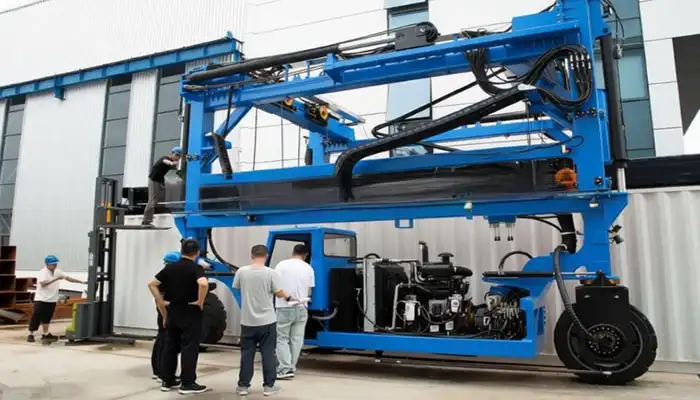
The straddle frame is the main structural design of the machine. It allows the carrier to move over containers and lift them directly from above using the spreader system.
This structure is what makes direct container handling possible without additional equipment.
- Allows direct lifting from ground or stacked containers
- Enables transport while carrying containers underneath the frame
- Provides strong structural support for heavy loads
- Designed for repeated industrial lifting cycles
In real operations, this structure is essential for efficient yard movement and stacking.
The spreader is the working interface between the machine and the container. It is designed to handle standard ISO containers, but it can also be adapted for oversized or special cargo.
Different spreader types are selected based on the job requirement.
- Standard spreader for ISO container lifting and transport
- Chain and lock systems for general cargo handling
- Oversized spreader for non-standard or heavy industrial loads
- Quick connection design for efficient operation
In practical use, spreader selection often depends on cargo type and yard operation complexity.
The diesel straddle carrier can be operated from a cabin or through a remote control system. The cabin is the standard setup, offering full visibility and direct control for daily operations.
Remote control is used in specific situations where better positioning or safer distance is needed.
- Cabin control for standard container handling operations
- Remote control option for flexible or precise positioning
- Integrated system for travel, lifting, and steering control
- Designed for easy operation in daily yard work
In industrial projects, cabin operation is used for continuous work, while remote control is applied in special handling conditions or confined spaces.
Key Advantages in Port and Yard Operations
In real port terminals and logistics yards, equipment is judged by one simple point—whether it can keep working under pressure. The Diesel Straddle Carrier is widely used because it supports continuous container flow without complicated infrastructure. It is built for daily operation, not occasional lifting tasks.
Below are the key practical advantages that matter in actual container handling projects.
- Continuous operation for multi-shift container yard work
- Strong load stability for heavy container transport
- Flexible movement without rail or fixed infrastructure
- Reduced civil engineering and installation cost requirements
- Suitable for high-frequency container transfer operations
These advantages directly affect how smoothly a yard runs. In practice, it means fewer interruptions, simpler layout planning, and more flexible container movement between storage and dispatch areas. It is often chosen where operational continuity is more important than system complexity.
Core Features of Diesel Straddle Carrier
In real port terminals, container yards, and industrial logistics operations, a diesel straddle carrier for container handling is judged by how well it performs under continuous working pressure. It is not only about lifting capacity, but also about structural stability, control precision, and long-term reliability in heavy-duty straddle carrier operations.
These features are designed for high-frequency container transport in ports and logistics yards, where equipment must run through multi-shift cycles with minimal interruption.
- FEM-based structural design for load safety and fatigue resistance in heavy-duty container straddle carrier operations
- Use of premium hydraulic and electrical components for reliable diesel straddle carrier performance in port logistics systems
- Advanced control system for smooth and precise container handling in straddle carrier yard operations
- Multi-mode steering system for narrow and complex container yard layouts in port terminal logistics handling
- Compact turning radius design for efficient yard space utilization in container stacking and transfer operations
- Fuel-based operation with optimized energy efficiency system for long-hour diesel straddle carrier working cycles
In practical use, these engineering features directly support container lifting, stacking, and transport operations in port terminals and industrial logistics yards. The result is more stable movement under full load, better maneuverability in tight container storage areas, and more consistent performance during continuous straddle carrier operations in real working environments.
Diesel Straddle Carrier Parameters
| Model | DSC-35T | DSC-60T | DSC-80T | |
| Capacity | 35t | 60t | 80t | |
| Length×Width×Height | 9200×5100×5500mm/7110×5100×6100mm | 9250×5700×6350mm | 12500×6000×6350mm | |
| Effective Inner Width | 3100mm | 3750mm | 3750mm | |
| Wheel Base | 6010mm | 6600mm | 7400mm | |
| Level 2 Lift Height | N/A |1550mm | 1750mm | 1750mm | |
| Max.Lifting Height(Below spreader) | 4600mm|6150mm | 6300mm | 6300mm | |
| Min.Ground Clearance | 230mm | 310mm | 310mm | |
| Tire Qty | 4 | 4 | 8 | |
| Deadweight(not contain spreader) | 19T|21T | 35T | 45T | |
| Weichai Engine-China StageII | 103KW | 129KW | 176KW | |
| Closed Travel Pump | Hytek/Danfoss/PMP | |||
| Empty-load max.speed | 115m/min | 80m/min | 80m/min | |
| Full-load max.speed | 80m/min | 50m/min | 50m/min | |
| Turning Radius | 6950mm | 8900mm | 13000mm | |
| No-load/full-load Gradeability | 6%/3% | |||
| Control mode | Cab(remote control optional) | |||
| Tires | solid tire | |||
| Lifting Tools | Chain+Lock/Automatic Spreader | Oversized LoadSpreader | ||
| Remarks Theengine can be optionally equippedwith National IV,and optional accessorybrand | ||||
Technical Parameters and Model Selection Guide
When choosing a diesel straddle carrier for container handling, the technical parameters are not just reference data. In real port container operations, logistics yards, and industrial material handling, they directly determine how well the equipment fits daily working conditions and container flow requirements.
Different yards have different operational needs. Some focus on tight-space flexibility, some require higher lifting capacity, and others prioritize long-hour continuous operation. That is why proper model selection is critical.
Diesel straddle carriers are usually divided into three main capacity levels. Each level is designed for a different container handling workload in port terminals and logistics yards.
- 35 ton model: suitable for smaller container yards and medium container flow
- 60 ton model: widely used in standard port and logistics operations
- 80 ton model: used for heavy-duty container handling and high-frequency port operations
In real projects, higher capacity is not always better. The selection depends on daily container volume and actual operational demand.
Each model has different dimensions and structural design, which directly affects yard mobility and stacking efficiency.
- Larger models require wider working space in container yards
- Smaller models are more suitable for narrow logistics areas
- Stronger frames are used for higher lifting capacities
- Structural design influences turning radius and stacking efficiency
In practice, yard layout is just as important as lifting capacity when selecting a model.
Speed plays an important role in container transfer between storage zones, but in real operation, loaded speed is more critical than empty speed.
- Empty load speed: faster movement when no container is carried
- Full load speed: slower but stable movement with container
- Balanced speed design ensures operational safety
- Supports stable container flow in busy terminals
In daily operations, stability and control are more important than maximum speed.
The wheel system directly affects stability during heavy container handling and determines the working ground conditions.
- Multiple wheel configurations depending on model size
- Solid tires for heavy-duty port and yard applications
- Ground clearance designed for uneven industrial surfaces
- Stable movement on compacted soil or concrete yards
In real environments, most equipment operates on outdoor yard surfaces rather than ideal indoor floors.
Lifting system design determines the type of containers and cargo that can be handled, which is critical in port stacking and logistics operations.
- Standard lifting height suitable for ISO container stacking
- Optional configurations for higher stacking requirements
- Spreader systems for standard containers and special cargo
- Quick switching between different lifting tools
In practice, spreader selection depends on the main cargo type handled in daily operations.
The diesel engine and hydraulic system form the core of the machine, controlling lifting force, travel stability, and continuous working capability.
- Diesel engine provides continuous power for long working shifts
- Hydraulic system controls lifting, steering, and movement
- Different power ratings match different capacity models
- Designed for continuous port and logistics operations
In industrial applications, stable output is more important than peak performance.
In real diesel straddle carrier applications, model selection is always based on actual working conditions rather than theoretical specifications.
- Container volume per day
- Yard size and layout
- Working shifts (single shift or 24-hour operation)
- Type of cargo (standard containers or mixed loads)
The correct model is the one that matches real operational demand, not just the highest specification on paper.
Diesel Straddle Carrier Application
The diesel straddle carrier for container handling is mainly used in environments where work is continuous, heavy, and cannot depend on charging systems or fixed rail equipment. In real industrial projects, it is chosen because it can move freely in the yard, handle full containers, and keep running for long shifts with simple refueling.
Below are the most common real-world applications where diesel straddle carriers are widely used in port logistics and industrial material handling systems.
In port terminals, diesel straddle carriers are used for daily container handling operations between ship side, yard area, and truck loading zones. The working cycle is continuous, and equipment must respond quickly to changing container flow.
- Container loading and unloading between vessels and yard
- Yard stacking and container repositioning operations
- Short-distance container transfer inside port areas
- Continuous 24/7 port logistics handling operations
In real port use, the diesel straddle carrier helps maintain stable container flow without waiting for charging or fixed crane scheduling.
In logistics distribution centers and container yards, diesel straddle carriers are used for internal movement of containers between different storage areas. These operations require flexibility more than fixed positioning systems.
- Container transfer between storage zones in logistics yards
- Sorting and repositioning of containers based on dispatch plans
- Short-distance heavy container movement inside the yard
- Support for fast container flow in distribution centers
In practical use, it allows operators to adjust yard layout and container placement without changing infrastructure.
In steel plants and industrial manufacturing sites, diesel straddle carriers are used for heavy cargo movement where strength and stability are more important than speed alone. The loads are often heavy and require stable lifting.
- Steel coil and steel product handling in steel mills
- Movement of heavy components in manufacturing yards
- Internal logistics between production and storage areas
- Heavy-duty cargo transfer in industrial environments
In real operations, diesel straddle carriers are preferred because they can handle heavy loads repeatedly under tough working conditions.
In bulk cargo yards and industrial storage areas, diesel straddle carriers are used for handling large-volume materials and mixed cargo types. These environments often require flexible handling equipment.
- Bulk material stacking and yard movement
- Container and non-standard cargo handling operations
- Flexible transport between storage and loading areas
- Support for mixed industrial logistics workflows
In practice, one machine often handles different cargo types depending on daily operational needs.
In remote industrial projects or developing logistics sites, electricity supply is often limited. In these cases, diesel straddle carriers are a practical choice because they do not rely on charging systems.
- Operation in sites without charging stations
- Remote construction and logistics projects
- Mining or infrastructure development areas
- Temporary industrial work zones
In real use, diesel power allows immediate deployment without waiting for electrical setup.
In temporary projects or fast-growing logistics operations, yard layouts often change. Diesel straddle carriers are used because they can adapt quickly without fixed infrastructure.
- Temporary container storage yards
- Emergency logistics operations
- Rapidly expanding port or warehouse areas
- Flexible yard layout adjustment without rail systems
In practice, this flexibility is important when container flow increases suddenly and the yard needs fast scaling.
Across all these scenarios, the diesel straddle carrier is chosen for one main reason: it keeps container operations moving without interruption. In real port logistics and industrial container handling systems, it works as a flexible and reliable machine that adapts to different yard conditions, load requirements, and working schedules.
Diesel Straddle Carrier Optional Configurations and Custom Solutions
In real diesel straddle carrier for container handling projects, not every yard works the same way. Some ports handle high-volume container flow, some deal with heavy industrial cargo, and some operate in remote locations. Because of this, the machine is often customized based on real working conditions, not a fixed standard setup.
These optional configurations are used to improve port container handling efficiency, reduce downtime, and adapt the straddle carrier to different logistics yard requirements.
In busy or narrow container yards, operators sometimes need better visibility and positioning control. A remote control system allows more flexible operation during container lifting and transfer.
- Wireless remote operation for diesel straddle carrier
- Improved visibility in tight container stacking areas
- Better precision in container positioning and movement
- Useful for complex port terminal yard layouts
In real use, this is often applied in container transfer operations where space is limited or accuracy is critical.
Standard spreaders are suitable for ISO containers, but many industrial projects involve special cargo. For this reason, upgraded spreaders are used in heavy-duty straddle carrier applications.
- Oversized spreader for non-standard containers
- Reinforced structure for heavy industrial cargo handling
- Suitable for steel coils, bulk cargo, and special loads
- Improved stability during lifting and transport
In practical operations, this option is common in steel plants and industrial logistics yards where cargo types are mixed.
For long-hour and high-frequency port container handling operations, engine reliability is critical. Upgraded power systems help improve stability and reduce maintenance frequency.
- Higher-grade diesel engine options for continuous operation
- Premium hydraulic pump systems for stable lifting performance
- Better durability in multi-shift working environments
- Improved overall reliability in heavy-duty yard operations
In real projects, this is usually selected for 24/7 container terminal operations with high workload demand.
Diesel straddle carriers are designed for continuous operation. Reducing refueling time helps improve efficiency in busy logistics yards and port terminals.
- Faster diesel refueling process
- Reduced downtime between working shifts
- Suitable for high-volume container flow operations
- Helps maintain continuous yard productivity
In practice, this is important in ports where container flow cannot be interrupted for long periods.
Fuel cost is a major part of long-term diesel straddle carrier operating cost. Optimization packages help reduce fuel consumption during continuous container handling work.
- Improved engine efficiency for long working cycles
- Reduced fuel consumption per container handling cycle
- Suitable for multi-shift logistics yard operation
- Lower long-term operating cost in port environments
In real use, this option is often selected for large-scale container logistics systems with daily continuous operation.
In many port terminal and industrial yard operations, operators work long shifts. Cabin comfort becomes important for safety and consistent performance.
- Air-conditioned operator cabin system
- Improved working comfort during long shifts
- Reduced operator fatigue in continuous operation
- Suitable for hot climate port and yard environments
These optional configurations allow the diesel straddle carrier system to be adapted to different port logistics, industrial material handling, and container yard operation requirements. In real projects, selection is usually based on workload, cargo type, and working environment rather than standard specification alone.
Diesel Straddle Carrier Maintenance and Operational Management
In real diesel straddle carrier for container handling operations, performance is not only about design or power. Long-term stability depends on daily maintenance and proper operational management. In ports, logistics yards, and industrial sites, equipment usually runs in multi-shift cycles, so small checks done regularly help avoid bigger downtime later.
This section focuses on practical maintenance routines used in container yard operations and heavy-duty straddle carrier applications, not theory.
The diesel engine is the main power source of the straddle carrier. In continuous port and yard operation, it must be checked regularly to ensure stable output.
- Regular engine oil, filter, and fuel system inspection
- Scheduled servicing based on working hours, not only calendar time
- Monitoring engine temperature and running condition during operation
- Preventive maintenance to avoid sudden breakdown in container handling work
In real use, most operators follow a simple rule: if the engine runs every day, it must also be checked every day.
The hydraulic system controls lifting, steering, and movement. Any pressure loss or oil issue can directly affect container lifting safety and straddle carrier stability.
- Daily hydraulic oil level inspection before operation
- Pressure monitoring during loaded container lifting
- Checking hoses and connections for leakage or wear
- Maintaining clean hydraulic oil for smooth system response
In practice, stable hydraulic performance is essential for safe and smooth container transfer in yard operations.
Diesel straddle carriers operate under heavy loads, often carrying full containers across long distances in the yard. Tires are under constant pressure and must be checked regularly.
- Regular inspection of tire surface wear and cracks
- Monitoring pressure and load distribution
- Replacement planning based on working intensity
- Ensuring stable contact with ground in yard operations
In real operations, uneven tire wear can affect stability during container handling and should not be ignored.
The straddle frame carries heavy containers every day. Over time, vibration and load cycles may affect structural joints, so inspection is necessary.
- Regular visual inspection of weld joints and frame connections
- Checking for fatigue cracks in high-stress areas
- Strengthening or repairing before damage expands
- Monitoring structural integrity during long-term operation
In practical port container handling systems, structural safety is critical because the machine works under repeated heavy cycles.
The control system manages travel, lifting, and steering functions. To maintain accuracy in container positioning and yard movement, periodic calibration is required.
- Routine system diagnostics for sensors and control modules
- Calibration of lifting and travel control functions
- Checking response accuracy of steering and braking systems
- Early detection of electronic or control irregularities
In daily diesel straddle carrier operations, maintenance is not a separate task—it is part of normal work. Regular checks on engine, hydraulics, tires, structure, and control systems help ensure reliable performance in continuous port terminal and logistics yard container handling environments, and reduce unexpected downtime during critical operations.
Diesel Straddle Carrier Selection Considerations and Buying Guidance
In real diesel straddle carrier for container handling projects, selection is not just about choosing a higher tonnage or a bigger machine. It is about matching the equipment with actual working conditions in port terminals, logistics yards, and industrial material handling operations. A well-matched machine runs smoothly every day. A wrong selection usually shows problems in fuel cost, yard efficiency, or downtime.
Below are the key practical points used in real buying decisions.
The first step in selection is understanding how many containers are handled per day. This directly determines whether a 35t, 60t, or 80t diesel straddle carrier is needed.
- Smaller container flow: suitable for 35 ton models in light logistics yards
- Medium flow operations: commonly use 60 ton straddle carriers in port terminals
- High-volume container handling: 80 ton models for heavy-duty continuous operations
- Capacity should match daily workload, not only peak demand
In real projects, over-sizing increases fuel cost, while under-sizing creates operational bottlenecks.
Yard layout plays a very important role in straddle carrier movement and container stacking efficiency. Even a powerful machine can perform poorly in a poorly matched space.
- Narrow yards: require compact design and better maneuverability
- Large port terminals: can support higher capacity models with wider turning space
- Stacking height and aisle width must match machine dimensions
- Layout planning affects container flow efficiency and travel distance
In practice, good layout matching often improves efficiency more than upgrading machine size.
Since diesel straddle carriers run for long hours in continuous port and logistics operations, fuel consumption becomes a major cost factor over time.
- Fuel usage depends on load cycles and working intensity
- Efficient engines reduce long-term operating cost
- Multi-shift operations require stable fuel performance
- Small efficiency differences become significant over months of use
In real operations, fuel efficiency is often more important than initial purchase price.
The control system affects how easily operators can handle the machine in daily container handling operations. Different sites have different skill levels and working styles.
- Cabin control is standard for most port and yard operations
- Remote control is useful for precision positioning in tight spaces
- Simplified systems reduce training time for new operators
- Advanced systems improve efficiency in complex yard layouts
In practice, the right control system reduces operational errors and improves safety.
In real industrial use, equipment uptime depends heavily on maintenance support. Even a reliable diesel straddle carrier system needs servicing over time.
- Availability of spare parts for hydraulic and engine systems
- Local or regional maintenance support capability
- Ease of routine servicing in port and yard environments
- Long-term technical support from manufacturer or supplier
In practical projects, after-sales support is often as important as machine specification.
Choosing the right diesel straddle carrier for container yard operations is always a balance between capacity, yard conditions, fuel cost, and maintenance support. In real port and logistics projects, the best equipment is not the biggest one, but the one that fits the actual working flow and keeps daily container handling stable and efficient.
Send Us An Inquiry
Diesel straddle carriers remain a practical solution for high-intensity container handling where continuous operation, strong lifting capability, and infrastructure independence are required. In real port and logistics environments, they are valued for stable performance and operational flexibility rather than complexity.
For projects involving port expansion, yard optimization, or industrial material handling, selecting the right configuration directly affects long-term efficiency and operating cost.
Send us an inquiry to get a tailored diesel straddle carrier solution based on your container handling capacity, yard layout, and operational requirements.