Double Hoist Gantry Crane vs Spreader Gantry Crane for Long Load
Double-Hoist vs. Spreader Gantry Cranes for Long Loads
Handling long or bulky loads like steel beams, wind turbine blades, or large pipes can be tricky. These materials often bend, swing, or lose balance if not lifted correctly. In many workshops or yards, operators face the same problem — how to lift these long items safely and keep them stable throughout the movement.
That’s where the choice between a double-hoist gantry crane and a spreader-type gantry crane comes in. Both are built for long load handling, but they do the job in slightly different ways. Choosing the right one is not just about load capacity — it’s about how the crane handles balance, positioning, and daily workflow. A poor choice can lead to uneven lifting, product damage, or even safety risks.
When comparing the two systems, it’s useful to think practically:
- How often do you handle long materials?
- Are your loads uniform or variable in length?
- Do you need flexibility or stability as your top priority?
These questions help determine which crane structure fits your operation best.
Scope of Discussion
This article focuses on comparing double-hoist gantry cranes and spreader gantry cranes specifically for long-load applications. The goal isn’t to promote one over the other, but to help buyers and operators understand their structural differences, working principles, and practical applications.
We’ll look closely at:
- How each system lifts and balances long materials
- The level of synchronization and operator skill required
- Typical usage scenarios in steel fabrication, precast yards, and manufacturing workshops
- Cost, maintenance, and operational efficiency over time
By the end, you’ll have a clear picture of which gantry crane setup — double-hoist or spreader-equipped — best fits your handling needs and working environment.
Overview of Long Loads Handling Requirements
Characteristics of Long Loads
Handling long or bulky materials is not as simple as picking up a single heavy block. These items behave differently — they flex, twist, and shift under their own weight. That’s why gantry cranes used for long loads need to do more than just lift; they must control balance, coordination, and safety throughout the movement.
Here’s what makes long loads challenging:
- Large span and uneven weight distribution
Long loads like beams or pipes often have an extended span, meaning their weight isn’t evenly spread. A single hook lift can easily cause one end to sag or tilt, which affects both handling safety and positioning accuracy. - Risk of bending or deformation
Materials such as aluminum profiles, concrete beams, or composite panels can bend or crack if not lifted at the right points. This is especially true when the material has a hollow core or is thin-walled. - Need for synchronized lifting and stability
When a crane uses two hoists or multiple lifting points, both sides must move in perfect coordination. If one hoist moves faster than the other, the load becomes unstable and may twist or shift dangerously.
Key Performance Needs
To handle long items safely, the crane system must be designed for steady balance, precise control, and smooth coordination. Operators need to maintain both vertical and horizontal alignment throughout the operation.
- Smooth load balance control
Dual hoists or spreader systems should lift evenly so that the load stays horizontal. This minimizes internal stress on long materials. - Precise hoist synchronization
Manual or electronic synchronization allows both lifting points to operate together, reducing the chance of uneven lifting. - Safe turning and positioning
Long items often require rotation or alignment in tight workshop spaces. Controlled movement ensures safety for workers and prevents damage to nearby equipment.
Typical Loads and Their Dimensions
Long-load gantry cranes are used across various industries — from steel fabrication and construction to wind energy and marine manufacturing. Each application has its own handling challenges and material dimensions.
Below are some of the most common long loads that gantry cranes handle, along with their typical size and weight ranges:
- Typical materials: I-beams, H-beams, steel columns, trusses, and long plates
- Common dimensions: 6–18 meters long, 1–20 tons per piece
- Notes: Often irregular in shape, requiring flexible dual-hoist positioning for balance
- Typical materials: Steel or ductile iron pipes, large tubes, cylindrical sections
- Common dimensions: 8–15 meters long, 0.5–8 tons per piece
- Notes: Frequently handled in groups using spreader beams with multi-point slings
- Typical materials: Precast girders, hollow slabs, bridge beams, tunnel segments
- Common dimensions: 12–30 meters long, 10–40 tons per unit
- Notes: Require multiple lifting points with even spacing to prevent cracking
- Typical materials: Hull sections, large panels, deck modules
- Common dimensions: 10–40 meters long, 10–50 tons per section
- Notes: Use synchronized hoists or spreader beams to maintain balance during horizontal movement
- Typical materials: Wind turbine blades, tower sections, and long steel shells
- Common dimensions: 30–70 meters long, 10–25 tons per piece
- Notes: High-precision lifting required due to aerodynamic shape and lightweight structure
What is a Double-Hoist Gantry Crane?
Definition and Structure
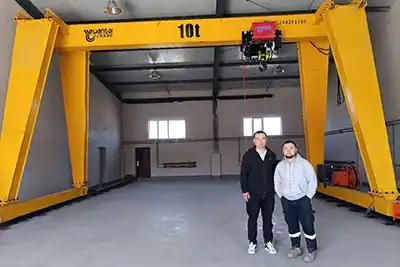
A double-hoist gantry crane is essentially a single crane girder that carries either one trolley with two hoists or two trolleys, each with its own hoist. The idea is simple: instead of lifting a long load from a single point, you have two lifting points, which allows the load to stay level and stable.
- Single trolley with two hoists: Both hoists move together on the same trolley, giving you precise control over load balance.
- Two trolleys with one hoist each: Each hoist can move independently along the girder, offering more flexibility for longer or uneven loads.
This setup makes it easier to handle long materials like steel beams, pipes, or precast concrete elements without relying on a complex spreader system.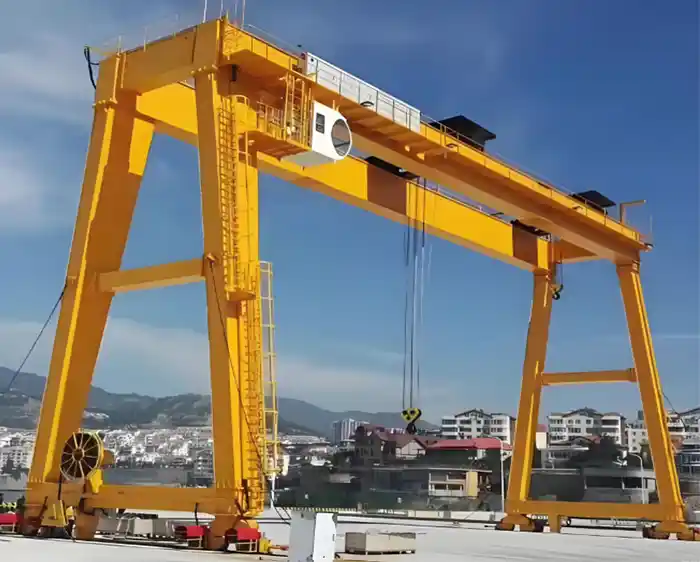
Operation Mode
The main principle behind a double-hoist crane is dual-point lifting. Both hoists lift the load at the same time, either:
- Synchronized: Both hoists move up or down at the same speed to maintain a perfectly level load.
- Independent: Operators can adjust the hoists individually to accommodate uneven weight distribution or obstacles in the workshop.
This flexibility allows operators to handle loads of different lengths and weights while maintaining stability during lifting, moving, and positioning.
Advantages
A double-hoist gantry crane offers several practical benefits for workshops and yards that handle long materials:
- Simpler structure compared to spreader systems: There’s no heavy spreader beam, which reduces initial cost and complexity.
- Independent or synchronized control: Operators can choose between fully synchronized lifts or manual adjustments depending on the load.
- Flexible for different load lengths: Ideal for workshops where load sizes vary day-to-day. You don’t need a separate setup for each length.
Other advantages include easier maintenance, lower weight on the crane girder, and faster setup for varying tasks.
Limitations
Despite its advantages, a double-hoist gantry crane does have some limitations:
- Requires skilled operator synchronization: If the hoists aren’t properly coordinated, the load may tilt or twist, increasing the risk of damage or accidents.
- Possible uneven tension: Particularly on very long loads, small misalignments between hoists can put extra stress on the material or the crane girder.
In short, while a double-hoist crane is practical, flexible, and cost-effective, it demands careful operation and monitoring, especially for very long or heavy loads.
What is a Spreader Gantry Crane?
Definition and Structure
A spreader gantry crane takes a different approach to long-load handling. Instead of relying solely on two hoists, it uses a spreader beam or lifting frame suspended from one or more hoists. This spreader acts like a bridge between the hoists and the load, allowing multiple lifting points along the length of the material.
- Spreader beam: A rigid bar or frame that distributes the lifting force evenly across the load.
- Suspension points: The hoists connect to the spreader at calculated points to prevent sagging or bending.
This setup is particularly useful for long, flexible, or fragile materials that need uniform support during lifting and moving.
gantry crane with spreaders for long and heavy loads handling
Operation Mode
The key principle of a spreader gantry crane is multi-point lifting. The load is attached at several points along the spreader beam, which ensures that the lifting force is evenly distributed.
- The hoists can be synchronized so that the entire load rises or lowers smoothly.
- Load positioning is more predictable, making it easier to align long items accurately for storage or assembly.
- Spreader beams can be adjusted for different load lengths or shapes, offering flexibility for repeated operations with standard-sized materials.
This method minimizes bending, twisting, or uneven load stress — problems that are common with long, heavy items lifted from just one or two points.
Advantages
A spreader gantry crane is designed for stability and precision. Its main advantages include:
- Excellent load stability and force distribution: Multiple lifting points reduce the chance of tilting or swinging.
- Reduced risk of deformation: Fragile or flexible loads, like aluminum panels or precast concrete beams, stay straight and undamaged.
- Faster alignment for standardized long materials: Once the hoists and spreader are set up, repeated handling of uniform loads becomes quicker and more efficient.
This makes spreader cranes ideal for industries that handle large volumes of long, heavy, or delicate materials regularly.
Limitations
Despite the benefits, spreader gantry cranes do have drawbacks:
- Heavier lifting system: The additional weight of the spreader beam and multiple hoists adds load to the crane structure.
- More complex design and higher cost: Compared to double-hoist cranes, spreader cranes require more planning, setup, and investment.
In practice, spreader cranes are a solid choice when load stability and precision are more important than simplicity or low upfront cost.
Key Comparison: Double-Hoist vs. Spreader Gantry Crane
When deciding between a double-hoist gantry crane and a spreader gantry crane, it helps to look at the differences in practical terms. Both cranes are designed for long-load handling, but the way they manage weight, stability, and operation varies significantly. Here’s a detailed comparison:
Comparison by Key Aspects
| Aspect | Double-Hoist Gantry Crane | Spreader Gantry Crane |
|---|---|---|
| Lifting Points | Two points via two hoists, either on a single trolley or two trolleys | Multiple points along a spreader beam or lifting frame |
| Load Distribution | Controlled manually by the operator; may require careful adjustment | Mechanically balanced across multiple points; load stays level automatically |
| Flexibility | Works well with varying load lengths; adaptable for different materials | Better suited for standardized long loads; less flexible for unusual sizes |
| Control Complexity | Requires a skilled operator to synchronize hoists and maintain load stability | Once configured, operation is simpler; hoist synchronization is built into the system |
| Cost | Lower initial investment; simpler structure and fewer components | Higher initial cost due to spreader beam and additional lifting points |
| Applications | Fabrication shops, steel structures, general workshops handling varied lengths | Pipe yards, precast concrete plants, wind turbine blade handling, long and fragile materials |
Practical Takeaways
- Double-hoist cranes are ideal when your workshop handles different types of long loads and flexibility is more important than full mechanical stability. They are easier to install and maintain, but require careful operation to avoid uneven lifting.
- Spreader gantry cranes shine in operations where load stability and uniformity are key, such as precast concrete yards or wind turbine blade handling. They reduce risk of bending or twisting and make repeated standardized lifts faster and safer, but come with higher cost and heavier equipment.
Application Scenarios
Choosing the right type of gantry crane depends heavily on the nature of your loads, the frequency of handling, and your workshop setup. Both double-hoist and spreader gantry cranes have practical strengths, and knowing when to use each can save time, reduce risk, and improve efficiency.
When to Choose a Double-Hoist Gantry Crane
Double-hoist cranes are best suited for operations where flexibility and adaptability are priorities rather than full mechanical load control. Practical scenarios include:
- Custom steel fabrication workshops
Where load lengths and weights vary frequently, operators can adjust hoists independently to handle different types of beams, frames, or columns. - Occasional handling of varied load sizes
When your workshop doesn’t deal with large long loads every day, a simpler double-hoist setup can meet your needs without overinvesting. - Limited budget or simpler lifting setup
Double-hoist cranes are lighter, easier to maintain, and cheaper to install. They fit small to medium workshops that need reliable lifting without complex systems.
When to Choose a Spreader Gantry Crane
Spreader gantry cranes are better for situations where load stability, precision, and repeated handling are critical. Typical applications include:
- Repetitive handling of uniform long materials
Such as precast concrete beams, standardized steel pipes, or wind turbine blades. The spreader beam allows consistent lifting every time with minimal adjustment. - High safety and precision requirements
For fragile or flexible loads, the even weight distribution of a spreader system reduces risk of deformation, bending, or tilting. - Automated or semi-automated lifting lines
In modern production facilities where loads move continuously, spreader cranes can integrate with hoist controllers and automation systems for smooth and precise operation.
In short:
- Choose double-hoist cranes if you need flexibility, lower cost, and manual adaptability for varied loads.
- Choose spreader cranes if your operation demands repeatable, stable, and precise lifting for long, uniform materials.
Both types can handle long loads efficiently, but the right choice depends on workshop conditions, operator skill, and the type of materials handled.
Safety and Operation Considerations
When handling long loads, safety is just as important as lifting capacity. Both double-hoist and spreader gantry cranes can perform well, but only if operators follow proper safety practices, maintain equipment, and monitor load behavior closely.
Maintaining a level load is critical. Even slight tilting or uneven weight distribution can stress the crane structure and damage the material. Practical ways to monitor balance include:
- Visual inspection during lifting
- Using built-in load sensors on hoists
- Checking that lifting points on long items are correctly spaced
- Adjusting hoists in real-time to keep the load level
Monitoring is especially important for double-hoist cranes, where operator control directly affects load stability.
Dual-hoist or multi-hoist setups require coordination between lifting points. There are two main approaches:
- Manual synchronization: Operators move hoists together using skill and experience. Good for small workshops or occasional lifts, but prone to error if not careful.
- Electronic or automated synchronization: Modern systems automatically keep hoists moving in sync, reducing risk of tilting, uneven tension, or material stress. Ideal for spreader cranes or heavy, repetitive lifts.
Choosing the right system depends on load type, operator skill, and the frequency of lifting operations.
Even the best cranes can be unsafe in untrained hands. Operators should receive:
- Training in dual-hoist or multi-point lifting techniques
- Guidance on load attachment points and spreader beam use
- Hands-on practice with load turning, alignment, and placement
- Awareness of swing, twist, and load deformation risks
Skilled operators can prevent accidents, protect materials, and extend crane service life.
Routine inspection is key for safety and reliability. Focus areas include:
- Hoist hooks, chains, and ropes for wear or damage
- Trolley wheels, rails, and movement tracks
- Spreader beams and lifting frames for cracks or bending
- Bolts, joints, and attachment points for tightness and stability
A consistent inspection schedule helps detect issues before they become safety hazards, reducing downtime and maintenance costs.
Safety in long-load handling comes down to three main principles: balance, synchronization, and equipment integrity. By monitoring load behavior, using proper synchronization systems, training operators thoroughly, and inspecting equipment regularly, workshops can lift long loads efficiently without risking material damage or accidents.
Cost and Maintenance Insights
When choosing between a double-hoist gantry crane and a spreader gantry crane, understanding the costs and maintenance requirements is just as important as considering load capacity or stability. These factors affect not only the budget but also long-term efficiency and downtime.
The upfront cost varies significantly between the two crane types:
- Double-Hoist Gantry Crane: Simpler structure with fewer components, lower material and installation costs, ideal for workshops handling varied loads or occasional long materials.
- Spreader Gantry Crane: More complex design due to spreader beams and multiple lifting points, heavier structure increases steel and hoist requirements, higher initial cost but justifiable for frequent uniform long-load operations.
Practical insight: If budget is a concern and load types vary, a double-hoist crane is more cost-effective. For high-volume, repetitive, or precision lifts, the extra investment in a spreader crane pays off through efficiency and safety.
Maintenance needs differ based on crane design:
- Double-Hoist Crane: Fewer components make inspections and repairs simpler. Regular checks focus on hoist synchronization, wire ropes, and trolley movement. Operator skill in adjustment is critical to prevent wear or misalignment.
- Spreader Crane: More moving parts and a heavier frame require detailed inspection. Spreaders, multiple hoists, and attachment points must be checked for wear, cracks, or bending. Electronic synchronization systems may require specialized servicing.
Routine maintenance schedules are essential for both types, but spreader cranes demand more planning and resources to maintain peak performance.
Efficiency isn't just about lifting speed; it's about minimizing downtime, avoiding material damage, and reducing operator fatigue.
- Double-Hoist Gantry Crane: Flexible and quick to adjust for different loads. Efficiency depends heavily on operator skill and experience. Ideal for workshops where load variety is higher than volume.
- Spreader Gantry Crane: Excellent for repetitive operations; once set up, handling is fast and predictable. Reduces risk of load damage and rework. Long-term efficiency is higher for standard long loads despite higher maintenance.
- Double-Hoist Gantry Crane: Lower upfront cost, simpler maintenance, operator-dependent efficiency, good for varied or occasional long loads.
- Spreader Gantry Crane: Higher initial investment, more maintenance, but higher long-term efficiency and safety for repetitive, standardized long-load handling.
Both types can be effective if matched to the workshop's load profile, operational frequency, and budget.
Conclusion
Summary of Key Differences
When it comes to handling long loads, double-hoist and spreader gantry cranes each have their strengths:
- Double-Hoist Cranes: Offer flexibility and simplicity. They adapt well to varied load sizes, are easier to install, and cost less upfront. Operator skill plays a big role in maintaining load stability.
- Spreader Cranes: Focus on stability and precision. They distribute weight evenly across multiple points, reduce the risk of deformation, and are ideal for repetitive handling of standardized long materials.
Understanding these differences is key to matching the crane to your workshop’s specific needs.
Recommendation
Choosing the right crane depends on a few practical considerations:
- Load type: Is it fragile, flexible, or heavy? Are the lengths consistent or varied?
- Handling frequency: Are long loads lifted occasionally or on a continuous production line?
- Safety requirements: Is minimizing material stress and operator risk a top priority?
If your operation deals with mixed or occasional long loads, a double-hoist crane may be sufficient. For regular, standardized, or delicate long materials, a spreader crane is a better fit.
For specialized operations, it’s worth considering a hybrid solution. Some workshops combine a dual-hoist system with an adjustable spreader beam, giving both flexibility and stability. This setup can handle a wide range of long loads safely and efficiently, providing the best of both worlds.