Low Headroom & Compact Cranes for Older Sugar Plants
Check low headroom and compact cranes for older sugar plants with limited height and crowded areas, optimizing lift without costly modifications.
Low Headroom and Compact Cranes for Older Sugar Plants
Choosing the right low headroom or compact crane allows older sugar plants to maximize lifting efficiency, improve maintenance operations, and avoid costly building modifications.
- Low headroom double girder cranes maximize hook height in restricted plant buildings.
- Compact single girder cranes are ideal for light to medium lifting in dense production areas.
- European-style compact cranes offer precision, smooth operation, and minimal space footprint.
- Proper crane selection avoids civil modifications while improving safety and reliability.
- Buyers can optimize existing overhead space without sacrificing lifting capacity.
FAQ — Questions Solved in This Guide
Below are the common questions answered in this guide about overhead cranes for low headroom sugar plants, crowded workshops, and older industrial facilities.
- These cranes are designed for workshops with limited ceiling height and dense overhead piping.
- Low headroom hoists maximize effective hook height while compact structures reduce interference with ducts and cable trays.
- Double girder designs handle heavier mill components, while single girder and European-style cranes are ideal for precision tasks or lighter maintenance loads.
- Compact trolley and end carriage designs reduce lost hook approach distance.
- Slight adjustments to runway beams can improve crane coverage in retrofit installations.
- These solutions are particularly useful in older sugar plants where mill rollers, gearboxes, and long drive shafts require full vertical travel.
- Low-profile girder and hoist designs create more usable hook clearance in tight spaces.
- Offset or modular hoist positioning allows the crane to bypass piping, cable trays, and ventilation ducts.
- European-style compact overhead cranes offer precise movement in congested maintenance zones.
- Double girder cranes are best for heavy loads like mill rollers and large gearboxes.
- Compact single girder cranes handle medium-duty or light maintenance tasks efficiently.
- European-style cranes are ideal when precise positioning is needed in low clearance and crowded workshops.
- Effective selection considers both real hook height and the presence of overhead piping, ducts, and beams.
- Use low headroom and compact overhead cranes to maximize lifting height and movement efficiency.
- Conduct proper obstruction mapping before installation to avoid interference during operations.
- Ensure easy access for maintenance of hoists, trolleys, and rails.
- Plan for future plant upgrades or expansions to keep crane systems functional long-term.
Introduction — Overhead Lifting Limits in Older Sugar Plants
Older sugar plants often face a simple problem: the workshop still works, but the space above it is no longer suitable for efficient overhead lifting. As equipment is added over the years, the building becomes more crowded, especially at the ceiling level.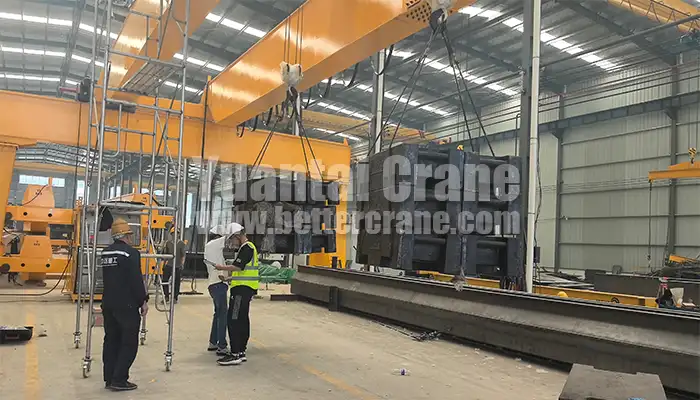
Low headroom overhead crane 6 ton + 6 ton for sugger plant for your reference
Many maintenance workshops in sugar plants have low roof clearance. Once the crane runway, girder, and hoist are installed, the remaining hook height is reduced.
- Less usable lifting height for mill parts and gearboxes
- Difficulty reaching lower maintenance points
- Reduced flexibility during installation and repair work
Sugar plants usually have dense piping and electrical systems above the crane area.
- Steam and process pipelines crossing crane travel paths
- Cable trays and ventilation ducts reducing clearance
- Structural beams blocking trolley movement in some zones
These obstructions limit smooth crane operation.
On the workshop floor, machines are often placed close together to save space.
- Narrow access for maintenance work
- Limited space for load positioning
- Frequent need to reposition loads during lifting
This slows down repair and replacement work.
Standard overhead cranes are designed for open, clear workshops. In older sugar plants, this is rarely the case.
- Reduced hook height after installation
- Trolley interference with overhead structures
- Inefficient use of available vertical space
Even with correct capacity (like 10 ton or 20 ton overhead crane), performance is limited by space, not load rating.
Instead of modifying the building, most plants adjust the crane design.
Low headroom and compact crane systems help:
- Increase usable hook height in existing buildings
- Improve movement in crowded workshops
- Reduce interference with pipes and structures
- Support maintenance work without civil modification
Common solutions include low headroom double girder cranes, compact single girder cranes, and European-style low clearance cranes.
Challenges of Overhead Lifting in Older Sugar Plants
Overhead lifting in older sugar plants is rarely straightforward. Even when using a correctly rated overhead crane, the actual working environment often limits lifting efficiency, safety, and flexibility. Maintenance teams face multiple practical challenges in workshops, processing halls, and repair areas.
Low roof height is one of the most common constraints in older sugar plant workshops. Installing a standard overhead crane reduces available hook height, because the crane girder, trolley, and hoist structure take up part of the vertical space.
- The effective lifting height for mill equipment, gearboxes, and crushers is reduced
- Limited hook travel can affect roller removal and replacement
- Maintenance cranes may not reach full vertical span without obstructing overhead piping
This is why buyers often look for low headroom overhead cranes or compact crane solutions specifically designed for restricted workshop environments.
In retrofitted sugar plants, dense piping systems, cable trays, and ventilation ducts frequently cross crane runways. These obstructions restrict the trolley travel distance and create dead zones where lifting becomes difficult or unsafe.
- Steam lines, juice pipes, and electrical conduits interfere with crane hook movement
- Ventilation ducts limit the crane trolley and girder operation
- In some areas, the crane cannot achieve full span due to overhead obstructions
Using compact or European-style low clearance cranes can help operators bypass these obstructions while maintaining safe lifting.
Sugar plant maintenance often requires lifting long, heavy, and awkwardly shaped components. Standard cranes may have the rated capacity, but operating in tight spaces requires stability, precise positioning, and proper load control.
- Mill rollers, shafts, and drive assemblies need careful alignment
- Gearboxes and mill maintenance equipment have irregular shapes that complicate lifting
- Overhead cranes must provide stable load handling even in constrained areas
Selecting cranes with twin hoist capability, low headroom double girder design, or precision trolley systems can make handling these loads safer and faster.
Tight spaces increase operational hazards. In older sugar plants, every lift is affected by limited clearance and nearby machinery, raising safety concerns for both operators and surrounding equipment.
- Risk of collision with nearby machines and pipelines
- Reduced visibility in congested areas
- Limited space for maneuvering heavy components
Practical solutions involve compact single girder cranes, low headroom double girder cranes, and European-style compact cranes that reduce interference and improve operator control.
Low Headroom Double Girder Cranes
Low headroom double girder cranes are specifically designed for sugar plants and industrial workshops where building height is limited. They maximize usable hook height while maintaining full lifting capacity, making them ideal for medium to heavy-duty maintenance tasks. These cranes are often chosen for older sugar plants, where standard double girder cranes cannot fit without reducing vertical lift.
- Hoist positioned above or between the girders: This design reduces the overall height of the crane structure, allowing the hook to reach closer to the floor without interfering with overhead piping or cable trays.
- Reduced approach distance: Compact end carriage design allows the crane to lift loads closer to walls or obstacles, optimizing use of tight workshop spaces.
- Heavy-duty lifting capability: Supports medium to heavy mill components, rollers, gearboxes, and other maintenance loads without compromising safety or stability.
Low headroom double girder cranes are widely used in older sugar plant environments, including:
- Maintenance workshops: Handling spare parts, replacement rollers, and machinery components where vertical space is limited.
- Mill overhaul zones: Lifting long and heavy shafts, drives, and gears during scheduled maintenance.
- Central repair areas: Supporting heavy assembly and disassembly operations in confined spaces while avoiding interference with overhead piping or structural beams.
These cranes are an excellent choice when a sugar plant buyer needs to maximize lifting height without costly building modifications, while ensuring reliable and safe operation in tight workshop conditions.
Compact Single Girder Cranes for Sugar Plants
Compact single girder overhead cranes are an ideal solution for older sugar plants where space is limited and lifting tasks are light to medium duty. These cranes are designed to fit into low headroom workshops, crowded maintenance areas, or congested production zones, providing efficient and safe lifting without major building modifications.
- Reduced girder height and dead weight: Minimizes overall crane profile, allowing the overhead crane to operate in tight spaces while maximizing usable hook height.
- Top-running or underslung configuration: Provides flexibility depending on ceiling height, structural beams, or existing runway systems.
- Easy integration with existing plant structures: Compact single girder overhead cranes can be installed on existing steelwork or beams, avoiding costly structural changes.
Compact single girder overhead cranes are particularly useful in sugar plant operations where precise lifting and safe handling of medium-weight equipment is needed:
- Spare parts handling: Transporting motors, gearboxes, or auxiliary machinery within workshops.
- Light maintenance zones: Servicing conveyors, small rollers, and other auxiliary sugar processing equipment.
- Assembly areas: Positioning and lifting equipment accurately in confined spaces while avoiding collisions with pipes, ducts, and overhead obstacles.
European-Style Compact Cranes for Sugar Plants
European-style compact overhead cranes are designed for sugar plants and industrial workshops where space is limited, but lifting precision and efficiency are critical. These cranes are widely used in older sugar plant facilities, where low headroom, crowded piping, and dense equipment layouts make standard cranes less effective.
They combine high-efficiency lifting, smooth operation, and minimal structural depth, allowing buyers to optimize both workflow and maintenance operations without major building modifications.
- Modular hoist and trolley design: Components are compact and interchangeable, enabling easy integration into existing overhead crane runway systems.
- Smooth acceleration and precise positioning: Ideal for handling long, heavy, or irregular sugar plant components, such as mill rollers, shafts, and gearboxes, with accuracy in tight spaces.
- Reduced structural depth: The low-profile crane girder and trolley minimize interference with overhead piping, cable trays, and ducts, maximizing usable hook height.
European-style compact cranes are particularly effective in sugar plants and industrial workshops with high-frequency lifting needs and precision handling requirements:
- High-frequency lifting operations: Handling spare parts, small machinery, or consumables multiple times a day without compromising speed or safety.
- Equipment alignment and assembly tasks: Precise positioning of long or heavy components in maintenance zones or assembly areas.
- Modernized retrofits in older plants: Upgrading low headroom workshops with compact European-style overhead cranes to improve efficiency without civil construction work.
By selecting a European-style compact overhead crane, sugar plant buyers can combine precision, safety, and maximum hook travel in crowded or low-clearance environments. These cranes are particularly valuable for retrofitting older plants, allowing maintenance teams to move equipment efficiently while avoiding interference with pipes, ducts, or structural beams.
Optimizing Lifting Height Without Structural Modifications
In many older sugar plants, increasing workshop height or rebuilding steel structures is not practical. Production cannot stop for civil work, and in most cases, the cost is too high. Because of this, the focus shifts to a more realistic approach: improving usable hook height of overhead cranes within the existing building.
The goal is simple—get more lifting height and smoother operation from the same workshop space without changing the structure.
One of the most effective ways to improve lifting performance is selecting a low headroom overhead crane hoist system instead of a standard hoist.
- Low headroom hoists reduce wasted vertical space above the hook
- They increase the actual effective lifting height inside the same building
- Suitable for sugar mill maintenance workshops with limited roof clearance
In practical sugar plant operation, this directly helps when lifting mill rollers, gearboxes, and long drive shafts that require full vertical travel.
The hook approach distance (end beam to hook center) often limits how close the crane can reach equipment.
To improve this:
- Use compact end carriage design on double girder overhead cranes
- Reduce side clearance requirements near walls and machines
- Improve access in narrow maintenance zones
This is especially useful in crowded sugar plant repair areas where equipment is installed close to structural columns.
In some cases, small adjustments to runway beam positioning can improve crane efficiency without major structural changes.
- Slight runway relocation can improve hook coverage area
- Better alignment reduces dead zones in workshop lifting range
- Works well for retrofit overhead crane systems in old factories
This method is often used during crane modernization projects in aging sugar plants.
Modern European-style overhead cranes and compact systems often include more efficient lifting components.
- Variable frequency drive (VFD) control improves smooth lifting and lowering
- Compact trolley design reduces structural height loss
- Better load control for irregular sugar mill equipment
These features improve both safety and precision during heavy equipment handling in confined workshops.
Older sugar plants often have unavoidable overhead obstacles such as pipes, ducts, and cable trays. Instead of rebuilding them, crane design can adapt.
- Customized trolley layouts avoid collision with overhead systems
- Offset hoist positioning improves clearance in tight areas
- Designed for low headroom and congested overhead crane environments
This approach is commonly used in sugar mill maintenance cranes where multiple utilities share the same ceiling space.
Optimizing lifting height in older sugar plants is not about changing the building—it is about improving the overhead crane design and configuration. By using low headroom hoists, compact crane structures, and efficient trolley layouts, buyers can significantly improve lifting performance while keeping existing plant infrastructure unchanged.
Selection Considerations for Buyers
Selecting the right overhead crane for a sugar plant is not only about tonnage or span. In older sugar factories, the real decision is based on how the crane fits into a constrained environment—especially low headroom workshops, crowded maintenance zones, and retrofitted steel structures.
A correct selection helps avoid long-term operational issues, while a wrong one often leads to reduced lifting efficiency and frequent interference during maintenance work.
The first and most critical factor is actual vertical space, not building height on paper.
- Measure real hook-to-ceiling clearance after crane installation design
- Consider girder height, hoist structure, and trolley dimensions
- Evaluate required lifting height for mill rollers, gearboxes, and heavy components
In many older sugar plant workshops, this determines whether a standard overhead crane or a low headroom overhead crane system is required.
Most sugar plants have dense overhead systems that directly affect crane operation.
- Steam and process pipelines crossing crane runway areas
- Cable trays and electrical conduits limiting trolley movement
- Ventilation ducts reducing usable lifting zones
Proper obstruction mapping for overhead crane installation is essential before final selection. Without it, even a correctly rated crane may face restricted operation.
Understanding what is being lifted is just as important as how much weight is involved.
- Heavy components such as mill rollers and drive assemblies require double girder overhead cranes or twin hoist systems
- Light maintenance tasks may only require a compact single girder overhead crane
- High-frequency lifting areas benefit from European-style overhead cranes with smooth control systems
Both load type and usage frequency directly affect crane durability and selection.
In sugar plant environments, maintenance space is often limited. This impacts both safety and operational efficiency.
- Ensure safe access for inspection and repair of crane components
- Avoid designs that block maintenance walkways or service platforms
- Consider anti-collision systems in congested workshop layouts
Safety is especially important in tight overhead crane working environments, where multiple operations may occur simultaneously.
Many sugar plants gradually expand production or upgrade equipment over time. The crane system should support this flexibility.
- Choose modular crane systems where possible
- Allow for future load increase or span adjustments
- Consider compatibility with upgraded control systems or automation
Planning ahead reduces the need for full crane replacement when plant capacity increases.
A proper overhead crane selection for sugar plants depends on real working conditions rather than theoretical specifications. By carefully evaluating clearance, obstructions, load requirements, safety needs, and future expansion, buyers can ensure reliable long-term performance in low headroom and compact industrial environments.
Conclusion
Low headroom and compact crane solutions are essential for older sugar plants with limited vertical space. Choosing the correct crane—whether a low headroom double girder, compact single girder, or European-style design—enables buyers to maximize lifting height, enhance operational efficiency, and maintain safety, all without costly structural modifications.