Heavy Machinery Maintenance Material Handling Requirements
Key Takeaways
- Heavy machinery requires precise load planning to ensure safety, efficiency, and equipment longevity.
- Different equipment types demand varying crane capacities, lifting aids, and precision handling.
- Duty cycles and intermittent lifting directly impact crane selection and maintenance strategy.
- Identify typical load ranges for engines, gearboxes, turbines, presses, and mining equipment.
- Factor precision and weight considerations for safe lifting.
- Match lifting aids (spreader beams, anti-sway devices) to the application.
- Consider duty cycle, intermittent operation, and ergonomic control options.
Introduction
Planning lifts in a maintenance workshop might sound straightforward at first, but anyone who has spent time moving heavy machinery knows it’s more than just hooking up a crane. Every lift carries risks—not only to personnel but also to the equipment itself. That’s why understanding load handling requirements is critical for workshop managers, engineers, and crane operators.
When dealing with engines, gearboxes, turbines, presses, or mining equipment, the first step is to match the maintenance crane load capacity to the actual weight of the machinery. A mismatch can cause anything from minor alignment issues to serious accidents. Even small mistakes in load planning can halt maintenance schedules, damage expensive components, and create safety hazards in the workshop.
This article is a practical guide for anyone responsible for lifting heavy machinery in a workshop setting. We’ll break down the essentials:
- Typical load ranges for different industrial equipment, including engines, gearboxes, turbines, presses, and mining machinery.
- Precision versus weight considerations, and when a standard hoist won’t cut it.
- Duty cycle and intermittent lifting requirements, so you know how often your crane can safely lift heavy loads without extra wear.
- Examples of lifting aids, such as spreader beams, anti-sway devices, and remote control systems that improve safety and control.
By the end of this guide, you’ll have a clear understanding of how to plan lifts that are safe, efficient, and reliable. You’ll also see practical ways to combine precision hoist systems for workshops with standard lifting equipment to handle both heavy and delicate loads.
In short, whether you’re moving a 500 kg gearbox or a 50-ton turbine, this guide provides the information you need to make informed, safe lifting decisions in your workshop.
single girder overhead crane for heavy machinery maintenance
Typical Loads in Heavy Machinery Maintenance
Lifting heavy machinery safely starts with knowing exactly what you’re moving. Workshop cranes aren’t one-size-fits-all, and the load ranges for different types of equipment vary widely. Understanding these ranges is the foundation for proper maintenance crane load capacity planning and ensures both safety and efficiency in your workshop.
Common Industrial Equipment & Approximate Load Ranges
Different machines present different challenges. Some are heavy but compact, others are large and awkward. Here’s a practical breakdown:
| Equipment Type | Typical Weight Range | Notes / Handling Considerations |
|---|---|---|
| Engines (diesel, gas) | 500 kg – 10 tons | Often requires lifting brackets, cradles, or custom engine mounts for stable handling. Alignment matters during installation. |
| Gearboxes / Transmissions | 1 – 8 tons | Sensitive components; using anti-sway devices or dual-hook setups prevents damage and misalignment. |
| Turbines (steam, gas) | 5 – 50 tons | Large footprint; spreader beams or multiple lift points are essential to distribute weight evenly and avoid bending the crane hook. |
| Presses & Punching Machines | 3 – 30 tons | Heavy base units; floor loading must be verified before lifting. Consider short travel lifts for safety. |
| Mining Equipment Components | 2 – 40 tons | Irregular shapes; may require slings, lifting clamps, or adjustable lifting frames for stable control. |
Pro Tip: Visualizing the weight range against equipment type helps quickly determine the right crane class. A simple diagram plotting equipment vs. load can guide operators and engineers at a glance.
Precision vs. Weight Considerations
Not every lift is about raw weight. Sometimes the challenge is positioning a component accurately without sway or misalignment. For example, aligning a gearbox shaft or turbine rotor may require millimeter-level accuracy. In such cases, a standard hoist can move the load, but a precision hoist for workshops gives smoother control and reduces risk of equipment damage.
Key factors to consider:
- Speed control: Precision hoists allow fine-tuned, low-speed operation, which is critical for alignment-heavy lifts.
- Sway mitigation: Anti-sway systems prevent dangerous pendulum effects when moving heavy components over long spans.
- Operator interface: Remote controls or joystick systems improve accuracy and keep the operator safe.
Here’s a practical comparison of standard hoists versus precision hoists for workshop applications:
| Feature | Standard Hoist | Precision Hoist |
|---|---|---|
| Load Accuracy | ±5 cm | ±1 cm |
| Speed Control | Fixed | Variable / fine-tuned |
| Operator Interface | Basic | Remote / joystick |
| Sway Mitigation | Minimal | High |
Practical Note: If your workshop handles both heavy and delicate loads, it’s often worth investing in a crane system that can switch between standard and precision hoisting modes. This approach maximizes flexibility without compromising safety.
Duty Cycle and Lifting Frequency
Understanding how often a crane will lift is just as important as knowing what it will lift. In crane and workshop planning, this concept is called the duty cycle. Simply put, the duty cycle refers to the ratio of active lifting time to total operating time. A crane used for heavy lifts once or twice a day is very different from one running dozens of precise lifts every hour.
Intermittent operation: Lifts happen occasionally, with long breaks between them. The crane experiences less mechanical wear. Standard hoists are usually sufficient for these lifts.
Continuous operation: The crane handles repeated lifts over long periods. This requires equipment rated for high duty cycles, robust hoist motors, and careful attention to maintenance schedules.
Knowing the duty cycle helps determine maintenance crane load capacity and choose the right hoist type. Overlooking this can shorten crane life and increase downtime in the workshop.
Low-frequency heavy lifts:
- Often involve large equipment like turbines or presses.
- A robust crane with a standard hoist is usually enough.
- Focus should be on weight distribution, spreader beams, and proper rigging.
Frequent precision lifts:
- Common for engines, gearboxes, or components requiring alignment.
- A precision hoist with anti-sway devices and remote control is highly recommended.
- Smooth, controlled motion prevents damage to sensitive components and reduces the risk of misalignment.
Mixed-use workshops:
- If your workshop handles both heavy intermittent lifts and frequent precision lifts, consider a crane system capable of switching between standard and precision hoist modes.
- This allows flexibility while maintaining safety and efficiency.
- Map out the expected number of lifts per shift.
- Cross-check with crane and hoist specifications for maximum allowed duty cycles.
- Schedule preventative maintenance based on load frequency to avoid unexpected downtime.
Diagram Suggestion: Plot a simple chart showing duty cycle vs. crane wear & maintenance interval. On the X-axis, show percentage of active lifting time; on the Y-axis, show recommended service intervals. Include color-coded zones: green for safe, yellow for moderate, red for high-risk. This visual helps engineers and crane operators quickly understand the limits of their equipment.
Lifting Aids and Load Control Devices
Even the strongest crane can struggle if the load isn't properly controlled. In real workshops, lifting aids and load control devices are essential for both safety and precision. Using the right combination of accessories ensures that heavy machinery moves smoothly, without damage, and that operators remain safe.
Spreader beams are one of the simplest but most effective tools for distributing a heavy load across multiple lifting points. They are especially useful when handling long or irregular machinery, such as turbine rotors, press beds, or extended gear shafts.
- Distribute weight evenly to reduce stress on the crane hook and hoist.
- Prevent bending or twisting of large equipment during lifts.
- Allow dual or multiple-point lifts for heavy, elongated loads.
Practical Note: When lifting a turbine rotor, attaching lifting slings directly to the ends without a spreader beam can create dangerous bending moments. A beam ensures stability and keeps the load level throughout the move.
Swinging loads are not just inconvenient—they're dangerous. Anti-sway devices reduce pendulum motion, which is especially critical when performing precise alignments in a maintenance bay.
- Minimize side-to-side and forward-backward motion of suspended loads.
- Essential when positioning components like engines or gearboxes with tight alignment tolerances.
- Can be integrated with hoists or added as separate attachments.
Tip: For workshops handling frequent precision lifts, pairing an anti-sway system with a precision hoist for workshops greatly reduces the risk of damage and improves operator confidence.
Remote-controlled hoist systems keep operators safe while improving accuracy. Instead of walking under a suspended load, the operator can control the lift from a safe distance.
- Allow smooth and precise positioning of heavy machinery.
- Reduce human error by combining speed control, anti-sway features, and load monitoring.
- Particularly valuable in tight or congested maintenance bays.
Pro Tip: Use remote control systems with variable-speed hoists for lifts that require both heavy load capacity and fine positioning. This combination is ideal for engines, gearboxes, and turbine components.
Beyond the main devices, a range of accessories can make lifting safer and more efficient:
- Lifting slings: Synthetic or wire rope slings designed for specific loads.
- Shackles and hooks: Rated for crane capacity; always inspect before each use.
- Load balancing bars: Distribute asymmetrical loads evenly across multiple lift points.
Practical Diagram Suggestion: Show a visual layout of a crane with a load, incorporating a spreader beam, anti-sway device, slings, and remote control operation. Label each component for clarity. This gives engineers and operators a clear understanding of how all lifting aids work together in heavy machinery maintenance lifting.
Practical Load Handling Examples
The theory behind load handling is one thing—but seeing real-world examples makes it practical. Below are three common scenarios in heavy machinery maintenance, showing how crane type, hoist, and lifting aids combine for safe and efficient lifts.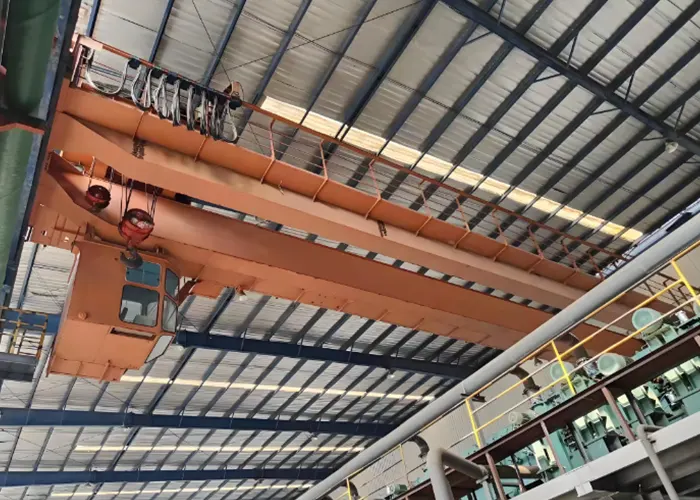
double girder overhead crane for heavier material handling in large span workshops
A medium-sized diesel engine often weighs around 5 tons. While not the heaviest lift in a workshop, improper handling can still cause misalignment or damage to engine mounts.
Setup:
- Crane type: Single-girder overhead crane, rated for 10 tons to include safety margin.
- Lifting aids: Spreader beam to distribute weight across multiple engine brackets.
- Safety checks: Inspect engine lifting points, confirm hook rating, ensure crane runway clearance, and verify load stability.
Practical Tip: Even with a 5-ton engine, always factor in 20–30% safety margin for dynamic effects during lifting. Use tag lines to control minor swings when positioning the engine into mounts.
Turbine rotors are long, heavy, and sensitive to bending. A 20-ton rotor lift requires precise handling and advanced control devices.
Setup:
- Crane type: Double-girder overhead crane with 25-ton capacity.
- Hoist: Precision hoist for workshops, low-speed variable control.
- Lifting aids: Spreader beam spanning rotor length; anti-sway device attached to hoist.
- Operator positioning: Remote control station at safe distance to monitor alignment and rotation during lift.
Practical Note: Always plan the lift path in advance. Any obstruction can create a swing or twist, which could damage bearings or the rotor casing. Anti-sway systems combined with a spreader beam are essential for this type of precision lift.
Installing a large gearbox in a compact maintenance bay requires both careful planning and consideration of duty cycle, especially if multiple lifts are needed during alignment.
Setup:
- Crane type: Single-girder crane, rated slightly above maximum gearbox weight.
- Hoist: Precision hoist with joystick control for slow, controlled movement.
- Lifting aids: Adjustable lifting slings and load balancing bar to keep the gearbox level.
- Workflow consideration: Limit repeated lifts; schedule enough downtime between lifts to prevent crane motor overheating.
Practical Tip: In tight workshops, even small miscalculations in lift path or hook clearance can slow down installation. Plan the sequence of lifts and use temporary supports if necessary.
Summary Table: Practical Lift Examples
| Example | Load | Crane Type | Lifting Aids | Key Considerations |
|---|---|---|---|---|
| 5-ton Diesel Engine | 5 tons | Single-girder overhead | Spreader beam, tag lines | Safety margin, load stability, alignment |
| 20-ton Turbine Rotor | 20 tons | Double-girder overhead Crane | Spreader beam, anti-sway device, remote control | Minimize bending, precise alignment, operator safety |
| Gearbox Alignment in Tight Bay | 3–5 tons | Single-girder overhead | Adjustable slings, load balancing bar | Precision positioning, duty cycle, clear lift path |
Planning for Maintenance Bay Lifting
Before any lifting work starts in a maintenance workshop, planning is not optional. It directly affects safety, equipment life, and how smoothly the job will run. In heavy machinery maintenance lifting, most issues come not from the crane itself, but from missing details in planning—clearance, load shape, or lifting method.
This checklist is designed for workshop engineers, crane operators, and procurement teams to quickly confirm whether a lift is properly prepared. It also aligns with maintenance crane load capacity planning and practical workshop execution.
- Verify workshop dimensions, including bay width, span, and travel length
- Confirm overhead clearance, especially hook height and highest lifting point
- Check for obstructions such as beams, pipes, cable trays, or maintenance platforms
- Ensure crane runway alignment is clear and structurally stable
Practical note: In low-headroom workshops, even a few centimeters of missing clearance can stop the entire operation. Always measure twice, not visually estimate.
- Confirm actual equipment weight (not estimated or catalog-only data)
- Check overall dimensions: length, width, height
- Identify center of gravity (COG), especially for irregular machinery
- Determine lifting points and whether they are factory-rated or custom-added
For precision hoist for workshops, COG accuracy becomes even more important because fine positioning depends on balanced lifting.
- Identify if the lift is installation, removal, or alignment work
- Define acceptable tolerance for positioning (coarse vs precision)
- Decide if anti-sway control or variable speed hoisting is required
- Check if the operation involves mating surfaces (gearbox, turbine, shaft alignment)
- Select standard hoist or precision hoist for workshops based on task
- Decide on spreader beams for long or flexible loads
- Use slings, shackles, or lifting frames based on load geometry
- Add anti-sway devices if precision positioning is required
- Consider remote control systems for improved operator safety
- Low-frequency heavy lifts → standard robust crane system is usually sufficient
- Frequent lifting operations → higher duty class crane recommended
- Continuous workshop activity → requires maintenance scheduling and thermal checks
- Evaluate motor heating limits and brake wear cycles
In real industrial workshop crane systems, duty cycle often determines long-term reliability more than load capacity alone.
- Ensure clear operator visibility of lifting area
- Use remote control systems where possible
- Define exclusion zones under suspended loads
- Confirm emergency stop and overload protection systems are active
- Train operators on load behavior (especially swing and inertia effects)
- Ensure crane rated capacity exceeds maximum load requirement
- Apply 20–30% safety margin for dynamic lifting effects
- Check hoist and hook ratings separately from crane structure
- Verify runway beam and support structure load limits
- Confirm certification and inspection validity
Practical rule: A crane working at its limit continuously is not a safe design—it reduces lifespan and increases maintenance frequency.
A proper lift in heavy machinery maintenance lifting operations is not just about lifting power. It is a combination of space, load behavior, precision requirements, duty cycle, and equipment selection. When all checklist points are confirmed, the result is predictable operation, reduced downtime, and safer workshop performance.
Checklist for Maintenance Bay Lifting (Buyer Fillable Form)
This checklist is designed for quick use during quotation, planning, or site preparation. Fill in the blanks and tick items where applicable. It helps ensure heavy machinery maintenance lifting is correctly planned and matches maintenance crane load capacity requirements before installation or operation.
Workshop Space and Clearance Verification
- Workshop bay width: ___________ m
- Crane span (rail to rail): ___________ m
- Travel length: ___________ m
- Overhead clearance (hook to highest point): ___________ m
- Obstructions present (beams / pipes / cable trays / platforms): ☐ Yes ☐ No
. If yes, specify: ___________________________ - Crane runway condition checked: ☐ Yes ☐ No
Note: Low-headroom workshops must confirm clearance with real measurements, not visual estimation.
Equipment Weight and Dimensions
- Equipment type: ___________________________
- Actual weight (confirmed): ___________ tons / kg
- Length: ___________ m
- Width: ___________ m
- Height: ___________ m
- Center of gravity identified: ☐ Yes ☐ No / Unknown
- Lifting points available: ☐ Factory-rated ☐ Custom ☐ Not confirmed
Note: For irregular loads, correct COG is critical for stable lifting and safe positioning.
Precision and Alignment Requirements
- Operation type: ☐ Installation ☐ Removal ☐ Alignment ☐ Maintenance repositioning
- Positioning accuracy required: ☐ Coarse ☐ Medium ☐ Precision (fine alignment)
- Anti-sway required: ☐ Yes ☐ No
- Variable speed control required: ☐ Yes ☐ No
- Sensitive mating surfaces involved (shaft, gearbox, turbine): ☐ Yes ☐ No
Hoist Type and Lifting Accessories
- Hoist type selected: ☐ Standard hoist ☐ Precision hoist for workshops
- Spreader beam required: ☐ Yes ☐ No
- Lifting slings type: ☐ Wire rope ☐ Synthetic ☐ Chain ☐ Not confirmed
- Shackles / hooks checked and rated: ☐ Yes ☐ No
- Load balancing bar required: ☐ Yes ☐ No
- Remote control system required: ☐ Yes ☐ No
Duty Cycle and Lift Frequency
- Expected lifting frequency: ☐ Occasional ☐ Daily ☐ Frequent (multi-shift)
- Duty level requirement: ☐ Low ☐ Medium ☐ High duty cycle crane
- Continuous operation expected: ☐ Yes ☐ No
- Planned maintenance interval awareness: ☐ Yes ☐ No
Note: In real industrial workshop crane systems, duty cycle affects lifespan as much as load capacity.
Operator Safety and Control
- Operator visibility is clear: ☐ Yes ☐ No
- Remote control used: ☐ Yes ☐ No
- Safety exclusion zone defined: ☐ Yes ☐ No
- Emergency stop system verified: ☐ Yes ☐ No
- Overload protection active: ☐ Yes ☐ No
- Operator training completed: ☐ Yes ☐ No
Crane Capacity and Safety Margin
- Maximum lifting load required: ___________ tons
- Recommended crane capacity (with margin): ___________ tons
- Safety margin applied (recommended 20–30%): ☐ Yes ☐ No
- Hoist rated capacity verified: ☐ Yes ☐ No
- Runway beam load capacity checked: ☐ Yes ☐ No
- Structural support confirmed: ☐ Yes ☐ No
- Inspection / certification valid: ☐ Yes ☐ No
A properly completed checklist ensures the crane system is correctly matched to real workshop conditions. In maintenance crane load capacity planning, most operational issues come from missing or incorrect site data—not from the crane itself.
This form helps align equipment selection with actual heavy machinery maintenance lifting requirements, reducing installation risks, downtime, and operational uncertainty.
Conclusion: Structured Load Handling in Maintenance Workshops
Load handling in a maintenance workshop is never just a lifting task. It is a coordination of planning, equipment selection, and controlled execution. When done properly, heavy machinery maintenance lifting becomes predictable, safe, and efficient—even for large engines, turbines, presses, or mining components.
- Ensures safe lifting by matching load weight, geometry, and center of gravity with crane capability
- Improves precision during installation and alignment for sensitive components like gearboxes or turbine rotors
- Reduces unnecessary stress on structural and mechanical crane components over time
In practical workshop environments, most lifting incidents are not caused by equipment failure but by incomplete planning. Maintenance crane load capacity planning must be treated as part of the maintenance process itself, not an afterthought.
- Crane capacity must cover maximum load plus a safe operational margin
- Hoist type selection (standard or precision) must match the required level of control and alignment accuracy
- Lifting aids such as spreader beams, slings, and anti-sway systems must match load shape and sensitivity
- Duty cycle selection must reflect how often the crane operates under load, not just occasional peak lifts
When these elements are balanced correctly, the workshop operates with fewer interruptions and more stable performance over time.
- Reduces unplanned downtime during equipment installation or removal
- Minimizes risk of load damage, misalignment, or structural stress
- Improves coordination between operators, engineers, and maintenance teams
- Supports long-term reliability of crane systems and workshop infrastructure
In practical terms, a well-planned lift often looks simple during execution. That simplicity comes from preparation, not chance.
Effective load handling depends on one principle: every lift should be planned as a controlled system, not an isolated action. When crane capacity, hoist selection, lifting aids, and duty cycle are properly matched, heavy machinery maintenance lifting becomes safer, more precise, and consistent across all operations.
This is what transforms a workshop from reactive repair work into a structured, efficient maintenance environment.