Workshop Crane Layout Planning for Maintenance Bay Design
Workshop Crane Layout Planning for Maintenance Bay Crane Design (Including Semi Gantry Crane Retrofit)
Most Important Takeaway
A workshop crane layout is not just a structural arrangement—it is a production efficiency system. The success of a maintenance bay crane design depends on how well the crane integrates with ceiling height, travel coverage, floor capacity, and workflow direction. A poorly planned layout reduces lifting height, creates dead zones, and increases retrofit cost, while a properly engineered layout ensures safe, continuous, and efficient maintenance operations.
- Workshop crane performance is determined by layout design, not only crane capacity
- Ceiling height and hook clearance directly define usable lifting height
- Bay coverage and travel length control productivity and workflow efficiency
- Floor load capacity and runway structure determine crane safety and lifespan
- Semi gantry crane retrofit is ideal for constrained or partially supported workshops
- Proper integration with pits, platforms, and service zones prevents operational conflicts
- Early-stage layout planning reduces costly structural modifications later
Questions This Guide Solves
This guide helps workshop owners, maintenance managers, engineers, and crane buyers understand the key factors involved in designing, selecting, and installing efficient maintenance bay crane systems. It covers crane layout planning, lifting height calculations, retrofit solutions, structural requirements, workflow integration, and common design mistakes that can affect safety and productivity.
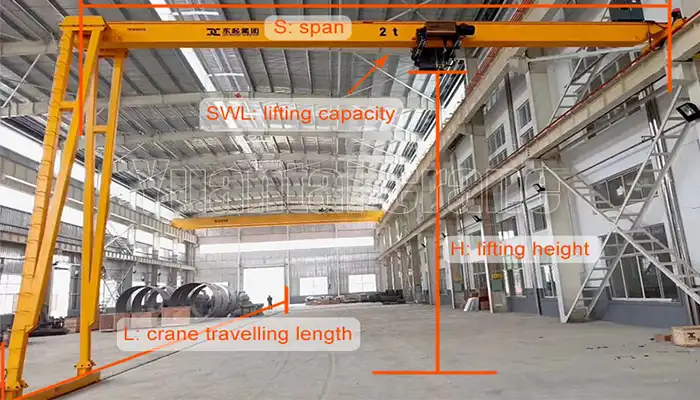
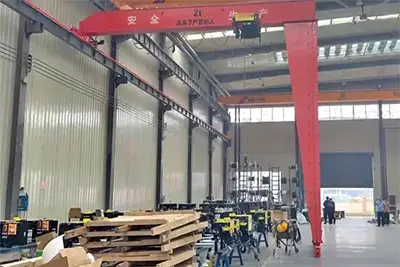
workhsop semi gantry crane for maintainence works , more workshop overhead cranes for maintenance works
Introduction: Why Workshop Crane Layout Planning Matters
In a maintenance workshop, cranes are used every day, not occasionally. They support repair work by lifting motors, gearboxes, machine parts, and steel components in and out of service areas. In many cases, they also work above maintenance pits and assembly stations. A workshop crane layout planning approach must reflect how the workshop actually runs, not just how much weight the crane can lift.
Common tasks in maintenance bays:
- Removing and installing motors and gearboxes
- Handling machine assemblies and steel structures
- Moving parts between storage and repair zones
- Supporting work above maintenance pits
In short, the crane is part of the workflow, not just a piece of equipment.
Many projects start by asking, "How many tons do we need?" But in practice, that is not the first question. The layout comes first.
A maintenance bay crane design depends on ceiling height, column spacing, travel distance, and obstruction points. These factors decide how usable the crane will be after installation.
For example, a smaller crane in a well-planned layout often works better than a larger crane in a poorly designed workshop.
Layout-focused design looks at:
- Industrial lifting height (hook clearance, not building height)
- Crane travel path and coverage area
- Column and wall interference
- Workflow direction inside the workshop
In retrofit cases, semi gantry crane retrofit systems are often used when the original layout cannot support a full overhead crane system.
If workshop crane layout planning is not done properly, problems show up during daily operation.
The most common issue is reduced lifting height due to missed clearance checks. Another is limited travel range caused by columns or structural barriers. These problems slow down maintenance work.
Typical issues caused by poor layout:
- Reduced usable lifting height
- Limited crane travel coverage
- Unsafe lifting angles
- Workflow congestion in repair areas
Fixing these later is expensive. It may require runway reinforcement, floor strengthening, or even replacing the crane system. In many cases, retrofit cost exceeds the original installation cost.
A maintenance workshop works as a flow: storage → repair → testing → return. The crane should support this flow directly.
Good maintenance bay crane design ensures materials move smoothly between zones without extra handling or repositioning.
Key integration points:
- Alignment with maintenance pits and workstations
- Direct access between storage and repair areas
- Clear crane travel paths without obstruction
- Coordination with tools, platforms, and service lines
A well-planned workshop crane layout is usually simple. Clear movement paths, defined zones, and no unnecessary interference. That is what keeps maintenance work stable and efficient over time.
Workshop Structural Analysis for Crane Integration
Ceiling Height and Hook Clearance Planning
In maintenance workshops, the effective lifting height is what industrially matters—not just the total building height. You need to consider how the hoist, hook block, and beam depth reduce the usable height. In low-headroom spaces, this can be a serious limitation, sometimes cutting several feet off your lift range.
To plan correctly:
- Measure from the floor to the lowest point of the beam or any overhead obstruction.
- Include the height of the hoist and the hook block when fully raised.
- Check for additional equipment, lights, or ducting that may interfere.
If your available height is tight, there are practical solutions:
- Low-headroom electric hoists: Designed to maximize lift in restricted spaces.
- Double girder cranes: The hoist rides above the main beams, saving vertical space.
- Semi gantry crane retrofit systems: Useful when one side of the workshop cannot support a full runway; they allow partial support without lowering lifting capacity.
Proper planning here ensures the crane can safely reach all necessary heights without risking collisions or overloading.
Column Grid and Obstruction Mapping
Columns and structural elements define the crane’s movement path. Even a perfectly sized crane can be limited if it cannot travel freely along the bay. Mapping obstructions is critical to ensure smooth operation and full coverage.
Key points to check:
- Column spacing and alignment: Determine maximum crane span and trolley path.
- Restricted areas: Include doors, HVAC, piping, and lighting that could interfere with crane travel.
- Runway alignment: The crane runway must avoid collisions while still covering all zones needed for maintenance work.
By carefully mapping columns and obstructions, you can:
- Identify areas where crane travel might be blocked.
- Adjust beam placement or choose a semi gantry solution to bypass limits.
- Ensure the crane can serve all required zones without constant repositioning.
In short, a detailed structural survey of ceiling height, hoist clearance, and obstructions sets the foundation for a practical, functional crane layout.
Maintenance Bay Crane Design and Coverage Optimization
In maintenance bay crane design, "coverage" means how much usable workshop area the crane can actually serve. This is not always the same as the building size. A crane may physically span a bay, but still leave areas difficult to reach if the layout is not planned properly.
There are two common approaches:
Full bay coverage: The crane travels across the entire workshop bay. This is suitable for continuous maintenance lines where equipment moves through different stages in one space.
Partial bay coverage: The crane only serves a specific section. This is often used in retrofit projects or when structural limits prevent full-span installation.
Workshops can also be designed as:
Single bay systems: One crane serves one defined maintenance area. Simple and easier to manage.
Multi-bay systems: Several bays share crane coverage or operate in sequence, improving throughput in larger facilities.
Choosing the right coverage model depends on workflow intensity, available space, and future expansion plans.
Crane travel length directly affects how fast and smoothly maintenance work is completed. A poorly planned travel path creates delays, extra handling, and unnecessary repositioning of heavy parts.
Key design considerations include:
Long travel vs cross travel planning: Long travel covers movement along the main workshop runway. Cross travel defines movement across the bridge beam. Both must work together to reach all working points without blind spots.
Eliminating dead zones: Dead zones are areas where the crane cannot reach or operate efficiently. These often appear near columns, walls, or poorly aligned workstations. Good workshop crane layout planning reduces or removes these zones completely.
Alignment with maintenance workflow: The crane travel direction should match the actual repair sequence—unloading, disassembly, repair, assembly, and loading. When aligned correctly, material movement becomes direct and predictable.
In practice, better travel efficiency means fewer stops, less repositioning, and smoother maintenance cycles.
A well-planned maintenance bay is divided into functional zones. The crane should support movement between these zones without interference or overlap.
Common workflow zones include:
Heavy repair zone
This area handles large components like gearboxes, motors, and steel assemblies. It usually requires full crane access and higher load stability.
Disassembly and assembly zone
This is where equipment is taken apart or rebuilt. It needs frequent lifting and precise positioning, so crane accessibility must be direct and unobstructed.
Parts staging and storage zone
Used for incoming materials and repaired components. The crane should allow quick loading and unloading without blocking other operations.
When these zones are clearly defined, the crane no longer works randomly across the workshop. Instead, it follows a structured flow that reduces confusion and improves overall efficiency.
Structural Load and Floor Reinforcement Considerations
In workshop crane layout planning, the floor system is not just a base—it is part of the lifting structure. Every movement of an overhead crane, maintenance bay crane, or semi gantry crane retrofit system transfers load directly into the floor through wheel pressure and dynamic forces.
Key evaluation points in industrial projects include:
Wheel load distribution in overhead crane systems: Each wheel of a single girder or double girder overhead crane transfers concentrated load. If spacing or slab strength is not properly verified, localized cracking can appear over time.
Static and dynamic load effects in maintenance workshop crane design: Static load is the lifted weight. Dynamic load comes from acceleration, braking, and trolley movement along the runway beam. In medium-duty 5–15 ton overhead crane systems, dynamic impact often becomes the controlling factor, not the rated capacity itself.
Ground bearing pressure in maintenance bay crane installation: Especially important in industrial maintenance workshops, steel fabrication bays, and repair depots, where concrete slab thickness varies. Poor bearing capacity can limit crane selection even if tonnage is sufficient.
Typical application examples:
- 1–5 ton workshop cranes for light maintenance workshops: usually suitable for standard reinforced concrete floors
- 5–15 ton overhead bridge cranes for machinery repair bays: may require slab verification and localized strengthening
- 20–50 ton heavy-duty overhead crane systems for industrial maintenance facilities: require engineered foundations or pile-supported floors
The crane runway beam system is the main load path in any overhead crane installation. In maintenance bay crane design, its strength and alignment directly affect operational safety and travel smoothness.
Key engineering considerations:
When reinforcement is required in workshop crane retrofit projects: Reinforcement is typically needed when:
- Upgrading from light-duty to heavy-duty double girder overhead cranes (10–32 ton range)
- Installing cranes in older industrial workshops with unknown structural history
- Adding semi gantry crane systems where one side still depends on runway support
Steel runway systems vs concrete support structures: Steel runway beams are common in modern fabrication workshops and steel structure maintenance bays, offering easier adjustment and higher span flexibility. Concrete corbels or columns are often used in new builds but may require post-installed steel brackets during retrofit.
Retrofit considerations for existing maintenance workshops: In many industrial crane retrofit projects, full structural replacement is not practical. Instead, engineers use:
- Partial reinforcement of runway girders
- Addition of steel support frames
- Conversion to semi gantry crane layout for low headroom or single-side support conditions
This approach is widely used in machine repair workshops, steel mill maintenance bays, and heavy equipment service facilities where downtime must be minimized.
Crane selection in maintenance workshop crane systems must always match industrial operational load scenarios, not theoretical maximum capacity.
Light-duty maintenance bays (1–5 ton overhead cranes): Used in equipment repair shops, automotive maintenance workshops, and light fabrication areas. Typical handling: motors, small gearboxes, tooling assemblies. Floor reinforcement is usually minimal if slab condition is good.
Medium-duty workshops (5–15 ton overhead bridge cranes): Common in machinery maintenance workshops, steel fabrication repair bays, and general industrial service centers. Typical handling: machine frames, medium motors, steel sections, production components. May require runway beam strengthening or partial structural upgrade.
Heavy maintenance facilities (15–50 ton crane systems): Found in steel mill maintenance workshops, power plant service bays, shipyard repair areas, and heavy equipment overhaul centers. Typical handling: large assemblies, turbines, press components, heavy structural steel. Usually requires engineered foundations, reinforced runway systems, or integrated double girder overhead crane + semi gantry crane hybrid layouts.
Semi Gantry Crane Retrofit in Workshop Layout Planning
In many maintenance workshops, ceiling height and structural support limit the use of a standard overhead crane. That's when a semi gantry crane retrofit system becomes the practical solution. Unlike a full overhead crane, semi gantry systems support one side on the floor, reducing structural demands while still covering the necessary workspace.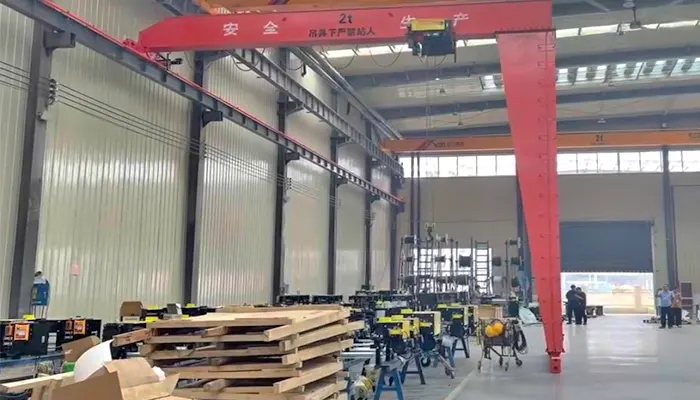
Wheel travelling Semi gantry crane with ground rail free design
Situations where semi gantry cranes are preferred:
- Low ceiling workshops: In light industrial repair bays or vehicle maintenance workshops, the headroom may be too low for a standard overhead crane. Semi gantry cranes allow lifting without compromising hook clearance.
- Partial structural support availability: Existing workshops often have one side with columns or walls suitable for crane support, while the opposite side cannot carry runway beams. Semi gantry cranes use floor-mounted supports, making them ideal in such conditions.
- Retrofit of existing maintenance bays: Older industrial facilities or steel fabrication shops may not have been designed for heavy lifting. Installing a full overhead crane may require costly structural modification. Semi gantry crane retrofits allow upgrades with minimal disruption and investment.
Semi gantry cranes offer several practical benefits for maintenance bay crane design and industrial workshop layout planning:
- Reduced structural modification requirements: Since one side is supported on the floor, there is no need for extensive ceiling or column reinforcement. This is a major cost saver in retrofit projects.
- Flexible installation in constrained environments: Semi gantry cranes can fit into tight workshops, low-headroom spaces, and partially obstructed bays. They are often easier to install and relocate compared to full overhead systems.
- Partial coverage optimization for workflow efficiency: While a full overhead crane covers the entire bay, a semi gantry crane can be strategically positioned to serve specific work zones, such as heavy repair areas, disassembly stations, or parts staging zones, improving operational flow without unnecessary travel.
Semi gantry cranes can be adapted to different load requirements and workshop layouts:
- Single girder semi gantry crane (1–10 ton range): Common in light maintenance workshops, automotive service bays, and small fabrication shops. Suitable for lifting motors, small assemblies, and machine components.
- Double girder semi gantry crane (10–32 ton range): Used in medium-to-heavy industrial maintenance workshops, steel fabrication repair bays, and equipment overhaul facilities. Capable of handling large machinery, structural steel sections, and heavy production components.
- Hybrid layouts combining overhead + semi gantry systems: In large industrial workshops or retrofit projects with mixed structural conditions, a combined system can maximize coverage and lifting efficiency. Overhead cranes handle main workflow zones, while semi gantry cranes cover low-headroom or partial support areas.
Integration with Maintenance Infrastructure
In industrial maintenance workshop crane layout planning, cranes must operate safely alongside pits, platforms, and service systems. Proper integration ensures that lifting operations do not block access, create collision risks, or interfere with workflow.
In industrial maintenance workshop crane layout planning, maintenance pits are common, especially in vehicle service bays, heavy equipment repair shops, and machinery overhaul facilities. The crane system must work above these pits without creating safety risks or limiting access.
The main issue is not just clearance, but how the load moves across the pit area during lifting and positioning. A poorly planned layout can block access or create unsafe lifting paths.
- Safe clearance design above maintenance pits: The overhead crane hook height must be checked at full lift position, ensuring the load can pass over pits without touching edges, tools, or workers below. This is especially important in 5–15 ton workshop overhead crane systems used in industrial repair bays.
- Avoiding load path interference during lifting operations: Crane travel routes should never force loads to swing across pit openings unnecessarily. In maintenance bay crane design, the safest approach is straight-line lifting between zones, reducing lateral movement over open pits.
Practical application:
- Automotive repair workshops often align pits parallel to crane travel direction
- Heavy equipment maintenance bays position pits outside main crane swing zones
- Retrofit workshops may require partial pit relocation when installing a semi gantry crane system
Many modern industrial maintenance workshops use elevated platforms to support inspection, assembly, or precision repair work. These structures introduce vertical constraints that must be considered during crane layout planning.
- Vertical clearance management: The crane hook, trolley, and load must pass safely under or above platforms depending on design. In low-headroom maintenance bay crane systems, this becomes a critical constraint that affects crane type selection, such as low-headroom hoists or double girder configurations.
- Multi-level maintenance coordination: Some workshops operate on multiple working levels—ground repair zones, elevated inspection decks, and mezzanine storage areas. A well-designed overhead crane layout must allow safe interaction between these levels without blocking access or creating collision risks.
Typical use cases:
- Machine repair shops with elevated engine testing platforms
- Steel fabrication workshops with mezzanine assembly stations
- Industrial maintenance facilities using tiered inspection zones
When properly planned, platforms and crane systems work together instead of competing for space.
A maintenance workshop is not only a lifting environment—it also includes power supply systems, fabrication tools, and material handling infrastructure. The workshop crane layout design must account for all of these elements.
- Welding stations and fabrication areas: These are common in steel structure maintenance workshops and machinery repair bays. Crane travel paths must avoid interference with welding zones, while still allowing material transfer to and from fabrication tables.
- Electrical, hydraulic, and pneumatic service lines: Overhead pipelines, cable trays, and air lines often run along workshop ceilings. In overhead crane and semi gantry crane retrofit projects, these systems must be mapped carefully to avoid conflict with crane beams and trolley movement.
- Tool storage and material staging zones: Efficient maintenance bay crane design requires direct access between storage areas and working zones. Cranes should support quick transfer of parts without crossing active repair spaces unnecessarily.
Common layout practice in industrial workshops:
- Storage zones placed near crane end positions
- Fabrication zones aligned with main crane runway
- Service lines routed outside crane interference corridors
When all these systems are integrated properly, the crane stops being an isolated machine and becomes part of a coordinated maintenance workshop workflow system, improving both safety and operational consistency.
Step-by-Step Workshop Crane Layout Planning Method
A proper workshop crane layout planning process ensures that an overhead crane system, maintenance bay crane design, or semi gantry crane retrofit solution fits the industrial working environment. The goal is not only installation, but smooth daily operation in maintenance workshops, steel fabrication bays, and industrial repair facilities.
Start with a full workshop structural assessment for overhead crane installation. This step defines whether the building can support a crane runway system or if a retrofit solution like a semi gantry crane is needed.
Key measurements include ceiling height, span, and obstruction mapping. These directly affect effective lifting height in overhead bridge crane systems.
- Measure building height and confirm usable hook clearance for single girder or double girder overhead cranes
- Check column spacing for crane runway beam installation in maintenance workshops
- Identify obstructions such as HVAC ducts, cable trays, and service platforms
- Evaluate floor condition for possible semi gantry crane floor-mounted support system
This step is especially important in retrofit crane installation projects in existing industrial maintenance bays.
Next, define the material handling workflow in maintenance workshop crane systems. The crane must follow industrial production movement, not random lifting points.
This is critical in maintenance bay crane design for machinery repair workshops, steel structure maintenance facilities, and equipment overhaul plants.
- Identify load movement from storage → repair → assembly → testing
- Map heavy lifting points for industrial overhead crane operations (5–50 ton range)
- Define repetitive lifting zones for motors, gearboxes, steel components, and machine assemblies
- Align crane travel direction with maintenance workflow optimization strategy
A well-mapped workflow reduces unnecessary trolley movement and improves workshop crane handling efficiency.
Choose the correct system based on structural and operational conditions. This is a key decision in overhead crane vs semi gantry crane vs jib crane selection for industrial workshops.
- Overhead bridge crane (single girder / double girder systems)
Best for full-span coverage in steel fabrication workshops, machinery repair bays, and heavy maintenance facilities - Semi gantry crane retrofit system
Ideal for low headroom workshops, partial runway support conditions, and retrofit industrial maintenance bays - Jib crane systems
Used for localized lifting in workstations, small assembly areas, and tool handling zones
Selection depends on tonnage (1–50 ton range), lifting height, bay coverage, and industrial workshop structural constraints.
This step defines crane working area optimization in maintenance bay layouts. It ensures the crane can reach all operational zones without dead space.
- Define long travel for overhead crane runway movement along workshop bays
- Define cross travel for trolley movement across bridge beams
- Map full coverage for heavy equipment maintenance zones and assembly stations
- Eliminate dead zones near columns, walls, or restricted service areas
This is especially important in multi-bay maintenance workshop crane systems and shared runway overhead crane layouts.
Verify structural capacity for safe operation of industrial overhead crane systems and semi gantry crane installations. This includes both floor and runway structures.
- Check wheel load distribution in double girder overhead crane systems (10–32 ton applications)
- Evaluate dynamic load impact during lifting, braking, and trolley movement
- Confirm floor bearing capacity for floor-mounted semi gantry crane support legs
- Review runway beam strength for maintenance workshop crane retrofit projects
Typical application ranges:
- 1–5 ton light-duty workshop cranes for repair shops and small fabrication areas
- 5–15 ton overhead cranes for machinery maintenance and industrial service bays
- 15–50 ton heavy-duty crane systems for steel mills, power plants, and heavy equipment overhaul workshops
Finally, simulate industrial operation of the maintenance workshop crane system before installation. This step checks whether the layout works under industrial lifting conditions.
- Simulate load transfer in overhead crane material handling workflows
- Test lifting paths across maintenance pits, platforms, and staging zones
- Check interference between crane runway systems and workshop service lines
- Adjust layout for semi gantry crane retrofit operation in constrained environments
This step ensures that the final workshop crane layout design supports industrial workflow conditions in machine repair workshops, steel fabrication plants, and maintenance service facilities.
Practical Engineering Case Studies
Here we look at industrial-world examples of maintenance workshop crane layout planning and semi gantry crane retrofit solutions. These case studies show how industrial facilities overcome common challenges with cranes while improving workflow, safety, and efficiency.
Challenge: The workshop had insufficient headroom for a standard overhead crane. Standard hook clearance was not achievable due to low ceiling height and overhead ductwork.
Solution:
- Installed a low-headroom electric hoist to maximize lifting capacity in restricted vertical space.
- Integrated a single girder semi gantry crane system, supporting one side on the floor to bypass ceiling structural limits.
- Adjusted travel path to avoid obstructions over pits and elevated work platforms.
Result:
- Usable lifting height increased by several feet, allowing full access to repair zones.
- Load paths no longer conflicted with overhead structures.
- Workshop crane operations became safer and more efficient for small-to-medium loads (1–10 ton range).
Challenge: Uneven crane coverage across multiple workshop bays caused workflow interruptions. Parts and machinery needed repeated repositioning between bays, slowing maintenance operations.
Solution:
- Extended the overhead crane runway system to cover all bays with minimal dead zones.
- Implemented shared crane operation, allowing one crane to serve multiple bays in sequence.
- Aligned crane travel paths with maintenance workflow zones, including heavy repair, assembly, and parts staging areas.
Result:
- Crane coverage became uniform across all bays, eliminating repetitive handling.
- Workflow continuity improved, with faster transfer of machinery and assemblies between bays.
- Increased crane utilization in medium-duty workshops (5–15 ton overhead crane range).
Challenge: The workshop floor could not handle the high wheel loads of 15–50 ton overhead crane systems, creating potential safety and structural issues during heavy lifts.
Solution:
- Reinforced runway beams and selected high-strength steel support structures.
- Distributed load design across multiple runway supports and crane wheels.
- Optimized crane travel and lift paths to minimize dynamic load spikes on the floor.
Result:
- Stable crane operation under high-frequency lifting cycles.
- Heavy-duty repairs (turbines, presses, and large machinery) were completed without floor damage.
- Workflow efficiency improved in heavy maintenance facilities, ensuring predictable crane performance.
These case studies illustrate practical industrial workshop crane solutions, including:
- How semi gantry cranes solve low-headroom or partial support challenges.
- How overhead bridge crane runway extensions optimize multi-bay coverage.
- How structural reinforcement and load distribution ensure safe heavy-duty crane operation.
In all cases, workflow alignment, structural assessment, and crane type selection were critical to achieving efficient and safe workshop operations.
Common Mistakes in Maintenance Bay Crane Design
In industrial maintenance workshops, small design oversights can lead to major operational problems. These mistakes are often avoidable if a structured workshop crane layout planning process is followed.
A frequent issue in overhead crane and semi gantry crane installations is overestimating lifting height. Designers sometimes measure total building height without accounting for:
- Hoist structure and hook block depth
- Beam depth and crane trolley profile
- Obstructions like lighting, HVAC ducts, or platforms
Impact: Loads cannot be fully lifted, increasing collision risk and slowing maintenance operations in vehicle repair bays, machinery workshops, and steel fabrication facilities.
Assuming the full ceiling height is usable often leads to cranes that cannot operate safely. Low-headroom workshops are particularly sensitive.
- Always calculate effective lifting height, including semi gantry or low-headroom hoist configurations.
- Consider future equipment upgrades that may require higher lift.
Impact: Frequent operational adjustments, interrupted workflow, and potential safety hazards.
If the crane travel path does not follow the maintenance workflow, the crane becomes a bottleneck rather than a facilitator.
- Misalignment occurs when crane runway placement ignores material movement between storage, heavy repair zones, assembly stations, and testing areas.
- Dead zones near columns or pits reduce operational efficiency.
Impact: Longer handling times, more manual intervention, and increased wear on crane systems like single girder and double girder overhead cranes.
Many workshops fail to assess floor bearing capacity for wheel loads, dynamic effects, and repeated lifting cycles.
- Light or medium-duty crane systems may appear compatible with existing slabs, but high-frequency lifting or heavier cranes (15–50 ton) can exceed safe limits.
- Neglecting floor reinforcement can damage concrete slabs and compromise safety.
Impact: Reduced crane lifespan, structural risk, and costly repairs.
Workshops often plan cranes for current loads only. Without future-proofing, the facility may require expensive modifications later.
- Plan for tonnage upgrades, additional bays, or semi gantry conversion options.
- Consider overhead crane runway reinforcement and crane coverage that can handle higher or heavier loads.
Impact: Missed opportunities for operational efficiency, and higher retrofit costs in industrial repair workshops and maintenance facilities.
Conclusion: Building a High-Efficiency Workshop Crane Layout
An effective workshop crane layout is a balance between structural constraints, operational workflow, and crane system selection. Maintenance bay crane design must be approached as an integrated engineering system rather than isolated equipment selection. Proper planning ensures safer operations, higher efficiency, and long-term adaptability—especially when using solutions like semi gantry crane retrofit systems in constrained workshops.