Modular Gantry Crane Systems for Lean Manufacturing Guide
Learn modular gantry crane systems for lean manufacturing, flexible material handling, reduced waste, scalable capacity, and efficient workshop workflow design.
Most Important Takeaway
Modular gantry crane systems are a practical lean manufacturing tool because they eliminate fixed-material-handling constraints, reduce production bottlenecks, and allow factories to scale lifting capacity and workflow layout without structural rebuilding.
- How modular gantry crane systems improve lean manufacturing efficiency
- When to choose modular gantry cranes instead of fixed overhead cranes
- How to reduce material handling waste in workshop and production lines
- How to select the right capacity (1 ton, 3 ton, 5 ton, 10 ton, and above)
- How rail-free and rail-mounted systems affect workflow flexibility
- How modular crane design supports factory expansion and layout changes
- What structural, floor, and operational factors influence selection
Fast Guide: Common Questions About Modular Gantry Crane Systems in Lean Manufacturing
This section gives a quick technical reference for buyers and engineers who are evaluating a modular gantry crane system for lean manufacturing workshops, fabrication plants, and flexible production lines. It focuses on real selection questions such as modular gantry crane working principle, rail-free gantry crane vs rail-mounted gantry crane, workshop floor requirements, lifting capacity selection, and production layout flexibility in industrial material handling systems.
Introduction: Modular Gantry Cranes in Lean Manufacturing Systems
Material handling is often where time is quietly lost in a workshop. It is not always obvious at first glance, but every extra lift, every unnecessary relocation of a steel part, adds cost and slows the line. In lean manufacturing environments, this becomes even more visible because production is organized around flow rather than isolated operations.
In many fabrication shops, the crane or lifting device is not just support equipment—it sits directly inside the production rhythm. When the lifting process is slow or poorly positioned, everything behind it waits. That is where material handling efficiency becomes a direct factor in production cost control.
- Material handling defines how fast components move between cutting, welding, machining, and assembly stations
- Poor lifting layout often leads to repeated handling of the same workpiece
- Even short delays accumulate into longer production cycle times
- Efficient crane positioning reduces idle time of workers and machines
- In lean production lines, lifting is part of workflow design, not separate from it
In real workshop situations, a simple question often comes up: "Do we really need to move this twice?" That question alone reflects lean thinking.
Fixed overhead bridge cranes are widely used, especially in large plants, but they come with structural limits when the workshop layout changes. The runway beams are fixed. Once installed, changing them is not simple, and sometimes not realistic without stopping production.
This becomes a challenge in workshops where production types change often, or where new product lines are added. The crane coverage area does not always match the updated workflow.
- Fixed overhead crane systems require permanent runway beam installation
- Layout modification often involves structural engineering work and downtime
- Coverage zones cannot be easily adjusted after installation
- Multiple stations may still compete for one crane span
- Expansion usually means additional civil construction cost
In practice, many factories end up working around the crane instead of the crane supporting the new workflow. That is not ideal for lean production, where layout flexibility is important.
Because production lines are changing faster than before, more factories are turning to modular gantry crane systems. These systems are designed to be reconfigured, relocated, or expanded without major structural changes.
A modular gantry crane system for lean manufacturing is often used where production flow is not fixed. For example, small-batch fabrication, custom machinery assembly, or multi-product workshops.
- Modular gantry crane systems support flexible workshop layout changes
- Rail-free gantry crane options allow movement without embedded tracks
- Portable gantry crane structures can be relocated within hours
- Suitable for 1 ton, 3 ton, 5 ton, 10 ton and medium-duty lifting needs
- Often used in fabrication shops, maintenance areas, and assembly lines
In many industrial projects, the decision is not only about lifting capacity. It is also about how quickly the crane system can adapt when the workshop changes.
Lean manufacturing focuses on removing waste in every form. In material handling, waste is usually seen as unnecessary movement, waiting time, and over-processing of handling steps. Modular gantry crane systems fit into this idea because they allow lifting points to be placed closer to where work actually happens.
Continuous flow is easier to achieve when materials do not need to travel long distances or wait for a fixed crane to become available. Instead, the crane follows the production layout.
- Supports continuous flow between production stages such as cutting, welding, and assembly
- Reduces muda such as waiting time, extra transport, and repeated lifting
- Helps align crane movement with workstation layout rather than fixed structure
- Improves takt time consistency in assembly operations
- Enables lean workshop design where material movement is direct and visible
In real workshop use, operators often describe it simply: "We bring the crane to the job, not the job to the crane." That reflects how modular systems support lean thinking in daily operation.
Modern production is rarely static. Orders change, product designs evolve, and workshops expand step by step. A scalable lifting system allows the crane setup to grow with production demand instead of becoming a fixed limitation.
Modular gantry crane systems are designed with this scalability in mind. Additional sections, different span lengths, or upgraded hoists can be integrated without replacing the entire structure.
- Scalable design supports gradual investment in lifting capacity
- Modular structure allows expansion of span and height when needed
- Suitable for growing factories that add new production lines over time
- Reduces need for full system replacement during expansion
- Supports long-term workshop planning in lean manufacturing environments
In practical terms, this means a factory can start with a smaller 3 ton or 5 ton modular gantry crane, and later upgrade to higher capacity or wider coverage as production increases, without redesigning the entire workshop layout.
Modular Gantry Crane Systems
A modular gantry crane system is a flexible lifting structure used in workshops where production layouts change frequently. Unlike fixed overhead bridge cranes, it does not rely on permanent runway beams. Instead, it is built from modular crane components that can be assembled, moved, or expanded based on real production needs.
In operation, the system works as a ground-supported gantry crane. An electric hoist runs along the main girder, while the whole structure travels on wheels or rails depending on the design. This makes it suitable for lean manufacturing environments where material flow needs to stay flexible and efficient.
- Configurable lifting system for variable workshop layouts
- Built from standardized, interchangeable crane modules
- Supports wheel-travel or rail-mounted movement options
- Suitable for multi-zone production and flexible workflows
- Practical alternative to fixed overhead crane systems
In industrial use, it allows lifting equipment to move to the working area instead of forcing materials to be transported to a fixed lifting point.
Structural Composition of Modular Gantry Crane Systems
The structure of a modular gantry crane system is based on a few core components designed for strength, stability, and easy assembly in industrial material handling environments and lean manufacturing workshop applications.
- The main girder carries the lifting load and defines the crane's capacity and span capability in industrial gantry crane systems
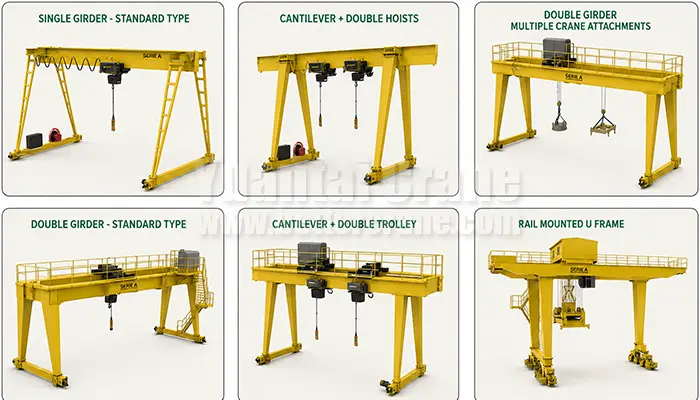
- Single girder modular gantry crane : used for 1–10 ton applications, light to medium duty modular gantry crane systems in workshop material handling
- Double girder modular gantry crane : used for heavier loads and improved structural stability in heavy-duty gantry crane applications
In most standard gantry crane systems, supporting legs are not adjustable. They are fabricated as fixed structural members designed based on load capacity, span, and working environment requirements in industrial material handling systems.
Depending on gantry crane duty classification and workshop application requirements, supporting legs are mainly produced in two structural forms: truss type and box type.
Truss-Type Supporting Legs in Modular Gantry Crane Systems
- Lightweight structural design with reduced steel usage in gantry crane fabrication
- Efficient force distribution through triangular truss frame structure
- Common in medium-duty gantry cranes and outdoor material handling applications
- Easier transportation and on-site installation in modular crane systems
- Suitable for flexible workshop layouts and fabrication workshops
Box-Type Supporting Legs in Heavy-Duty Gantry Crane Applications
- Fully enclosed steel box structure with high rigidity in industrial gantry cranes
- Strong resistance to bending and lateral load impact
- Suitable for heavy-duty and high-frequency lifting operations
- Stable performance in continuous industrial production environments
- Preferred for steel fabrication and heavy manufacturing workshops
Full Gantry Crane (Double-Sided Leg Structure)
- Equipped with two supporting legs on both sides
- Operates independently on ground rails or wheel systems
- Provides full-span coverage across the working area
- Common in open workshops, yards, and production zones
Semi Gantry Crane (Single-Sided Leg Structure)
- Semi Gantry Cranes including the single girder semi gantry crane and double girder semi gantry cranes.
- Uses a single supporting leg on one side
- Opposite side runs on elevated runway beam or building structure
- Suitable for space-limited workshops or hybrid crane systems
- Helps reduce floor space occupation while maintaining lifting coverage
A Frame vs L Frame vs U Frame Supporting Leg Designs
- A-frame legs: standard balanced structure for stability and cost efficiency
- L-frame legs: used in space-restricted or asymmetric workshop layouts
- U-frame legs: applied where wider clearance or special lifting access is required
Travel System (Wheel or Rail Type in Gantry Crane Systems)
- Wheel-travel type gantry cranes : runs directly on concrete floors, no rail installation required, high flexibility and easy repositioning in workshop material handling systems
- Rail-mounted type: fixed travel path, stable movement, higher precision for repetitive lifting tasks in production lines
Lifting System (Electric Hoist in Modular Gantry Crane Systems)
- Electric wire rope hoist or chain hoist options for industrial gantry crane applications
- Capacity selected based on working load requirements and duty cycle classification
- Designed for repeated lifting cycles in fabrication, assembly, and maintenance workshops
Capacity Range and Application Scope of Modular Gantry Crane Systems
Modular gantry crane systems are designed to cover a wide range of industrial material handling requirements, from light maintenance tasks to heavy fabrication and continuous production operations in workshops, assembly plants, and steel structure manufacturing environments.
Used in small workshops, maintenance areas, and flexible workstation environments where light industrial lifting is required.
- 1–3 ton lifting capacity range for light-duty gantry crane systems
- Suitable for tools, small components, and maintenance lifting tasks
- Easy to move, reposition, and adapt within workshop layouts
- Common in repair workshops, small fabrication shops, and assembly stations
Commonly used in fabrication workshops, machinery manufacturing plants, and general industrial production environments where stable and frequent lifting is required.
- 5–10 ton capacity range for medium-duty gantry crane systems, hot sale 5 ton gantry crane, 10 ton gantry cranes
- Suitable for steel components, machine parts, and assembly operations
- Balanced solution for most industrial workshop material handling needs
- Widely used in lean manufacturing production lines and batch production systems
Used in heavy industrial environments such as steel fabrication plants, large machinery assembly projects, and high-load material handling operations.
- Up to 20–32 ton lifting capacity range for heavy-duty gantry crane systems, hot sale 20 ton gantry crane , 25 ton gantry crane, 40 ton gantry cranes and 50 ton gantry cranes,
- Typically adopts double girder structure for improved stability and load distribution
- Suitable for continuous or high-frequency industrial lifting operations
- Common in steel structure manufacturing, shipbuilding, and heavy assembly workshops
In practical gantry crane selection, capacity is not determined only by maximum lifting weight. It also depends on duty cycle frequency, material flow requirements, and how effectively the modular gantry crane system integrates into the overall workshop layout and lean manufacturing production process.
Lean Manufacturing Principles Applied to Material Handling
In lean manufacturing, material handling is often where hidden waste builds up. It is not always obvious on paper, but in real workshop operations, extra lifting steps and repeated transportation quickly increase both time and cost.
When a modular gantry crane system is used properly, it helps reduce these unnecessary movements by bringing lifting capability closer to the work area. This reduces dependence on fixed crane positions and limits the need to move materials back and forth across the workshop.
- Eliminates unnecessary lifting steps between workstations
- Reduces transportation delays between production stages
- Minimizes repeated handling of the same workpiece
- Shortens material transfer distance in workshop layouts
- Helps lower overall handling time per production cycle
In practice, the difference is simple: instead of moving a heavy part across the workshop to find a crane, the crane is positioned where the work actually happens. That alone removes a large portion of wasted movement.
- Supports smooth material transfer between machining, assembly, and inspection areas
- Helps maintain consistent workflow between production stations
- Reduces idle waiting time caused by crane availability or position limits
- Improves coordination between different workshop zones
- Prevents bottlenecks caused by fixed lifting points
In many workshops, bottlenecks are not caused by machines themselves but by material movement delays. A flexible gantry system helps remove that constraint by keeping lifting access closer to each stage of production.
- Supports rapid reconfiguration of production lines
- Reduces downtime during layout changes or process adjustments
- Allows relocation of lifting points based on new workflow design
- Improves adaptability for multi-product manufacturing environments
- Reduces dependency on permanent crane installation structures
In practical terms, when a workshop needs to switch from one product type to another, the lifting system does not become a fixed limitation. Instead, it can be adjusted to match the new production direction with minimal interruption.
Role of Modular Gantry Crane Systems in Lean Manufacturing
A modular gantry crane system is often selected because it does not depend on permanent runway beams or fixed building structures. This makes it suitable for industrial workshops where production layouts are still evolving or frequently adjusted in lean manufacturing environments.
In many real factory situations, workshop layouts change step by step as order volume increases or product types are updated. A fixed overhead crane system does not always follow these changes easily, while a modular gantry crane system can be installed, relocated, or reconfigured with less disruption to production flow.
- No reliance on permanent overhead runway beam structures in industrial gantry crane systems
- Suitable for temporary production setups and phased workshop planning
- Can be used in semi-permanent or frequently changing manufacturing layouts
- Supports gradual expansion of workshop areas without major structural reconstruction
- Practical for retrofit industrial crane projects where building structure is already fixed
In simple terms, the modular gantry crane system adapts to the workshop layout, rather than forcing the workshop to be designed around a fixed crane structure.
- One modular gantry crane system can serve multiple production zones or workstations
- Reduces need for duplicated lifting equipment across industrial workshops
- Improves utilization rate of available gantry crane capacity
- Helps balance workload between different fabrication and assembly areas
- Supports flexible task allocation in small and medium manufacturing plants
In actual workshop operation, this often means fewer cranes are required, while overall utilization efficiency of material handling equipment is improved across the production cycle.
- Improves utilization of limited workshop floor space in gantry crane applications
- Reduces obstruction compared to fixed overhead crane runway systems
- Allows more flexible arrangement of aisles, machines, and workstations
- Supports cleaner material flow paths in lean manufacturing workshops
- Improves accessibility between different production zones
In practical use, this allows the workshop layout to be designed around the production process first, with the modular gantry crane system integrated afterward without major structural conflict.
- Modular structure allows expansion of span or lifting coverage in industrial gantry crane systems
- Additional sections can be added to increase working area in workshops
- Supports gradual investment aligned with production growth in lean manufacturing
- Reduces need for full system replacement during workshop expansion
- Allows crane capacity upgrades based on changing production demand
In practical terms, a workshop can start with a smaller modular gantry crane system and expand later as production increases, without redesigning the entire facility layout.
Types of Modular Gantry Crane Systems Used in Lean Manufacturing
Modular gantry crane systems used in lean manufacturing environments are available in several structural and mobility configurations. Each type is selected based on workshop layout, production flow stability, lifting capacity requirements, and the level of flexibility needed in industrial material handling operations.
Rail-free wheel traveling gantry cranes are widely used in flexible workshop environments where production layouts are frequently adjusted. The system runs directly on reinforced concrete floors using heavy-duty wheels, without the need for embedded rails or fixed ground tracks.
This type of rail-free gantry crane system is commonly used in lean manufacturing workshops where multiple workstations share one lifting system or where production zones are reconfigured over time.
- Suitable for flexible and frequently changing industrial workshop layouts
- No embedded rail infrastructure required on the factory floor
- Easy relocation within lean manufacturing production environments
- Common in maintenance workshops, fabrication shops, and assembly lines
- Lower installation complexity compared to rail-mounted gantry crane systems
In practical use, this system is often selected when factories require fast deployment without civil construction work for rail installation.
Rail-mounted modular gantry crane systems are designed for controlled and repetitive movement along fixed rail paths. The crane travels on installed steel rails, providing stable guidance, higher positioning accuracy, and improved load control during lifting operations.
This type of industrial gantry crane system is commonly used in structured production lines where material flow is stable and follows repeated routes across defined workstations.
- Stable and guided movement along fixed rail tracks
- High positioning accuracy for repetitive lifting tasks
- Suitable for production lines with defined material flow routes
- Improved safety and load control during continuous operation
- Common in structured manufacturing and assembly systems
In practical applications, this system is selected when workshop workflow is stable and does not require frequent layout changes.
Single girder modular gantry cranes use one main beam structure to support the electric hoist and lifting load. This simplified design reduces overall structural weight and cost while maintaining reliable lifting performance for general workshop applications.
This type is widely used in small and medium industrial workshops where cost efficiency and basic material handling capability are key requirements.
- Lightweight structural design with simplified beam configuration
- Suitable for 1 ton to 10 ton lifting capacity applications
- Lower material cost and installation cost compared to double girder systems
- Common in maintenance workshops and light fabrication environments
- Easy installation and operation in standard industrial facilities
In many small and medium factories, this is often the first step when introducing modular gantry crane systems into production.
Double girder modular gantry cranes use two parallel main beams, providing higher structural strength, improved rigidity, and greater lifting stability. This configuration is designed for demanding industrial environments where heavy loads and continuous operation are required.
It is commonly used in steel fabrication plants, heavy machinery assembly, and large-scale industrial material handling operations.
- Higher lifting capacity and improved structural stability
- Suitable for heavy-duty industrial gantry crane applications
- Supports larger spans and heavier loads compared to single girder systems
- Better performance under continuous and high-frequency operation
- Common in steel structure manufacturing and heavy production workshops
In practical operation, double girder systems are selected when load stability, safety margin, and long-term durability are primary requirements in production planning.
Application Scenarios in Lean Manufacturing Industries
In lean manufacturing environments, modular gantry crane systems are widely used across different industrial sectors. They are applied wherever material handling needs to be flexible, repeatable, and closely integrated with production flow, especially in workshops where layout and workload change over time.
In metal fabrication and welding workshops, modular gantry crane systems are mainly used for handling steel plates, structural sections, and welded assemblies. These materials are often heavy, irregular in shape, and require controlled positioning during fabrication steps in industrial production environments.
The gantry crane system helps reduce manual handling and improves material flow between cutting, welding, and assembly stations in fabrication workshops.
- Steel plate lifting and positioning for cutting and welding operations
- Handling of structural steel components in fabrication production lines
- Support for assembly alignment during welding and fitting processes
- Reduction of repeated lifting between different workshop zones
- Improved workflow continuity in steel structure manufacturing
In practical workshop operation, it allows operators to move large components directly to the workstation without relying on fixed overhead crane coverage areas.
In machinery manufacturing plants, modular gantry crane systems are commonly used for lifting machine components, subassemblies, and precision parts where both weight handling and controlled positioning are required.
The system supports assembly operations where alignment accuracy and stable movement between stations are important in industrial production processes.
- Lifting of machine housings, frames, and heavy industrial components
- Support for precision assembly and equipment installation tasks
- Movement of parts between machining and assembly stations
- Reduction of waiting time for shared lifting equipment
- Improved coordination in multi-stage manufacturing workflows
In real production lines, it helps maintain continuous assembly flow without interruption caused by limited crane access points.
In automotive manufacturing, modular gantry crane systems are used for handling engines, chassis components, and modular assemblies. These operations require repeated lifting with stable timing and consistent workflow integration.
The crane system supports lean production principles by ensuring components are delivered directly to each assembly stage in synchronized production lines.
- Engine and transmission lifting during automotive assembly operations
- Chassis and frame handling in vehicle production lines
- Movement of modular vehicle components between stations
- Support for synchronized lean manufacturing assembly workflow
- Reduction of manual handling in high-volume production systems
In practical terms, it helps maintain a steady production rhythm where each workstation receives components at the correct timing in the assembly sequence.
In warehousing and logistics environments, modular gantry crane systems are used for loading, unloading, and internal material transfer operations. They support efficient handling of goods during storage, sorting, and distribution processes.
The system is especially useful in logistics centers where flexibility and fast repositioning are required for changing storage layouts and material flow paths.
- Loading and unloading of heavy goods and palletized materials
- Cross-docking operations for fast material transfer
- Internal warehouse material movement between storage zones
- Flexible deployment in dynamic warehouse layouts
- Improved handling efficiency in distribution and logistics centers
In practical use, it reduces dependency on fixed loading systems and improves adaptability in warehouse operations with changing demand patterns.
In maintenance and equipment repair workshops, modular gantry crane systems are used as temporary or semi-permanent lifting solutions. These environments often deal with unpredictable workloads, varied equipment sizes, and urgent repair requirements.
The gantry crane provides reliable lifting support during overhaul, servicing, and equipment replacement operations in industrial maintenance facilities.
- Temporary lifting support for machine repair and overhaul operations
- Handling of motors, gearboxes, and heavy industrial components
- Flexible positioning for different maintenance workstations
- Suitable for workshops without permanent overhead crane systems
- Improved safety during maintenance lifting and servicing tasks
In industrial use, it is often deployed where permanent crane systems are not installed, but lifting capability is still required for heavy equipment servicing.
Key Design and Selection Considerations
Selecting a modular gantry crane system for lean manufacturing applications requires a structured evaluation of load conditions, workshop layout, floor strength, mobility needs, and operational safety requirements. The goal is not only lifting capacity, but stable integration into real production flow.
Selecting a modular gantry crane system always starts with understanding the real working load, not only the maximum theoretical lifting weight. In many industrial applications, errors occur when peak load is considered without analyzing actual operating frequency and duty conditions.
In lean manufacturing environments, lifting frequency and cycle time are as important as rated capacity. A properly sized industrial gantry crane can improve safety and reduce structural fatigue during continuous operation.
- Match crane capacity with real peak lifting loads in workshop operations
- Consider lifting frequency and daily industrial duty cycles
- Evaluate duty class based on production intensity (light, medium, heavy duty)
- Include safety margin for dynamic loads and handling conditions
- Avoid under-sizing that may lead to overload risk and production downtime
In practical use, a 5 ton modular gantry crane used continuously in fabrication behaves very differently from the same capacity used occasionally in maintenance operations.
Workshop geometry directly affects the performance of a modular gantry crane system. Span length, aisle width, and material flow paths must be evaluated before final selection in any industrial installation.
Unlike fixed overhead crane systems, modular gantry cranes offer more flexibility, but physical space constraints still determine operational efficiency.
- Determine span based on workstation layout and material flow direction
- Ensure sufficient aisle space for safe crane movement and operation
- Check ceiling height and lifting clearance requirements
- Consider obstacles such as columns, machines, and storage areas
- Align crane coverage with actual production zones, not unused space
In real workshop planning, the crane should follow the production workflow instead of forcing workflow adaptation to crane limitations.
Since modular gantry crane systems are ground-supported material handling equipment, floor conditions play a critical role in safety and performance. Concrete strength, flatness, and load distribution must be properly assessed before installation.
This requirement becomes especially important for rail-free wheel traveling gantry cranes that operate directly on workshop floors.
- Verify concrete floor strength for wheel load distribution
- Ensure floor flatness for stable crane movement
- Consider load spread under wheel or rail contact points
- Evaluate suitability for rail-free or rail-mounted configurations
- Assess long-term floor wear under repeated crane movement
In practical engineering terms, insufficient floor strength can limit crane capacity more than the steel structure itself.
One of the main reasons for selecting a modular gantry crane system is mobility. However, required mobility levels vary depending on production type, workshop layout stability, and operational planning.
Some industrial environments require frequent repositioning, while others only need occasional layout adjustments.
- Choose between fixed installation or mobile crane deployment
- Rail-free systems for high flexibility and repositioning capability
- Rail-mounted systems for controlled and repetitive movement paths
- Selection depends on indoor or semi-outdoor operating conditions
- Consider environmental factors such as wind, dust, and moisture
In industrial applications, crane mobility is closely linked to how often production layouts change.
Safety is a core requirement in modular gantry crane selection, especially in lean manufacturing environments where multiple workstations operate close together. At the same time, operational efficiency must be maintained to support continuous production flow.
A well-designed system balances load control precision, operator visibility, and mechanical safety features.
- Anti-sway control for stable load movement
- Reliable braking systems for safe load stopping
- Clear operator visibility for accurate positioning
- Ergonomic control systems to reduce operator fatigue
- Proper safety margins for dynamic lifting conditions
In practical operation, a stable and controllable crane reduces handling errors, improves productivity, and lowers accident risk in daily workshop use.
Advantages of Modular Gantry Crane Systems in Lean Manufacturing
In lean manufacturing environments, modular gantry crane systems are often selected because they directly reduce internal handling inefficiencies and support more flexible production flow. Their advantages are closely related to how material moves between processes and how quickly a workshop can adapt to change.
In lean manufacturing, a large portion of hidden inefficiency comes from unnecessary material movement and waiting time. Modular gantry crane systems reduce this by positioning lifting capability closer to the actual workstations instead of relying on fixed lifting points.
This improves internal logistics flow and reduces repeated handling steps between production stages.
- Reduces unnecessary lifting and repositioning of materials in workshops
- Lowers waiting time between machining, assembly, and inspection processes
- Minimizes idle time caused by limited crane availability
- Shortens internal transport distance inside industrial facilities
- Supports smoother production flow with fewer interruptions
In real workshop operation, this often leads to shorter cycle times without changing the production equipment itself.
Modern manufacturing environments rarely remain static. Product variations, order changes, and process updates often require workshop layout adjustments. Modular gantry crane systems are designed to adapt to these changes without major structural modification.
- Easily adapts to new workshop layouts and production line changes
- Can be repositioned or reconfigured based on workflow updates
- Suitable for multi-product and small-batch manufacturing environments
- Reduces dependency on fixed crane installation points
- Supports gradual adjustment of production zones over time
In practical terms, the crane system follows the factory's evolution instead of restricting how production is reorganized.
Unlike overhead bridge crane systems that require permanent runway beams and building-integrated structures, modular gantry crane systems operate independently from the building framework. This reduces civil engineering requirements and simplifies installation.
- No requirement for permanent overhead runway beam structures
- Reduced building modification and civil construction cost
- Suitable for existing workshops and retrofit installations
- Faster installation compared to fixed bridge crane systems
- More flexible workshop layout and space utilization planning
This makes modular gantry crane systems practical for facilities where structural modification is difficult, costly, or time-consuming.
Production growth typically occurs in phases rather than a single expansion step. Modular gantry crane systems support this development model by allowing incremental upgrades instead of complete system replacement.
- Modular structure allows extension of span or working coverage area
- Capacity upgrades can be integrated gradually over time
- Supports phased investment aligned with production growth
- Reduces need for full crane system replacement during expansion
- Helps match lifting capacity with actual industrial demand
In industrial planning, this scalability allows factories to invest based on current needs while keeping future expansion options open.
Workshop space is always limited, especially in fabrication and assembly environments. Modular gantry cranes improve space utilization by enabling more flexible layout planning and reducing structural restrictions.
- Optimizes use of available floor space in workshops
- Reduces obstruction compared to fixed overhead crane systems
- Allows more efficient arrangement of workstations and aisles
- Supports better material flow organization
- Improves overall resource utilization efficiency
In practical terms, the workshop layout becomes easier to organize around production needs rather than being constrained by fixed lifting infrastructure.
Limitations and Engineering Trade-Offs
Modular gantry crane systems offer strong flexibility in lean manufacturing environments, but this flexibility comes with engineering trade-offs. Understanding these limitations is important when selecting a system for real industrial applications, especially where load intensity, span requirements, and automation level vary.
Modular gantry crane systems are flexible, but this flexibility introduces structural limits. Compared with fixed overhead bridge crane systems, they are generally less efficient for very long spans or large uninterrupted coverage areas in industrial workshops.
This limitation is mainly related to ground-supported structural behavior and the need to maintain stability across the entire gantry frame.
- Span length is more limited compared to overhead bridge crane systems
- Structural rigidity decreases as span increases
- Not suitable for very wide, continuous production hall coverage
- Load distribution depends on ground-supported gantry frame structure
- Better suited for localized or segmented workshop lifting zones
In practical engineering use, when full building coverage is required, overhead bridge crane systems typically provide better performance.
Wheel-travel (rail-free) modular gantry crane systems depend heavily on floor conditions. Since the crane runs directly on the workshop floor, any limitation in surface quality directly affects movement performance and operational safety.
This makes floor engineering a critical factor in system selection and installation planning.
- Requires strong and level concrete floor conditions
- Load is directly transferred to floor through wheel contact points
- Uneven floors can affect stability and smooth travel movement
- Long-term operation may cause localized floor wear
- Not suitable for weak or poorly constructed workshop floors
In real industrial applications, floor reinforcement is sometimes required before installation, which adds to planning and preparation requirements.
Standard modular gantry crane systems are typically designed for manual or semi-manual operation. Compared to advanced fixed crane systems, integration with automation, positioning systems, and digital control can be limited in basic configurations.
This influences their suitability for highly automated production environments.
- Basic systems rely on manual or pendant control operation
- Limited integration with advanced automation or positioning systems
- Lower compatibility with fully automated production lines
- Upgrading to smart control requires additional configuration
- More suitable for flexible rather than fully automated workshops
In practical use, these systems are more commonly applied in semi-automated or human-operated industrial environments.
While modular gantry crane systems are suitable for a wide range of industrial applications, they are not always the optimal choice for extremely high-duty, continuous operation environments. In such cases, fixed overhead crane systems or specialized lifting solutions may provide better long-term stability.
- Not optimized for continuous 24/7 heavy-duty lifting cycles
- Structural fatigue considerations under extreme usage conditions
- Higher maintenance demand under high-frequency operation
- Better suited for intermittent or medium-duty workflows
- Heavy continuous production may require fixed crane systems
In industrial planning terms, modular gantry crane systems are selected primarily for flexibility and adaptability rather than maximum continuous-duty performance.
Maintenance and Lifecycle Management
Maintenance of modular gantry crane systems is structured around modularity and lifecycle efficiency, allowing industrial operators to manage wear, upgrades, and inspections without disrupting overall workshop production flow. This approach supports long-term operational stability in lean manufacturing environments.
Maintenance of modular gantry crane systems is based on a component-level approach rather than treating the crane as a single fixed structure. Because the system is built from standardized modules, inspection and replacement can be carried out section by section.
In practical workshop operation, this reduces downtime and allows maintenance to be scheduled without stopping the entire production process.
- Regular inspection of modular beams, joints, and connection points
- Replacement of individual components instead of full structure overhaul
- Faster maintenance response due to standardized parts
- Easier troubleshooting when structural issues occur
- Reduced production interruption during maintenance work
In real use, this means a damaged section can often be replaced without dismantling the full crane system.
Since modular gantry cranes operate on either wheel-travel or rail-mounted systems, wear monitoring is an important part of lifecycle management. Continuous movement under load creates gradual wear on contact surfaces and structural joints.
Proper inspection helps maintain stable operation and prevents long-term deformation or travel issues.
- Monitoring wheel wear patterns and bearing condition
- Checking rail alignment and surface condition (for rail-mounted systems)
- Inspecting structural deflection and frame stability
- Identifying uneven load distribution during operation
- Preventing long-term damage caused by misalignment or wear
In practice, early detection of wear issues is more cost-effective than structural correction after deformation occurs.
The electric hoist is the most frequently used mechanical part of the modular gantry crane system. It carries the load directly, so its maintenance schedule has a strong impact on overall crane safety and performance.
Routine inspection and scheduled servicing help ensure stable lifting operation in daily production environments.
- Regular inspection of wire rope or chain condition
- Brake system testing for safe load control
- Motor and gearbox lubrication and performance checks
- Load testing to confirm rated capacity safety
- Electrical system inspection for control reliability
In real workshop conditions, hoist maintenance is usually the most critical factor in preventing operational failure.
One of the key advantages of modular gantry crane systems is that they can be upgraded or expanded without replacing the entire structure. This supports long-term use in growing production environments.
Instead of removing the existing system, additional modules or improved components can be integrated into the original setup.
- Expansion of span or working coverage through additional modules
- Capacity upgrades by replacing hoist or structural components
- Structural reinforcement for increased load requirements
- Integration of improved control or safety systems
- Extended service life through phased upgrades instead of full replacement
In practical industrial use, this reduces long-term capital cost and allows the crane system to grow with the factory rather than becoming outdated.
Future Trends in Modular Gantry Crane Systems
Development of modular gantry crane systems is closely linked with changes in manufacturing structure, especially the shift toward digital production management, data-based maintenance, and more flexible workshop layouts. These trends are shaping how lifting systems are designed and used in lean manufacturing environments.
Modular gantry crane systems are gradually moving toward integration with factory-level digital management platforms. In modern production environments, material handling is no longer only mechanical work—it is becoming part of data-driven production control.
By connecting cranes with MES (Manufacturing Execution Systems) or ERP systems, lifting operations can be tracked, scheduled, and optimized in real time. This helps improve coordination between production planning and actual workshop execution.
- Connection with MES/ERP systems for production tracking
- Real-time monitoring of lifting tasks and workflow status
- Better coordination between material handling and production scheduling
- Improved traceability of lifted components in manufacturing processes
- Support for lean manufacturing data-driven decision systems
In practical terms, the crane becomes part of the production information flow, not just a standalone lifting tool.
Another clear development trend is the use of sensors for real-time load monitoring and equipment condition tracking. Instead of relying only on manual inspection, cranes can now provide continuous operational data.
This improves safety and allows maintenance to be planned before failure occurs, rather than after damage happens.
- Real-time load monitoring through integrated sensor systems
- Detection of overload conditions during lifting operations
- Predictive maintenance based on usage data and wear patterns
- Early warning for structural or mechanical issues
- Improved operational safety and reduced unexpected downtime
In real workshop environments, this reduces reliance on scheduled checks alone and helps avoid sudden equipment failure during production.
Material development is also influencing the design of modular gantry crane systems. Manufacturers are increasingly using high-strength steel and optimized structural profiles to reduce weight while maintaining load capacity.
This helps improve mobility, reduce floor load impact, and simplify installation.
- Use of high-strength steel for improved load-to-weight ratio
- Lighter structural design for easier transport and assembly
- Reduced floor stress in wheel-travel crane systems
- Improved energy efficiency during crane movement
- Better adaptability for modular expansion systems
In practical use, lighter structures make modular systems easier to deploy in flexible workshop environments.
Automation in gantry crane systems is gradually increasing, especially in positioning control and repetitive lifting tasks. While full automation is still limited in many workshops, semi-automated functions are becoming more common.
These systems help improve positioning accuracy and reduce operator workload in repetitive operations.
- Semi-automated positioning for repetitive lifting tasks
- Improved load alignment and placement accuracy
- Reduced operator effort in routine handling operations
- Integration with basic control systems for workflow consistency
- Support for lean production lines with standardized processes
In real applications, this allows operators to focus more on workflow coordination rather than manual positioning tasks.
Conclusion: Modular Gantry Cranes as a Lean Manufacturing Enabler
A modular gantry crane system is not only a lifting device. In lean manufacturing environments, it functions as part of the production layout itself. The way materials are lifted and transferred directly affects workflow stability, station efficiency, and overall workshop rhythm.
Unlike fixed overhead crane systems, modular gantry cranes are designed for changing conditions. Workshops can adjust their layout, expand production zones, or reorganize stations without being locked into a permanent crane path.
In practical terms, this means the crane supports production changes instead of limiting them.
A modular gantry crane system is not only a lifting device. In lean manufacturing environments, it functions as part of the production layout itself. The way materials are lifted and transferred directly affects workflow stability, station efficiency, and overall workshop rhythm.
Unlike fixed overhead crane systems, modular gantry cranes are designed for changing conditions. Workshops can adjust their layout, expand production zones, or reorganize stations without being locked into a permanent crane path.
In practical terms, this means the crane supports production changes instead of limiting them.
The main value of modular gantry crane systems is not only lifting capacity, but how they influence material flow inside the workshop. They help reduce unnecessary handling steps and support smoother movement between processes.
- Reduces repeated material handling and internal transport distance
- Supports steady flow between machining, assembly, and inspection areas
- Helps maintain continuous production without waiting for fixed crane availability
- Improves flexibility when production layouts are adjusted
- Lowers dependency on permanent structural crane systems
In many workshops, these improvements are not theoretical—they are visible in daily operation, especially where production lines change frequently.
One of the most practical advantages is the ability to expand or adjust the system over time. Instead of replacing the entire crane setup, modular components can be added or modified as production grows.
- Modular expansion based on production demand
- Gradual investment instead of full system replacement
- Suitable for growing workshops and phased factory development
- Adaptable to multi-product and variable production environments
- Reduces long-term infrastructure modification costs
This type of flexibility is often more useful than maximum fixed capacity in real industrial planning.
In lean manufacturing applications, modular gantry cranes are best understood as workflow tools. They help define how materials move, how stations connect, and how efficiently a workshop responds to change.
They are widely used in fabrication shops, assembly lines, maintenance facilities, and flexible production plants because they match how modern manufacturing actually operates—step by step, not in a fixed structure.
In this sense, their value lies in adaptability. Not just lifting weight, but supporting a production system that can adjust, expand, and continue operating without major disruption.