Practical Tips for Sourcing Wire Rope Electric Hoists
Practical Tips for Sourcing Wire Rope Electric Hoists from Chinese Manufacturers: A Buyer’s Guide
Most Important Takeaway:: When sourcing wire rope electric hoists from China, verified suppliers, certified materials, realistic lead times, and thorough pre-shipment inspection are critical. Prioritizing quality and compliance over low price protects your operations from delays, unsafe equipment, and hidden costs.
Key Takeaways for Buyers:
- Always verify the manufacturer’s credentials, ISO/CE certifications, and factory audit reports.
- Confirm wire rope grade, duty cycle, hoist load capacity, and safety factors before purchase.
- Factor in realistic lead times for production, shipping, and customs clearance.
- Ensure clear communication and technical support for specifications, manuals, and drawings.
- Consider total cost of ownership, including maintenance, energy use, and spare parts availability.
- Conduct pre-shipment inspections or third-party audits to avoid defective hoists.
- Set clear contract terms with warranty, defect resolution, and payment conditions.
- Confirm after-sales service and long-term spare parts availability.
Questions This Guide Solves
- How can I find a reliable Chinese wire rope electric hoist manufacturer?
- Which certifications and materials ensure a safe, durable hoist for industrial use?
- How can I avoid delays and substandard products when ordering from China?
- What factors should I consider to calculate the total cost of ownership (TCO)?
- How do I ensure proper after-sales support and spare parts availability?
Verify Manufacturer Credentials
When you’re sourcing wire rope electric hoists from China, the very first step is to make sure the supplier is legitimate. It sounds obvious, but too often buyers get caught up in low prices and overlook basic verification. A reliable manufacturer is not just about having a website—it’s about proven experience, proper licensing, and adherence to international standards.
Key Steps to Verify a Manufacturer:
- Check company registration and licenses: Make sure the company is legally registered in China and holds the necessary business licenses for manufacturing heavy machinery. You can request a copy of their business license and verify it through official Chinese government websites or trusted directories. Also, pay attention to how long they have been in business—experience matters, especially for complex products like wire rope hoists.
- Look for international certifications: Certifications are more than just badges—they show that the manufacturer meets recognized quality and safety standards. Look for ISO 9001, which covers quality management systems, and CE certification for products that meet EU safety standards. Other relevant certifications can include TÜV, BV, or CCC, depending on your target market. Certified manufacturers are less likely to deliver substandard hoists that fail during operation.
- Request factory audit reports or third-party inspections: Ask the supplier to provide recent factory audit reports. These are often performed by third-party agencies and show whether the company follows proper manufacturing processes and safety standards. If possible, consider hiring an inspection company yourself—this is especially important for large or high-capacity hoists where safety cannot be compromised.
- Ask for references from previous clients: A trustworthy manufacturer should be able to provide references from past buyers, particularly international clients. Contact these references to ask about delivery timelines, product quality, and after-sales support. Real-world feedback gives a clearer picture of what working with the supplier will actually be like.
Why This Matters to Buyers:
- Prevents delays and substandard products.
- Ensures your hoists meet international safety and quality standards.
- Reduces the risk of hidden costs due to poor manufacturing or lack of support.
Evaluate Product Quality and Standards
After verifying the manufacturer, the next step is to make sure the hoist itself meets your operational needs. Quality is more than just certificates—it's about performance, safety, and durability in real conditions. Skipping this step can lead to downtime, higher maintenance, or even accidents.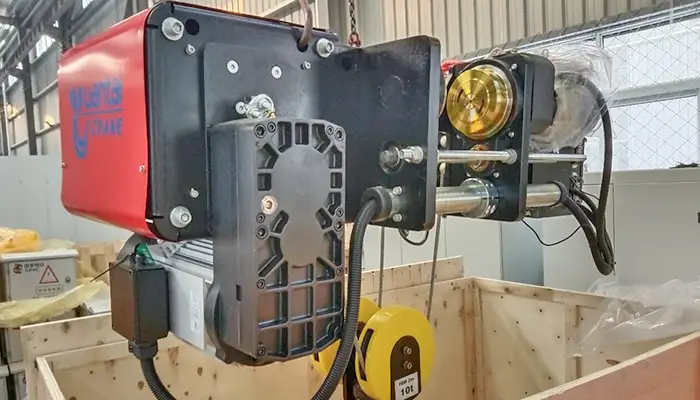 European style wire rope electric hoist for sale
Start with the wire rope, the most critical component of a wire rope electric hoist. Confirm the grade—commonly G80 or G100—and make sure it matches the weight and frequency of your lifts.
The hoist's load factor must comply with your expected usage. A rope that's too weak or a hoist rated for light duty will not perform reliably in a heavy industrial environment.
Motors must match your required lifting speed, duty cycle, and operating environment.
Underpowered motors can overheat, trip frequently, or fail prematurely—especially in continuous or high-frequency lifting applications.
Brakes are a primary safety-critical component of any electric hoist.
Always confirm the hoist is equipped with reliable, failsafe braking systems that comply with international safety standards to prevent load slippage or uncontrolled lowering.
Hooks should be forged, properly heat-treated, and equipped with safety latches to prevent accidental disengagement.
Gearboxes must provide smooth transmission, low noise, and long service life. Poor-quality gearboxes are a common source of early failure and vibration issues.
Not every electric hoist is designed for continuous or heavy-duty operation.
Ensure the hoist matches your actual lifting frequency, lifting height, and load requirements, and confirm compliance with recognized standards such as ISO 4301, EN 14492, or applicable local regulations.
Always request documentation to verify product quality and compliance:
- Welding certificates for structural components.
- Material test reports for steel and critical parts.
- Product datasheets detailing load capacity, motor power, duty class, and environmental suitability.
Evaluating product quality and standards protects both your operation and investment.
- Ensures safe and reliable hoist operation under real working conditions.
- Reduces long-term maintenance costs and unplanned downtime.
- Provides documented proof for compliance, insurance, and third-party audits.
Assess Lead Times and Production Capacity
Timing can make or break your hoist purchase. Even a top-quality wire rope hoist is useless if it arrives late. That's why understanding lead times and the manufacturer's production capacity is critical.
Not all hoists are ready-made. Standard hoists usually have shorter lead times, often just a few weeks. Custom hoists—designed for special lifting capacities, spans, or environments— may require two to three months or more.
Key points to confirm:
- Expected production time for your specific hoist model
- Availability of partial shipment if some units are completed earlier
- Supplier flexibility for urgent or rush orders
A verified factory may still struggle with large or repeated orders. Buyers should confirm that the manufacturer can meet volume requirements without creating bottlenecks.
- Monthly production capacity for wire rope electric hoists
- Number of production lines or shifts in operation
- Ability to scale output for repeat or long-term projects
Lead time does not end when production is finished. International shipping, customs clearance, and inland delivery can add several weeks to your schedule.
- Port congestion and peak-season shipping delays
- Completeness and accuracy of customs documentation
- Coordination between delivery, installation, and site readiness
- Supports realistic project scheduling and workforce planning
- Reduces the risk of idle equipment and delayed commissioning
- Improves coordination of international shipments and on-site installation
Communication and Technical Support
Good communication is often overlooked, but it's one of the most important factors when sourcing wire rope electric hoists from China. Even if the manufacturer is certified and the hoist meets your specifications, poor communication can still lead to misunderstandings, delays, and extra costs.
Confirm that the supplier has responsive, English-speaking sales and technical staff. Accurate communication is essential when discussing specifications, safety standards, and customization requirements.
- Clear understanding of technical terminology
- Fast responses to technical and commercial questions
- Proactive updates on production and delivery status
All critical specifications should be confirmed in writing before placing an order to avoid costly changes later.
- Lifting speed: Matched to operational efficiency and safety needs
- Power supply: Voltage, phase, and frequency compatibility
- Trolley type: Single or double girder, top-running or under-running
- Control method: Pendant, remote control, or cabin operation
A professional hoist manufacturer should provide complete technical documentation to support installation, operation, and maintenance.
- Hoist datasheets with rated capacity and duty class
- Dimensional and installation drawings
- Operation and maintenance manuals
- Reduces errors caused by misinterpreted specifications
- Ensures smooth installation and long-term maintenance
- Provides reliable technical support when issues arise
Price vs. Total Value
When buying a wire rope electric hoist, price is important—but it should never be the only factor. What appears cheap at the quotation stage can result in higher costs later due to repairs, downtime, or inefficient operation. The smarter approach is to evaluate the total value of the hoist over its service life.
A low quotation often hides compromises that only appear after the hoist is in use. Buyers should look beyond the initial number on the invoice.
- Inferior motors, brakes, or wire ropes
- Shorter service life with frequent breakdowns
- Increased safety risks for operators and equipment
Instead of asking "What's the cheapest hoist?", consider "What will this hoist cost over the next 5–10 years?"
Warranty coverage and after-sales service are essential parts of a hoist's real value. Reliable support minimizes operational risk.
- Clear warranty terms and coverage scope
- Availability of spare parts, locally or from the supplier
- Fast technical response for troubleshooting and repairs
A hoist backed by strong support helps keep your operation running smoothly.
Total Cost of Ownership provides a realistic view of long-term expenses and helps compare true cost-effectiveness between hoist options.
- Energy consumption: High-efficiency motors reduce long-term energy costs
- Maintenance: Frequency of service, lubrication, and part replacement
- Downtime impact: Production losses from unexpected failures
TCO analysis shifts the focus from "cheap hoists" to cost-effective hoists.
- Avoids hidden costs and unplanned downtime
- Ensures stable performance and longer service life
- Supports smarter purchasing decisions based on value, not just price
Inspection and Testing Before Shipment
Even after verifying the manufacturer, specifications, and lead times, the process is not complete until the hoist is physically checked before leaving the factory. Pre-shipment inspection and proper testing are essential to prevent receiving damaged or non-compliant equipment.
Third-party inspection is one of the most reliable ways to protect buyers' interests. Independent inspectors verify that the hoist meets contractual and technical requirements before shipment.
Key checks include:
- Compliance with agreed technical specifications
- Quality of welds, hooks, motors, brakes, and gearboxes
- Verification of duty cycle and functional operation
Load testing confirms that the hoist can safely handle its rated capacity under real operating conditions. This step is especially critical for heavy-duty or customized electric hoists.
- Testing under realistic load conditions
- Verification of safety factors per ISO 4301, EN 14492, or local standards
- Formal load test reports provided before shipment
Proper packaging is critical to protect the hoist during international transport. Poor packaging can damage even high-quality equipment.
- Protective covers for motors, wire ropes, and electrical components
- Strong crates or pallets to prevent movement during transit
- Clear labeling and handling instructions for shipping and lifting
- Confirms compliance with specifications and safety standards
- Minimizes the risk of receiving damaged or substandard equipment
- Saves time, cost, and disputes by identifying issues before shipment
Contract and Payment Terms
Even after verifying the supplier, reviewing specifications, and inspecting the hoist, a clear and detailed contract is your final layer of protection. Well-defined contract and payment terms set expectations, allocate responsibilities, and significantly reduce the risk of disputes.
All technical and commercial requirements should be clearly written into the contract to avoid ambiguity after the order is placed.
- Hoist type, lifting capacity, and duty class
- Wire rope grade, trolley configuration, and control method
- Delivery schedule, Incoterms, and shipping responsibilities
- Penalty clauses for late delivery or non-compliance
Written specifications help ensure the supplier delivers exactly what was agreed.
Avoid paying the full amount upfront. Standard international payment methods protect both buyer and supplier while encouraging performance.
- Letter of Credit (L/C): Payment released only after meeting agreed terms
- Staged T/T payments: Deposit, pre-shipment payment, and final balance
- Escrow or verified trade platforms: Additional protection for large orders
Secure payment terms ensure obligations are met before full settlement.
A strong contract defines how defects, warranty claims, and post-delivery support are handled to prevent future disputes.
- Warranty duration and coverage scope
- Responsibility for replacement parts or repairs
- Availability and response time of technical support
Clear terms provide confidence that support will be available if problems occur.
- Minimizes risk of receiving defective or non-compliant hoists
- Protects your financial investment and establishes accountability
- Creates a clear process for warranty claims and post-delivery support
After-Sales Service and Spare Parts
Purchasing a wire rope electric hoist is only the beginning. Long-term reliability, safety, and operating efficiency depend heavily on after-sales service quality and spare parts availability. These factors directly affect downtime, maintenance costs, and equipment lifespan.
Confirm that critical spare parts will remain available for at least 5–10 years. Without reliable parts supply, even a high-quality hoist can become unusable.
- Motors, gearboxes, and braking systems
- Hooks, wire ropes, and trolleys
- Electrical components and control units
Ready access to spare parts helps maintain continuous production and avoids costly emergency sourcing.
Even well-maintained hoists may require technical assistance. Clarify the level of support offered by the supplier after delivery.
- Remote troubleshooting: Phone, email, or video-based support
- On-site service: Technicians for installation, repairs, or urgent issues
- Defined response times and service cost structure
Strong technical support reduces downtime and keeps daily operations running smoothly.
Proper use and scheduled maintenance are essential for long-term hoist performance. Suppliers should provide clear training and documentation.
- Operator training for safe lifting and daily inspections
- Maintenance manuals with lubrication and inspection schedules
- Guidelines for identifying early signs of wear or failure
Training and documentation help prevent accidents, extend equipment life, and reduce unexpected maintenance costs.
- Protects your investment and ensures long-term hoist operation
- Minimizes downtime and maintenance disruptions
- Guarantees access to spare parts and technical support when needed
Conclusion
Sourcing wire rope electric hoists from Chinese manufacturers offers cost advantages, but it also comes with real risks. Success depends on a careful, step-by-step approach.
Buyers should prioritize:
- Verified suppliers with proper registration and international certifications
- Certified materials and components that meet duty cycles and safety standards
- Realistic lead times and confirmed production capacity
- Thorough pre-shipment inspections to ensure quality and prevent damage
Frequently Asked Questions (FAQ)
Start by confirming the company is legally registered and experienced in producing heavy-duty hoists. Look for ISO 9001 or CE certifications, and request third-party factory inspection reports if possible.
Reach out to previous clients, especially international buyers, to learn about their experience with product quality, delivery timeliness, and after-sales support.
Certifications prove the hoist meets recognized quality and safety standards:
- ISO 9001 for quality management
- CE for safety compliance
- Other certificates like TÜV or CCC depending on your region
Materials are equally important:
- High-quality wire ropes (G80 or G100)
- Forged hooks and reliable gearboxes
- Tested motors and braking systems
Ask for welding and material test reports to verify quality.
Plan well in advance. Confirm realistic production times for standard and custom hoists, and verify the factory can handle your order size.
Include shipping and customs considerations in your schedule. Communicate specifications clearly with the supplier, and consider hiring a third-party inspection company to check the hoist before shipment.
TCO accounts for more than the purchase price. Consider long-term costs:
- Energy costs: Efficient motors reduce electricity use
- Maintenance and spare parts: Frequency and cost over time
- Downtime: Production losses if the hoist fails
- Warranty and support: Cost coverage for repairs or replacements
This approach ensures you select a hoist that is truly cost-effective for long-term operation.
Confirm the supplier can provide spare parts for at least 5–10 years. Ask about remote troubleshooting and on-site support availability.
Request operator training and maintenance manuals. Reliable support ensures safe operation and reduces unplanned downtime.