How Ladle Handling Cranes Are Customized for BOF & LF
How Ladle Handling Cranes Are Customized for BOF & LF Operations
Most Important Takeaway
Ladle handling overhead cranes are not one-size-fits-all; precise positioning, tilt coordination, and process integration are essential for safe, efficient, and reliable BOF and LF steelmaking operations. Choosing the right ladle crane configuration directly impacts safety, productivity, and long-term plant performance.
Key Takeaways
- Precise Positioning: Ensures accurate ladle placement in BOF and LF operations to reduce spillage, protect furnace linings, and improve steel quality.
- Tilt Coordination: Customized tilting mechanisms allow controlled ladle pouring, reducing refractory wear and preventing accidents.
- Process Integration: Synchronization with BOF/LF automation systems ensures efficient ladle transfer and reduces downtime.
- Environment Adaptation: High-temperature, corrosive, and high-load environments require reinforced ladle overhead crane structures and explosion-proof electrical components.
- Maintenance and Lifecycle Optimization: Proper customization simplifies maintenance and extends operational lifespan of ladle handling overhead cranes.
Introduction
Ladle handling overhead cranes are an essential part of modern steelmaking operations. They are specifically designed to move molten steel safely between furnaces, transfer stations, and casting areas. In Basic Oxygen Furnace (BOF) and Ladle Furnace (LF) operations, these cranes do more than just lift heavy loads—they ensure that molten steel is handled with precision, minimizing risks and protecting both equipment and personnel.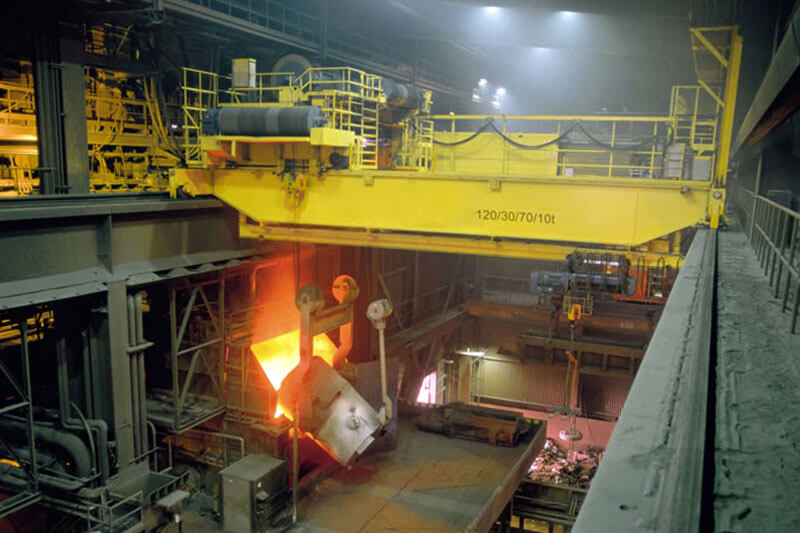
Standard overhead cranes, the kind you see in general industrial workshops, simply aren’t built for the extreme demands of molten steel handling. Without proper customization, a crane might struggle with precise positioning, tilt control, or integration with automated plant processes. That’s why ladle handling overhead cranes are engineered for the specific environment they will operate in.
Practical customization of a ladle crane includes:
- Load Precision: The ability to place the ladle exactly where it’s needed, down to a few millimeters, is critical to prevent spillage and reduce wear on furnace linings.
- Tilt Control: Controlled tilting of the ladle ensures smooth steel pouring, which protects both the ladle lining and the people working nearby.
- Process Integration: The crane can communicate with BOF/LF automation systems, torpedo cars, and casting equipment to ensure smooth workflow and minimize downtime.
- Environmental Adaptation: Reinforced structures, heat-resistant components, and explosion-proof electrical systems make sure the crane can survive high temperatures and harsh industrial conditions.
- Safety and Maintenance: Design adjustments make regular inspection and maintenance simpler, keeping the crane operational 24/7 without unexpected shutdowns.
In short, customized ladle handling overhead cranes are not just lifting equipment—they are a core part of the steelmaking process. They combine mechanical precision, safety, and workflow efficiency in a way that standard cranes simply cannot. For plant managers and crane buyers, understanding these differences is key to selecting a solution that meets both operational demands and long-term maintenance goals.
Precise Positioning
In BOF and LF operations, where molten steel is involved, even small placement errors can cause serious problems. A ladle that is slightly off-target can spill molten steel, damage the furnace lining, or create safety hazards for operators. That's why precise positioning isn't just a nice-to-have—it's a requirement.
Ladle handling overhead cranes are designed to place heavy, hot ladles exactly where they are needed, often within millimeters. This level of control keeps operations smooth, reduces the risk of accidents, and ensures the steel produced meets consistent quality standards.
In BOF and LF operations, even minor placement errors can lead to spills, damage, and safety risks. Precise positioning ensures ladles are delivered exactly where needed, maintaining safety and production quality.
Practical ladle crane customizations focus on achieving pinpoint accuracy and repeatability:
- Advanced Hoist and Trolley Control: Modern ladle overhead cranes are equipped with hoist and trolley systems capable of millimeter-level adjustments. Operators can make fine movements to ensure the ladle lines up perfectly with the furnace or transfer station.
- Position Feedback Systems: Laser sensors, encoders, or PLC-based feedback loops continuously monitor the ladle's location. This allows the crane to correct its position automatically, even under heavy load conditions.
- Pre-Programmed Positioning Sequences: For repetitive operations, cranes can be programmed to follow specific paths and stop at precise points. This reduces operator error, saves time, and ensures consistent workflow.
When a ladle handling overhead crane is customized for precise positioning, the practical advantages are immediate and measurable:
- Safe and Consistent Ladle Pouring: Minimizes spills and prevents damage to furnace linings or surrounding equipment.
- Reduced Refractory Wear and Maintenance Costs: Accurate placement reduces direct impact on furnace surfaces, extending their service life.
- Increased Process Reliability and Throughput: Fewer errors and smoother operation mean the plant can maintain higher production efficiency with less downtime.
Tilt Coordination
In BOF and LF operations, tilting the ladle is more than just pouring steel—it's a critical operation that affects safety, product quality, and equipment longevity. Uncontrolled or uneven tilting can cause splashes of molten steel, damage the refractory lining inside the ladle, or even put operators at risk.
Tilt coordination in ladle handling overhead cranes ensures that the ladle moves smoothly and predictably. When the crane and tilting mechanism work together, steel can be poured at a controlled rate, protecting both the ladle and the surrounding work area.
In BOF and LF operations, tilting the ladle affects safety, product quality, and equipment longevity. Precise tilt coordination ensures smooth, predictable ladle movement, preventing spills, damage, or operator hazards.
Practical crane modifications make tilt control precise, repeatable, and safe:
- Electric or Hydraulic Tilt Mechanisms: Integrated directly with the crane's control system, these mechanisms allow precise control of the ladle's angle. Operators can adjust tilt speed and position depending on the process requirements.
- Programmable Tilt Curves: For BOF and LF operations, tilt curves can be pre-programmed to match furnace or casting needs. This ensures a smooth, consistent flow of molten steel every time.
- Safety Interlocks: Modern ladle cranes include interlocks that prevent accidental tilting. This safety feature ensures the ladle only tilts when it's properly positioned and all conditions are safe.
When ladle handling overhead cranes are equipped with advanced tilt coordination, the practical benefits are clear:
- Smooth, Controlled Pouring: Reduces the risk of splashes or spills, protecting both operators and equipment.
- Extended Refractory Lining Life: Controlled tilting prevents sudden impacts on the ladle lining, reducing wear and extending its service life.
- Safer Working Environment: Operators can tilt the ladle with confidence, knowing the crane's safety mechanisms will prevent unexpected movements.
Process Integration
In modern steelmaking, a ladle handling overhead crane is only as effective as the system it works within. If the crane operates independently of furnaces, torpedo cars, or casting machines, the workflow can slow down, errors can increase, and production efficiency can drop.
Process integration ensures that ladle handling overhead cranes work as part of a coordinated system. When cranes are synchronized with the BOF or LF operations, each ladle transfer happens at the right time, every time. This not only keeps the production line moving smoothly but also enhances safety and reduces wear on equipment.
A ladle crane's effectiveness depends on the overall steelmaking system. Process integration ensures coordinated movement with furnaces, torpedo cars, and casting machines, reducing delays, errors, and equipment wear while maintaining safe operations.
Ladle cranes can be tailored to integrate seamlessly with steelmaking processes through several practical solutions:
- Automated Ladle Transfer: The crane can be programmed to move the ladle along pre-defined paths and synchronize with BOF/LF cycle times, reducing delays between furnace operations.
- Communication with Upstream and Downstream Equipment: Integration with torpedo cars, casting machines, or intermediate ladle stations ensures that the ladle arrives where it is needed without manual intervention.
- Plant Process Control System Integration: Modern ladle cranes can connect to PLCs or plant control systems to provide real-time monitoring of position, load, tilt, and operation status. This enables predictive maintenance, reduces operator workload, and supports coordinated production.
Custom process integration provides tangible operational advantages for steel plants:
- Reduced Downtime and Improved Production Cycles: Coordinated crane movement keeps BOF and LF operations running smoothly with minimal pauses.
- Minimized Human Error in Ladle Transfers: Automation and system communication reduce reliance on manual control, lowering the risk of misplacement or accidents.
- Optimized Throughput and Operational Efficiency: Synchronized operations allow the plant to maintain higher output without compromising safety or quality.
Additional Customization Considerations
While precise positioning, tilt coordination, and process integration are the core of ladle handling overhead crane customization, there are several additional factors that steel plants need to consider to ensure long-term reliability and safety.
BOF and LF environments expose cranes to extreme heat, sparks, and corrosive gases. Standard crane structures can warp, weaken, or fail under these conditions. Reinforced steel frames, high-temperature paint, and heat-resistant components are often added to ladle handling overhead cranes to ensure they remain safe and stable during continuous operation.
- Reinforced main girders and trolley supports for heavy molten loads.
- Heat-resistant coatings to prevent structural weakening over time.
- Corrosion-resistant materials for environments with chemical exposure.
Molten steel environments can be hazardous for electrical systems. Explosion-proof and high-temperature rated electrical components are critical to protect operators and maintain reliable crane operation.
- Explosion-proof hoist motors and control panels for hazardous zones.
- High-temperature cables and connectors that withstand radiant heat.
- Fail-safe electrical interlocks to prevent accidental movement or overload.
Ladle handling overhead cranes operate nearly around the clock. Designing for easy inspection and maintenance ensures minimal downtime and extends the crane's service life.
- Easy access to hoist, trolley, and tilt mechanisms for routine checks.
- Modular components that can be replaced quickly without shutting down the entire system.
- Built-in monitoring for predictive maintenance to prevent unexpected failures.
Frequently Asked Questions (FAQ) – Ladle Handling Overhead Cranes
Ladle handling overhead cranes are specifically designed for molten steel operations, unlike standard cranes used in general industry. They handle extremely heavy, hot ladles while providing precise control and tilt mechanisms. Standard cranes typically lack the precision, safety features, and environmental protections needed for BOF and LF operations.
Key differences include:
- Reinforced structures to handle high temperatures and heavy molten loads.
- Tilt control for safe steel pouring.
- Integration with furnaces and plant automation for process synchronization.
- Explosion-proof electrical components for hazardous conditions.
Customization ensures that the ladle lands exactly where it is needed, reducing spillage and protecting furnace linings. Tilt mechanisms allow smooth, controlled pouring.
Customization examples:
- Advanced hoist and trolley systems for millimeter-level placement.
- Laser, encoder, or PLC feedback for real-time position monitoring.
- Programmable tilt curves tailored to BOF and LF process requirements.
- Safety interlocks to prevent accidental tilting.
Benefits: Safe and consistent pouring, longer refractory life, and higher operational reliability.
A crane that works in isolation can slow down production and increase human error. Integration with furnaces, torpedo cars, and casting machines ensures seamless workflow.
Integration solutions include:
- Automated ladle transfers synchronized with furnace cycles.
- Communication with upstream and downstream equipment.
- Real-time monitoring via plant control systems.
Benefits: Reduced downtime, fewer mistakes in ladle transfers, and optimized throughput for the steel plant.
BOF and LF environments expose cranes to extreme heat, sparks, and corrosive gases. Without proper adaptations, cranes can fail or become unsafe.
Key adaptations:
- Reinforced steel frames and heat-resistant coatings.
- Corrosion-resistant materials and high-temperature components.
- Explosion-proof motors, hoists, and control panels.
- Maintenance-friendly access for quick inspections and repairs.
Benefits: Safe operation, extended crane lifespan, and reduced risk of accidents.
Customized ladle handling overhead cranes reduce downtime, minimize errors, and protect equipment. While the upfront cost may be higher, the return on investment comes from improved safety, longer equipment life, and higher plant productivity.
Practical outcomes:
- Fewer furnace lining replacements due to accurate ladle placement.
- Consistent steel quality with controlled pouring.
- Reduced labor errors and smoother plant workflow.
- Predictable maintenance cycles and lower unplanned shutdowns.
Conclusion: Choosing the Right Ladle Handling Overhead Crane
Ladle handling overhead cranes for BOF and LF operations are specialized machines, built to handle molten steel safely and reliably. They are not like standard workshop cranes—every feature, from positioning to tilt control, is tailored for demanding steelmaking environments.
Why customization matters:
- Precise Positioning: Ensures the ladle is placed exactly where it’s needed, reducing spillage and protecting furnace linings.
- Tilt Coordination: Smooth and controlled pouring protects both the ladle lining and plant personnel.
- Process Integration: Synchronizes with BOF/LF cycles and connected equipment, minimizing delays and human errors.
- Structural & Safety Adaptations: Reinforced frames, heat-resistant materials, and explosion-proof electrical components make the crane reliable in harsh environments.
What this means for you:
- Reduced downtime and maintenance costs.
- Consistent steel quality with safer operations.
- Long-term reliability and operational efficiency.
In short, a well-customized ladle handling crane is more than equipment—it’s a long-term investment in plant safety, process efficiency, and consistent steel production. Selecting the right crane now saves time, money, and operational headaches later.