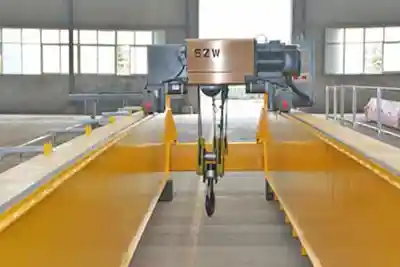
20T/10T QDX Overhead Crane Philippines | 6.8m Double Girder
Project Overview
20/10T QDX double girder overhead crane project in the Philippines with 6.8m span and 14m lifting height. European-style crane system with 400V 60Hz power, designed for efficient heavy-duty industrial lifting and dual-hoist operation.
Project Background
On 2026/05/06, a QDX European-style double girder overhead crane system was specified for an industrial project in the Philippines. The requirement comes from a workshop environment where lifting tasks are not fixed, but change throughout daily production. Sometimes heavy components need to be moved, sometimes smaller loads are handled in sequence.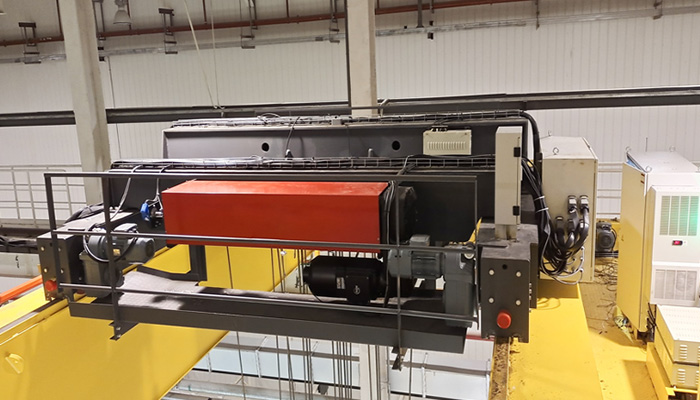
European style double girder overhead crane
This is a typical condition in fabrication shops and machinery assembly plants. The crane is expected to run continuously during working hours, not in short or occasional cycles.
- Project date: 2026/05/06
- Installation country: Philippines
- Crane type: QDX European double girder overhead crane
- Application: Industrial workshop material handling, multi-load lifting
- Operation condition: Medium to heavy duty working cycle
The main requirement is dual-capacity lifting capability, combining both heavy and medium lifting tasks in one system.
- Main lifting capacity: 20 ton for heavy industrial components
- Auxiliary lifting capacity: 10 ton for secondary handling and positioning work
- Working style: mixed-load operation within the same production line
In practical workshop terms, this means operators do not need to switch equipment when load weight changes. One crane system covers different stages of production handling.
The project is located in the Philippines, where industrial workshops commonly operate under 400V / 60Hz / 3-phase power supply. This electrical standard supports stable motor performance for crane travel, hoisting, and trolley movement.
The workshop environment is typically:
- Steel structure building with fixed runway beams
- Medium span installation conditions
- Continuous daily production demand
- High frequency lifting cycles during working hours
These conditions require a crane system that is stable under repeated start-stop operation and can maintain consistent lifting performance over long shifts.
From a system planning point of view, the design focus is not only lifting capacity. It is also about how the crane fits into real production flow.
- Handle different load weights without changing equipment
- Maintain stable operation under frequent lifting cycles
- Adapt to fixed workshop height and span conditions
- Support continuous production without downtime interruptions
In many Philippine industrial projects like this, the priority is simple: one crane system should be able to do multiple jobs inside the same workshop line, without adding extra lifting equipment or complicating the workflow.
Technical Specifications
This section defines the core technical parameters of the QDX European-style double girder overhead crane system. The specification is based on a dual-hoist configuration, which is commonly used in industrial workshops where both heavy lifting and secondary handling are required in the same working cycle. The structure, lifting system, and electrical design are all aligned with continuous production operation in standard factory environments.
Technical Data Overview
| Item | Specification | Practical Function |
|---|---|---|
| Crane Series | QDX European standard overhead crane | Designed for controlled industrial lifting with stable performance |
| Crane Type | Double girder overhead crane | Provides higher rigidity for heavy-duty lifting |
| Configuration | Dual hoist (main + auxiliary) | Supports two-level lifting tasks in one system |
| Main Hook Capacity | 20 ton | Heavy component lifting in production line |
| Auxiliary Hook Capacity | 10 ton | Secondary lifting and positioning assistance |
| Span | 6.8 m | Suitable for medium-width workshop structure |
| Main Hook Lifting Height | 14.29 m | Primary vertical lifting for heavy loads |
| Auxiliary Hook Lifting Height | 14.74 m | Extra flexibility for positioning and assembly work |
| Power Supply | 400V / 60Hz / 3-Phase | Standard industrial power in Philippines factories |
The table above shows the full technical configuration in a structured format. In real workshop application, these parameters are not just numbers—they directly affect how the crane behaves during daily production. For example, the 20 ton main hook is used for heavy fabrication parts, while the 10 ton auxiliary hook supports alignment and assisted lifting. Both operate under the same bridge structure, reducing the need for additional lifting equipment.
The 6.8 m span indicates that the system is designed for medium-size industrial buildings, where space is controlled but lifting coverage must remain efficient. The lifting height difference between main and auxiliary hooks is also intentional. It allows more flexibility during assembly work, especially when positioning components at different levels.
Overall, this technical configuration reflects a practical dual-function crane setup. It is designed for continuous workshop use, stable under 400V 60Hz industrial power, and suitable for production environments in the Philippines where mixed-load lifting tasks are common in daily operations.
System Configuration
Overall Structural Arrangement
The crane system is built around a double girder bridge structure, which is commonly used in medium-to-heavy industrial overhead crane applications. This configuration provides higher rigidity compared with single girder systems, especially when handling combined loads such as 20 ton main lifting and 10 ton auxiliary lifting within the same working cycle.
The end carriage system is reinforced to support repeated travel cycles under full load conditions. In practical workshop operation, this is important because the crane does not work in a single lift mode—it runs continuously throughout production shifts.
| System Section | Configuration | Functional Role |
|---|---|---|
| Bridge Structure | Double girder design | Provides structural strength and stable load distribution |
| End Carriages | Reinforced heavy-duty type | Supports long-term travel under frequent loading cycles |
The bridge and end carriage system work together to maintain stable movement across the workshop runway. In real industrial use, this helps reduce structural deformation and improves long-term operating reliability.
The hoisting system is designed as a dual hoist configuration, combining a main hoist and an auxiliary hoist within the same crane system.
- Main hoist: QDX 20T, used for primary heavy lifting operations such as steel sections, machinery parts, and large assemblies
- Auxiliary hoist: 10T unit, used for precision handling, positioning, and assisted lifting during assembly tasks
This dual arrangement allows the crane to handle different lifting stages without switching equipment. In practical workshop conditions, it reduces handling time and improves workflow continuity.
The crane adopts a dual-trolley operating system, which can run in either coordinated or independent mode depending on operational requirements.
- Coordinated mode: both trolleys work together for controlled lifting operations
- Independent mode: each hoist operates separately for flexible task handling
This structure is commonly used in fabrication workshops where lifting tasks vary from heavy structural components to smaller assembly parts within the same production line.
The electrical system is designed for stable industrial operation under standard workshop conditions.
- Power supply: 400V / 60Hz / 3-phase
- Control system: Industrial-grade electrical control panel
- Drive system: VFD (Variable Frequency Drive) controlled travel and hoisting
The use of VFD control helps reduce mechanical impact during start and stop operations. In real use, this results in smoother lifting, less load swing, and better control during precision positioning.
The crane is equipped with flexible control options to match different operator preferences and site conditions.
- Pendant control for direct operator handling on ground level
- Wireless remote control for improved mobility and safer operation distance
In many industrial workshops, both control modes are used depending on the task. Pendant control is often used for routine lifting, while wireless control is preferred when operators need better visibility or safer positioning during heavy load movement.
Overall, the system configuration is designed as a fully integrated dual-hoist overhead crane solution. The double girder structure, reinforced travel system, and VFD-controlled electrical setup work together to support stable and continuous operation in industrial workshop environments.
Application Requirements & Engineering Considerations
This section explains how the crane specification is matched to real workshop operating conditions. The focus is not only on lifting capacity, but also on how the system behaves inside a fixed industrial building where space, power supply, and workflow are already defined.
The system is designed to handle two different lifting levels within one crane. This is a common requirement in fabrication and assembly workshops where load conditions change during production.
| Function | Capacity | Practical Use |
|---|---|---|
| Main lifting | 20 ton | Heavy steel structures, machinery parts, large assemblies |
| Auxiliary lifting | 10 ton | Positioning, alignment, assisted lifting tasks |
In real operation, this means the crane can complete both heavy lifting and fine adjustment work without changing equipment. It keeps the workflow continuous, especially during multi-step assembly tasks.
The 6.8 m span is selected for compact to medium-size workshop layouts. It fits well into standard steel structure buildings commonly used in industrial production.
- Suitable for limited-width workshops
- Improves structural rigidity under load
- Reduces beam deflection during frequent lifting cycles
- Keeps trolley movement stable across the runway
In practical terms, this span is often used where space is controlled but production coverage must remain efficient across the working area.
The lifting height requirement exceeds 14 meters, which is relatively high for indoor workshop cranes. The purpose is to fully use the available vertical space inside the building.
- Main hook: 14.29 m working height
- Auxiliary hook: 14.74 m working height
This difference allows more flexibility during assembly and positioning work. It is especially useful when lifting components to different installation levels.
In many existing factories, the building height is fixed. So instead of changing the structure, the crane is designed to maximize usable lifting height within the available space.
The crane is designed for 400V / 60Hz / 3-phase industrial power, which matches standard electrical systems in the Philippines.
Key operational points:
- Stable motor performance under continuous operation
- Smooth acceleration and deceleration during hoisting
- Reliable travel performance for bridge and trolley movement
- Direct compatibility with local industrial power supply
This avoids the need for additional frequency conversion systems and supports stable long-term operation in factory environments.
From a system design perspective, the main consideration is matching crane performance to real workshop constraints rather than theoretical capacity.
The combination of:
- dual-load operation (20T + 10T)
- medium span layout (6.8 m)
- high lifting height utilization (14m+)
- local 60Hz power standard
creates a configuration suitable for continuous industrial production. It is designed for workshops where lifting tasks vary, but operating conditions remain fixed.
Engineering Design Focus
This section explains the key engineering points considered in the design of the QDX 20/10T double girder overhead crane system. The focus is on structural stability, controlled movement, and safe operation under continuous industrial working cycles.
The crane structure is reinforced to support combined loading conditions from both 20 ton and 10 ton hoists operating within the same bridge system.
- Double girder structure improves load distribution
- Reinforced end carriage supports repeated travel cycles
- Designed for frequent heavy lifting in workshop environments
In practical terms, the structure is not designed for single heavy lifts only, but for continuous mixed-load operation throughout daily production.
To improve lifting accuracy, the system integrates anti-sway control logic for both hoisting and trolley movement.
- Reduces load swinging during acceleration and deceleration
- Improves positioning accuracy during assembly work
- Helps operators handle long or uneven steel components
This is especially important in fabrication workshops where precise alignment is required before installation or welding.
The hook travel design is optimized to maximize usable lifting height within a fixed workshop structure.
- Efficient use of vertical space inside existing buildings
- Suitable for medium-height industrial workshops
- Supports both main and auxiliary lifting at different levels
In real installation conditions, this allows better use of available headroom without changing the building structure.
The crane is designed for 400V / 60Hz industrial power systems, ensuring stable motor behavior during continuous operation.
- Smooth speed response under VFD control
- Stable hoisting performance under frequent start-stop cycles
- Consistent travel behavior across bridge and trolley systems
This is important in real factory use where the crane runs repeatedly throughout the working shift.
Safety is integrated into the crane system to support reliable operation under industrial conditions.
- Overload protection system: prevents operation beyond rated capacity
- Upper and lower limit switches: control safe hook travel range
- Emergency stop system: allows immediate shutdown during abnormal conditions
These safety functions are standard in modern overhead crane systems used in continuous production environments.
Operational Value
The operational value of this crane system is defined by how it improves daily workflow inside a real workshop environment, rather than only focusing on lifting capacity.
The dual-hoist system allows the crane to handle different lifting stages within one integrated system.
- Heavy lifting using 20 ton main hook
- Secondary positioning using 10 ton auxiliary hook
- Reduced switching between different lifting equipment
This supports smoother workflow during assembly and fabrication processes.
By combining two lifting functions into one crane system, the need for additional lifting equipment is reduced.
- Fewer standalone hoists or cranes required
- Less equipment coordination inside workshop area
- Lower operational complexity during production
This simplifies material handling inside the factory.
The system improves overall production flow by reducing handling time between different lifting tasks.
- Faster material transfer between processes
- Reduced waiting time for lifting equipment
- More consistent production rhythm
In practical use, this helps maintain steady workshop output.
This crane configuration is suitable for multiple industrial sectors, including:
- Steel fabrication workshops
- Machinery assembly plants
- Heavy component manufacturing
- General industrial production lines
It is designed for environments where load variation is common during daily operations.
The dual-hoist arrangement supports continuous production by allowing different lifting tasks to be performed without changing equipment.
- Main and auxiliary hooks operate within one system
- Flexible switching between lifting tasks
- Stable support for continuous workflow
This improves operational continuity, especially in workshops with repeated lifting cycles and mixed load requirements.
This QDX 20/10T overhead crane system delivered a balanced engineering solution between heavy lifting capacity and operational flexibility, optimized for Philippine industrial environments with 60Hz power systems and medium-span workshop layouts.
The result is a high-efficiency dual-purpose overhead crane system capable of handling both primary heavy loads and precision auxiliary lifting tasks within a single integrated structure.