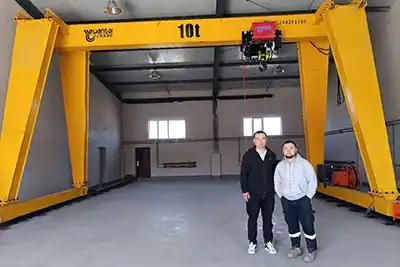
Low Headroom vs Standard Gantry Crane Workshop Guide
MOST IMPORTANT TAKEAWAY
In existing workshops with fixed roof height, the key decision is not crane capacity—it is usable lifting height.
Choosing the wrong gantry crane type directly reduces operational efficiency, even if the crane is technically “correct” on paper.
- Low headroom gantry cranes maximize usable hook height in restricted workshops
- Standard gantry cranes perform best only when building height is not a limitation
- Rated lifting height is not equal to industrial working lifting height
- Most crane inefficiency comes from poor early-stage selection, not equipment failure
- Structural geometry (not tonnage) is the decisive factor in retrofit projects
Frequently Asked Questions (FAQ)
This section addresses the most common practical questions from workshop owners and engineers when selecting between low headroom gantry cranes and standard gantry cranes. The focus is on real industrial workshop conditions, especially in fixed-height factories where vertical space, hook travel, and installation constraints directly affect performance.
A: A low headroom gantry crane is designed to maximize usable lifting height in fixed-height workshops, while a standard gantry crane is optimized for environments with sufficient vertical clearance.
- The key difference is not tonnage but usable hook travel and vertical space efficiency in real workshop crane applications.
- Low headroom systems are commonly used in existing factory crane retrofit projects where building height cannot be modified.
A: Lifting height decreases because crane structural design and hoist arrangement consume part of the available vertical space, even when the rated load capacity remains unchanged.
- Two cranes with the same 5 ton or 10 ton capacity can still have different effective lifting height in workshop environments.
- Standard gantry crane layouts typically require more vertical clearance, reducing usable hook travel in low ceiling industrial buildings.
A: A low headroom gantry crane is necessary when the workshop has fixed roof height, limited beam elevation, or cannot be structurally modified.
- It is widely used in retrofit gantry crane installation projects for existing industrial buildings.
- Common in steel fabrication workshops, assembly plants, and warehouse environments where vertical space optimization is critical.
A: The most common mistake is selecting a gantry crane based only on lifting capacity without evaluating real workshop height and hook travel limitations.
- Buyers often focus on tonnage (e.g., 5 ton or 10 ton gantry crane) while ignoring roof clearance and usable lifting height.
- This leads to reduced efficiency in industrial workshop crane applications for existing factories.
A: Factories can maximize lifting efficiency by selecting crane designs that optimize existing vertical space, most commonly using low headroom gantry crane systems.
- This improves usable hook travel and stacking height without changing building structure or runway systems.
- It is a standard approach in industrial workshop crane modernization projects where upgrading equipment is more practical than rebuilding facilities.
Introduction: Why Gantry Crane Selection Is Critical in Existing Workshops
In many existing industrial workshops, the building is already there. Roof height, steel structure, and runway positions are fixed long before any crane decision is made. This creates a very practical limitation: the crane must work inside the space that already exists, not the other way around. In this situation, gantry crane selection is no longer just a question of tonnage or span. It becomes a question of how much usable lifting height inside an existing workshop can actually be achieved after installation. This is where many projects run into issues. On paper, both a standard gantry crane and a low headroom gantry crane may show the same capacity—5 ton, 10 ton, or even 20 ton. But once installed inside a fixed-height factory building, the industrial working height can be quite different.
- Workshop structure is fixed and cannot be easily modified
- Roof beams and steel trusses reduce vertical clearance
- Crane design directly affects hook travel distance
- Installation results often differ from initial expectations if headroom is not calculated correctly
In practical workshop upgrades—steel fabrication plants, machinery maintenance shops, or warehouse lifting zones—this becomes one of the first industrial constraints engineers face. Not capacity. Not span. But vertical space.
Fixed Workshop industriality and Why It Cannot Be Ignored
In many existing industrial workshops, the building is already there. Roof height, steel structure, and runway positions are fixed long before any crane decision is made. This creates a very practical limitation: the crane must work inside the space that already exists, not the other way around.
In this situation, gantry crane selection is no longer just a question of tonnage or span. It becomes a question of how much usable lifting height inside an existing workshop can actually be achieved after installation.
This is where many projects run into issues. On paper, both a standard gantry crane and a low headroom gantry crane may show the same capacity—5 ton, 10 ton, or even 20 ton. But once installed inside a fixed-height factory building, the industrial working height can be quite different.
- Workshop structure is fixed and cannot be easily modified
- Roof beams and steel trusses reduce vertical clearance
- Crane design directly affects hook travel distance
- Installation results often differ from initial expectations if headroom is not calculated correctly
In practical workshop upgrades—steel fabrication plants, machinery maintenance shops, or warehouse lifting zones—this becomes one of the first industrial constraints engineers face. Not capacity. Not span. But vertical space.
Vertical Working Efficiency in industrial Workshop Conditions
Vertical working efficiency refers to how much usable lifting height remains after the crane is installed. This is often where the difference between crane types becomes very clear.
A standard gantry crane typically has a higher structural height between the beam and the hook. In a new workshop with sufficient roof clearance, this is not a problem. But in an existing low-clearance building, it directly reduces the working range.
A low headroom gantry crane is designed differently. The structure is compact, and the hoist arrangement is optimized to reduce wasted vertical space.
In industrial workshop use, this difference affects daily operations in a very direct way:
- Less wasted space between hook and beam means more usable lifting height
- Better fit for workshops where roof height is already limited
- More stable handling of taller components or stacked materials
- Improved usability in retrofit crane installations where building modification is not an option
To be honest, operators usually do not talk about "headroom design." They just notice whether the hook can reach the required height or not. That simple observation often decides whether the crane feels suitable for the workshop.
Storage and Stacking Capability Inside Fixed-Height Workshops
Another important point is vertical storage. Many workshops do not only lift loads—they also store them in stacked layers. Steel bundles, molds, pipes, and machinery parts are often stacked vertically to save floor space.
Here, crane headroom has a direct impact on how many layers can actually be used.
A standard gantry crane in a low workshop may reduce stacking height because part of the vertical space is already consumed by crane structure. This leads to a practical limitation: materials cannot be stacked as high as the building originally allows.
A low headroom gantry crane helps recover part of that lost space.
- More stacking layers possible in steel yards and warehouse workshops
- Better use of existing floor area without expanding building size
- More efficient material storage in fabrication and logistics zones
- Reduced space waste caused by structural overhead limitations
In many industrial cases, operators describe it simply: there is still room on the floor, but stacking higher becomes impossible. That is not a load issue. It is a headroom issue.
Material Handling Flexibility in Everyday Workshop Operations
Material handling inside a workshop is not only about lifting—it is about moving different shapes, heights, and sizes without interrupting workflow. When vertical clearance is tight, flexibility becomes limited if crane geometry is not properly matched to the building.
A standard gantry crane works well when the workshop height is generous. But in existing facilities, especially retrofit projects, its geometry can restrict movement of taller loads.
A low headroom gantry crane improves flexibility by making better use of the available vertical space.
- Easier lifting of tall or irregular components inside confined buildings
- Better compatibility with assembly and maintenance workflows
- Reduced interference with roof structures during lifting cycles
- More predictable movement path for operators handling large parts
In actual factory use, this translates into fewer adjustments during operation. The crane fits the building instead of forcing the workflow to adapt around it.
Fixed Workshop Constraints and Hidden Design Limits
In most existing factories, especially older production halls, the building structure is already locked in place. The crane is not designed together with the building. It is added later, inside a space that was never fully optimized for modern lifting equipment. This is where hidden limitations start to appear. When planning a gantry crane installation in an existing workshop, engineers often discover that the industrial constraint is not floor space, but vertical space and beam geometry. These constraints are easy to underestimate during early planning, but they directly control the final lifting performance.
industrial Conditions Inside Existing Industrial Workshops
In most existing factories, especially older production halls, the building structure is already locked in place. The crane is not designed together with the building. It is added later, inside a space that was never fully optimized for modern lifting equipment. This is where hidden limitations start to appear.
When planning a gantry crane installation in an existing workshop, engineers often discover that the industrial constraint is not floor space, but vertical space and beam geometry. These constraints are easy to underestimate during early planning, but they directly control the final lifting performance.
Fixed Roof Truss Height and Its Direct Impact
Roof truss height is one of the most rigid constraints in any workshop structure. Once the steel truss system is built, it cannot be adjusted without major reconstruction work.
In practical terms:
- Roof height determines the maximum possible crane hook travel
- Any crane installed must fit under the lowest structural point
- Even small height losses affect lifting usability
- In low clearance workshops, every millimeter matters
This is why low headroom gantry crane design is often considered in retrofit projects. It helps recover part of the vertical space that would otherwise be lost to standard crane structure.
Limited Beam Elevation Space in Retrofit Projects
Another common limitation is beam elevation. In many workshops, the runway beams are already fixed at a specific height based on original building design or earlier equipment installation.
This creates a strict boundary:
- Beam cannot be raised without structural modification
- Column reinforcement is often not feasible or too costly
- Existing production must continue during upgrade
- Installation space is therefore constrained from day one
In this situation, a standard gantry crane system may reduce usable hook height more than expected. A compact low headroom gantry crane for workshop use is usually preferred because it minimizes vertical loss between beam and hook.
Predefined Runway Positioning and Layout Restrictions
Many workshops already have runway systems installed before a new crane is selected. These runways define the movement path of the crane and limit how much redesign is possible.
Typical restrictions include:
- Fixed span distance between runway beams
- Pre-installed end stops and rail alignment
- Limited space for structural adjustment
- Existing workflow paths that cannot be interrupted
Because of these constraints, crane selection must adapt to the existing geometry rather than redesigning it. This is especially common in steel fabrication workshops, maintenance halls, and warehouse lifting zones where operations cannot stop for structural changes.
No Structural Modification Budget in industrial Projects
In theory, many issues could be solved by raising the roof, adjusting beams, or redesigning the workshop layout. In industriality, most projects do not have this option.
Common limitations include:
- Tight renovation budgets
- Production cannot be stopped for long periods
- Structural changes require permits and engineering approvals
- Cost of modification often exceeds crane upgrade budget
As a result, the crane must work within the existing envelope. This is where headroom efficiency becomes critical, and where low headroom gantry cranes are often selected as a practical solution.
Hidden Engineering industriality: Every Centimeter Matters
There is a simple but important engineering fact in existing workshop crane design:
Every centimeter of lost headroom reduces usable lifting capacity in industrial operation.
This is not about rated load. It is about working height.
When structural space is reduced by crane design, the operator experiences it as:
- Lower maximum lifting position
- Reduced stacking height
- Limited ability to handle tall components
- Less flexibility in assembly or loading operations
So while two cranes may both be rated for the same tonnage, their actual performance inside a fixed-height workshop can be very different.
In practice, this is why careful gantry crane selection for existing workshop height limitations is not a theoretical exercise—it directly affects daily production efficiency and material handling capability.
Standard Gantry Crane in Workshop Applications
A standard gantry crane is built on a traditional structure: a main girder supported by legs, with a trolley and hoist running along the beam. It is designed for general lifting tasks where the building height is not a major limitation. In many cases, this type is the first choice for new projects because it is straightforward, widely available, and easy to install. In actual workshop use, especially in industrial gantry crane applications for material handling, this design behaves predictably—but only when there is enough vertical clearance.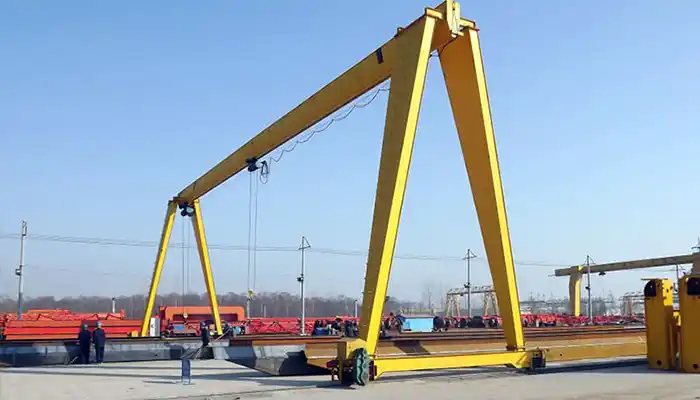 MH Electric hoist gantry crane
Conventional Design and How It Works in industrial Workshop Environments
A standard gantry crane is built on a traditional structure: a main girder supported by legs, with a trolley and hoist running along the beam. It is designed for general lifting tasks where the building height is not a major limitation. In many cases, this type is the first choice for new projects because it is straightforward, widely available, and easy to install.
In actual workshop use, especially in industrial gantry crane applications for material handling, this design behaves predictably—but only when there is enough vertical clearance.
Core Structural Characteristics
The standard configuration follows a conventional engineering layout that has been used for decades in factories and yards.
- Higher hook-to-beam distance compared with compact designs
- Traditional top-running or under-running hoist installation depending on system type
- Straightforward steel structure with standard end carriages
- Simple maintenance and widely available spare parts
This simplicity is one reason why many buyers choose it for new installations. The system is familiar to engineers, technicians, and maintenance teams.
Typical Application Scenarios
A standard gantry crane performs best when the workshop or working environment does not restrict vertical space. It is commonly used in:
- Newly built factory workshops with designed crane clearance
- High-ceiling production halls in manufacturing plants
- Outdoor yards for steel storage, logistics, and container handling
- Construction sites with open lifting environments
In these conditions, the crane can operate close to its design potential because there is no tight ceiling or structural obstruction limiting hook travel.
Limitation in Existing Low-Height Workshops
The situation changes when the same crane is installed in an existing workshop with fixed roof height. Here, the structural advantages of simplicity can become a practical disadvantage.
In industrial low headroom workshop environments, several limitations appear:
- Reduced effective lifting height due to larger structural clearance
- Loss of usable vertical space between hook and building roof
- Lower stacking capability for materials and components
- Possible mismatch with tall workpieces or assembly requirements
In other words, even if the crane is correctly rated for 5 ton or 10 ton, the working height may feel restricted once installed inside a low-clearance building.
Practical Observation from Workshop Use
In many industrial factory cases, operators notice the issue only after installation. The crane works normally, moves smoothly, and lifts the rated load—but the hook cannot reach as high as expected.
This leads to a common situation:
- Floor space is available
- Crane capacity is sufficient
- But vertical working space feels limited
This is not a mechanical failure. It is a geometry mismatch between standard gantry crane design and existing workshop height constraints.
Key Practical Understanding
A standard gantry crane is not "better" or "worse" by itself. It is simply designed for environments where height is not a limiting factor.
- Works efficiently in new or high-clearance buildings
- Less suitable for retrofit workshops with fixed roof structures
- Can underperform in vertical efficiency if installed in low-headroom spaces
- Requires careful evaluation of industrial lifting height before selection
In practice, this is why many engineers compare it directly with low headroom gantry crane systems for workshop retrofit projects, especially when upgrading older factories without changing building structure.
Low Headroom Gantry Crane Design Concept
A low headroom gantry crane is designed for one specific working condition: limited vertical space inside an existing workshop. Unlike a standard crane that assumes enough clearance above the beam, this type is developed to recover every possible millimeter of lifting height within a fixed building envelope. In many low clearance workshop crane applications, the goal is simple. Keep the same lifting capacity, but improve how much usable hook height remains after installation.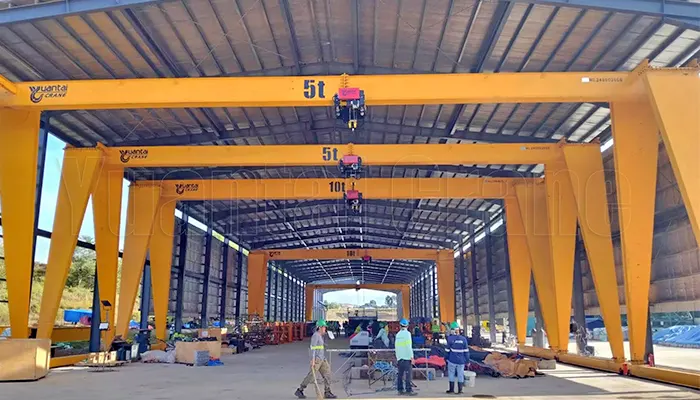
Purpose-Built Structure for Restricted Workshop Height
A low headroom gantry crane is designed for one specific working condition: limited vertical space inside an existing workshop. Unlike a standard crane that assumes enough clearance above the beam, this type is developed to recover every possible millimeter of lifting height within a fixed building envelope.
In many low clearance workshop crane applications, the goal is simple. Keep the same lifting capacity, but improve how much usable hook height remains after installation.
Core Design Optimization Features
The structure of a low headroom gantry crane is not just a smaller version of a standard system. It is rearranged to reduce wasted vertical space and improve lifting efficiency inside confined buildings.
Key engineering adjustments include:
- Reduced trolley structural height to lower the hook position closer to the beam
- Compact end carriage design to minimize overall vertical footprint
- Optimized hoist positioning along the girder for better space utilization
- Shortened structural connections to reduce unnecessary "dead height"
These adjustments are especially important in retrofit gantry crane projects, where the workshop structure cannot be changed.
How the Design Improves industrial Lifting Performance
The main objective of this design is not appearance or complexity reduction. It is about recovering usable lifting travel that would otherwise be lost in a standard setup.
In practical workshop operation:
- More hook travel is available within the same building height
- Taller workpieces can be lifted without modification to the structure
- Stacking height is improved in warehouse-style workshops
- Operators gain a more usable vertical working range
This makes a noticeable difference in facilities where roof clearance is already tight, such as steel workshops, mechanical assembly plants, or maintenance bays.
Resulting Benefit in Existing Workshop Conditions
When installed correctly in a fixed-height workshop, the low headroom design delivers a very direct outcome:
Maximum possible hook travel within the existing building height.
This means the crane does not require additional structural clearance to perform effectively. Instead, it adapts to the limitations of the workshop and works within them.
In industrial terms, this often translates into:
- Better use of vertical storage space
- Improved lifting range for assembly tasks
- Reduced risk of roof interference during operation
- More stable workflow in constrained production environments
Ideal Applications in Industrial Workshops
Low headroom gantry cranes are most commonly used in environments where reconstruction is not practical or not cost-effective.
Typical applications include:
- Retrofit workshops upgrading older lifting systems
- Low ceiling factories with fixed structural height
- Industrial facilities modernizing production lines without rebuilding
- Warehouses where vertical stacking efficiency is important
They are often selected when companies want to improve lifting performance without changing the building itself. In many gantry crane modernization projects, this type becomes the practical solution between keeping existing constraints and improving operational efficiency.
| Comparison Factor | Standard Gantry Crane | Low Headroom Gantry Crane |
|---|---|---|
| Lifting Height Efficiency | Loses usable lifting height due to higher structural clearance between beam, trolley, and hoist. Effective hook travel is reduced in low workshop buildings. |
Maximizes usable lifting height by reducing structural height. Minimizes hook-to-beam distance for better vertical range in fixed-height workshops. |
| Space Utilization | Suitable for workshops with no vertical restrictions. Best when roof height is sufficient and designed in advance. |
Optimized for constrained buildings with limited vertical space. Improves stacking height and overall space usage. |
| Installation Context | Used mainly in greenfield projects. Building structure and crane runway are planned together. |
Used in retrofit and modernization projects. Fits existing workshop structures without modification. |
| Operational Performance | Stable and reliable under normal conditions. Performance depends on available vertical clearance. |
More efficient in compact workshops. Better lifting utilization in restricted environments. |
Direct Functional Comparison in industrial Workshop Conditions
In industrial workshop environments, the difference between a standard gantry crane and a low headroom gantry crane is not theoretical. It shows up during daily lifting work, especially where building height is already fixed. The comparison below focuses on how each system behaves once installed inside actual industrial workshops, not just on design drawings.
Lifting Height Efficiency
Lifting height is usually the first limitation noticed after installation. Even when the rated capacity is the same, the usable hook travel can vary depending on crane geometry.
- Standard gantry crane: loses part of the vertical space due to higher structural clearance between beam, trolley, and hoist system. In low workshop buildings, this reduces effective lifting height and can limit tall component handling.
- Low headroom gantry crane: designed to reduce unnecessary structural height and bring the hoist closer to the beam, allowing more usable hook travel within the same building height.
In practical terms, this difference decides whether a full-height load can be lifted without adjusting the workshop layout.
Space Utilization Inside Workshop Layout
Space utilization is not only about floor area, but also about how efficiently vertical space is used inside the building envelope.
- Standard gantry crane: works well when there is no restriction above the runway beams. It fits naturally in workshops with high roofs or purpose-built crane halls.
- Low headroom gantry crane: better suited for constrained buildings where every portion of vertical space must be used efficiently. It reduces wasted height and improves stacking and assembly space usage.
In many existing workshop crane upgrade projects, this becomes a key factor when comparing options.
Installation Context and Project Type
The choice between the two crane types is often determined before installation starts, based on whether the project is new or an upgrade.
- Standard gantry crane: commonly used in greenfield projects where building height, beam position, and crane runway can be designed together from the beginning.
- Low headroom gantry crane: commonly used in retrofit or modernization projects where the workshop structure is already fixed and cannot be modified easily.
In industrial industrial planning, this distinction is important because it affects both design flexibility and final performance inside the workshop.
Operational Performance in Daily Use
Once the crane is in operation, performance is not only about load capacity but also about how smoothly it fits into the workflow.
- Standard gantry crane: generally stable and reliable, but its performance depends heavily on available vertical space. In tight workshops, operators may feel limited during lifting and stacking operations.
- Low headroom gantry crane: performs more efficiently in compact environments because it makes better use of the available lifting height and reduces unnecessary space loss during operation.
In practice, this leads to smoother material handling in workshops where ceiling height cannot be changed.
Practical Summary
In industrial workshop conditions, the key difference is not strength or capacity. It is how each crane type uses vertical space inside a fixed structure.
- Standard gantry crane performs best when space is open and unrestricted
- Low headroom gantry crane performs better when workshop height is limited and cannot be modified
This is why many gantry crane selection decisions for existing factories focus first on building height and hook travel efficiency, not just tonnage or span.
Selection Framework for Workshop Buyers
Choosing between a standard gantry crane and a low headroom gantry crane for workshop use should not start from capacity or price. In industrial engineering practice, it starts from the building itself and how the workshop is actually used every day. This framework is commonly used in industrial gantry crane selection for retrofit factories, where structural conditions are fixed and cannot be redesigned.
Building Geometry (Fixed Workshop Constraints)
The first step is to understand the industrial physical limits of the workshop structure. Many selection errors happen here because drawings do not always reflect usable space.
Key points to evaluate:
- Internal clearance height from floor to lowest roof structure
- Beam-to-floor distance where crane runway is installed
- Obstruction points under roof trusses, lighting, pipes, or steel beams
In many low ceiling workshops, even small differences in structural height directly affect usable lifting range. This is where low headroom gantry crane design often becomes necessary, especially when standard crane geometry reduces hook travel too much.
Load Profile Requirements (What You Actually Lift)
After understanding the building, the next step is to define the industrial lifting conditions inside the workshop.
Important factors include:
- Maximum height of typical loads during lifting operations
- Required stacking height for storage or warehouse use
- Frequency of vertical lifting cycles in daily operation
In some workshops, loads are short but frequent. In others, lifting is less frequent but involves tall or irregular components. This difference directly influences whether a compact low headroom crane system is required or if a standard configuration is sufficient.
Production Workflow (How the Crane Is Used Daily)
A gantry crane does not work alone—it is part of the production flow. The way materials move inside the workshop affects crane selection as much as structural height.
Key workflow considerations:
- Whether the workshop is mainly for assembly or storage
- Whether lifting is continuous (production line style) or intermittent
- How materials move between different zones inside the factory
For example, in assembly workshops, vertical precision and smooth lifting are more important. In storage-heavy environments, stacking efficiency becomes the priority. These differences often determine whether a standard gantry crane application or a low headroom gantry crane system fits better.
Future Facility Planning (Long-Term Use)
Crane selection should also consider how the workshop may evolve in the future. Even if the building is fixed today, production requirements may change over time.
Key questions include:
- Will the workshop remain in its current structure long-term, or be expanded later
- Is production expected to increase load size or stacking height requirements
- Will equipment layout change in the next few years
If the workshop is truly fixed with no structural changes planned, then optimizing for current headroom becomes more important. In such cases, low headroom gantry cranes are often selected to maximize present-day efficiency rather than future flexibility.
Practical Summary
In industrial workshop gantry crane selection projects, the correct decision is made by combining four elements:
- Building geometry defines physical limits
- Load profile defines lifting demand
- Workflow defines operational behavior
- Future planning defines long-term flexibility
When these four factors are evaluated together, it becomes much clearer whether a standard design is sufficient or whether a low headroom gantry crane for existing workshops is the more practical solution.
Common Selection Mistakes in Gantry Crane Projects
In many gantry crane projects for existing workshops, performance problems do not come from manufacturing quality. They come from early selection decisions where building height, lifting geometry, and industrial working conditions are not fully evaluated. Once installed in a fixed-height workshop, these mistakes are difficult and expensive to correct.
Choosing crane capacity without evaluating headroom geometry
A very common mistake is focusing only on tonnage, such as 5 ton or 10 ton gantry crane, while ignoring how much vertical space is actually available in the workshop.
- Engineers select crane based on load weight only
- Roof clearance, beam position, and hook height are not properly checked
- Final installation results in reduced usable lifting height
In industrial workshops, especially low ceiling industrial buildings, capacity is rarely the limiting factor. Headroom is.
Assuming all gantry cranes provide similar lifting height
Another frequent misunderstanding is treating all gantry cranes as functionally identical in vertical performance.
- Standard gantry crane and low headroom gantry crane are often considered the same
- Buyers assume rated lifting height equals industrial working height
- Structural differences are ignored during selection stage
In practice, two cranes with the same capacity can have very different effective hook travel in workshop conditions, especially in retrofit installations.
Ignoring hook travel loss in standard configurations
Standard gantry crane designs naturally consume more vertical space due to their structure.
- Higher trolley and hoist arrangement reduces usable hook range
- Extra clearance between beam and hook is often not calculated
- Loss of lifting height becomes visible only after installation
This is one of the most common issues in existing workshop crane upgrades, where every centimeter of vertical space matters for stacking and assembly.
Delaying crane design decisions until after building completion
In many projects, crane selection is treated as a late-stage decision after the workshop is already built.
- Building height and beam layout are fixed first
- Crane is selected afterward without optimization flexibility
- Structural limitations cannot be changed anymore
At this stage, options become limited. In most cases, engineers must choose between reduced lifting efficiency or more expensive structural modifications.
Overlooking industrial operational stack height requirements
Another practical mistake is underestimating how the crane will be used in daily operations.
- Stack height requirements are not clearly defined
- Future production changes are not considered
- Only single lift operation is evaluated instead of full workflow
In industrial warehouse and fabrication workshop environments, cranes are often used for stacking, assembly, and repeated lifting cycles. If vertical requirements are underestimated, the crane may technically work but fail to meet operational needs.
Practical takeaway
Most problems in gantry crane selection for fixed workshops are not mechanical failures. They come from early-stage planning errors where:
- Headroom is ignored
- industrial lifting height is underestimated
- Standard crane geometry is assumed to fit all buildings
Once a crane is installed in a fixed-height workshop, correcting these mistakes is difficult. That is why headroom evaluation must come before capacity selection in every project.
Engineering Principle Behind Low Headroom Optimization
The basic logic behind a low headroom gantry crane design is straightforward. In a fixed-height workshop, the total building space is already limited, so any unnecessary vertical structure directly reduces usable lifting height. In practice, the goal is not to change the building, but to reorganize the crane structure so that more of the available height is used for actual lifting work.
Core Engineering Logic
At the design level, the principle can be summarized clearly:
Reduce non-working vertical structure → increase usable lifting range
This means removing or compressing parts of the crane structure that do not contribute to lifting, and industriallocating that space into hook travel.
Mechanical Layout Compression
Mechanical layout compression focuses on reducing the vertical size of crane components without affecting load capacity.
- Compact trolley structure replaces taller conventional designs
- Reduced end carriage height lowers overall crane profile
- Shortened vertical connection points between beam and hoist system
- Better integration of lifting components within limited space
In industrial low ceiling workshop crane applications, this is one of the main methods used to recover lost lifting height.
Hoist Repositioning Efficiency
Hoist positioning plays a direct role in how much usable hook travel remains after installation.
- Hoist is arranged closer to the main girder
- Side-mounted or low-profile hoist configurations are used
- Hook path is optimized to reduce unnecessary vertical distance
- Movement efficiency is improved within fixed beam height
This adjustment is especially important in retrofit gantry crane systems, where even small changes in hoist placement can significantly improve lifting performance.
Structural Redesign of Load Path Alignment
The load path is the way force is transferred from the hook to the crane structure and finally to the building supports. In low headroom designs, this path is optimized to reduce wasted space.
- Load path is shortened and made more direct
- Structural elements are arranged to avoid vertical overlap
- Stress distribution is optimized without increasing structure height
- Beam and end carriage connection is redesigned for compact geometry
This ensures that strength is maintained while reducing unnecessary structural depth.
Practical Engineering Outcome
When these three design approaches are combined, the result is a crane that fits more efficiently into a fixed-height workshop.
- More usable hook travel within the same building height
- Better lifting performance in confined environments
- Reduced vertical space waste caused by standard structural layouts
In industrial industrial gantry crane engineering practice, this is how low headroom systems achieve better performance without changing the building itself.
Application Scenarios in Industrial Workshops
In industrial industrial gantry crane selection for workshop applications, the choice between low headroom and standard designs is usually decided by building height and how the workshop is used on a daily basis. It is not only about load capacity, but about whether the crane can work efficiently inside the available space.
Low Headroom Gantry Crane Application Scenarios
Low headroom gantry cranes are commonly used where vertical space is limited and cannot be changed. These are typical existing workshop crane upgrade situations or retrofit projects.
They are especially effective in:
- Steel fabrication workshops: Where steel beams, plates, and welded structures need frequent lifting in fixed-height buildings with tight roof clearance.
- Machinery assembly plants: Where equipment parts must be lifted to assembly positions without interference from roof trusses or overhead structures.
- Warehousing with vertical stacking requirements: Where maximizing stacking height is important for storage efficiency, especially in indoor logistics areas with limited ceiling height.
- Retrofit manufacturing facilities in Europe and Asia: Where old factories are upgraded without changing building structures, and crane systems must adapt to existing workshop geometry.
In these environments, the focus is usually on improving usable lifting height rather than increasing crane capacity.
Standard Gantry Crane Application Scenarios
Standard gantry cranes are more suitable when the workshop environment does not impose strict vertical limitations. They are commonly used in new industrial crane installation projects where the building is designed together with the lifting system.
Typical applications include:
- Open-yard logistics operations: Where there is no roof restriction and lifting height is not limited by building structure.
- New industrial plant construction: Where crane runway, beam height, and building clearance are designed in coordination from the beginning.
- High-roof production environments: Where sufficient vertical space allows full use of standard crane geometry without reducing lifting efficiency.
In these cases, the standard design performs well because the building itself does not restrict hook travel or vertical movement.
Practical Understanding for Workshop Planning
In industrial projects, the decision often comes down to one simple question:
Is the workshop height flexible or fixed?
- If the building is fixed and already built → low headroom gantry crane is often the practical solution
- If the building is newly designed with sufficient height → standard gantry crane is usually sufficient
This is why gantry crane selection for workshop environments must always start from the building conditions, not only from lifting capacity or span requirements.
Conclusion: Practical Selection Logic for Buyers
In actual industrial gantry crane projects, the final decision is rarely about choosing the highest capacity or the lowest price. The industrial issue is whether the crane structure matches the physical limits of the workshop, especially when the building is already built and cannot be changed. In many existing workshop crane installations, performance problems appear later not because the crane is defective, but because the geometry of the crane does not fit the available space from the beginning.
When Building Height Is Limited
In workshops with fixed roof structures, low clearance, or restricted beam elevation, vertical space becomes the controlling factor.
In these cases:
- Low headroom gantry crane is not optional, but necessary
- It helps recover usable lifting height inside fixed workshop structures
- It improves stacking height, assembly reach, and overall lifting range
- It reduces wasted vertical space caused by standard crane geometry
In simple terms, when height is already limited, the crane must be designed to fit inside that limitation as efficiently as possible.
When Building Height Is Flexible
In new factories or high-roof workshops where structural design is not restricted, the selection logic is different.
In these situations:
- Standard gantry crane is usually the more economical choice
- There is sufficient vertical clearance for normal hoist arrangement
- Installation is simpler and widely supported
- No need for special headroom optimization
Here, the building provides enough space, so crane design does not need to be compressed or modified.
Final Practical Understanding for Buyers
In industrial workshop operation, most performance issues do not come from crane failure. They come from early decisions made before installation.
Common root causes include:
- Underestimating industrial lifting height requirements
- Ignoring roof and beam structural constraints
- Assuming all gantry cranes provide similar usable hook travel
- Selecting crane type after construction is already completed
Once a crane is installed in a fixed-height workshop, changing its performance is difficult. That is why correct selection at the planning stage is critical.
Closing Insight
A gantry crane does not operate in isolation. It works inside a building that defines its limits.
- Fixed building height → low headroom gantry crane becomes the practical solution
- Flexible building height → standard gantry crane remains suitable and cost-effective
In industrial workshop crane engineering practice, matching crane geometry to workshop constraints is what determines long-term operational efficiency.