What Makes a Ladle Crane Different from Standard Overhead Cranes
What Makes a Ladle Crane Different from a Standard Overhead Crane
Introduction
Overhead cranes are found in many industrial facilities—factories, workshops, storage yards, and assembly lines. In these settings, a standard overhead crane handles routine lifting jobs: moving raw materials, positioning parts, or supporting production flow. The working environment is usually controlled, and the lifting risks are manageable. But in a steel mill, things are very different.
Steelmaking involves extreme heat, continuous movement, and heavy loads. A crane in this environment isn’t just moving material—it is supporting the core of the production line. This is where the ladle crane comes in. It carries molten metal from one process to the next, and even a small failure can lead to severe consequences.
Why Steel Mills Need a Specialized Crane
The demands of a steel mill go beyond the capability of a standard crane. Ladle cranes need to withstand harsh heat, heavy cycles, and long operating hours.
- High-temperature exposure: Molten steel can reach 1,600°C, creating strong thermal radiation that affects the crane’s girder, trolley, and electrical parts.
- Heavy-duty cycles: Steel production runs almost nonstop, so the crane must work reliably throughout long shifts.
- Higher safety margin: Any fault—brake failure, cable damage, or unexpected load drop—could lead to a dangerous spill.
- Reinforced components: Brakes, wire ropes, hoist mechanisms, and motors must be designed to handle extreme conditions.
The Role of the Ladle Crane
A ladle crane is one of the most critical pieces of equipment in a steel plant. It moves molten metal from the furnace to refining stations and finally to the casting area. Because molten steel is involved, the crane must operate with precision, stability, and strict safety controls.
Why Performance Requirements Are Higher
Unlike a standard overhead crane, which is mainly built for general material handling, a ladle crane has to meet elevated performance levels:
- Steady lifting during pouring operations
- Stronger structure to handle impact and heat
- Multiple layers of safety systems
- Continuous operation under harsh conditions
In short, while standard overhead cranes support production, ladle cranes carry the heart of the steelmaking process. This is why their design standards, safety requirements, and operating conditions are far more demanding.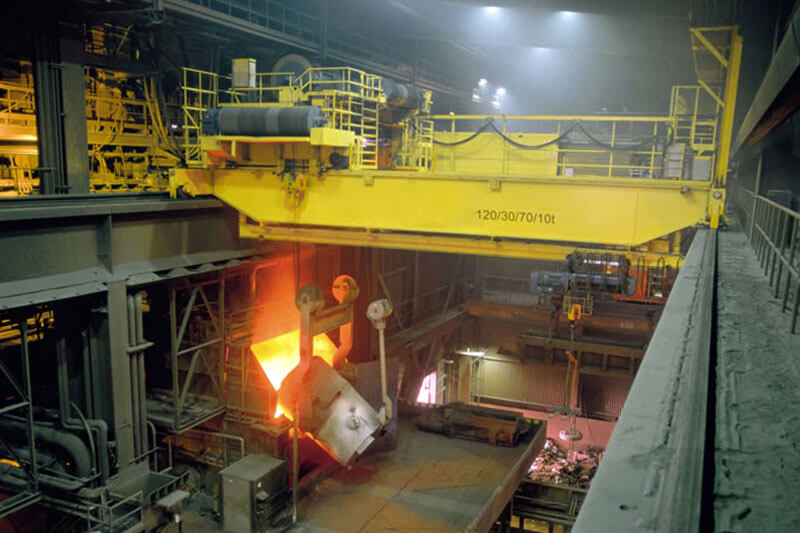
Yuantai Better Crane Ladle Crane for Sale
What Is a Ladle Crane?
A ladle crane is a special type of overhead crane designed specifically for handling molten metal inside a steel mill. Unlike a standard crane used for moving steel plates, machinery, or raw materials, a ladle crane operates directly above furnaces, ladle pits, and casting bays. This places the crane in one of the hottest and most demanding environments in the entire plant. Its structure, hoisting system, and safety features are built to meet the unique challenges of molten steel handling.
In a steel mill, the production flow moves in a fixed sequence. A ladle crane supports this sequence by transporting molten metal through each key stage. Its job is not just lifting—it is part of the timing and coordination of the steelmaking process.
- After the converter (BOF or EAF): The crane picks up a ladle filled with molten steel.
- During refining: It delivers the molten steel to the ladle furnace or refining station for adjustment of chemical composition and temperature.
- Before casting: The crane moves the refined ladle to the continuous caster, where steel is poured into molds to form billets, blooms, or slabs.
This continuous movement means the crane must operate smoothly, stay stable under high temperatures, and keep the ladle steady—especially during pouring.
Transporting molten metal is not a simple lifting task. The load is extremely heavy, the temperature is intense, and the liquid nature of molten steel makes the load dynamic. Even small swings or sudden movements can create risks. To handle this safely, a ladle crane uses:
- High-strength wire ropes and drums
- Redundant braking systems
- Heat-resistant components
- Main and auxiliary hoists for control
Each of these systems ensures the crane can lift, carry, and position the ladle with accuracy.
A ladle crane failure is one of the most serious accidents that can occur inside a steel plant. The consequences are far more severe than the failure of a standard overhead crane.
- Molten metal spill: Hot steel can break through flooring, damage surrounding equipment, and cause severe injury or death.
- Production stoppage: A damaged ladle crane can stop the entire steelmaking line. Restarting operations may take days or weeks.
- Damage to furnaces and casting equipment: Overheating or impact can lead to costly downtime and repairs.
- Structural damage to the building: High-temperature spills can compromise columns, beams, and foundations.
Because the stakes are so high, ladle cranes are designed with strict safety standards, heavy-duty structures, and multiple layers of protection. This is what sets them apart from standard overhead cranes and makes their role in steelmaking essential.
Ladle Crane vs. Standard Overhead Crane: Key Differences
Ladle cranes may look similar to standard overhead cranes at a glance, but the internal design, structure, and safety systems are far more advanced. Each difference exists for one reason: molten metal handling leaves zero room for error. Below is a practical breakdown of how ladle cranes differ in the areas that matter most to steel mill buyers and maintenance teams.
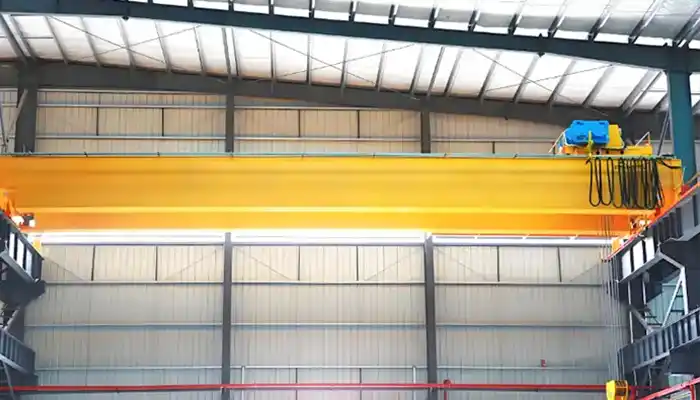
A ladle crane carries one of the heaviest and most dangerous loads in the steel plant. Because of this, its structure is built far stronger than a standard workshop crane.
Key differences include:
- Higher safety factors for molten metal:
Structural parts are designed with extra margins to avoid deformation under extreme heat and weight. - Reinforced girders, end trucks, and connections:
These areas are strengthened to reduce risk of fatigue or cracking during continuous heavy-duty cycles. - Thermal-resistant materials and heavier-duty steel:
Bottom flanges, wheels, and other exposed parts use materials that resist heat radiation coming from molten steel.
Standard overhead cranes rarely need this level of reinforcement because they work in much cooler and more controlled environments.
Ladle cranes operate almost nonstop. The workload is intense, and downtime can disrupt the entire steelmaking process.
Typical classifications:
- Ladle cranes: A6–A8 (heavy to extra-heavy duty)
- Standard overhead cranes: A3–A5 (light to medium duty)
What this means in practice:
- Frequent lifting and traveling across long shifts
- Higher motor load and more hoisting cycles
- Stronger gearboxes and motors to handle extreme conditions
Standard cranes simply don't face these levels of continuous demand.
The molten steel below the crane can reach 1,300–1,600°C, generating intense heat radiation. Without proper protection, electrical parts and mechanical components would fail quickly.
Ladle cranes include:
- Heat shields for the trolley, motors, and electrical boxes
- Insulated cable and festoon systems to prevent melting or hardening
- Heat-resistant coatings on bottom flanges and exposed structural areas
These protections are rarely required for general overhead cranes.
Ladle cranes use a hoisting system designed for both safety and operational precision, especially during the pouring stage.
Key features:
- Main hoist + emergency backup hoist
Ensures the ladle can still be supported even if the main hoist fails. - High-strength wire rope and drums
Designed to withstand extreme weight and heat. - Dual braking systems
A second brake automatically engages if the primary brake has issues. - Smooth speed control
Variable frequency drives allow stable movement while pouring molten metal.
Standard overhead cranes typically use simpler hoisting systems without redundancy.
Ladle cranes are engineered with multiple layers of safety because a failure can cause catastrophic damage.
Common redundant systems include:
- Main + auxiliary brakes for extra stopping capability
- Emergency raising/lowering functions to protect the ladle during malfunction
- Overload protection, limit switches, and encoders to monitor safe movement
- Load sway control for steady handling of liquid metal
Standard cranes usually do not include this many safety layers.
Control systems on ladle cranes are designed for high accuracy and reliability, especially during pouring and ladle positioning.
Key features:
- Fail-safe PLC control platforms
- Real-time monitoring of temperature, load, rope condition, and motor status
- Anti-sway algorithms for stable movement
- Auto-positioning for consistent operation in casting bays
Standard workshop cranes might use simpler relay systems or entry-level PLCs without these advanced monitoring functions.
A steel mill's environment is harsh—dust, fumes, vibration, and temperature changes are constant. Ladle cranes are built to survive this.
Environmental adaptations include:
- Heat-resistant festoon or conductor bar systems
- Sealed electrical components to block dust and fumes
- Heavy-duty motors and gearboxes resistant to vibration and heat
Standard cranes don't require this level of protection because they operate in cleaner, cooler environments.
Ladle cranes require more frequent and detailed checks to ensure safe operation. The inspection routine is far stricter compared with a standard crane.
Typical requirements:
- Shorter inspection intervals for brakes, ropes, and hoisting components
- Predictive maintenance systems to monitor wear and temperature
- More frequent brake and gearbox inspections
- Thermal checks on motors, panels, and exposed surfaces
In contrast, standard cranes follow lighter maintenance schedules because their working conditions are not as severe.
Typical Ladle Crane Configurations
Ladle cranes come in several structural and hoisting arrangements, each designed to handle the extreme demands of steelmaking. While a standard overhead crane might use a simple single-girder or double-girder setup, ladle cranes require stronger frames, specialized hoists, and a layout that keeps the molten metal stable during every movement. Below is a practical breakdown of the configurations most commonly used in steel mills.
Ladle cranes almost always use double-girder or four-girder structures, depending on the size of the ladle and the working environment.
This is the most common type, used in many medium and large steel mills.
- Good balance between strength and cost
- Supports a heavy-duty trolley with redundant hoist systems
- Suitable for A6–A8 duty levels
- Provides adequate space for heat shields and protective covers
This design is used when the load is extremely heavy or when heat protection requirements are stricter.
- Stronger rigidity and torsional resistance
- Higher safety factor for molten steel
- Better distribution of weight across crane wheels
- Ideal for furnaces or casting bays with high radiant heat
Some ladle cranes use two trolleys on the same bridge.
- One trolley carries the main hoist
- The second trolley carries the auxiliary hoist
- Provides better balance and reduces stress on the structure
- Useful for operations with frequent refining and tilting work
This twin-trolley setup gives operators more options during pouring, ladle maintenance, and backup handling.
A ladle crane always comes with at least two hoists—this is part of its built-in safety and operational flexibility.
Main Hoist
- Handles the full ladle weight
- Designed for extreme loads and high temperatures
- Equipped with dual brakes and a heavy-duty gearbox
Auxiliary Hoist
- Supports ladle tilting for pouring
- Helps remove slag, change ladle hooks, or perform maintenance tasks
- Acts as an emergency backup during abnormal conditions
Having two hoists reduces the risk of downtime and gives operators more control during critical steps of the steelmaking process.
Standard overhead cranes follow far simpler configurations because their working conditions are lighter.
Standard Single-Girder Crane
- Used in workshops and warehouses
- Not suitable for high heat or heavy-duty cycles
- Simple hoist and control system
Standard Double-Girder Crane
- Can carry heavier loads than a single-girder
- Still lacks thermal protection and redundancy
- Not built for molten steel handling
- Ladle cranes use heavy-duty main + auxiliary hoists (standard cranes usually have one hoist).
- Structural strength is much higher, often using four-girder setups.
- Heat protection is essential, while standard cranes operate in cooler environments.
- Duty class is higher, requiring stronger motors and gearboxes.
- Control systems are more advanced, including anti-sway and temperature monitoring.
In short, while a standard overhead crane focuses on general lifting tasks, a ladle crane is engineered specifically for molten metal handling, safety redundancy, and long continuous shifts inside a steel plant.
Applications Where Ladle Cranes Are Required
Ladle cranes play a central role in every stage of liquid steel handling. Wherever molten metal needs to be lifted, transferred, or positioned, a standard overhead crane simply cannot meet the safety or performance demands. Below are the key areas in a steel plant where a ladle crane is not just useful—but absolutely required.
In BOF steelmaking, ladle cranes move molten iron from the blast furnace to the converter and then transport refined steel to the next station. The workflow is fast-paced, and each heat must be handled with precise timing.
Why ladle cranes are essential in BOF:
- They transport extremely heavy molten iron ladles safely.
- The heat and dust levels are too extreme for regular cranes.
- The crane must stay stable during tapping and pouring operations.
- High duty cycles and continuous shifts demand A6–A8 performance levels.
Without a ladle crane, the BOF line simply cannot function.
EAF plants rely heavily on ladle cranes because molten steel must be moved repeatedly between the furnace, ladle refining stations, and casting areas.
Common uses in EAF workshops:
- Carrying molten steel after tapping from the EAF
- Transferring the ladle to the ladle furnace (LF)
- Positioning the ladle for alloying, reheating, and refining
- Feeding continuous casters with stable and controlled movement
EAF environments generate intense heat, sparks, and arc radiation, making the ladle crane's thermal protection and heavy-duty components essential.
The continuous casting machine (CCM) is where molten steel becomes billets, blooms, or slabs. Ladle cranes are used to position the ladle over the tundish with careful, steady control.
Why this area requires a ladle crane:
- Smooth speed control prevents turbulence during steel pouring.
- Anti-sway systems maintain steady load positioning.
- Auxiliary hoists assist with tundish swaps and maintenance.
- The crane must work close to the hottest zone in the plant.
Even a slight swing or vibration can affect casting quality, which is why precision motion control is important here.
After the initial melt, steel must be refined to adjust its chemical composition and temperature. Ladle cranes handle all transfers between these refining stations.
Typical tasks include:
- Moving ladles to and from the ladle furnace (LF)
- Transporting molten steel to RH/VD/VOD refining units
- Supporting slag removal operations
- Coordinating with auxiliary hoists for ladle tilting and lifting tools
Refining requires repeated lifting cycles, high accuracy, and fast turnaround—conditions that standard overhead cranes are not designed for.
Across BOF plants, EAF operations, refining stations, and continuous casting lines, a ladle crane is the backbone of liquid steel handling. Its design, structure, and safety systems allow it to operate reliably in environments where molten metal, constant heat, and fast-moving production schedules leave no room for error.
Why Standard Overhead Cranes Cannot Replace Ladle Cranes
A standard overhead crane may be suitable for lifting raw materials, equipment, or finished products, but it is not designed to handle molten metal. The demands of steelmaking are far beyond what a normal crane can safely manage. Below is a clear explanation of why a standard overhead crane cannot be used as a substitute for a ladle crane—both from a safety and legal standpoint.
Ladle handling involves a unique combination of extreme weight, temperature, and continuous duty. A standard crane is simply not engineered for these risk conditions.
- Standard cranes use lower safety factors.
- Their girders, end carriages, and wheel systems are not designed to carry molten metal loads for long periods.
- Heat radiation from the ladle can weaken bottom flanges and welds.
A sudden failure here could lead to catastrophic damage.
- Standard cranes usually have one brake per hoist.
- Ladle cranes use dual or even triple braking systems with redundancy.
If the brake on a standard crane fails while lifting molten steel, there is no backup to stop the load.
- Standard wire ropes are not tested for heat exposure.
- Ladle cranes use high-strength wire ropes with strict inspection cycles and overheating protection.
A rope break during molten steel lifting is one of the most dangerous events in a steel plant.
- Motors, cables, festoons, and gearboxes of standard cranes cannot tolerate radiant heat from 1,300–1,600°C molten steel.
- Insulation melts or hardens, causing electrical failure.
- Brake linings can overheat and lose friction.
This makes standard cranes unsafe anywhere near a ladle bay or furnace.
Global crane standards clearly distinguish between general-purpose cranes and molten metal handling cranes. These standards specify different safety factors, redundancy requirements, and thermal protection measures.
Relevant Standards Include:
- FEM (European Materials Handling Federation) – Special regulations for molten metal duty
- CMAA (Crane Manufacturers Association of America) – Duty classes and ladle crane requirements
- GB/T (China National Standards) – Detailed codes for lifting molten metal
- IEC Standards – Electrical protection and heat resistance rules
These standards require features such as:
- Secondary brakes
- Emergency hoisting capability
- Thermal shielding
- Overload protection for extreme-duty cycles
- Higher structural fatigue resistance
A standard overhead crane is not compliant with these codes for molten metal handling.
Insurance companies treat molten metal handling as a high-hazard operation. Using a non-ladle crane exposes the steel plant to major liabilities.
Typical insurance requirements:
- Certified molten metal handling equipment
- Redundant safety systems
- Documented thermal protection
- Strict inspection intervals
- Compliance with FEM, CMAA, GB, or other national standards
If an accident occurs with a standard overhead crane used improperly for ladle lifting:
- Insurance claims may be denied.
- The plant may face penalties for violating industrial safety regulations.
- The entire facility may fail compliance audits.
In many countries, using a general-purpose crane for molten steel handling is outright prohibited.
A standard overhead crane cannot replace a ladle crane due to:
- Higher risk of structural or mechanical failure
- Lack of redundancy and heat protection
- Incompatibility with molten metal safety standards
- Insurance and legal compliance issues
Simply put, ladle cranes exist for a reason: they are built to handle one of the harshest and most dangerous lifting tasks in the industrial world. Standard cranes are not.
Key Specifications Buyers Must Confirm for a Ladle Crane
To ensure safe and reliable molten-steel handling, every buyer should verify the following core specifications before finalizing a ladle crane order:
1. Rated Load and Safety Margin
- Confirm the crane’s nominal capacity.
- Ensure the safety factor meets steel-plant standards (typically 1.2–1.5× for ladle lifting).
2. Duty Cycle Classification
- Verify the working grade (A6, A7, or A8).
- Higher duty grades are essential for continuous, high-temperature operations.
3. Redundant Safety Systems
- Dual hoisting mechanisms (main + auxiliary or twin-drum).
- Redundant braking systems to prevent accidental drop.
4. Thermal Protection Requirements
- Heat-insulated electrical components.
- Extra shielding for hoist, trolley, and bottom block.
- Protection for cables, limit switches, and motors from radiant heat.
5. Control & Monitoring System
- Ensure compatibility with PLC control or smart monitoring.
- Check for sway control, load display, fault diagnostics, and safety interlocks.
6. Environmental Adaptation Needs
- Verify protection levels for dust, humidity, corrosive fumes, or high temperatures.
- Confirm enclosure ratings (IP55/IP65 where required).
7. Optional Automation or Smart Features
- Semi-automatic or fully automatic ladle handling.
- Position memory, anti-skew, collision avoidance, and data recording.
Conclusion
A ladle crane is not just another overhead crane—it is a highly specialized steel mill crane designed to handle molten steel safely under extreme heat, heavy loads, and continuous duty conditions. Its engineering, components, and safety features are far more demanding than standard workshop cranes.
For buyers, the key takeaway is simple:
Carefully verifying the unique specifications, protection measures, and redundant safety systems of a ladle crane is essential. Doing so ensures operational safety, regulatory compliance, and long-term reliability in one of the harshest industrial environments.