
10 Ton Low Headroom Single Girder Overhead Crane
Why 10 Ton Low Headroom Design Matters in Real Workshop Conditions
In many real industrial workshops, the biggest limitation is not lifting capacity, but usable height. A factory may already have enough structural strength and floor space, but the roof height cannot be changed. This is where a 10 ton low headroom overhead crane becomes practical.
Instead of increasing building height, the crane is designed to reduce internal space loss inside the hoisting system. This allows more lifting height under the same roof, which directly improves handling efficiency in daily production.
In real operation, even a small increase in hook height can reduce repeated lifting steps, improve installation accuracy, and shorten handling time.
What problem it is solving in industrial use
This section explains the practical limitations that low headroom design is intended to solve in real workshop conditions.
Many factories already have fixed building structures where roof height cannot be modified. In these cases, installing a standard crane often results in insufficient lifting height for real production needs.
Traditional crane structures consume more vertical space inside the hoisting system, which reduces usable hook height. This becomes a major limitation in low ceiling workshops.
Many industrial operations involve lifting taller components or assemblies. Without sufficient hook height, operators are forced to adjust or reposition loads multiple times, reducing efficiency.
In retrofit projects, modifying the building structure is often too costly or impossible. Low headroom cranes allow upgrading lifting capacity without changing the existing workshop layout.
Why 10 ton capacity is commonly selected
The 10 ton range is widely used in industrial environments because it matches many real production loads without being oversized or inefficient.
Many industrial parts such as fabricated steel components, machine assemblies, and equipment units fall within the 10 ton handling range, making it a balanced choice for general production use.
This capacity is frequently used in steel workshops and machining facilities where regular lifting of structural parts and machine components is required.
10 ton cranes are commonly used for assembly lines and maintenance workshops where equipment needs to be lifted, positioned, or replaced during production cycles.
The 10 ton range provides a practical balance between investment cost and lifting capability, making it suitable for a wide range of industrial applications.
Typical workshop environments where it is needed
This crane type is widely used across different industries wherever lifting height becomes the main limiting factor in production.
Used for lifting steel beams, welded structures, and heavy fabricated components during production and assembly processes.
Common in machining environments where molds, machine bodies, and heavy mechanical parts require controlled lifting and positioning.
Used in warehouse systems where goods need to be stacked or loaded vertically within limited space conditions.
Applied in production lines where repeated lifting and precise positioning of components are required for continuous workflow.
Core design idea behind low headroom structure
The engineering principle is to reduce unnecessary vertical space inside the crane system so that more of the building height is used for actual lifting work.
The hoist is installed closer to the main girder, reducing unnecessary vertical distance and improving usable lifting height.
Compared with standard crane systems, the top hook limit is significantly reduced, allowing more effective lifting range within the same building height.
The trolley system is redesigned to reduce vertical space consumption, improving structural compactness and lifting efficiency.
This design allows workshops to gain additional lifting height without modifying the building structure, making it ideal for retrofit projects.
How Low Headroom Design Improves Lifting Efficiency in 10 Ton Cranes
In a 10 ton lifting system, efficiency is not only about how much weight the crane can carry, but how effectively it uses the available vertical space. Low headroom design directly improves this by reducing wasted height inside the crane structure.
This results in a more practical lifting range, especially in workshops where every millimeter of height affects production flexibility.
The main advantage comes from reducing the vertical distance between the hook and the crane beam. Compared with standard cranes, less space is wasted in the hoist structure itself, which directly increases usable lifting height.
- Reduced top hook limitation improves vertical reach
- Compact hoist structure minimizes space loss
- More effective use of existing building height
- Better performance in low ceiling workshops
Standard LD cranes use conventional hoist arrangements that occupy more vertical space. Low headroom cranes modify the hoist position and trolley structure to reduce this loss.
- LD crane: higher structural height loss in hoist system
- Low headroom crane: compact hoist design with reduced space waste
- Improved lifting height under same workshop conditions
- Better suited for retrofit and low ceiling applications
Frequency inverter control improves not only safety but also positioning accuracy during lifting and traveling operations.
- Smoother start and stop reduces load swing
- Improved positioning accuracy for assembly work
- Reduced mechanical stress on motor and gearbox
- Better control in precision lifting applications
In retrofit projects, the building structure already exists, so the crane must adapt to the available space instead of requiring construction changes.
- No need for roof height modification
- Better use of existing workshop structure
- Lower overall project cost compared to building expansion
- Faster installation and commissioning process
The main advantage comes from reducing the vertical distance between the hook and the crane beam. Compared with standard cranes, less space is wasted in the hoist structure itself, which directly increases usable lifting height.
- Reduced top hook limitation improves vertical reach
- Compact hoist structure minimizes space loss
- More effective use of existing building height
- Better performance in low ceiling workshops
Standard LD cranes use conventional hoist arrangements that occupy more vertical space. Low headroom cranes modify the hoist position and trolley structure to reduce this loss.
- LD crane: higher structural height loss in hoist system
- Low headroom crane: compact hoist design with reduced space waste
- Improved lifting height under same workshop conditions
- Better suited for retrofit and low ceiling applications
Frequency inverter control improves not only safety but also positioning accuracy during lifting and traveling operations.
- Smoother start and stop reduces load swing
- Improved positioning accuracy for assembly work
- Reduced mechanical stress on motor and gearbox
- Better control in precision lifting applications
In retrofit projects, the building structure already exists, so the crane must adapt to the available space instead of requiring construction changes.
- No need for roof height modification
- Better use of existing workshop structure
- Lower overall project cost compared to building expansion
- Faster installation and commissioning process
Main Structural Design Features
The 10 ton low headroom single girder overhead crane is built around one practical requirement: make full use of limited workshop height while still keeping stable and safe 10 ton lifting performance. Each part of the structure is designed to reduce wasted space and improve usable hook height without complicating installation.
The crane uses a top running single girder bridge structure, which is one of the most common layouts in industrial workshops. The main beam is designed in a square box-shaped form to improve rigidity while keeping the structure compact.
- Square box-shaped main beam improves overall strength and stability
- High rigidity design reduces beam deformation during 10 ton lifting
- Suitable for continuous industrial operation under A3 working class conditions
- Works well in standard runway beam systems without special foundation changes
In practical use, this structure helps maintain stable lifting performance even when the load is not perfectly centered, which is common in industrial workshop operations.
The key feature of this crane is how the hoist is integrated into the beam system. Instead of hanging lower like traditional designs, the hoist is arranged closer to the runway beam level to reduce wasted vertical space.
- Hoist installed in a compact position near the beam
- Reduced top hook limit distance improves lifting height
- Better use of vertical space inside fixed-height workshops
- More effective lifting range for taller workpieces
In industrial working conditions, this means operators gain more usable lifting height without changing the building structure. It is especially useful in retrofit factories where every millimeter of clearance matters.
The traveling system is designed to ensure smooth and stable movement of the crane along the runway beams. Even when handling 10 ton loads, the motion remains controlled and consistent.
- Crane travels smoothly along standard runway beams
- Wheel arrangement optimized for load balance and stability
- Reduced vibration during long-distance movement
- Stable operation during frequent start-stop cycles
In actual workshop use, this helps reduce unnecessary sway and improves positioning accuracy when moving heavy components across production areas.
All structural elements are optimized with one goal in mind: improving usable lifting height in restricted workshop conditions. This ensures the crane performs effectively even in low clearance environments.
- Reduced unnecessary vertical structural space
- Improved hook travel range within fixed workshop height
- Better adaptation to retrofit and old factory buildings
- Balanced design between strength and compact structure
This makes the crane a practical solution for workshops where structural modification is not possible but lifting performance still needs to be improved.
Lifting Height Advantages
For most workshop owners, the first question is not about structure or design drawings. It is very direct: "How much lifting height will I actually get?" This is where the 10 ton low headroom overhead crane shows its main value in industrial installation projects.
Compared with a standard LD single girder crane, the difference is not in load capacity, but in how much usable vertical space is left for lifting work.
The low headroom design places the hoist closer to the main beam, which directly improves the hook position under the crane.
- Higher hook travel compared with standard LD single girder crane
- Reduced top hook limitation inside the crane structure
- More usable lifting stroke for the same workshop height
- Better performance in low-clearance industrial buildings
In practical terms, operators often notice that taller parts can be lifted without changing lifting methods or re-positioning the load multiple times.
One of the main reasons this crane is selected is simple: the building does not change, but the usable lifting height improves.
- Same workshop height, more working lifting space
- Better adaptation to existing factory structures
- No need for roof modification or steel column changes
- Helps maximize usable space in retrofit installations
In industrial projects, this is often the deciding factor when replacing older cranes or upgrading production capacity in an existing plant.
Standard crane systems lose part of the lifting height due to the hoist and trolley arrangement. The low headroom design reduces this loss by compacting the upper structure.
- Compact hoist reduces unnecessary vertical gap
- Lower top hook dimension improves space efficiency
- Less structural "dead height" above the hook
- More of the crane height is used for actual lifting
This is not a theoretical improvement. In workshops with limited height, it directly affects how large a component can be lifted in one operation.
When workshop height is limited, small improvements in lifting height often translate into smoother daily operation. It reduces unnecessary adjustments and saves time during positioning work.
- Easier lifting of taller components in confined spaces
- Fewer secondary adjustments during installation work
- Better workflow in steel and machinery workshops
- More stable handling in narrow clearance conditions
In industrial use, this means the crane fits the building instead of forcing the operator to work around its limitations.
Technical Specifications Typical 10 Ton Model
The 10 ton low headroom single girder overhead crane is commonly used in general industrial workshops where lifting is frequent but not extremely heavy-duty. The configuration below represents a typical working setup, but final design is always adjusted according to workshop height, span, and industrial load conditions.
In industrial projects, small differences in span or power supply can change the final configuration, so these parameters are usually confirmed after site information is provided.
- Capacity: 10 ton
- Span range: 7.5–28.5 m
- Working duty: A3 (standard workshop operation)
- Power supply: 3-phase 380V 50Hz (customized for different countries if needed)
- Installation type: Top running single girder structure for indoor workshop use
These values are commonly selected for medium-size factories, especially where production runs on a steady daily cycle rather than continuous heavy-duty lifting.
The operating performance is designed to balance smooth control and practical efficiency in daily workshop work.
- Lifting speed: dual-speed or variable frequency (VFD) control
- Trolley and crane traveling: stable movement for controlled positioning
- Smooth start and stop to reduce load swing
- Suitable for repeated lifting cycles in production environments
In actual use, operators usually prefer dual-speed or VFD systems because it makes positioning easier when handling steel parts, molds, or machine components.
Different control methods can be selected depending on workshop layout and operator preference.
- Pendant control for basic operation close to the load area
- Wireless remote control for safer distance operation
- Optional cabin control for larger or more complex workshop layouts
Each control mode is used based on how the production line is arranged. For example, remote control is often preferred in steel workshops where operators need better visibility and mobility.
This crane type is mainly used indoors, where steel structure runway beams are already installed or planned.
- Indoor industrial workshops with fixed runway beams
- Steel fabrication and machining production areas
- Equipment assembly and maintenance workshops
- Warehouse lifting systems with regular 10 ton handling tasks
In industrial factory conditions, it is usually selected when users need stable daily operation rather than occasional lifting.
Low Headroom Hoist Options for 10 Ton Overhead Crane
The hoist is the key part that directly decides how much lifting height you actually get from a 10 ton low headroom overhead crane. In industrial workshop projects, even when the crane structure is the same, different hoist choices can change the usable hook height and operating comfort.
That is why hoist selection is usually discussed early, especially for factories with limited ceiling height or retrofit installations.
This is the most commonly used option for 10 ton low headroom single girder cranes. It is designed to reduce the top hook limit and improve lifting height compared with standard CD/MD hoists.
- Increases net headroom by about 200–500 mm
- Alloy steel gearbox with multi-stage reduction system for stable operation
- Motor insulation class F with IP54 protection for industrial environments
- Optional configurations: dual speed, VFD control, overload protection
In practical use, this type is often selected for general manufacturing workshops where the working environment is stable and maintenance conditions are normal.
The chain hoist version is used in more compact or limited-space workshops where installation space is tight and lifting requirements are not extremely heavy-duty.
- Compact body structure suitable for low-clearance areas
- High space utilization with reduced hook blind zone
- Suitable for light to medium-duty lifting applications
- Can be used with overhead cranes, jib cranes, and hoist systems
In industrial applications, it is often seen in maintenance workshops or small production areas where flexibility and space efficiency are more important than high-speed operation.
This version is designed with a more integrated and modular structure. It focuses on improving lifting efficiency, reducing maintenance workload, and providing smoother operation in continuous industrial use.
- Modular structure: motor, drum, gearbox, and wheel set separated for easy service
- Large diameter drum improves lifting height efficiency and reduces cable stress
- Maintenance-free design with pre-lubricated components
- Low operating noise, generally below 70 dB
- Energy-saving motor with up to 30% reduced power consumption
- Clean operation with minimal dust and no metal particle pollution
In practical workshop use, this type is often chosen where long-term operation stability and lower maintenance frequency are more important than initial cost.
Single Girder Low Headroom Crane vs Standard LD Crane (10 Ton Comparison)
When a workshop is already built, the roof height becomes a fixed condition. At that point, the choice between a standard LD single girder crane and a low headroom 10 ton crane is not about capacity, but about how much lifting height you can actually use in daily work.
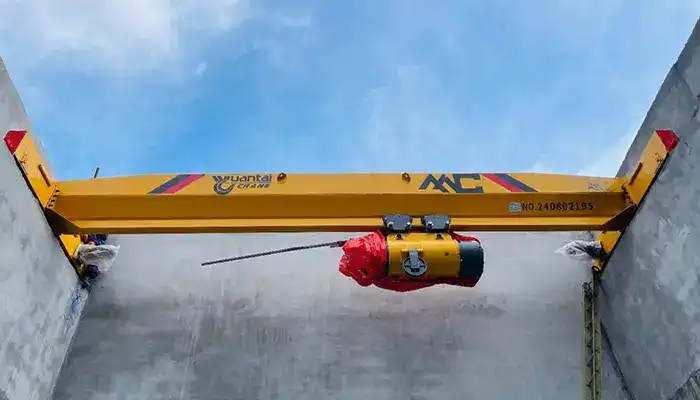 LD Series of single girder overhead crane 10 ton
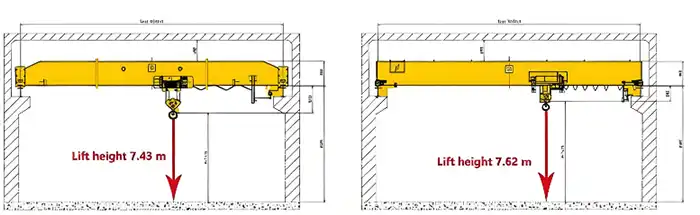
LD overhead crane 10 ton VS LDC low headroom overhead crane 10 ton
Both cranes can handle the same 10 ton load. The difference appears when you start lifting taller parts or working inside a restricted-height building.
In most retrofit or existing factory projects, the building structure is not changed. The crane must adapt to the available space.
- Both cranes installed under the same roof height
- Same runway beam elevation and span conditions
- Same 10 ton working capacity requirement
- Different internal structure affects usable lifting height
In industrial projects, this is the point where users usually notice the limitation of a standard LD crane.
The main advantage comes from how the hoist is arranged closer to the main beam, reducing wasted vertical space inside the crane structure.
- Typical gain: about 0.5 meters of additional lifting height
- More usable hook travel in the same building height
- Reduced top hook limitation compared with LD crane
- Better performance in low-clearance workshops
In practice, this extra height can decide whether a component can be installed directly or needs secondary lifting steps.
In industrial workshop operation, lifting height is not just a number on paper. It affects how easily workers can assemble, position, and install large parts.
- Easier assembly of taller steel or machine components
- Fewer lifting adjustments during positioning work
- More efficient use of vertical workspace
- Improved workflow in compact production areas
Operators often notice the difference during installation work, especially when handling large frames or equipment housings.
Standard cranes can still work in low buildings, but they often limit flexibility during lifting. The low headroom design reduces these constraints in daily operation.
- Less restriction when lifting tall workpieces
- Lower risk of "insufficient hook height" issues
- Smoother handling in confined industrial spaces
- More practical for retrofit and old factory upgrades
In industrial environments, this difference is not about theory. It directly affects how fast and how comfortably lifting tasks can be completed on site.
Low Headroom Crane vs European Low Headroom Crane 10 Ton Comparison
In 10 ton low headroom crane projects, the choice is often not only between "low headroom or standard," but also between different low headroom design philosophies. The most common comparison is the traditional LDC-type low headroom crane and the European-style low headroom crane.
 European Low Headroom Crane 10 Ton
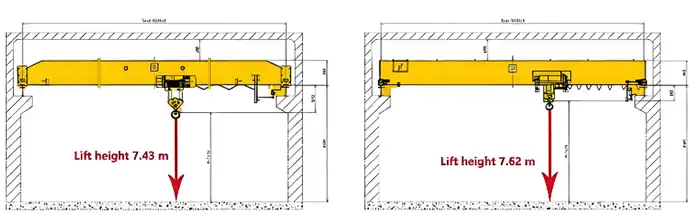
Traditional 10 Ton Overhead Crane vs European Low Headroom Crane 10 Ton Comparison
Both can work in the same workshop conditions, but their structure and long-term operating behavior are not exactly the same. In industrial projects, the decision usually comes down to lifting height demand, maintenance expectations, and budget planning.
The European low headroom design focuses more on compact integration of the hoist system. The structure is tighter, and the lifting mechanism is optimized to reduce unnecessary vertical space.
- In some configurations, lifting height improves by around 0.19 m
- Compact drum and hoist layout reduces wasted space
- Better hook travel efficiency in limited-height workshops
- Suitable for projects where every small increase in lifting height matters
In practical use, this difference may look small on paper, but in low-clearance workshops, it can affect whether a component clears the lifting path in one operation.
The biggest structural difference is how the crane system is built and maintained.
- European type uses a modular design (motor, gearbox, drum, wheel set separated)
- Traditional low headroom crane uses a more integrated, conventional layout
- Modular system allows easier part replacement and maintenance access
- Traditional structure is simpler and often more cost-controlled
In industrial workshop maintenance conditions, modular design usually means less downtime when service is needed, especially in continuous production environments.
The European-style low headroom crane is designed with more focus on long-term operation stability and reduced maintenance frequency.
- Pre-lubricated components reduce routine servicing work
- High precision gearbox reduces wear over time
- Maintenance-free or low-maintenance design elements in key parts
- Cleaner operation with reduced dust and mechanical residue
In practice, this is useful for factories that run frequent lifting cycles and want to reduce shutdown time for maintenance checks.
The difference between the two types is not only technical, but also financial. Each option fits a different type of project.
- Traditional low headroom crane: lower initial investment, widely used in general workshops
- European low headroom crane: higher initial cost, but better efficiency and lower maintenance demand
- Choice depends on project budget, working frequency, and lifting precision requirements
In industrial purchasing decisions, many users choose based on workshop condition first, then adjust based on long-term operating cost expectations. For light or medium-duty usage, traditional type is often sufficient. For higher efficiency or more intensive production, European design becomes more practical over time.
Applications of 10 Ton Low Headroom Overhead Crane
A 10 ton low headroom overhead crane is not limited to one specific industry. It is usually selected in situations where the workshop height is already fixed, but lifting work still needs to be stable, frequent, and controlled. In industrial projects, it is often used as a replacement or upgrade solution for existing crane systems.
Below are the most common application environments where this type of crane is used in practice.
Steel fabrication is one of the most common use cases. Large steel sections, welded structures, and assembled frames often require 10 ton level lifting with enough vertical clearance.
- Lifting steel beams, plates, and welded assemblies
- Handling long or uneven structural components
- Suitable for indoor fabrication lines with fixed roof height
- Helps improve assembly efficiency in limited space workshops
In industrial use, the extra lifting height is often used to simplify positioning during assembly work.
Machine building workshops often deal with medium-heavy components that need stable lifting and accurate placement.
- Lifting machine bases, housings, and assembled units
- Supporting production line assembly operations
- Suitable for controlled lifting and positioning tasks
- Works well in continuous production environments
Operators usually prefer low headroom design here because it reduces repositioning during installation.
In mold workshops and precision machining areas, lifting space is often limited, but accuracy is important.
- Handling molds, tooling, and precision equipment
- Controlled lifting with stable movement
- Reduced swing during positioning
- Better use of vertical space in compact workshops
In practice, smoother lifting control is often more important than lifting speed in these environments.
Warehouses with fixed structures often use overhead cranes for internal material handling, especially for heavy goods or steel products.
- Lifting and stacking heavy materials
- Supporting internal logistics flow
- Suitable for limited-height storage buildings
- Improves vertical space utilization
This helps increase storage efficiency without changing building structure.
This is one of the main reasons low headroom cranes are selected. Many factories already exist and cannot be rebuilt.
- Installed in existing workshop structures
- No modification required for building height
- Replaces older cranes with better lifting performance
- Helps recover lost lifting height in old systems
In industrial projects, this is often the most practical and cost-sensitive application.
Assembly and maintenance areas require frequent lifting and precise positioning of equipment parts.
- Used for equipment installation and repair work
- Frequent lifting cycles with controlled movement
- Suitable for workshop maintenance platforms
- Helps reduce manual handling in assembly processes
In actual operation, the crane is often used for repeated lifting and positioning rather than single heavy lifts.
How to Select the Right 10 Ton Low Headroom Crane
Choosing a 10 ton low headroom overhead crane is usually not about picking a standard model from a catalog. In industrial workshop projects, the selection depends heavily on site conditions, especially building height and how the crane will be used day to day. A small mistake in early data can lead to limited lifting height after installation, so the basic parameters must be clear before design.
The first step is always to confirm the industrial usable height inside the workshop. Not the drawing height, but the actual clearance after beams, lights, and structures are considered.
- Measure from floor to lowest obstruction inside workshop
- Include roof beams, lighting systems, and ventilation ducts
- Confirm whether there is enough space for crane installation and maintenance
- Avoid using estimated or rounded values
In practice, many lifting problems come from incorrect height assumptions at the beginning.
Lifting height is the most important parameter for low headroom crane selection. It directly affects whether the crane can complete the required work without restriction.
- Define maximum lifting height needed for industrial operation
- Consider tallest workpiece + lifting rigging height
- Check if full lifting stroke is required or partial lifting is acceptable
- Ensure clearance for safe handling at upper limit
In industrial projects, this step often decides whether a low headroom design is necessary or not.
The crane span and runway beam structure must match the workshop layout and load distribution.
- Confirm span between runway beams accurately
- Check structural strength of existing beams or design new ones if needed
- Ensure beam alignment for smooth crane travel
- Verify installation conditions for top running system
If the runway beam is not properly aligned, even a good crane will not perform smoothly.
The working intensity of the crane affects motor selection, structure design, and service life.
- Light duty: occasional lifting, low frequency use
- Medium duty: regular daily operation in production lines
- Heavy duty: continuous or high-frequency lifting environment
- Duty class affects motor power and structural reinforcement
In practice, many 10 ton cranes fall into A3–A5 duty range depending on workshop activity.
The installation environment affects protection level and structural design requirements.
- Indoor use: standard configuration suitable for controlled environments
- Semi-outdoor use: requires additional protection for dust, moisture, or temperature changes
- Consider corrosion protection if environment is humid or industrially harsh
- Electrical system protection level may need upgrading
This factor is often overlooked but becomes important after long-term operation.
Control method affects both operator convenience and lifting accuracy during daily work.
- Pendant control: simple and reliable for close-range operation
- Wireless remote control: safer and more flexible for workshop movement
- VFD (variable frequency drive): smoother start/stop and better positioning control
- Optional cabin control for larger or more complex workshop layouts
In industrial use, remote control and VFD systems are often preferred for improving positioning accuracy and reducing load swing during lifting.
Installation Requirements and Workshop Conditions (What Must Be Confirmed Before Choosing a 10 Ton Low Headroom Crane)
For a 10 ton low headroom single girder overhead crane, installation is not only about fitting the crane into the workshop. It is about ensuring the building structure, available height, and working space can support safe operation while achieving the required lifting height.
Below are the key conditions that must be checked before final design and quotation.
Measure the clear height from floor to roof structure accurately
Calculate total required space including:
- Crane main beam height
- Hoist structure height
- Required lifting height (hook height)
- Safety clearance margin
Low headroom design can increase usable lifting height by approximately 200–500 mm compared with standard cranes, but only if the workshop dimensions are correctly confirmed.
A common mistake is only measuring building height without considering beam position and hook travel loss.
The runway beam must support:
10 ton rated load with dynamic impact
- Crane self-weight during operation
Key inspection points include:
- Beam size and steel grade
- Column spacing and support condition
- Existing structure condition for retrofit projects
If the structure is not strong enough, reinforcement or new supporting columns may be required before installation.
Confirm hook working range on both sides of the workshop
Ensure the crane can cover the full production area without obstruction
Check for interference from:
- Walls
- Columns
- Fixed production equipment
Hook limit dimensions depend on end carriage design and crane configuration. In narrow workshops, this becomes a critical design factor.
Standard power supply is typically 3-phase 380V, 50Hz, with customization available for different regions
Verify:
- Voltage stability under full load operation
- Factory electrical capacity
- Cable routing safety and protection
Optional electrical configurations may include:
- Frequency inverter control for smooth operation
- Soft start systems
- Overload and motor protection systems
Ensure sufficient space for routine maintenance tasks such as:
Hoist inspection
- Gearbox servicing
- Brake adjustment
- Wire rope or chain replacement
Although low headroom cranes are designed for compact workshops, maintenance space is still necessary to ensure long-term safety and performance.
A common issue in tight workshops is that the crane fits operationally but becomes difficult to service later.
Engineering Advantages of Low Headroom Design
The 10 ton low headroom single girder overhead crane is designed specifically to solve one core problem in industrial workshops with limited height: how to maximize lifting height without increasing building cost. Its engineering structure is optimized to reduce wasted vertical space and improve overall operating efficiency.
The most important advantage of a low headroom design is the reduced top hook limit.
- The hoist structure is compactly designed to minimize the distance from the hook to the crane beam
- Compared with standard hoists, it significantly reduces "non-working height" loss
- In the same workshop height, this design can increase usable lifting height by approximately 200–500 mm
This improvement directly solves the problem of insufficient lifting height in existing workshops.
Low headroom cranes use a more compact structural integration between the main beam and trolley system.
- The hoist runs closer to the lower flange of the main beam
- Side-mounted or partial-suspension arrangement reduces vertical space waste
- Improves overall structural efficiency of the single girder top running system
This integration allows better space utilization without compromising load capacity.
Modern low headroom cranes often use frequency inverter (VFD) control systems.
- Enables smooth acceleration and deceleration during lifting and traveling
- Reduces load swing during operation
- Improves positioning accuracy to millimeter-level in precision applications
- Suitable for assembly lines and mold handling environments
This is especially valuable in workshops requiring controlled and precise load placement.
To improve reliability in industrial conditions, the crane system adopts protective structural design.
- Enclosed or semi-enclosed hoist housing
- Protection against dust, metal particles, and workshop debris
- Suitable for steel fabrication plants, machining workshops, and heavy-duty environments
This design helps maintain stable performance even under continuous industrial operation.
Low headroom cranes are designed with improved component durability.
- Lubrication-optimized gearbox system reduces wear
- High-quality bearings reduce friction and maintenance frequency
- Enclosed structure protects key components from contamination
Compared with conventional hoist systems, maintenance intervals can be significantly extended, reducing downtime and long-term operating costs.
Price Range for 10 Ton Low Headroom Overhead Crane
The price of a 10 ton low headroom single girder overhead crane is not fixed. It varies based on technical configuration, workshop conditions, and required performance level. For most industrial buyers, it is considered a mid-range investment in the overhead crane category, balancing cost efficiency with improved lifting height.
The final cost is mainly determined by the following technical parameters:
Span length
- Longer spans require stronger main beams and higher structural reinforcement
- Directly increases steel usage and manufacturing cost
Duty class (working level)
- Light-duty (A3) is standard for most workshops
- Higher duty classes require upgraded motors, gears, and structural design
Hoist configuration
- Standard low headroom hoist (most economical option)
- Chain hoist (compact but limited application range)
- European-style hoist (higher efficiency, higher cost)
Control system
- Pendant control (basic configuration)
- Wireless remote control (medium cost)
- Frequency inverter (VFD) control for precision operation (higher cost)
For a standard configuration 10 ton low headroom single girder overhead crane:
- Basic industrial configuration: mid-budget range
- Price is generally higher than standard LD single girder cranes due to improved lifting height design
- Still significantly more economical than double girder or full European heavy-duty systems
This makes it a cost-effective solution for workshops with height limitations that need maximum lifting efficiency without rebuilding the facility.
Final pricing cannot be accurately confirmed without project details. A proper quotation requires:
- Workshop span
- Building height and clearance conditions
- Required lifting height
- Duty cycle and working frequency
- Control and hoist selection
- Installation environment (new or retrofit project)
For accurate pricing, a detailed workshop drawing or site photos are typically required so engineers can match the crane design to industrial working conditions.
Instead of focusing only on initial purchase price, most industrial buyers evaluate:
- How much lifting height is gained
- Whether building modification can be avoided
- Long-term maintenance cost
- Production efficiency improvement
In many cases, the low headroom design reduces overall project cost by eliminating the need for structural building changes, making it more economical at the system level.
Common Buyer Mistakes When Choosing a 10 Ton Overhead Crane
When selecting a 10 ton low headroom single girder overhead crane, many buyers focus mainly on price or rated capacity. However, in industrial workshop conditions, most problems come from incorrect planning of height, structure, and future usage requirements rather than the crane itself.
Below are the most common mistakes that lead to reduced lifting efficiency, higher modification costs, or operational limitations.
One of the most frequent errors is choosing a conventional electric hoist instead of a low headroom hoist.
- Standard hoists reduce usable lifting height in low-ceiling workshops
- More vertical space is wasted in the hoist structure
- Final hook height becomes insufficient for industrial operations
In limited-height workshops, this mistake can directly affect whether the crane can complete required lifting tasks.
Many buyers only consider crane capacity and span, but ignore the actual building height.
- Failing to calculate total vertical space including beams and hoist structure
- Not considering hook travel loss and safety clearance
- Assuming the crane will "automatically fit" into the workshop
In industriality, workshop height is often the most critical constraint in crane selection.
Another common issue is focusing on capacity (10 ton) while underestimating lifting height needs.
- Not considering the actual height of lifted materials or equipment
- Ignoring lifting clearance required for safe operation
- Overlooking future changes in product size or handling requirements
This often results in insufficient lifting space even if the crane capacity is correct.
Many crane systems are selected based only on current production needs.
- Future equipment may be larger or heavier
- Production layout may change over time
- Higher lifting frequency may require upgraded duty class
Failing to consider future expansion can lead to early system replacement or costly upgrades.
The runway beam system is often underestimated during planning.
- Beam strength may be insufficient for 10 ton load operation
- Incorrect beam spacing can limit crane movement
- Existing structures may require reinforcement or redesign
If runway conditions are not properly evaluated, even a correctly selected crane cannot operate safely or efficiently.
Key Buyer Insight
A 10 ton overhead crane is not only selected based on tonnage. In industrial industrial applications, performance depends heavily on:
- Available workshop height
- Hoist type and headroom design
- Structural runway beam strength
- Future operational requirements
Avoiding these common mistakes ensures better lifting height utilization, safer operation, and lower long-term installation costs.
Customization Options for a 10 Ton Low Headroom Single Girder Overhead Crane
A 10 ton low headroom overhead crane is rarely a "standard product." In industrial industrial projects, especially in limited-height workshops, most cranes are customized to match building conditions, production flow, and lifting requirements.
Below are the key customization options commonly required by workshop and industrial buyers.
Crane span and lifting height are the two most critical design parameters.
- Span can be customized to match workshop width and runway beam layout
- Lifting height is adjusted based on actual ceiling height and hook requirements
- Low headroom design is especially effective when maximizing lifting height in restricted buildings
Proper adjustment ensures full coverage of the working area without wasting space or reducing lifting efficiency.
Frequency inverter control is widely used in modern 10 ton cranes.
- Enables smooth acceleration and deceleration
- Reduces load swing during lifting and traveling
- Improves positioning accuracy for assembly and precision handling
- Extends motor and gearbox service life by reducing mechanical impact
This option is especially important for workshops requiring controlled and precise load movement.
Different operation modes can be selected depending on workshop layout and safety requirements.
- Pendant control for basic operation
- Wireless remote control for flexible movement and improved safety
- Operator cabin control for large-span or high-frequency operations
Remote systems are commonly preferred in modern workshops to reduce operator exposure to hazardous areas.
When the crane is used in semi-outdoor or harsh environments, additional protection is required.
- Rainproof and dustproof electrical enclosures
- Anti-corrosion surface treatment for steel structure
- Waterproof motors and electrical components
- Wind-resistant and weather-resistant design modifications
This ensures stable performance in outdoor storage yards, steel yards, and open production areas.
For heavy industrial applications such as steel mills or metallurgy workshops, structural reinforcement is required.
- Reinforced main girder design for higher fatigue resistance
- Upgraded wheel sets for continuous heavy-duty operation
- High-temperature resistant components for harsh environments
- Enhanced duty class design (higher than standard A3 applications)
These upgrades ensure safe and reliable performance under continuous and demanding working conditions.
Key Buyer Insight
Customization is not optional in most 10 ton low headroom crane projects. The final configuration depends on:
- Workshop height and span limitations
- Production type and load characteristics
- Operating frequency and duty requirements
- Environmental conditions (indoor or outdoor use)
A properly customized design ensures maximum lifting efficiency, safer operation, and longer service life in industrial industrial use.
Frequently Asked Questions
This section addresses the most common practical questions from buyers considering a 10 ton low headroom single girder overhead crane for limited-height workshops and retrofit projects.
A low headroom overhead crane typically improves usable lifting height by about 200–500 mm compared with a standard single girder overhead crane.
This improvement comes from:
- Reduced top hook dimension
- Compact hoist structure
- Optimized trolley integration with the main beam
In low-ceiling workshops, this extra height can make the difference between a workable system and a restricted lifting operation.
The main difference is in structural design and lifting efficiency.
- LD standard crane: uses a conventional hoist, resulting in higher vertical space loss
- Low headroom crane: uses a compact hoist system designed to maximize hook height
As a result, the low headroom crane provides better lifting height under the same workshop conditions, especially in existing buildings with limited clearance.
Yes, it is specifically designed for retrofit applications.
However, installation depends on:
- Available building height
- Runway beam condition and load capacity
- Column spacing and structural layout
In many cases, it allows installation without modifying the building height, making it a practical solution for upgrading older workshops.
There is no fixed universal value, because it depends on:
- Required lifting height
- Span and beam design
- Hoist configuration
- Safety clearance requirements
However, low headroom cranes are typically selected when standard cranes cannot achieve sufficient lifting height within the existing workshop height.
A proper engineering check is required before final confirmation.
A 10 ton low headroom overhead crane is widely used in industries where medium-heavy lifting and space limitations exist, including:
- Steel fabrication workshops
- Machinery manufacturing plants
- Mold processing and maintenance workshops
- Warehouse and logistics facilities
- Equipment assembly lines
- Retrofit industrial buildings
It is especially common in plants where building height cannot be changed.
Yes, the crane can be designed for different working levels depending on operational demand.
Options include:
- Upgraded motor and gearbox systems
- Higher duty class configurations
- Reinforced structural components
- Frequency inverter control for reduced mechanical impact
For continuous or heavy-duty operations, the crane structure and components can be strengthened to ensure long-term reliability and stable performance.
Key Buyer Insight
Most purchasing decisions are not based only on tonnage, but on whether the crane can:
- Fit the existing workshop height
- Provide sufficient lifting clearance
- Support industrial production frequency
- Adapt to future operational needs
This is why low headroom design is often selected in modern industrial workshop upgrades.
Summary: When to Choose a 10 Ton Low Headroom Single Girder Overhead Crane
A 10 ton low headroom single girder overhead crane is not simply a capacity upgrade—it is a space optimization solution designed for workshops where building height is already a limiting factor.
It becomes the right choice when the project requires a balance between lifting capacity, usable height, and installation feasibility.
When the workshop has limited vertical clearance and a standard crane cannot provide sufficient hook height, the low headroom design ensures maximum use of available space without rebuilding the structure.
It is well-suited for stable and repetitive 10 ton material handling tasks, including machinery parts, steel components, molds, and assembly operations in industrial environments.
This crane is widely used in existing workshops where:
- The building height cannot be increased
- Structural modification costs are too high
- Production needs to be upgraded within existing space
It allows factories to modernize lifting systems without major civil engineering changes.
Compared with conventional LD single girder cranes, the low headroom design reduces vertical space loss and increases usable lifting height, improving operational flexibility in tight environments.
By maximizing lifting height within the same building, it often eliminates or reduces the need for costly structural modifications, making it a more economical solution at the system level rather than just equipment level.
Choose a 10 ton low headroom single girder overhead crane when your priority is not only lifting capacity, but also:
- Making full use of limited workshop height
- Improving operational efficiency in existing buildings
- Avoiding reconstruction costs
- Ensuring long-term production flexibility
It is a practical engineering solution for modern industrial workshops facing space limitations.